December 15, 2025: A Year of Trial Results and Innovations From the NIH Pragmatic Trials Collaboratory
A collage of journal covers with the label "NIH Pragmatic Trials Collaboratory 2025 Publications Roundup"In 2025, NIH Pragmatic Trials Collaboratory investigators published new study designs and trial results, shared insights from program leadership, and developed innovative methods in the design, conduct, implementation, and dissemination of pragmatic clinical trials. Their work included perspectives from the Coordinating Center, best practices from the Core Working Groups, and results from the NIH Collaboratory Trials.

The program contributed 45 articles to the peer-reviewed literature this year, including the primary results of the ACP PEACE, BackInAction, HiLo, INSPIRE, and PRIM‑ER trials. Cross-Core and cross-Trial collaborations led to the sharing of important lessons from the conduct of multiple NIH Collaboratory Trials.

The total number of published articles from the program reached 386.

Coordinating Center

Cross-Core and Cross-Trial Collaborations

Distributed Research Network

Core Working Groups

Biostatistics and Study Design Core

Community Health Improvement Core

Electronic Health Records Core

Ethics and Regulatory Core

Health Care Systems Interactions Core

Patient-Centered Outcomes Core

NIH Collaboratory Trials

ABATE Infection

ACP PEACE

ARBOR-Telehealth

BackInAction

BeatPain Utah

BEST-ICU

EMBED

FM-TIPS

GGC4H

GRACE

HiLo

I CAN DO Surgical ACP

IMPACt-LBP

INSPIRE

iPATH

LIRE

MOMs Chat & Care Study

NOHARM

Nudge

OPTIMUM

PRIM-ER

SPOT

TAICHIKNEE

December 11, 2025: New Resource Promotes Community Health Improvement in Pragmatic Trials

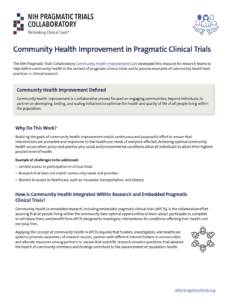
Screenshot of the Community Health Improvement in Pragmatic Clinical Trials guideThe NIH Pragmatic Trials Collaboratory’s Community Health Improvement Core has developed a new resource on community health improvement in embedded pragmatic clinical trials (ePCTs).

The Community Health Improvement in Pragmatic Clinical Trials guide includes information for research teams including:

  • A clear definition of community health improvement in the context of ePCTs
  • Examples of challenges to be addressed
  • Information on how community health is integrated within research and ePCTs
  • Examples of efforts to promote community health in clinical trials

“Realizing the goals of community health improvement requires purposeful effort to ensure that all community members can benefit from the innovations being generated through the NIH Collaboratory, especially those who need them most. We hope this new resource helps research teams plan for and embed community health improvement into their trials,” said Rosa Gonzalez-Guarda, cochair of the Community Health Improvement Core and a professor in the Duke University School of Nursing.

The Community Health Improvement Core provides leadership and guidance that will help the NIH Pragmatic Trials Collaboratory, its trials and investigators, and ultimately the research community at large conduct research that can improve the health of all populations. The Core’s work includes supporting ePCTs to address gaps in access to quality care, implementing patient and community engagement strategies, and developing person- and community-centered research and translation methods that are contextually aligned.

June 12, 2025: Living Textbook Chapter Covers Consent, Disclosure, and Nondisclosure for Pragmatic Trials

A new chapter of the Living Textbook of Pragmatic Clinical Trials describes regulatory requirements for informed consent, waivers and alterations of consent, mechanisms for notification, and research participants’ perspectives on a variety of approaches to consent and notification—all with a focus on special considerations for pragmatic clinical trials.

For a variety of reasons, the  application of ethical principles and regulations regarding informed consent can be complex for pragmatic clinical trials. For example, pragmatic trials often use novel study designs, including cluster randomization, in which the unit of randomization may be a clinic, hospital, or healthcare system rather than the individual. Some pragmatic trials also use stepped-wedge designs, in which the study intervention is introduced to sites at different times.

The new chapter has 5 sections:

  • Section 1 discusses reasons why the application of ethical principles and regulations regarding informed consent can be complex for pragmatic trials.
  • Section 2 describes the regulatory requirements for informed consent.
  • Section 3 focuses on waivers and alterations of the informed consent process.
  • Section 4 provides examples of mechanisms for notifying participants about the trial when consent is not required.
  • Section 5 presents findings on research partners’ preferences regarding various approaches to research and consent.

The chapter was developed by members of the NIH Pragmatic Trials Collaboratory’s Ethics and Regulatory Core.

May 28, 2025: New NIH Collaboratory Learning Module Explores Challenges and Possibilities of Working With Electronic Health Record Data

The NIH Pragmatic Trials Collaboratory has launched a new learning module, Healthcare Data Interoperability and Standardization for Research, exploring the complexities of collecting, storing, and transforming healthcare data in the electronic health record to achieve optimal patient and research outcomes.

The learning module, which was developed by members of the NIH Collaboratory’s Electronic Health Records Core Working Group, comprises 2 new learning topic videos, “The Big Picture: Healthcare Data and Interoperability” and “Common Data Models.” The module is led by Lesley Curtis of Duke University, a co⁠–⁠principal investigator of the NIH Collaboratory Coordinating Center.

“Research requires a common data structure that can be meaningfully compared across sources,” Curtis explained. “To be useful beyond patient care, complex and variable healthcare data must be organized and standardized,” she said.

The first video in the module, “The Big Picture: Healthcare Data and Interoperability,” covers the key concepts of the Fast Healthcare Interoperability Resources (FHIR) standard, the US Core Data for Interoperability (USCDI) standard, and the Trusted Exchange Framework and Common Agreement (TEFCA). The module explains that these key elements of healthcare data collection, storage, and transfer are a step toward greater interoperability for the US healthcare system.

“Common Data Models” explores the tools and processes available for transforming healthcare data into research data. The video introduces common data models such as Sentinel, OMOP, and PCORnet and explains how each model accomplishes the goal of transforming raw data into a standard format, curating this data for accuracy and completeness, and phenotyping for consistency.

“By employing frameworks that improve healthcare data interoperability and using tools to standardize data structure, we move closer to unlocking the full potential of healthcare data,” Curtis said.

Find all the NIH Collaboratory Learning Modules.

May 14, 2025: New Living Textbook Chapter Provides Guidance for Investigators Facing Tough Decisions After a Trial Ends

Icon for the Health Care Systems Interactions CorePragmatic clinical trials embedded in healthcare systems rely on partnerships between investigators and healthcare system leaders to conduct research. As the end of a pragmatic trial approaches, research teams and their partners often face uncertainties around this undefined phase when researchers are waiting on results. End-of-trial decision-making, including whether to sustain an intervention, has implications for research teams, healthcare systems, and patients.

A new chapter of the Living Textbook of Pragmatic Clinical Trials, published this week, describes the challenges investigators face during this common period of ambiguity and offers considerations for decision-making that honors researchers’ responsibilities and fosters ongoing collaboration with healthcare system partners while awaiting trial results:

  • Section 1 introduces possible trial outcomes and describes the intersection of posttrial responsibilities, sustainment, and deimplementation.
  • Section 2 provides case studies describing how research teams from 3 NIH Collaboratory Trials approached end-of-trial decision-making.
  • Section 3 focuses on considerations for investigators and an end-of-trial decision-making framework.
  • Section 4 provides approaches that investigators might take to support research teams and healthcare system partners as they navigate the last part of a trial, before outcomes are known.

The chapter was developed by members of the NIH Pragmatic Trials Collaboratory’s Health Care Systems Interactions Core.

March 10, 2025: Developing Monitoring Plans Warrants Special Attention in Pragmatic Clinical Trials

Cover of Contemporary Clinical TrialsIn an article published online ahead of print, leaders from the NIH Pragmatic Trials Collaboratory share lessons learned about the importance of independent oversight by a safety office or data and safety monitoring board in pragmatic clinical trials, even for trials deemed to have minimal risk.

Challenges specific to pragmatic trials include:

  • complexity, quality, and timing of a real-world data pipeline, especially in trials with many heterogeneous sites
  • embedding of interventions in clinical workflows, so investigators have less control over treatments or interventions
  • potential for incidental and collateral findings

“We recommend regular, rigorous data quality checks, ongoing monitoring of adherence to interventions, and including someone who is knowledgeable about pragmatic clinical trials and novel research designs in the development of Data and Safety Monitoring Plans and Data and Safety Monitoring Boards,” the authors wrote.

By attempting to reflect real-world conditions, pragmatic trials are conducted in settings that cannot be closely controlled. Therefore, close monitoring is critical for a successful study that produces meaningful results, whether it be by independent monitors or data and safety monitoring boards.

The authors drew on experiences from 7 of the NIH Collaboratory Trials and the expertise of the Coordinating Center, the Ethics and Regulatory Core, the Biostatistics and Study Design Core, and the Health Care Systems Interactions Core.

The article was published in Contemporary Clinical Trials.

October 3, 2024: JAMA Commentary Highlights Gap Between Research Results and Implementation Decisions

Headshots of Richard Platt, Hayden Bosworth, and Greg SimonIn a JAMA Viewpoint published online this week, leaders from the NIH Pragmatic Trials Collaboratory discuss the discordance between the results of pragmatic clinical trials and the implementation of those results in healthcare settings, even in settings that championed the work.

Coauthors Richard Platt, Hayden Bosworth, and Gregory Simon posit that, to provide evidence that healthcare systems leaders will actually use, changes are necessary:

  • Trials need to be faster (2 to 3 years)
  • Trials should consider outcomes that healthcare system leaders care about (such as costs and subgroup analyses)
  • The evidence required for change should be at the level that healthcare system leaders use (such as not necessarily rejecting the null hypothesis at P < .05 but also considering results of Bayesian methods and interim analyses)

Read the full article.

“We believe it is possible to make pragmatic clinical trials of policies and procedures more useful to delivery systems by accommodating their priorities, introducing flexibility in the level of evidence trials require, shortening the duration of planning and implementation, addressing system leaders’ interest in multiple outcomes and subgroup analyses, encouraging modification of protocols during the implementation phase, and by providing timely interim analyses that can guide decisions about continuing or modifying an intervention,” the authors wrote.

This work was based on an NIH Pragmatic Trials Collaboratory workshop held in 2023, Getting the Right Evidence to Decision-Makers Faster. The workshop explored the critical cycle of evidence generation to decision by healthcare system leaders to implement the findings of pragmatic clinical trials conducted within healthcare systems.

Platt is a cochair of the NIH Collaboratory’s Distributed Research Network and the Harvard Pilgrim Health Care Institute Distinguished Professor of Population Medicine at the Harvard Pilgrim Health Care Institute and Harvard Medical School. Bosworth is a cochair of the Implementation Science Core and a professor in population health sciences at Duke University. Simon is the chair of the Health Care Systems Interactions Core and a senior investigator at the Kaiser Permanente Washington Health Research Institute.

View the full workshop materials.

August 19, 2024: Ethics Core and Biostatistics Core Guide Newest Trials Through Planning Phase

Leaders of 2 of the NIH Pragmatic Trials Collaboratory’s long-standing Core Working Groups recently shared updates from their work with the newest cohort of NIH Collaboratory Trials. We spoke with them during the NIH Collaboratory’s 2024 Annual Steering Committee Meeting in May.

Over the last year, the Ethics and Regulatory Core engaged in a formal onboarding process with the program’s 9 newest pragmatic trials, consulting with the investigators about their trial planning and implementation. Cochairs Stephanie Morain and Pearl O’Rourke summarized several of the ongoing and emerging challenges.

“One of the challenges we’re continuing to see is understanding what are the appropriate duties that institutions and investigators have in the context of a [pragmatic clinical trial],” said Morain. “One concrete area is in data and safety monitoring. What kinds of issues need to be monitored as adverse events? How do we think about them as being related to the trial vs relating to the background care?” she added.

Onboarding documentation from the Ethics and Regulatory Core’s consultations with the NIH Collaboratory Trials is available on our Data and Resource Sharing page.

We also spoke with Liz Turner and Patrick Heagerty, cochairs of the Biostatistics and Study Design Core. They have spent the past year advising the NIH Collaboratory Trial investigators on key study design challenges.

“Many of these studies have individually randomized patients but then they’re studying implementation pathways when they implement through a specific person that puts them in groups—these are individually randomized group treatment trials,” said Heagerty. “Several of the studies didn’t see that, and so we helped them see it and we helped them work through how to adapt their analysis and modify their sample size work to ensure the trial was properly sized,” he explained.

In addition to consultations with the NIH Collaboratory Trials, the Biostatistics and Study Design Core continues to develop and innovate pragmatic trials methodology.

Learn more about the Core Working Groups.

August 13, 2024: EHR Core and Patient-Centered Outcomes Core Reflect on Challenges in Pragmatic Trials

At the NIH Pragmatic Clinical Trials Collaboratory’s 2024 Annual Steering Committee Meeting, leaders of the Electronic Health Records (EHR) Core and the Patient-Centered Outcomes (PCO) Core discussed challenges and lessons learned in the NIH Collaboratory Trials.

EHR cochairs Keith Marsolo and Rachel Richesson shared challenges related to EHR usage, including EHRs switching midtrial, unanticipated changes to the EHR that impacted intervention delivery, and difficulties navigating data sharing policies.

“We continue to be challenged, but we fall back on our core principles, which is looking for good quality data and good quality research with an eye on how we can share the results in the underlying data in the future,” Richesson said.

Over the next year, the EHR Core will explore improving data access, transparency of computable phenotypes, and capturing dietary supplement information in the EHR.

PCO Core cochairs Cristy Zigler and Emily O’Brien shared goals for effective collection PCO data.

“We have advised studies about the importance of delivering patient-reported outcomes to participants in a way that is easy to complete, doesn’t overburden them, and is relevant for their population,” O’Brien said.

The Core has compiled a list of best practices for collecting PCO data and collaborated with the Health Equity Core to create a Health Equity Toolkit, designed to give investigators practical guidance for incorporating health and equity considerations in research.

The Core has also been working closely with Implementation Science Core to consider the sustainability of PCO data systems and facilitate reuse of collection methods.

“We often see separate systems set up to collect PCO data for the trial, and then those systems sunset at the end and are not in place to support an assessment over time,” O’Brien said.

Access the complete meeting materials from the 2024 Annual Steering Committee Meeting.

June 20, 2024: Health Equity Core Leaders Reflect on Supporting NIH Collaboratory Trials

NIH Pragmatic Trials Collaboratory Health Equity Core cochairs Rosa Gonzalez-Guarda and Cherise Harrington recently discussed the Core’s work supporting the NIH Collaboratory Trials to address issues related to health equity.

Gonzalez-Guarda and Harrington sat down together during the NIH Collaboratory’s 2024 Annual Steering Committee Meeting in May and reflected on the past year.

Throughout the last year, the Health Equity Core cochairs have conducted consultations with investigators from new NIH Collaboratory Trials to learn about the trials and provide support and resources for health equity challenges.

“One of the biggest issues the new trials are seeing is the context of the healthcare delivery system they are partnering with and the limitations that has. Healthcare in general is not designed for minoritized populations so the trials are having to retrofit their strategies within a system that is not really designed to engage these populations,” Gonzalez-Guarda said.

The Health Equity Core is providing education and developing resources to help investigators navigate challenges and integrate a health equity lens to their studies.

“A resource we provide is helping the trials assess what health equity means. Across the field we are having issues with the definition. It is a process that must be intentional; it must be embedded across the culture of a project. We are making teams more aware and helping them understand that just assessing demographic data isn’t addressing health equity. Trials need to ask how are we going to address the needs of that particular community? We have been able to provide that resource to the previous and incoming trials,” Harrington said.

In addition to consultations, the Health Equity Core is developing a dashboard to help monitor the areas of diversity in the NIH Collaboratory’s patient population and help identify resources that may be needed. The Core also uses the Duke University School of Nursing’s INFusE checklist to help investigators think through from design to dissemination specific strategies for integrating a health equity lens into their study.

Gonzalez-Guarda is an associate professor of nursing and assistant dean for the PhD program in the Duke University School of Nursing. Harrington is an associate professor of public health education and a senior researcher at North Carolina Central University.