May 28, 2025: New NIH Collaboratory Learning Module Explores Challenges and Possibilities of Working With Electronic Health Record Data

The NIH Pragmatic Trials Collaboratory has launched a new learning module, Healthcare Data Interoperability and Standardization for Research, exploring the complexities of collecting, storing, and transforming healthcare data in the electronic health record to achieve optimal patient and research outcomes.

The learning module, which was developed by members of the NIH Collaboratory’s Electronic Health Records Core Working Group, comprises 2 new learning topic videos, “The Big Picture: Healthcare Data and Interoperability” and “Common Data Models.” The module is led by Lesley Curtis of Duke University, a co⁠–⁠principal investigator of the NIH Collaboratory Coordinating Center.

“Research requires a common data structure that can be meaningfully compared across sources,” Curtis explained. “To be useful beyond patient care, complex and variable healthcare data must be organized and standardized,” she said.

The first video in the module, “The Big Picture: Healthcare Data and Interoperability,” covers the key concepts of the Fast Healthcare Interoperability Resources (FHIR) standard, the US Core Data for Interoperability (USCDI) standard, and the Trusted Exchange Framework and Common Agreement (TEFCA). The module explains that these key elements of healthcare data collection, storage, and transfer are a step toward greater interoperability for the US healthcare system.

“Common Data Models” explores the tools and processes available for transforming healthcare data into research data. The video introduces common data models such as Sentinel, OMOP, and PCORnet and explains how each model accomplishes the goal of transforming raw data into a standard format, curating this data for accuracy and completeness, and phenotyping for consistency.

“By employing frameworks that improve healthcare data interoperability and using tools to standardize data structure, we move closer to unlocking the full potential of healthcare data,” Curtis said.
Find all the NIH Collaboratory Learning Modules.

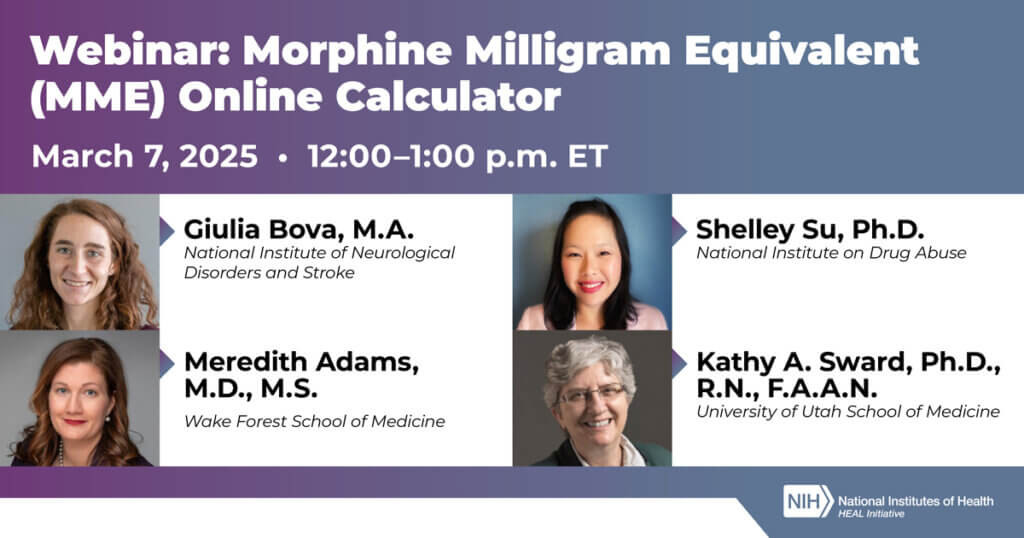
February 25, 2025: NIH HEAL Initiative to Host Webinar on Morphine Milligram Equivalent (MME) Online Calculator

Webinar: Morphine Milligram Equivalent (MME) Online CalculatorThe NIH HEAL Initiative’s Common Data Elements (CDE) program this week announced the release of an online tool to calculate morphine milligram equivalents (MME), a standardized metric for reporting prescribed opioid use. In a webinar scheduled for Friday, March 7, speakers from the CDE program will explain the tool, demonstrate how researchers can use the tool to calculate MMEs for research purposes, and answer questions from researchers about the use of the tool for calculating and reporting MME data.

Standardizing approaches to data collection remains a critical challenge in pain research. The CDE program mandated collection of MME data in all NIH HEAL Initiative–funded research in 2023.

Webinar information: Friday, March 7, 2025; 12:00-1:00 pm ET. Registration is required to attend the webinar.

Ten of the NIH Collaboratory Trials are supported by funding from the NIH HEAL Initiative through the Pragmatic and Implementation Studies for the Management of Pain to Reduce Opioid Prescribing (PRISM) program. They explore a range of interventions to improve implementation of pain management strategies and reduce inappropriate prescribing of opioids.

October 28, 2024: New Living Textbook Contribution Explains Differences Between Medicare Data Sources

Living Textbook iconResearch-identifiable Medicare data can come from traditional fee-for-service Medicare claims or from Medicare Advantage claims. A new contribution to the Living Textbook of Pragmatic Clinical Trials published this month, Use of Medicare Data in PCTs, describes the important differences between these data.
At the healthcare system level, differences in incentives for documenting diagnoses can affect the reliability and relevance of data used for pragmatic clinical trials. The populations served by fee-for-service Medicare plans and Medicare Advantage plans are also disparate, as Medicare Advantage plans include a higher proportion of patients who require chronic disease management. There are also variations in enrollment rates across states and counties that reflect characteristics of the counties themselves (urban vs rural) and the firms that offer Medicare Advantage plans across regions.

Read the new contribution.

For more on using Medicare data in pragmatic trials, see the following Living Textbook sections:

July 16, 2024: OS-PCORTF Report Focuses on Building Data Capacity for Patient-Centered Outcomes Research

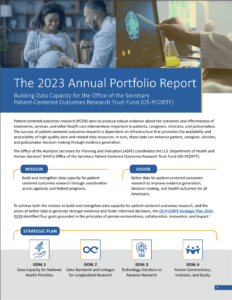
OS-PCORTF Annual Report screenshotA recent report from the Assistant Secretary for Planning and Evaluation in the US Department of Health and Human Services outlines 36 projects funded by the Office of the Secretary Patient-Centered Outcomes Research Trust Fund (OS-PCORTF).

OS-PCORTF was created to build national data capacity and infrastructure and leverage existing clinical data and federal data for patient-centered outcomes research. OS-PCORTF projects involve collaboration across an array of federal agencies to develop products and resources (such as data linkages, data standards, and tools to improve data interoperability) that serve this core mission.

The 2023 Annual Portfolio Report focuses on the most recent advancements in data infrastructure for priority topic areas, including COVID-19, opioid use disorder, and maternal and infant health across a variety of settings and levels.

Read the full report.

October 18, 2022: Richesson to Present on EHR-Based Phenotyping at IMPACT Collaboratory Grand Rounds

Headshot of Rachel RichessonRachel Richesson, cochair of the NIH Pragmatic Trials Collaboratory’s Electronic Health Records (EHR) Core, will present this week at IMPACT Collaboratory Grand Rounds.

The virtual session, “Developing Standards and Quality Metrics for Clinical Phenotyping Using EHR Data in Pragmatic Clinical Trials,” will be held on Thursday, October 20, 2022, at 12:00 pm eastern.

Richesson is a professor of learning health sciences in the University of Michigan School of Medicine. She is working with the EHR Core to develop standards and quality metrics for EHR-based phenotyping, the topic of her upcoming Grand Rounds presentation.

Zoom Details for IMPACT Grand Rounds:

  • Please click the link to join the webinar: https://hebrewseniorlife.zoom.us/j/97344810673
  • Or iPhone one-tap: US: +13126266799,,97344810673#  or +14702509358,,97344810673#
  • Or Telephone: US: +1 312 626 6799  or +1 470 250 9358
  • Webinar ID: 973 4481 0673

Podcast July 8, 2022: FDA Draft Guidance on Real-World Evidence (John Concato, MD, MS, MPH)

This podcast continues the discussion with Dr. John Concato as he discusses the FDA draft guidance on real-word evidence. Click on the recording below to listen to the podcast.

Want to hear more? View the full Grand Rounds presentation.

For alerts about new episodes, subscribe free on Apple Podcasts or SoundCloud. Read the transcript.

June 24, 2022: FDA Draft Guidance on Real-World Evidence (John Concato, MD, MS, MPH)

Speaker

John Concato, MD, MS, MPH
Associate Director for Real-World Evidence Analytics
Office of Medical Policy (OMP)
Center for Drug Evaluation and Research (CDER)
Food and Drug Administration (FDA)


Keywords

Big data; Real-word evidence; Real-world data; 21st Century Cures Act; FDA Draft Guidance


Key Points

  • Big Data, a term first used in the 1990s, leverages modern technology to increase the quantity, forms, speed, and capability to manipulate large-scale data. Real-world data (RWD) is a term with specific regulatory implications referring to health care data routinely collected from a variety of sources. Real-world evidence (RWE) is clinical evidence derived from analysis of RWD regardless of study design.
  • Terminology is important in research work, and we should strive to be as precise as possible with the terminology we use.
  • With the 21st Century Cures Act of 2016, the FDA established a program to evaluate the potential use of real-world evidence to support new indications for drugs and satisfy post-approval study requirements.
  • In 2021, the FDA issued 4 draft guidance documents for Real-world data and Real-world evidence intended to guide the selection and management of data sources to appropriately address the study question and support decision-making for drug and biological products.

Discussion Themes

– Could real-world data sources be certified and preclude the need for submission of source data on a study specific basis? From the FDA point-of-view, while reliability can be more readily evaluated and would tend to be more stable, the relevance to a particular study could not be determined as easily.

– While there can be a reflex that says we can never be sure about major confounding, it should not be the miasma of the 21st century. A thoughtful approach that considers the characteristics that matter is the best approach.


Read Dr. Concato’s publication Randomized, observational, interventional, and real-world—What’s in a name? and the FDA Draft Guidance for RWD/RWE.

Tags

#pctGR, @Collaboratory1

December 15, 2021: This Friday in PCT Grand Rounds, Cybersecurity and Compliance in Clinical Research and Healthcare

Headshot of Dr. Eric Perakslis
Dr. Eric Perakslis

In this Friday’s PCT Grand Rounds, Dr. Eric Perakslis of Duke University will present “Cyberthreat, Cybersecurity and Cyber Compliance in Clinical Research and Healthcare: One Size Fits None.” The Grand Rounds session will be held on Friday, December 17, at 1:00 pm eastern.

Dr. Perakslis is the chief science and digital officer for the Duke Clinical Research Institute and the chief research technology strategist in the Duke University School of Medicine. Join the online meeting.

October 5, 2021: New Article Identifies Challenges and Prerequisites for Using Electronic Health Record Systems for Pragmatic Research

JAMIA Cover

In a new NIH Collaboratory study, 20 NIH Collaboratory Trials responded to a survey about challenges encountered when using the electronic health record (EHR) for pragmatic clinical research. The goal of the study was to elucidate challenges and develop solutions—or prerequisites for pragmatic research—to enable healthcare system leaders, policy makers, and EHR designers to improve the national capacity for generating real-world evidence.

The article was published in the Journal of American Medical Informatics Association (JAMIA).

The challenges identified by the projects fell into 6 broad themes, including inadequate collection of patient-centered data, lack of functionality for structured data collection, lack of standardization, lack of resources to support customization, difficulties aggregating data from multiple sites, and difficult and inefficient access to EHR data.

Researchers from the NIH Collaboratory’s EHR Core and colleagues from the Patient-Centered Outcomes and the Health Care Systems Interactions Core Working Groups discussed the issues and iterated possible solutions. The authors developed the following prerequisites for the conduct of pragmatic research:

  • Integrate collection of patient-centered data into EHR systems
  • Facilitate structured research data collection by leveraging standard EHR functions, usable interfaces, and standard workflows
  • Support creation of high-quality research data by using standards
  • Ensure adequate IT staff to support embedded research
  • Create aggregate, multidata type resources for multisite trials
  • Create reusable and automated queries

The authors argue for the ability to tailor EHR systems to enable the collection of patient-centered outcomes and the extraction of high-quality, standardized data. Although the primary uses of the data are for clinical care and billing, high-quality data from the EHR also have the potential to improve clinical care and population health by providing reliable evidence and to support pragmatic research and learning within and across healthcare systems.

Read the full article.

This work was supported within the National Institutes of Health (NIH) Health Care Systems Research Collaboratory by the NIH Common Fund through cooperative agreement U24AT009676 from the Office of Strategic Coordination within the Office of the NIH Director. This work was also supported by the NIH through the NIH HEAL Initiative under award number U24AT010961.