December 15, 2025: A Year of Trial Results and Innovations From the NIH Pragmatic Trials Collaboratory

A collage of journal covers with the label "NIH Pragmatic Trials Collaboratory 2025 Publications Roundup"In 2025, NIH Pragmatic Trials Collaboratory investigators published new study designs and trial results, shared insights from program leadership, and developed innovative methods in the design, conduct, implementation, and dissemination of pragmatic clinical trials. Their work included perspectives from the Coordinating Center, best practices from the Core Working Groups, and results from the NIH Collaboratory Trials.

The program contributed 45 articles to the peer-reviewed literature this year, including the primary results of the ACP PEACE, BackInAction, HiLo, INSPIRE, and PRIM‑ER trials. Cross-Core and cross-Trial collaborations led to the sharing of important lessons from the conduct of multiple NIH Collaboratory Trials.

The total number of published articles from the program reached 386.

Coordinating Center

Cross-Core and Cross-Trial Collaborations

Distributed Research Network

Core Working Groups

Biostatistics and Study Design Core

Community Health Improvement Core

Electronic Health Records Core

Ethics and Regulatory Core

Health Care Systems Interactions Core

Patient-Centered Outcomes Core

NIH Collaboratory Trials

ABATE Infection

ACP PEACE

ARBOR-Telehealth

BackInAction

BeatPain Utah

BEST-ICU

EMBED

FM-TIPS

GGC4H

GRACE

HiLo

I CAN DO Surgical ACP

IMPACt-LBP

INSPIRE

iPATH

LIRE

MOMs Chat & Care Study

NOHARM

Nudge

OPTIMUM

PRIM-ER

SPOT

TAICHIKNEE

November 26, 2025: Goals-of-Care Conversations Affect Emergency Department Care in PRIM-ER Substudy

Headshots of Dr. Corita Gruzen and Dr. Keith Goldfeld
Dr. Corita Gruzen and Dr. Keith Goldfeld, principal investigators for PRIM-ER

In a single-site substudy of the PRIM-ER trial, an intervention to initiate palliative care in the emergency department did not increase the proportion of patients having goals-of-care conversations. However, when those conversations did occur, they frequently influenced patients’ care.

The article was published online ahead of print in Internal and Emergency Medicine.

PRIM-ER, an NIH Collaboratory Trial, was a stepped-wedge, cluster randomized trial of a palliative care training program in emergency departments in the United States. The program consisted of training in palliative care, simulation-based communication workshops, clinical decision support tools, and audit and feedback.

In the substudy led by Julia Murray of Ohio State University, which was conducted as a quality improvement initiative at a large academic medical center, the researchers wanted to explore whether the PRIM-ER intervention changed physician behavior at the institution. Although the proportion of critically ill patients having a goals-of-care conversation did not change, more than three-quarters of the patients who did have a conversation saw a change in code status, their care plan, hospice care, or updated advance care planning documents.

Read the full article.

PRIM-ER was supported within the NIH Pragmatic Trials Collaboratory by a grant award from the National Institute on Aging. Learn more about PRIM-ER.
July 8, 2025: PRIM-ER Team Observes More Healthy Days at Home for Patients With Cancer Diagnosis

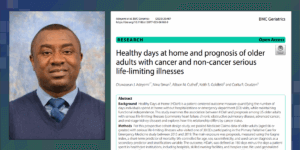
Headshot of Dr. Oluwaseun Adeyemi with screenshot of PRIM-ER article
Dr. Oluwaseun Adeyemi, lead author of the report

In an analysis of data on seriously ill older adults from emergency departments that participated in the PRIM-ER trial, poor prognosis was associated with fewer healthy days at home. However, a cancer diagnosis was associated with more healthy days at home.

The analysis was published online this month in BMC Geriatrics.

PRIM-ER, an NIH Collaboratory Trial, was a stepped-wedge, cluster randomized trial of a palliative care training program in emergency departments in the United States. The program consisted of training in palliative care, simulation-based communication workshops, clinical decision support tools, and audit and feedback.

In the new analysis of data for nearly 123,000 seriously ill older adults, worse prognosis was associated with a lower rate of healthy days at home for patients both with and without cancer. However, having a cancer diagnosis was associated with more healthy days at home. Demographic factors such as age and race/ethnicity were also associated with healthy days at home.

The authors of the report, led by Oluwaseun Adeyemi of New York University, under the guidance of principal investigators Corita Grudzen and Keith Goldfeld, believe this difference may be related to the “structured and comprehensive care pathways available to cancer patients, such as outpatient oncology services, home-based palliative care, and symptom management plans designed to minimize hospitalizations.”

“Our findings highlight the need for tailored care models, including enhanced outpatient services and home-based care to reduce hospitalizations and increase [healthy days at home] for patients with serious non-cancer illnesses,” the authors wrote.

Read the full article.

PRIM-ER was supported within the NIH Pragmatic Trials Collaboratory by a grant award from the National Institute on Aging. Learn more about PRIM-ER.
March 4, 2025: PRIM-ER Team Develops Innovative Statistical Techniques for Stepped-Wedge Trials

Cover image of Statistics in MedicineResearchers with PRIM-ER, an NIH Collaboratory Trial, published 2 innovative statistical techniques for evaluating intervention effects in stepped-wedge, cluster randomized trials. The new models, which use Bayesian methods, outperformed traditional analytic methods and other Bayesian approaches in simulations and real-world applications.

The article was published online in Statistics in Medicine.

In cluster randomized trials with stepped-wedge designs, the clusters are randomized into several groups, and all groups start the trial in the control condition. Groups of clusters cross over to the intervention condition on a staggered timeline, and all groups receive the intervention before the end of the trial.

Stepped-wedge designs can be advantageous when simultaneous rollout of the intervention to all clusters is infeasible, or when withholding the intervention from any cluster would be unethical, or when there is a risk of contamination between intervention subjects and control subjects. However, stepped-wedge designs can also introduce confounding by time, as the intervention is rolled out to clusters in waves. Temporal trends during the study can influence the study’s outcomes.

(Learn more about stepped-wedge designs in the Living Textbook.)

The PRIM-ER researchers tested 2 new Bayesian hierarchical penalized spline models to improve the estimation of intervention effects in stepped-wedge trials. The first model focuses on immediate intervention effects and accounts for large numbers of clusters and time periods. The second model extends the first by accounting for time-varying intervention effects. The researchers applied both models to data from PRIM-ER.

Read the full report.

PRIM-ER tested a multidisciplinary primary palliative care intervention in a diverse mix of emergency departments in the United States to improve the delivery of goal-directed emergency care of older adults. The study was supported by the National Institute on Aging. Learn more about PRIM-ER.

January 21, 2025: In PRIM-ER Trial, Palliative Care Training in Emergency Departments Did Not Reduce Hospital Admissions

Headshots of Dr. Corita Gruzen and Dr. Keith Goldfeld
Dr. Corita Grudzen and Dr. Keith Goldfeld, principal investigators for PRIM-ER

An evidence-based training program to improve the capacity of emergency department care teams to communicate with seriously ill older patients about palliative care did not lead to lower rates of hospital admission, according to the results of the PRIM-ER trial.

The results were published online ahead of print in JAMA.

More than three-quarters of seriously ill older adults in the United States will visit an emergency department in their last 6 months of life. Palliative care specialists are not always available in emergency departments, and emergency clinicians may lack the training or tools to assist older adults who have serious, life-limiting illness in making complex medical decisions.

PRIM-ER, an NIH Collaboratory Trial, was a stepped-wedge, cluster randomized trial of a palliative care training program in 29 emergency departments in the United States. The program consisted of training in palliative care, simulation-based communication workshops, clinical decision support tools, and audit and feedback.

The study team, led by Corita Grudzen at Memorial Sloan Kettering Cancer Center and Keith Goldfeld at New York University, evaluated the initial emergency department visits of nearly 99,000 older adults with serious, life-limiting illness before and after implementation of the training program. The primary outcome was hospital admission from the emergency department. Secondary outcomes included subsequent healthcare use and survival.

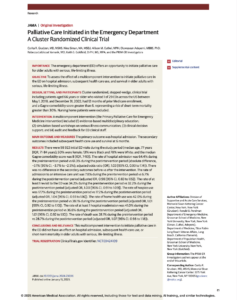
A screenshot of the first page of the JAMA article reporting the results of PRIM-ER.There was no difference in the rate of hospital admission for seriously ill older adults after emergency department staff received the palliative care training intervention. The intervention also did not have an effect on subsequent health care use or short-term mortality.

Read the full article.

“Our complex, multicomponent intervention designed to embed palliative care skills in emergency medicine practice for patients with serious, life-limiting illness did not show an effect on hospital admission, subsequent health care use, or short-term mortality,” said Grudzen, an emergency medicine physician and palliative care specialist. “Despite this, the development, implementation, and testing of primary palliative care interventions remain a priority, given the workforce shortages in hospice and palliative medicine,” Grudzen said.

An important and unanticipated experience in the conduct of the PRIM-ER trial between 2018 and 2022 was the COVID-19 public health emergency. Strain placed on the healthcare system by the pandemic limited the ability of home care and hospice agencies to accept patients and narrowed the referral options available to emergency department clinicians. These impacts may have influenced the trial’s results.

PRIM-ER was supported within the NIH Pragmatic Trials Collaboratory by a grant award from the National Institute on Aging.

“The NIH Collaboratory is a critical resource for the conduct of pragmatic trials,” Grudzen said. “The faculty willingly share their expertise in all aspects of pragmatic trial design, conduct, and analysis. Their recommendations are the rare combination of cutting edge, practical, and battle tested. The program’s additional electronic and virtual resources are invaluable to growing the pragmatic trial community,” she said.

Learn more about PRIM-ER.

December 12, 2024: A Year of Innovations and Insights From the NIH Pragmatic Trials Collaboratory

A graphic showing a collection of journal covers.In 2024, experts from the NIH Pragmatic Trials Collaboratory published the results of newly completed studies, shared insights from program leadership, and developed innovative methods in the design, conduct, and analysis of pragmatic clinical trials. Their work included perspectives from the Coordinating Center, best practices from the Core Working Groups, and results from the NIH Collaboratory Trials.

The program contributed more than 30 articles to the peer-reviewed literature this year, including the primary results of the ICD-Pieces and Nudge trials. Several cross-Core and cross-Trial collaborations led to the sharing of important lessons from the conduct of multiple NIH Collaboratory Trials.

The total number of published articles from the program surpassed 340.

Coordinating Center

Cross-Core and Cross-Trial Collaborations

Core Working Groups

Biostatistics and Study Design Core

Electronic Health Records Core

Ethics and Regulatory Core

Community Health Improvement Core

Implementation Science Core

Patient-Centered Outcomes Core

NIH Collaboratory Trials

ABATE Infection

BackInAction

BeatPain Utah

EMBED

FM-TIPS

GGC4H

GRACE

I CAN DO Surgical ACP

ICD-Pieces

LIRE

NOHARM

Nudge

OPTIMUM

PRIM-ER

PROVEN

SPOT

STOP CRC

TSOS

Grand Rounds April 12, 2024: Primary Palliative Care for Emergency Medicine, A Cluster-Randomized Stepped-Wedge Trial Across 33 Emergency Departments (Corita R. Grudzen, MD, MSHS, FACEP)

Speaker

Corita R. Grudzen, MD, MSHS, FACEP
Fern Grayer Chair in Oncology Care and the Patient Experience
Division Head, Supportive and Acute Care Services
Memorial Sloan Kettering Cancer Center
Professor of Emergency Medicine
Weill Cornell Medical College

Keywords

Palliative Care, Emergency Medicine, PRIM-ER

Key Points

  • Past research found that inpatient palliative care, when triggered by an ED visit, improves quality of life and decreases health care use, but what happens when patients leave the ED? How can we better help patients going home and trigger community-based palliative care?
  • The default approach in the ED is “pedal to the metal,” to do everything and initiate life-saving procedures instead of taking a step back, looking at the records to see if the patient has a DNR or medical orders for life-sustaining treatment. The default is to do everything instead of taking a step back to look and see if there are prior records.
  • The goal of the PRIM-ER intervention is system and provider change. It is modeled on the theory of planned behavior, that to change behavior, you have to change intentions by changing their attitudes, cultural norms, and perceived behavioral control (is it achievable).
  • The PRIM-ER intervention had multiple components. The first was an evidence-based, multidisciplinary primary palliative care education, which involved the End-of-Life Nursing Education Consortium (ELNEC), using a modified version of the intensive care module, and an emergency medicine module from Education in Palliative and End-of-Life Care (EPEC-EM). The second component was simulation-based workshops on serious illness communication. The third component was clinical decision support (CDS), and the fourth component was provider audit and feedback, which were contextualized to the local ED feedback.
  • For the clinical decision support, the study wanted to identify patients who already had advanced planning documents (active ACP). The second core function was to identify patients who are already enrolled in hospice. Finally, there are patients with serious life-limiting illness who do not have information about their wishes or preferences but would benefit from a goals of care conversations.
  • The PRIM-ER aims were to test the effectiveness of PRIM-ER on ED disposition and healthcare use in older adults with serious, life-limiting illness using a pragmatic, cluster-randomized stepped wedge design in 33 EDs and to describe barriers and facilitators to implementation at the micro- (individual), meso- (department and institutional), and macro- (health system) level. The hypothesis was that PRIM-ER will reduce ED disposition to acute care and 6-month healthcare use for older adult patients with serious, life-limiting illness.
  • The interventions were piloted at 2 sites and eventually studied at 18 sites/33 EDs across the country. The study was stepped-wedge in design with new sites starting every 3 weeks during the course of the trial, except for 6 months during the COVID-19 pandemic. The primary outcome was acute care admission. The secondary outcomes were ED revisits, inpatient days, hospice use, and home health use, and survival defined as 6 months from the ED visit.
  • To be included in the study, patients had to make an ED visit at one of the participating sites, be 66 years or older, and have one-year mortality of at least 30 percent. Patients were excluded if they resided at a nursing facility or were already on hospice.
  • PRIM-ER found that a multi-level, complex primary palliative care intervention in 33 EDs did not decrease acute care disposition in older adults at high risk for short-term mortality, but reduced ED revisits at 6 months. Nurses and providers are willing and able to use new skills, especially those deemed clinically relevant. Electronic CDS tools must be thoughtfully tailored to unique workflows and environments.

Discussion Themes

– What other options were generally available at these Eds (inpatient hospice, outpatient hospice, case managers, etc.)? How do you explain the link between the intervention and reduced repeat ED visits? In terms of the 33 EDs, there are many different variations on the options that were available to providers. We tried to develop greater connections and a sweep of options to understand the options in each community and strengthen the ties. There was a reduction in ED visits. We are now funded to do a similar study in dementia with ED revisit as primary outcome. As ED providers we have a little more control. We know why a patient made the visit to the ED and can refer them to other services.

– As you reflect on this trial, what are the big takeaways for you as a trialist? We presented this first to the health systems and our collaborators, and it was the most satisfying and fun work I have been a part of. We changed so much – we improved communication, got people excited, even though our outcome was not successful. It was the process that was fun and made a difference through the training we provided. The primary outcome is hard to pick. It feels random even though we put a lot of thought into it. We figured out we did not choose the correct primary outcome.

April 10, 2024: Primary Results of PRIM-ER Trial to Be Featured in This Week’s PCT Grand Rounds

Headshot of Dr. Corita Grudzen
Dr. Corita Grudzen, principal investigator of PRIM-ER

In this Friday’s PCT Grand Rounds, Corita Grudzen of the Memorial Sloan Kettering Cancer Center will present “Primary Palliative Care for Emergency Medicine, a Cluster Randomized Stepped-Wedge Trial Across 33 Emergency Departments,” including the results of the PRIM-ER trial.

The Grand Rounds session will be held on Friday, April 12, 2024, at 1:00 pm eastern.

Grudzen is a professor of emergency medicine at Weill Cornell Medical College and the Fern Grayer Chair in Oncology Care and the Patient Experience and division head of supportive and acute care services at the Memorial Sloan Kettering Cancer Center.

PRIM-ER, an NIH Collaboratory Trial, is a stepped-wedge, cluster randomized trial testing a multidisciplinary primary palliative care intervention in a diverse mix of emergency departments in the United States. The study is supported within the NIH Pragmatic Trials Collaboratory by a cooperative agreement from the National Institute on Aging. Read more about PRIM-ER.

Join the online meeting.

February 26, 2024: In PRIM-ER Qualitative Study, EM Talk Program Improved Serious Illness Conversation Skills

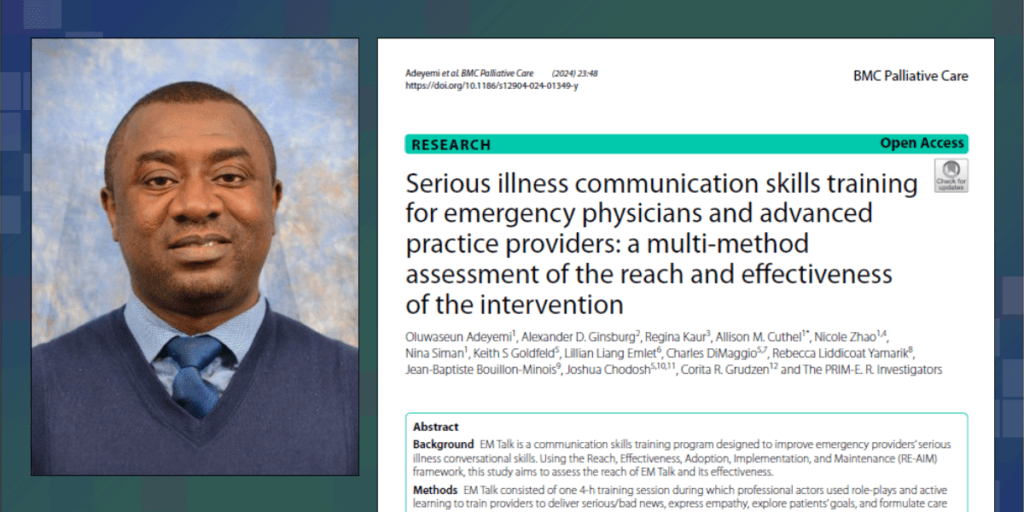
Dr. Oluwaseun Adeyemi, lead author of the report

Communication skills training using the EM Talk model reached a high proportion of clinicians in participating emergency departments and improved their serious illness conversation skills, according to a qualitative study conducted as part of the PRIM-ER trial. The observed reach and effectiveness of the training program has the potential to improve use of these skills in clinical practice.

The results of the study were published last week in BMC Palliative Care.

PRIM-ER, an ongoing NIH Collaboratory Trial, is a stepped-wedge, cluster randomized trial testing a multidisciplinary primary palliative care intervention in a diverse mix of emergency departments in the United States. The intervention consists of education, clinical decision support, and other elements and is intended to improve the delivery of goal-directed emergency care of older adults.

The PRIM-ER intervention includes, among other elements, communication skills training and simulation workshops for emergency medicine clinicians using the EM Talk training program. The program is designed to improve serious illness conversation skills for emergency medicine physicians and advanced practice providers.

The authors of the report, led by Oluwaseun Adeyemi of New York University, under the guidance of principal investigators Corita Grudzen and Keith Goldfeld, found that 85% of emergency medicine physicians and advanced practice providers across 33 emergency departments completed the EM Talk training. In course evaluations completed after the training, participants reported that the training improved their serious illness conversation skills and their attitude toward engaging patients in serious illness conversations. Participants also reported that the training encouraged them to commit to using these skills in clinical practice.

A previously published study by the PRIM-ER research team reported the reach and effectiveness of a related training program for emergency nurses.

PRIM-ER is supported within the NIH Pragmatic Trials Collaboratory by a cooperative agreement from the National Institute on Aging. Read more about PRIM-ER.

July 18, 2022: New Article Offers Recommendations for Pragmatic Trials in Emergency Medicine

Dr. Edward Melnick, Co-PI of EMBED, and Dr. Corita Grudzen, PI of PRIM-ER
(From left) Dr. Edward Melnick, Co-PI of EMBED, and Dr. Corita Grudzen, PI of PRIM-ER

Investigators planning emergency department (ED)­–based pragmatic clinical trials (PCTs) face multiple decisions during the planning phase to ensure robust and meaningful study findings in this unique setting; however, there is no guide for planning and conducting these studies.

A new article in Academic Emergency Medicine fills the gap by providing recommendations for the design of PCTs in emergency settings. Among the authors are investigators from EMBED and PRIM-ER, both NIH Pragmatic Trials Collaboratory Trials.

The authors recommend that investigators planning ED-based PCTs should strongly consider the use of the PRECIS-2 wheel diagram during the study design phase to increase chances that the results of the trial are generalizable across the intended practice settings. The PRECIS tool was developed to help investigators work through study design decisions to avoid designing a trial that does not meet their own intentions.

The authors expand upon the 9 domains within the PRECIS-2 framework to identify points for investigators to consider in the design of ED-based PCTs, and they provide examples of successful studies. Using the PRECIS-2 framework can help investigators navigate unique challenges in the ED setting, including time-sensitive conditions, limited availability of electronic health data for the patient population, and added complexity surrounding capacity and consent for certain vulnerable ED populations with mental illness or substance use disorder.

The authors also address special considerations for randomization, human subjects concerns, and electronic health record integration.

Finally, the authors provide an analysis that highlights the advantages, disadvantages, and rationale for the use of 4 common randomized PCT study design types and examples of similar trials set in the ED.

Read the full text of the article.