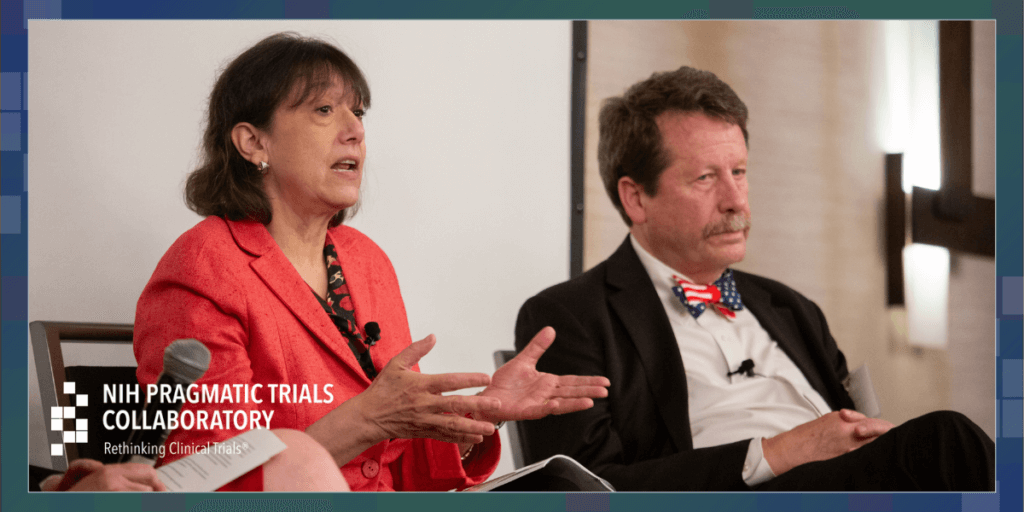
Speaking at the NIH Pragmatic Trials Collaboratory’s 2024 Annual Steering Committee Meeting in May, Commissioner of Food and Drugs Robert Califf and NIH Director Monica Bertagnolli discussed the intersection of pragmatic research and national health priorities.
Califf and Bertagnolli spoke about the role the NIH Collaboratory can play in promoting scientifically rigorous, pragmatic clinical research that addresses the urgent need for better and faster implementation of research findings into patient care. They also addressed shortcomings of the electronic health record (EHR) and the challenges of building a learning health system.
Wendy Weber of the National Center for Complementary and Integrative Health moderated the discussion, which focused on 3 challenges in clinical research and their relation to the NIH Collaboratory:
- Medical providers and patients lack scientific evidence to support medical decisions
- A learning health system can help to develop this evidence, but challenges in developing this system remain
- How can the NIH Pragmatic Trials Collaboratory aid in these challenges?
“The most fundamental flaw we have in general right now is that we don't tell people that their biggest risk is getting standard healthcare in the healthcare system,” Califf said. “Without evidence, clinicians don't actually know what to do. We act like we know, but we don’t,” he added.
Medical providers and patients alike must often make underinformed decisions. The lack of scientific evidence to support these decisions poses a challenge, as it demands clinicians use their individual experience and judgment when making a recommendation. Here, the deficiencies of the EHR become most obvious, as it fails to meet the needs of the population by not providing sufficient data for providers to refer to. Bertagnolli emphasized this, stating the EHR needed to become a learning environment, facilitating both the collection and dissemination of knowledge even for busy doctors.
“We need to reach every person,” Bertagnolli challenged the researchers in the audience. “We need to get in every corner of the United States with our data, with our research. We need to make it possible for busy doctors and clinics to be in a learning environment,” she said.
“What's the one unifying bit of technology we have that is not delivering what we need? It's the electronic health record,” Bertagnolli added.
Developing a health system that fosters collaboration and constant learning is paramount to obtaining generalizable medical evidence. Califf emphasized this need, calling for a singular “voice” that can represent the population’s prevention and health issues, collectively demonstrating what works.
However, several barriers hinder the development of such a system. The healthcare industry often finds that delivery practices that optimize profit margins are not optimal for patient health outcomes, which creates an environment of ethical uncertainty. Furthermore, the United States spends more on healthcare than do comparable countries with higher life expectancies, leading to unnecessary expenditures and unwillingness to adopt new initiatives.
“We're paying for a lot of things that don't help. So how are we going to figure out what to stop doing?” Bertanolli asked. “The only way is data. And the only people who can bring that data are our care providers to collect those data and learn from them. It is imperative to get a learning health system in progress,” she said.
The NIH Pragmatic Trials Collaboratory has long played a role in establishing cost-effective, large-scale research that treats care providers as research partners to deliver generalizable, actionable data. The program’s efforts in promoting collection of data from clinical care environments ensure that research remains grounded in real-world patient outcomes. Moreover, the NIH Collaboratory's emphasis on gathering data from underrepresented populations enhances the relevance of research findings, addressing disparities in healthcare delivery and outcomes.
Along with data collection, Bertagnolli encouraged the NIH Collaboratory to be an advocate for this new health system and encourage organizations to participate in the development of this system. The NIH Collaboratory brings years of specialized clinical knowledge and input, ensuring that the system is informed by evidence-based practices and responsive to the needs of both care providers and patients.
“It's a matter of convincing people to get over the hump, embrace a learning health system, and participate—and specifically, I'd say get the wheel turning as fast as you can, answer as many questions as you can, and talk about it,” added Califf.
View the full materials from the 2024 Annual Steering Committee Meeting.


 The NIH Pragmatic Trials Collaboratory this week published a new chapter of its Living Textbook of Pragmatic Clinical Trials. The chapter, Decentralized Pragmatic Clinical Trials, covers activities of a pragmatic trial that can occur remotely—at a location separate from an investigator’s location—such as participant engagement, recruitment, consent, study interventions and procedures, collection of patient-reported outcomes, and follow-up.
 In a JAMA Viewpoint published online this week, leaders from the NIH Pragmatic Trials Collaboratory discuss the discordance between the results of pragmatic clinical trials and the implementation of those results in healthcare settings, even in settings that championed the work.
 The
The  In an article published this month in the American Journal of Bioethics, FDA Commissioner Robert Califf and coauthors suggest that—despite the potential of embedded pragmatic research to generate information to improve clinical practice and public health policy—it is still relatively uncommon in US healthcare.