December 2, 2024: NCI-Supported LungSMART Trial Joins the NIH Pragmatic Trials Collaboratory

Headshots of LungSMART investigators David Wetter, Guilherme Del Fiol, and Ken Kawamoto
From left to right: Drs. David Wetter, Guilherme Del Fiol, and Ken Kawamoto, principal investigators for LungSMART

The NIH Pragmatic Trials Collaboratory is pleased to welcome LungSMART (Population Health Management Approaches to Increase Lung Cancer Screening in Community Health Centers) to its portfolio of innovative NIH Collaboratory Trials.

Lung cancer is the leading cause of cancer-related deaths in the United States, but only 6.5% of eligible individuals were screened for lung cancer in 2020. Moreover, there are significant disparities in lung cancer screening related to race/ethnicity and socioeconomic status.

The LungSMART team will conduct a sequential multiple-assignment randomized trial (SMART) in community health centers in Utah to test telehealth interventions designed to address logistical barriers and hesitancy around completing lung cancer screening. The new project is supported by a grant award from the National Cancer Institute, a first for the NIH Pragmatic Trials Collaboratory.

David Wetter, Guilherme Del Fiol, and Ken Kawamoto will serve as the principal investigators for LungSMART. Wetter is the Jon M. and Karen Huntsman Presidential Professor, director of the Center for Health Outcomes and Population Equity, senior director for cancer health equity science at the Huntsman Cancer Institute, and director of community and stakeholder engagement at the Clinical and Translational Sciences Institute; Del Fiol is professor and vice chair of biomedical informatics; and Kawamoto is professor and vice chair of clinical informatics—all at the University of Utah.

Learn more about the LungSMART trial.

November 26, 2024: Hybrid Methods Improve Collection of Patient-Reported Outcome Measures in Rural and Underserved Populations

ACI

In an article published online this week, leaders from the NIH Pragmatic Trials Collaboratory share lessons learned about the collection of patient-reported outcome measures (PROMs) in medically underserved patients, including people with incomes below the federal poverty threshold, racial or ethnically minoritized groups, and rural and frontier communities.

The electronic health record and other digital modes are frequently used to collect PROM data, and engagement with these digital tools can be low among disparities-prone populations.

“Our ability to measure PROMs is hampered by patients’ limited digital proficiency, difficulty understanding PROMs as written, and access to portals and the Internet. …With low uptake among disparities prone populations, reliance on portals may inadvertently exacerbate health inequities,” the authors wrote.

Therefore, the authors recommend hybrid approaches:

  • multiple outreach modes
  • high-touch methods
  • creativity in promoting digital uptake
  • multimodal participant engagement, and
  • text messaging for the collection of PROMs

The authors draw on on experiences from 5 of the NIH Collaboratory Trials and the expertise of the Patient-Centered Outcomes Core and the Health Equity Core.

The article was published this week in Applied Clinical Informatics.

August 13, 2024: EHR Core and Patient-Centered Outcomes Core Reflect on Challenges in Pragmatic Trials

At the NIH Pragmatic Clinical Trials Collaboratory’s 2024 Annual Steering Committee Meeting, leaders of the Electronic Health Records (EHR) Core and the Patient-Centered Outcomes (PCO) Core discussed challenges and lessons learned in the NIH Collaboratory Trials.

EHR cochairs Keith Marsolo and Rachel Richesson shared challenges related to EHR usage, including EHRs switching midtrial, unanticipated changes to the EHR that impacted intervention delivery, and difficulties navigating data sharing policies.

“We continue to be challenged, but we fall back on our core principles, which is looking for good quality data and good quality research with an eye on how we can share the results in the underlying data in the future,” Richesson said.

Over the next year, the EHR Core will explore improving data access, transparency of computable phenotypes, and capturing dietary supplement information in the EHR.

PCO Core cochairs Cristy Zigler and Emily O’Brien shared goals for effective collection PCO data.

“We have advised studies about the importance of delivering patient-reported outcomes to participants in a way that is easy to complete, doesn’t overburden them, and is relevant for their population,” O’Brien said.

The Core has compiled a list of best practices for collecting PCO data and collaborated with the Health Equity Core to create a Health Equity Toolkit, designed to give investigators practical guidance for incorporating health and equity considerations in research.

The Core has also been working closely with Implementation Science Core to consider the sustainability of PCO data systems and facilitate reuse of collection methods.

“We often see separate systems set up to collect PCO data for the trial, and then those systems sunset at the end and are not in place to support an assessment over time,” O’Brien said.

Access the complete meeting materials from the 2024 Annual Steering Committee Meeting.

July 23, 2024: Article From Ethics and Regulatory Core Highlights Key Challenges for Pragmatic Trials

Headshots of Caleigh Propes, Stephanie Morain, and Pearl O'RourkeIn an invited commentary published this month in Circulation: Cardiovascular Quality and Outcomes, authors from the NIH Pragmatic Trials Collaboratory’s Ethics and Regulatory Core describe the recurring and emerging ethical issues in pragmatic clinical trials.

Coauthors Caleigh Propes, Stephanie Morain, and Pearl O’Rourke discuss 3 key challenges facing pragmatic trials researchers:

  • waivers and alterations of informed consent and their implications for transparency
  • managing and responding to “collateral findings” in pragmatic trials
  • representativeness of study populations, and the risk of reinforcing existing inequalities in healthcare delivery systems

Read the full article.

Each of the 3 challenges has taken on increasing importance for the NIH Collaboratory’s Ethics and Regulatory Core. For example, the group completed a 2-year multimethod investigation of collateral findings in pragmatic trials, identifying the core themes and proposing directions for future research.

Propes is a doctoral student in bioethics and health policy, and Morain is an associate professor of health policy and management and a core faculty member of the Berman Institute of Bioethics—both at Johns Hopkins University. O’Rourke is a retired bioethicist who served as the director of human research affairs at Partners HealthCare Systems in Boston and as an associate professor of pediatrics at Harvard Medical School.

Learn more about the Ethics and Regulatory Core.

June 20, 2024: Health Equity Core Leaders Reflect on Supporting NIH Collaboratory Trials

NIH Pragmatic Trials Collaboratory Health Equity Core cochairs Rosa Gonzalez-Guarda and Cherise Harrington recently discussed the Core’s work supporting the NIH Collaboratory Trials to address issues related to health equity.

Gonzalez-Guarda and Harrington sat down together during the NIH Collaboratory’s 2024 Annual Steering Committee Meeting in May and reflected on the past year.

Throughout the last year, the Health Equity Core cochairs have conducted consultations with investigators from new NIH Collaboratory Trials to learn about the trials and provide support and resources for health equity challenges.

“One of the biggest issues the new trials are seeing is the context of the healthcare delivery system they are partnering with and the limitations that has. Healthcare in general is not designed for minoritized populations so the trials are having to retrofit their strategies within a system that is not really designed to engage these populations,” Gonzalez-Guarda said.

The Health Equity Core is providing education and developing resources to help investigators navigate challenges and integrate a health equity lens to their studies.

“A resource we provide is helping the trials assess what health equity means. Across the field we are having issues with the definition. It is a process that must be intentional; it must be embedded across the culture of a project. We are making teams more aware and helping them understand that just assessing demographic data isn’t addressing health equity. Trials need to ask how are we going to address the needs of that particular community? We have been able to provide that resource to the previous and incoming trials,” Harrington said.

In addition to consultations, the Health Equity Core is developing a dashboard to help monitor the areas of diversity in the NIH Collaboratory’s patient population and help identify resources that may be needed. The Core also uses the Duke University School of Nursing’s INFusE checklist to help investigators think through from design to dissemination specific strategies for integrating a health equity lens into their study.

Gonzalez-Guarda is an associate professor of nursing and assistant dean for the PhD program in the Duke University School of Nursing. Harrington is an associate professor of public health education and a senior researcher at North Carolina Central University.

February 7, 2024: Pragmatic Recruitment of Underrepresented Groups, in This Week’s PCT Grand Rounds

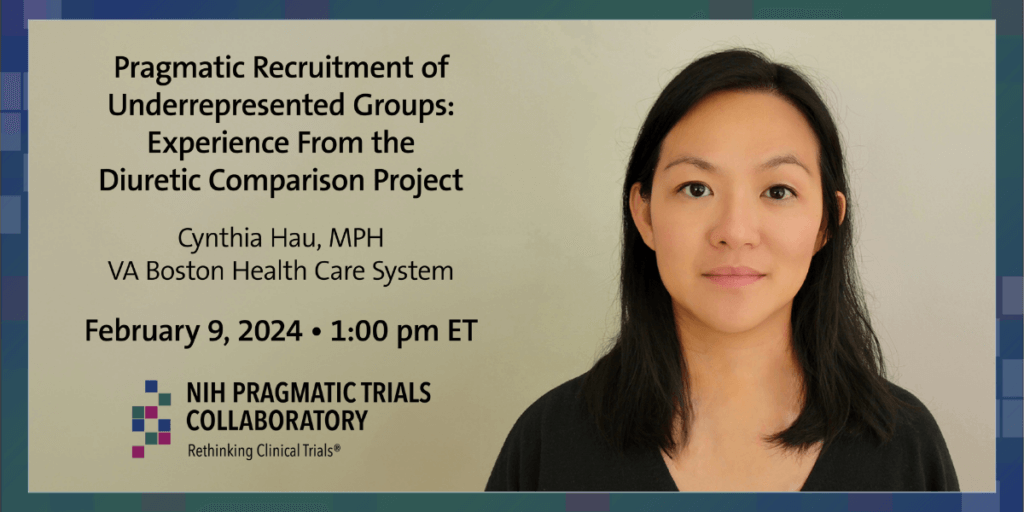
In this Friday’s PCT Grand Rounds, Cynthia Hau of the VA Boston Health Care System will present “Pragmatic Recruitment of Underrepresented Groups: Experience From the Diuretic Comparison Project.”
The Grand Rounds session will be held on Friday, February 9, 2024, at 1:00 pm eastern.

Hau is a statistician for the VA Cooperative Studies Program Coordinating Center in the VA Boston Health Care System. Hau recently led a secondary analysis of the Diuretic Comparison Project presenting a centralized electronic health record–based model for the recruitment of participants from underrepresented groups.

Join the online meeting.

February 6, 2024: Racial and Ethnic Minority Injury Survivors See Greater Improvements in PTSD Symptoms in the TSOS Study

Cover of the journal Trauma Surgery & Acute Care OpenInjury survivors from racial and ethnic minority groups experienced greater improvements than White injury survivors in their posttraumatic stress disorder (PTSD) symptoms after receiving a stepped collaborative care intervention. This was the finding of a secondary analysis of data from the Trauma Survivors Outcomes and Support (TSOS) study, an NIH Collaboratory Trial led by principal investigator Doug Zatzick of the University of Washington.
The report was published online in Trauma Surgery & Acute Care Open.

In the TSOS study's main analysis, which was published in JAMA Surgery in 2021, the researchers saw a significant reduction in PTSD symptoms at 6 months in the intervention group compared with the control group. In the new secondary analysis, they saw that reduction in symptoms among racial and ethnic minority patients but not among White, non-Hispanic patients.

The findings "suggest that the previously reported 6-month treatment effects derive predominantly from intervention-related PTSD symptom improvements in non-white/Hispanic patients," wrote author Khadija Abu and colleagues from the University of Washington and the University of California, Los Angeles.

The TSOS study, an NIH Collaboratory Trial, was a stepped-wedge, cluster randomized pragmatic clinical trial testing the delivery of a stepped collaborative care intervention vs usual care for injured patients with PTSD symptoms and comorbid conditions. The study was conducted at 25 level I trauma centers in the United States. Of the 635 patients in the trial, 350 were from racial backgrounds other than White—including 218 patients who identified as African American, 15 as American Indian or Alaska Native, 8 as Asian or Pacific Islander, and 109 as multiple or other races. One-hundred two patients were Hispanic.

Patients in the control group received usual care plus nurse notification about their high level of distress. Patients in the intervention group received collaborative care consisting of evidence-based medication, cognitive behavioral therapy, and case management.

The study team proposed a few possible explanations for their findings:

  • In addition to its universal components, the TSOS intervention and referral elements consisted of tailored components designed to address the needs of a multicultural patient population by incorporating social determinants of health.
  • Collaborative care models include shared decision-making approaches, which are thought to enhance patients' engagement in care in racial and ethnic minority populations and other underserved groups.
  • In the year before their injury, almost half of the white, non-Hispanic patients in the study had accessed mental health services, compared with only about a quarter of the non-White and Hispanic patients, suggesting that participation in the study improved access to mental health care for patients in racial and ethnic minority groups.

A commentary accompanying the article praised the TSOS research team for "taking important steps to care for adverse sequelae associated with traumatic injury," and noted that "these first steps represent giant leaps for health equity" for underserved populations.

The TSOS study was supported within the NIH Pragmatic Trials Collaboratory by a cooperative agreement from the National Institute of Mental Health and by the NIH Common Fund through a cooperative agreement from the Office of Strategic Coordination within the Office of the NIH Director. Learn more about the NIH Collaboratory Trials.

January 29, 2024: IMPACT Collaboratory Announces Health Equity Certificate Program for Pragmatic Trials Researchers

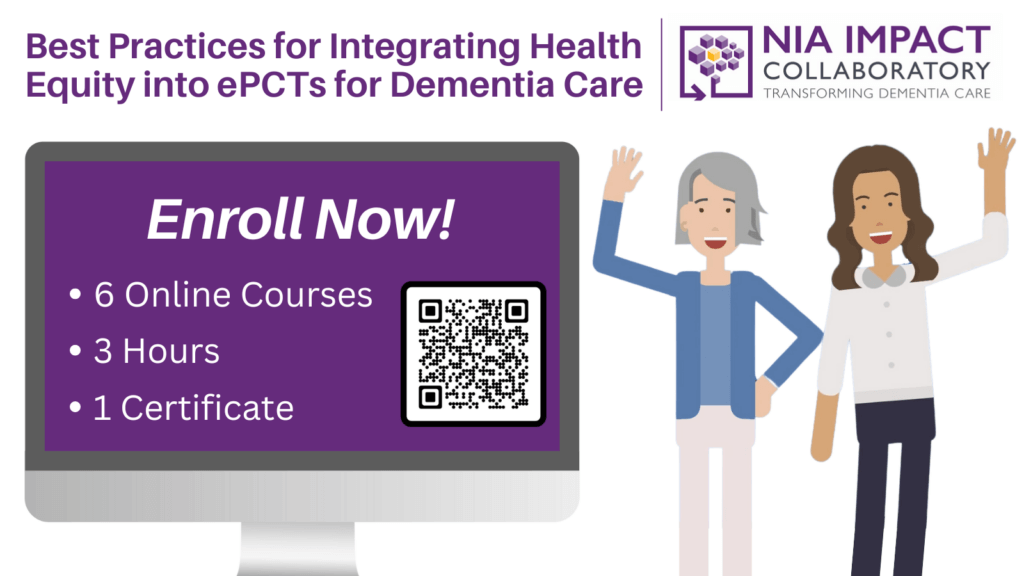
The NIA IMPACT Collaboratory announced a new online certificate program designed to empower researchers at all levels in integrating health equity considerations into embedded pragmatic clinical trials (ePCTs) for people living with dementia and their care partners.

Program Overview

This comprehensive training program, aligned with the IMPACT Collaboratory's "Best Practices for Integrating Health Equity into ePCTs for Dementia Care" document, equips researchers with the knowledge and skills to incorporate health equity considerations into design and research activities at every level of ePCTs for people living with dementia. The program covers 6 essential topic areas:

  • Getting started
  • Community Partner Engagement
  • Design and Analysis
  • Intervention Design and Implementation
  • Healthcare System and Participant Selection
  • Selecting Outcomes

Key Features

  • Free, accessible online training
  • Six courses, each including 2 to 5 brief and engaging videos
  • Self-paced learning, typically completed in 3 hours or less
  • Certificate upon successful completion of the program

Access the Training

Visit the IMPACT Collaboratory website for details and links to set up your free learning account. This account not only provides access to the health equity training program but also to other certificate programs and training materials.

The NIA IMPACT Collaboratory is supported by a grant from the National Institute on Aging.

January 2, 2024: NINR Announces Funding Opportunity to Address Social Needs Through Healthcare-Community Partnerships

The National Institute of Nursing Research (NINR) has published a funding opportunity for research to develop and expand interventions and programs that leverage existing or create new healthcare-community partnerships to address unmet social needs among individuals and families and adverse social determinants of health within communities—especially in populations that experience health disparities.

Read the full announcement for more information about the funding opportunity and details on eligibility, research objectives, key dates, application review, and award administration.

  • Letter of intent due date: February 21, 2024
  • Application due date: March 22, 2024

NINR will hold a pre-application webinar for prospective applicants on February 15, 2024, from 1:00 to 2:00 pm ET. NIH staff will provide an overview of the funding opportunity and answer questions from potential applicants. Registration is required.

November 27, 2023: NIH Announces Funding Opportunity for Implementation Studies of Substance Use Treatment and Prevention in Populations That Experience Health Disparities

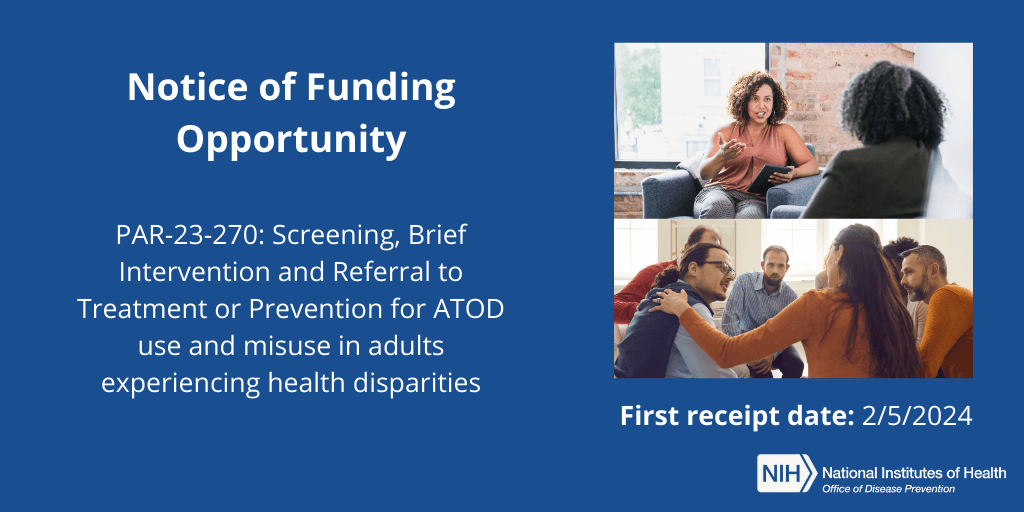
The National Institutes of Health’s Office of Disease Prevention (ODP) issued a new funding opportunity to support implementation studies in treatment and prevention for alcohol, tobacco, and other drugs use and misuse in adult populations that experience health disparities.

ODP and participating NIH Institutes and Centers are inviting applications for research projects that test innovative approaches to implementing screening, brief intervention, and referral to treatment or prevention for alcohol, tobacco, and other drugs use and misuse. This R01 funding opportunity will support clinical trial research that develops and prospectively tests implementation strategies that overcome barriers to prevention and treatment in diverse settings. Applicants are strongly encouraged to include in their proposals robust engagement with relevant healthcare and community partners and to examine organizational and system contexts.

The first receipt date for new applications is February 5, 2024.

Read the full funding opportunity.