


Dissemination Approaches for Different Audiences
Section 1
Introduction
Clinical researchers traditionally have reported their study results in scientific journals. The results of pragmatic clinical research are often used to inform clinical and healthcare system decision-makers, frame clinical guidelines, and inform policy and, ultimately, may be implemented into routine care or clinical operations. A shift has begun toward using dissemination strategies that shorten the time it takes for research findings to change clinical practice and benefit patient care (Balas and Boren 2000).
The mode and medium for disseminating the findings of a pragmatic clinical trial should be tailored to the specific audience. The Patient-Centered Outcomes Research Institute (PCORI) recommends that patients and other research partners be involved in plans to disseminate study findings by, for example, identifying the audiences for dissemination, shaping the study design with dissemination in mind, and developing creative approaches to getting information into the hands of those who need it.
Having research partners at the table from the start can be key to driving practice change if it is indicated from the results or to redesign or adjust if results are not as expected. The Building Partnerships and Teams to Ensure a Successful Trial chapter of the Living Textbook describes the wide range of research partner groups relevant to pragmatic trials.
This chapter explores dissemination strategies for different audiences, including considerations for transparent reporting to the scientific community and approaches for disseminating results to patients, clinicians, and healthcare system leaders.
Learn more in these Living Textbook chapters:
SECTIONS
Resources
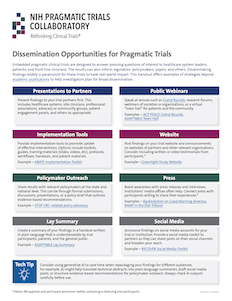
Dissemination Opportunities for Pragmatic Trials
A reference offering examples of strategies beyond academic publications to help investigators plan for broad dissemination
Data and Resource Sharing
Resources from the NIH Collaboratory Trials, including protocols, consent documents, public use datasets, computable phenotypes, and analytic code
REFERENCES
Balas EA, Boren SA. 2000. Managing clinical knowledge for health care improvement. Yearb Med Inform. 2000;(1):65-70. PMID: 27699347.
ACKNOWLEDGMENTS
Karen Staman, Gina Uhlenbrauck, and Liz Wing of the NIH Pragmatic Trials Collaboratory Coordinating Center served as contributing editors for previous versions of this chapter.