August 13, 2024: EHR Core and Patient-Centered Outcomes Core Reflect on Challenges in Pragmatic Trials

At the NIH Pragmatic Clinical Trials Collaboratory’s 2024 Annual Steering Committee Meeting, leaders of the Electronic Health Records (EHR) Core and the Patient-Centered Outcomes (PCO) Core discussed challenges and lessons learned in the NIH Collaboratory Trials.

EHR cochairs Keith Marsolo and Rachel Richesson shared challenges related to EHR usage, including EHRs switching midtrial, unanticipated changes to the EHR that impacted intervention delivery, and difficulties navigating data sharing policies.

“We continue to be challenged, but we fall back on our core principles, which is looking for good quality data and good quality research with an eye on how we can share the results in the underlying data in the future,” Richesson said.

Over the next year, the EHR Core will explore improving data access, transparency of computable phenotypes, and capturing dietary supplement information in the EHR.

PCO Core cochairs Cristy Zigler and Emily O’Brien shared goals for effective collection PCO data.

“We have advised studies about the importance of delivering patient-reported outcomes to participants in a way that is easy to complete, doesn’t overburden them, and is relevant for their population,” O’Brien said.

The Core has compiled a list of best practices for collecting PCO data and collaborated with the Health Equity Core to create a Health Equity Toolkit, designed to give investigators practical guidance for incorporating health and equity considerations in research.

The Core has also been working closely with Implementation Science Core to consider the sustainability of PCO data systems and facilitate reuse of collection methods.

“We often see separate systems set up to collect PCO data for the trial, and then those systems sunset at the end and are not in place to support an assessment over time,” O’Brien said.

Access the complete meeting materials from the 2024 Annual Steering Committee Meeting.

October 18, 2022: Richesson to Present on EHR-Based Phenotyping at IMPACT Collaboratory Grand Rounds

Headshot of Rachel RichessonRachel Richesson, cochair of the NIH Pragmatic Trials Collaboratory’s Electronic Health Records (EHR) Core, will present this week at IMPACT Collaboratory Grand Rounds.
The virtual session, “Developing Standards and Quality Metrics for Clinical Phenotyping Using EHR Data in Pragmatic Clinical Trials,” will be held on Thursday, October 20, 2022, at 12:00 pm eastern.

Richesson is a professor of learning health sciences in the University of Michigan School of Medicine. She is working with the EHR Core to develop standards and quality metrics for EHR-based phenotyping, the topic of her upcoming Grand Rounds presentation.

Zoom Details for IMPACT Grand Rounds:

  • Please click the link to join the webinar: https://hebrewseniorlife.zoom.us/j/97344810673
  • Or iPhone one-tap: US: +13126266799,,97344810673#  or +14702509358,,97344810673#
  • Or Telephone: US: +1 312 626 6799  or +1 470 250 9358
  • Webinar ID: 973 4481 0673

August 11, 2021: EHR Core Facing Familiar Challenges, Intensified by Pandemic

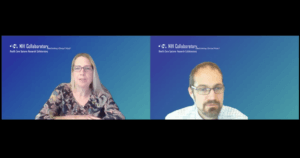
Leaders of the NIH Collaboratory’s Electronic Health Records (EHR) Core Working Group spoke in a recent interview about the impacts of the COVID-19 pandemic on pragmatic trials. They also talked about upcoming projects and a recent survey of the NIH Collaboratory Trials.


“The pandemic amplified themes that we’ve heard all along, which is how to get resources, how to get support for the data that we need for these trials or to configure EHRs as we need for these trials,” said Dr. Rachel Richesson, a professor of learning health sciences at the University of Michigan and a cochair of the EHR Core. “The pandemic just shifted priorities tremendously and made it quite challenging. As a result, we’ve had discussions about…really making the value case for pragmatic research and embedded research,” Richesson said.

View the full video.

Dr. Keith Marsolo, also a cochair of the Core, added, “The pandemic obviously was a big challenge for health systems in general as they transitioned to telehealth, dealt with shutdowns, things of that nature.” Marsolo is an associate professor in population health sciences at Duke University.

“Things are starting to move forward a little bit more. In one [NIH Collaboratory Trial], they were able to leverage some infrastructure that was purchased to help provide telehealth services for their region. So they’ve been able to bootstrap their trial off of that infrastructure,” Marsolo said.

Richesson also described an upcoming paper reporting the results of a recent survey of the NIH Collaboratory Trials. The survey focused on the challenges of using EHR data in pragmatic trials embedded in healthcare systems.

“No surprise on the challenges we encountered: It’s still challenging to get data from organizations for research, the data are still heterogeneous,…and there are challenges on the research team to ensure that that information is equivalent and how these data can be pulled together to support the research question,” Richesson said. “There’s a particular emphasis with the newer studies on patient-reported outcomes and how to get those collected as part of routine care,” she said.

View the full video.


Screen shot of video interview with Dr. Rachel Richesson and Dr. Keith Marsolo
Dr. Rachel Richesson and Dr. Keith Marsolo