June 12, 2025: Living Textbook Chapter Covers Consent, Disclosure, and Nondisclosure for Pragmatic Trials

A new chapter of the Living Textbook of Pragmatic Clinical Trials describes regulatory requirements for informed consent, waivers and alterations of consent, mechanisms for notification, and research participants’ perspectives on a variety of approaches to consent and notification—all with a focus on special considerations for pragmatic clinical trials.


For a variety of reasons, the  application of ethical principles and regulations regarding informed consent can be complex for pragmatic clinical trials. For example, pragmatic trials often use novel study designs, including cluster randomization, in which the unit of randomization may be a clinic, hospital, or healthcare system rather than the individual. Some pragmatic trials also use stepped-wedge designs, in which the study intervention is introduced to sites at different times.

The new chapter has 5 sections:

  • Section 1 discusses reasons why the application of ethical principles and regulations regarding informed consent can be complex for pragmatic trials.
  • Section 2 describes the regulatory requirements for informed consent.
  • Section 3 focuses on waivers and alterations of the informed consent process.
  • Section 4 provides examples of mechanisms for notifying participants about the trial when consent is not required.
  • Section 5 presents findings on research partners’ preferences regarding various approaches to research and consent.

The chapter was developed by members of the NIH Pragmatic Trials Collaboratory’s Ethics and Regulatory Core.

The Stepped Wedge Cluster Randomized Trial: Friend or Foe?

The Stepped Wedge Cluster Randomized Trial: Friend or Foe?

Description

This Grand Rounds presentation was part of our special Grand Rounds series, Ethical & Regulatory Dimensions of Pragmatic Clinical Trials. Monica Taljaard and David Magnus present their lessons learned from using stepped-wedge designs in ePCTs.

Speakers

Monica Taljaard, PhD
Senior Scientist, Clinical Epidemiology Program, Ottawa Hospital Research Institute
Full Professor, Epidemiology and Community Medicine, University of Ottawa

David Magnus, PhD
Professor of Medicine and Biomedical Ethics and Professor of Pediatrics, Medicine, and by courtesy of Bioengineering
Director, Stanford Center for Biomedical Ethics
Associate Dean for Research


Related Content

Living Textbook: Stepped-Wedge Designs

Responding (or Not) to Signals of Potential Clinical Significance in Pragmatic Clinical Trials

Responding (or Not) to Signals of Potential Clinical Significance in Pragmatic Clinical Trials

Description

This Grand Rounds presentation was part of our special Grand Rounds series, Ethical & Regulatory Dimensions of Pragmatic Clinical Trials. Joe Ali, Tanya Matthews, and Leslie Crofford discuss what to do when data in a pragmatic clinical trial includes information that might signal physical, mental health or behavioral health risks to patient-subjects (e.g. substance use, depression, anxiety, suicidality).

Speakers

Joseph Ali, JD
Assistant Professor, Dept. of International Health
Johns Hopkins Bloomberg School of Public Health
Core Faculty & Associate Director for Global Programs
Johns Hopkins Berman Institute of Bioethics

Tanya Matthews, PhD
HRPP Director
Kaiser Permanente Washington


Leslie J. Crofford, MD
Wilson Family Chair in Medicine
Professor of Medicine and Pathology, Microbiology & Immunology
Chief, Division of Rheumatology
Vanderbilt University Medical Center


Related Content

Living Textbook: How Are PRO Measures Used?

Headshot of Dr. Emily Largent

Ethical Considerations When Vulnerable Populations are Subjects in Pragmatic Trials

Ethical Considerations When Vulnerable Populations are Subjects in Pragmatic Trials

Description

This Grand Rounds presentation was part of a special series, Ethical & Regulatory Dimensions of Pragmatic Clinical Trials. Emily Largent explains that while it is ethically acceptable and imperative to enroll vulnerable subjects in research, we must also think about their vulnerability in systematic ways so that we know not only what they are vulnerable to but how we can protect them.

Speaker

Headshot of Dr. Emily LargentEmily A. Largent, JD, PhD, RN
Emanuel & Robert Hart Assistant Professor of Medical Ethics and Health Policy
Department of Medical Ethics and Health Policy
University of Pennsylvania Perelman School of Medicine


Related Content

Living Textbook: Data and Safety Monitoring

Ethical Considerations for Data Sharing in Pragmatic Trials

Ethical Considerations for Data Sharing in Pragmatic Trials

Description

Dr. Stephanie Morain of Johns Hopkins University discusses a supplemental grant award to the NIH Pragmatic Trials Collaboratory Coordinating Center to study the ethical issues that arise in data sharing in the context of pragmatic trials.

Biography

Stephanie Morain, PhD, MPH
Assistant Professor, Bloomberg School of Public Health, Johns Hopkins University
Ethics and Regulatory Core Co-chair


Headshot of Dr. Pearl O'Rourke

Informing and Consenting: What Are the Goals?

Informing and Consenting: What Are the Goals?

Description

This Grand Rounds presentation was part of a special series, Ethical & Regulatory Dimensions of Pragmatic Clinical Trials. Drs. Pearl O’Rourke, Dave Wendler, Miguel Vazquez, and Michael Ho shared the difference between informing participants about research and the informed consent process.

Speakers

Headshot of Dr. Pearl O'RourkePearl O’Rourke, MD (retired)
Harvard Medical School
Ethics and Regulatory Core Co-chair


David S. Wendler, PhD, MA
Senior Researcher, Department of Bioethics, NIH Clinical Center


Miguel Vasquez, MD
Professor of Internal Medicine, UT Southwestern Medical Center
ICD-Pieces NIH Collaboratory Trial PI


Michael Ho, MD, PhD
Professor of Medicine, University of Colorado School of Medicine
Nudge NIH Collaboratory Trial PI

Related Content

Living Textbook: Mechanisms for Notification

Headshot of Dr. Stepanie Morain

Data Sharing and Pragmatic Clinical Trials: Law & Ethics Amidst a Changing Policy Landscape

Data Sharing and Pragmatic Clinical Trials: Law & Ethics Amidst a Changing Policy Landscape

Description

In this Grand Rounds presentation, Drs. Stephanie Morain and Kayte Spector-Bagdady share the substantial logistical burdens in preparing data for sharing, meaningful risks of reidentification, and concern for biased or misleading analyses.

Speakers

Stephanie Morain, PhD, MPH
Assistant Professor, Bloomberg School of Public Health, Johns Hopkins University
Ethics and Regulatory Core Co-chair


Kayte Spector-Bagdady, JD, MBioethics
Associate Director, Center for Bioethics & Social Sciences in Medicine
Assistant Professor of Obstetrics & Gynecology
University of Michigan Medical School

Related Content

Living Textbook: Ethical Considerations of Data Sharing in PCTs

August 17, 2023: American Journal of Bioethics Publishes Special Issue on Pragmatic Clinical Trials

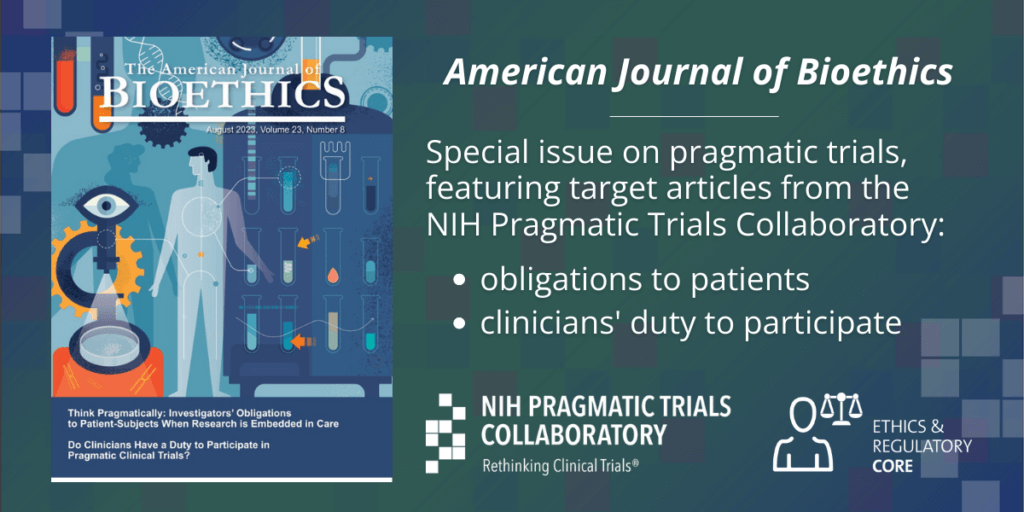
A graphic that includes the cover image from the August 2023 issue of the American Journal of Bioethics. The text in the graphic reads as follows: "American Journal of Bioethics Special issue on pragmatic trials, featuring target articles from the NIH Pragmatic Trials Collaboratory."When research and clinical care are deliberately integrated in an embedded pragmatic clinical trial, the nature and extent of investigators’ obligations to patient-subjects are blurred, as is the clinician’s duty to participate is such research. To address these questions, the American Journal of Bioethics (AJOB) recently published commentaries on 2 target articles in a special issue on pragmatic clinical trials. Both of the target articles for the special issue are from the NIH Pragmatic Trials Collaboratory’s Ethics and Regulatory Core.

Target Article #1

Think Pragmatically: Investigators’ Obligations to Patient-Subjects When Research Is Embedded in Care by Stephanie Morain and Emily Largent

  • The authors challenge the notion that the current ethical model can simply be extended to pragmatic research. Instead, the authors suggest a shift to a model that better reflects the team- and institution-based nature of both clinical care and embedded research.

Target Article #2

Do Clinicians Have a Duty to Participate in Pragmatic Clinical Trials? by Andrew Garland, Stephanie Morain, and Jeremy Sugarman

  • The authors argue that clinicians have a duty to participate in pragmatic research in usual care but suggest acceptable reasons to refuse, such as a badly designed trial, trial activities that violate the clinician’s conscience, or that the trial will impose excessive burdens on the clinician.

Some of the responses to the target articles are highlighted below.

Blurred Boundaries: Toward an Expanded Ethics of Research and Clinical Care
Megan C. Hailey and Nate Olson

  • The authors applaud the articles and offer a range of different research contexts where similar issues apply, including rare disease and genomics research.

Progressing From “Whether to” to “How to” Conduct Pragmatic Trials
Jonathan Casey, Todd Rice, and Matthew Smelner

  • The authors state that clinicians are confronted daily with clinical decisions where the best treatment is unknown and suggest that pragmatic trials are best situated to address the problem.

    “We believe that the US healthcare system has a basic choice to make: allow arbitrary variation in clinical care and continue to systematically expose patients to suboptimal or harmful therapies indefinitely or structure that variation through pragmatic trials to generate knowledge, reduce variation, and improve outcomes over time.”

Ethical Pragmatic Clinical Trials Require the Virtue of Cultivated Uneasiness
Joel Pacyna and Jon Tilburt

  • The authors suggest that softening the default requirement of documenting individual consent removes a primary tool that researchers rely on to ensure the ethical nature of their research. Cultivated uneasiness about waiving consent is warranted and will push researchers to fully examine their decisions and subsequent consequences.

Distinguishing Clinical and Research Risks in Pragmatic Clinical Trials: The Need for Further Stakeholder Engagement
Benjamin S. Wilfond, Sinem Toraman Turk, Stephanie A. Kraft, Elliott M. Weiss, Philip I. Tarr, David Schnadower, and Stephen B. Freedman

  • The authors present a case study involving complex interventions to support the target articles’ supposition that ethical frameworks for pragmatic clinical trials need to account for shortcomings in clinical care.

More-Than-Partial Entrustment in Pragmatic Clinical Trials
Henry S. Richardson

  • The author strongly supports the obligations of the investigators to report significant, actionable incidental findings about individuals.

End-to-End Integration of Pragmatic Trials Into Health Care Settings
Sarah M. Greene

  • The author agrees that pragmatic trials will provide invaluable evidence, but argues that trialists must take care not to interrupt the flow of clinical practice.

For more, see the 15 other commentaries in the special issue of AJOB and the Living Textbook chapter on Consent, Waiver of Consent, and Notification.