


Implementation
Section 1
Introduction
The process of implementing research findings into clinical practice is complex, and implementation strategies are needed to promote real change. Implementing evidence-based interventions often requires organizational change at the health system or provider level (Greenhalgh et al. 2004). Implementation science was developed to create specific strategies to promote the uptake of evidence-based practices into clinical care (Bauer et al. 2015).
Implementation science is defined as “the scientific study of methods to promote the systematic uptake of research findings and other evidence based practices into routine practice to improve the quality and effectiveness of health services and care (Eccles and Mittman 2006).”
Geoffrey Curran developed this slide to explain implementation science at its most basic level (Curran 2020):
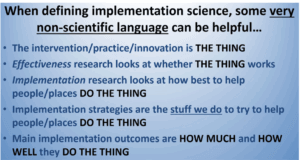
Part of implementation research is to describe gaps in use of “the thing” (an evidence-based practice), including relevant barriers and facilitators that can impact use at the patient, provider, and/or organizational levels.
Dissemination science is related to implementation science, and concerns the spread of information and education about an evidence-based practice (Bauer et al. 2015). Dissemination is about distributing and sharing information and tools, while implementation tends to focus on more proactive efforts to get that information into practice. The chapter Dissemination Approaches for Different Stakeholders provides more specific guidance on dissemination strategies for different audiences.
Why Is Implementation Research Needed?
When research uncovers new information or new knowledge that will improve the care of patients, the findings may not—or may be slow to—be adopted or “translated” into clinical practice, creating a “translation gap.” These gaps persist because of complex provider-level and system-level barriers to rapid translation (Curran et al. 2012). Typically, clinical trials are intended to test the clinical effectiveness of interventions, or the impact of interventions on health outcomes. Implementation research focuses on how to get effective interventions into practice. Proctor and colleagues (Proctor et al. 2009) identified a set of key outcomes and related questions related to implementation that need to be considered:
- How feasibly can an intervention be delivered in a particular health system?
- Can the practitioners deliver the intervention with fidelity?
- How acceptable is it to the variety of patients, clinicians, and leaders within the health system?
- What will the adoption (i.e., uptake) be?
- What are the costs associated with having the intervention integrated into a system of care?
- How sustainable can it be?
Implementation trials typically compare 2 or more implementation strategies to study their effects on adoption and/or fidelity.
This chapter will describe implementation science, but not quality improvement activities. For more on quality improvement and its intersection with ePCTs, see the Living Textbook section: Differentiating Between RCTs, PCTs, and Quality Improvement Activities.
SECTIONS
Resources
Successful dissemination and implementation of trial interventions involves teamwork with health system partners. For more, see the Living Textbook chapter on Building Partnerships to Ensure a Successful Trial.
An introduction to implementation science for the non-specialist
Review that introduces non-specialist investigators, administrators, and policymakers to the principles and methods of implementation science
Implementation science made too simple: a teaching tool
The article provides a teaching tool to assist scientists and non-scientists to grasp key concepts in implementation science.
REFERENCES
Bauer MS, Damschroder L, Hagedorn H, Smith J, Kilbourne AM. 2015. An introduction to implementation science for the non-specialist. BMC Psychol. 3:32. doi:10.1186/s40359-015-0089-9. PMID: 26376626
Curran GM. 2020. Implementation science made too simple: a teaching tool. Implement Sci Commun. 1:27. doi:10.1186/s43058-020-00001-z. PMID: 32885186
Curran GM, Bauer M, Mittman B, Pyne JM, Stetler C. 2012. Effectiveness-implementation hybrid designs: combining elements of clinical effectiveness and implementation research to enhance public health impact. Med Care. 50:217–226. doi:10.1097/MLR.0b013e3182408812. PMID: 22310560
Eccles MP, Mittman BS. 2006. Welcome to Implementation Science. Implement Sci. 1. doi:10.1186/1748-5908-1-1.
Greenhalgh T, Robert G, Macfarlane F, Bate P, Kyriakidou O. 2004. Diffusion of innovations in service organizations: systematic review and recommendations. Milbank Q. 82:581–629. doi:10.1111/j.0887-378X.2004.00325.x. PMID:15595944.
Proctor EK, Landsverk J, Aarons G, Chambers D, Glisson C, Mittman B. 2009. Implementation research in mental health services: an emerging science with conceptual, methodological, and training challenges. Admin Policy Ment Health. 36:24–34. doi:10.1007/s10488-008-0197-4. PMID: 19104929