October 16, 2025: New Article Surveys Landscape of Empirical Ethics Research Related to Pragmatic Clinical Trials

Headshots of Dr. Kayla Mehl, Dr. Stephanie Morain, and Dr. Jeremy Sugarman
Left to right: Kayla R. Mehl, Stephanie R. Morain, and Jeremy Sugarman

A new article from the NIH Pragmatic Trials Collaboratory’s Ethics and Regulatory Core offers a comprehensive scoping review of published empirical ethics research related to pragmatic clinical trials. These trials, which are designed to assess evidence-based interventions in real-world settings, present a variety of unique ethical and regulatory challenges.

The article was published online ahead of print in Learning Health Systems.

The review analyzed 82 published studies of ethics issues that have been explored in the context of pragmatic clinical trials. The authors, led by Kayla Mehl at Johns Hopkins University, identified 22 distinct ethical themes, with the 5 most prevalent being consent and disclosure, risk assessment, trust and transparency, operational burdens and implementation barriers, and the role of engagement.

  • Consent and disclosure: Traditional written informed consent is often impractical in pragmatic trials, prompting the exploration of alternative approaches such as opt-out or general notification.
  • Risk assessment: Pragmatic trials present challenges in risk assessment, particularly regarding how “minimal risk” is defined and communicated, which complicates regulatory determinations and participant protections.
  • Trust and transparency: Trust-building practices, such as results sharing and transparent data use disclosures, are essential for fostering participant confidence.
  • Burdens, barriers, and costs: Institutions, investigators, and research teams face a variety of operational and logistical burdens in pragmatic trials, especially when integrating interventions into routine care and navigating ethics concerns around data governance and data sharing.
  • Engagement: Engagement practices in pragmatic trials have been limited and inconsistent, highlighting “a persistent gap between the ideal of inclusive, sustained collaboration and the realities of constrained resources, power dynamics, and unclear stakeholder roles.”

Read the full article.

The authors point out that most empirical ethics research related to pragmatic trials has been concentrated in the United States and other Western countries and is heavily reliant on surveys and hypothetical scenarios. This limits the generalizability and real-world applicability of current findings. The authors advocate for future research that is geographically inclusive and that employs innovative methodologies, including nested empirical studies within ongoing pragmatic trials, to provide richer, context-sensitive insights.

Mehl completed a postdoctoral fellowship in the ethics and regulatory aspects of pragmatic clinical trials at the Berman Institute for Bioethics at Johns Hopkins University. Coauthor Stephanie Morain is a core faculty member at the Berman Institute and an associate professor of health policy and management at the Johns Hopkins Bloomberg School of Public Health. Coauthor Jeremy Sugarman is the Harvey M. Meyerhoff Professor of Bioethics and Medicine, professor of medicine, and professor of health policy and management at Johns Hopkins and the deputy director for medicine of the Berman Institute.

Morain and Sugarman are cochairs of the NIH Collaboratory’s Ethics and Regulatory Core.

June 11, 2025: Improving Ethical Oversight of Pragmatic Trials, in This Week’s Rethinking Clinical Trials Grand Rounds

Headshots of Drs. Stephanie Morain, Nancy Kass, and Ruth Faden
Stephanie Morain, Nancy Kass, and Ruth Faden

In this Friday’s Rethinking Clinical Trials Grand Rounds, Stephanie Morain, Nancy Kass, and Ruth Faden will present “Fit for Purpose: Improving the Ethical Oversight of Pragmatic Clinical Trials.”

The live webinar will be held on Friday, June 13, 2025, at 1:00 pm eastern.

Morain is an associate professor of health policy and management in the Bloomberg School of Public Health and a core faculty member at the Berman Institute of Bioethics at Johns Hopkins University. Kass is the vice-provost for graduate and professional education at Johns Hopkins, the Phoebe R. Berman Professor of Bioethics and Public Health in the Bloomberg School of Public Health, and the deputy director for public health at the Berman Institute. Faden is the Philip Franklin Wagley Professor of Biomedical Ethics at Johns Hopkins and the founding director of the Berman Institute.

Join the online meeting.

December 3, 2024: Sharing Results With Research Participants Raises Special Considerations in Pragmatic Trials

Cover image of the journal Clinical TrialsIn a new report from the NIH Pragmatic Trials Collaboratory, a team of bioethicists explores the ethical obligation to share aggregate results from pragmatic clinical trials with research participants. They conclude with recommendations for how to meet this obligation.

The article was published online ahead of print in Clinical Trials.

There is growing appreciation of the importance of sharing aggregate results of clinical trials with research participants. However, this practice has not been examined in the context of pragmatic clinical trials, which have special features that may complicate the ethics and logistics of sharing aggregate results.

The report’s authors summarize the ethical arguments for sharing aggregate results and describe the features of pragmatic trials that may raise logistical and other barriers to disclosure. They also discuss the important role healthcare system partners play in sharing results from pragmatic trials.

The authors offer the following recommendations:

  • Sharing aggregate results with research participants should be the default, and decisions not to share should be justified
  • Planning for sharing aggregate results should begin early in the planning of the trial
  • The healthcare care systems in which the trial is embedded should be key partners in decisions about what and how to share
  • Proactive sharing of results from a pragmatic trial that was conducted under a waiver or alteration of consent, including an explanation for why consent was not obtained in the study, can promote trust in the investigators and their healthcare system partners

Read the full report.

The article was coauthored by members of the NIH Pragmatic Trials Collaboratory’s Ethics and Regulatory Core, including Stephanie Morain, Abigail Brickler, Joseph Ali, Caleigh Propes, and Kayla Mehl of Johns Hopkins University; Pearl O’Rourke, formerly of Partners HealthCare; Kayte Spector-Bagdady of the University of Michigan; Benjamin Wilfond of the Seattle Children’s Hospital; Vasiliki Rahimzadeh of the Baylor College of Medicine; and David Wendler of the NIH Clinical Center.

November 21, 2024: Are Pragmatic Trials Living Up to the Promise of Improving Representativeness?

Headshots of Stephanie Morain, Kayla Mehl, and Caleigh Propes
(Left to right) Authors Stephanie Morain, Kayla Mehl, and Caleigh Propes

In a new commentary, members of the NIH Pragmatic Trials Collaboratory’s Ethics and Regulatory Core explore the potential of pragmatic trials to improve demographic representativeness and health equity in clinical research. The article, “Untapped Potential? Representativeness in Pragmatic Clinical Trials,” was published online ahead of print in JAMA.

Authors Caleigh Propes, Kayla Mehl, and Stephanie Morain review early experiences with pragmatic trials and describe the challenges researchers face in achieving representative enrollment:

  • Pragmatic trials are embedded in unjust healthcare systems
  • Pragmatic trials often rely on electronic health record systems for data collection
  • As in traditional clinical trials, site selection in pragmatic trials tends to be biased toward better-resourced sites and sites with closer ties to established researchers
  • There is a general lack of attention to health equity considerations in trial design

The authors conclude that “further empirical scholarship is needed to assess the extent to which [pragmatic trials] are (or are not) truly representative and to define appropriate enrollment goals.”

Read the full article.

Propes is a doctoral student in bioethics and health policy and management at the Berman Institute of Bioethics, Mehl is a postdoctoral fellow in the ethics and regulatory aspects of pragmatic clinical trials at the Berman Institute, and Morain is a core faculty member at the Berman Institute and an associate professor of health policy and management at the Bloomberg School of Public Health—all at Johns Hopkins University.

August 19, 2024: Ethics Core and Biostatistics Core Guide Newest Trials Through Planning Phase

Leaders of 2 of the NIH Pragmatic Trials Collaboratory’s long-standing Core Working Groups recently shared updates from their work with the newest cohort of NIH Collaboratory Trials. We spoke with them during the NIH Collaboratory’s 2024 Annual Steering Committee Meeting in May.

Over the last year, the Ethics and Regulatory Core engaged in a formal onboarding process with the program’s 9 newest pragmatic trials, consulting with the investigators about their trial planning and implementation. Cochairs Stephanie Morain and Pearl O’Rourke summarized several of the ongoing and emerging challenges.

“One of the challenges we’re continuing to see is understanding what are the appropriate duties that institutions and investigators have in the context of a [pragmatic clinical trial],” said Morain. “One concrete area is in data and safety monitoring. What kinds of issues need to be monitored as adverse events? How do we think about them as being related to the trial vs relating to the background care?” she added.

Onboarding documentation from the Ethics and Regulatory Core’s consultations with the NIH Collaboratory Trials is available on our Data and Resource Sharing page.

We also spoke with Liz Turner and Patrick Heagerty, cochairs of the Biostatistics and Study Design Core. They have spent the past year advising the NIH Collaboratory Trial investigators on key study design challenges.

“Many of these studies have individually randomized patients but then they’re studying implementation pathways when they implement through a specific person that puts them in groups—these are individually randomized group treatment trials,” said Heagerty. “Several of the studies didn’t see that, and so we helped them see it and we helped them work through how to adapt their analysis and modify their sample size work to ensure the trial was properly sized,” he explained.

In addition to consultations with the NIH Collaboratory Trials, the Biostatistics and Study Design Core continues to develop and innovate pragmatic trials methodology.

Learn more about the Core Working Groups.

July 23, 2024: Article From Ethics and Regulatory Core Highlights Key Challenges for Pragmatic Trials

Headshots of Caleigh Propes, Stephanie Morain, and Pearl O'RourkeIn an invited commentary published this month in Circulation: Cardiovascular Quality and Outcomes, authors from the NIH Pragmatic Trials Collaboratory’s Ethics and Regulatory Core describe the recurring and emerging ethical issues in pragmatic clinical trials.

Coauthors Caleigh Propes, Stephanie Morain, and Pearl O’Rourke discuss 3 key challenges facing pragmatic trials researchers:

  • waivers and alterations of informed consent and their implications for transparency
  • managing and responding to “collateral findings” in pragmatic trials
  • representativeness of study populations, and the risk of reinforcing existing inequalities in healthcare delivery systems

Read the full article.

Each of the 3 challenges has taken on increasing importance for the NIH Collaboratory’s Ethics and Regulatory Core. For example, the group completed a 2-year multimethod investigation of collateral findings in pragmatic trials, identifying the core themes and proposing directions for future research.

Propes is a doctoral student in bioethics and health policy, and Morain is an associate professor of health policy and management and a core faculty member of the Berman Institute of Bioethics—both at Johns Hopkins University. O’Rourke is a retired bioethicist who served as the director of human research affairs at Partners HealthCare Systems in Boston and as an associate professor of pediatrics at Harvard Medical School.

Learn more about the Ethics and Regulatory Core.

March 7, 2024: New Report Sets Out Posttrial Responsibilities in Pragmatic Clinical Trials

Headshot of Dr. Stepanie Morain
Dr. Stephanie Morain

In a new report from the NIH Pragmatic Trials Collaboratory, a team of bioethicists and implementation scientists argue for a “presumptive default” that the results of pragmatic clinical trials should be incorporated into healthcare delivery processes. This responsibility arises from a key rationale for conducting pragmatic trials: that they can facilitate uptake of their results by relevant decision-makers.

The open-access article was published this week in Learning Health Systems.

Much of the literature on posttrial responsibilities offers guidance on what is owed to research participants and broader communities at the conclusion of traditional explanatory clinical trials. Similar guidance is lacking for pragmatic trials.

The NIH Collaboratory researchers, led by Stephanie Morain of Johns Hopkins University, explore the distinct considerations that shape posttrial responsibilities in pragmatic trials. These include the responsibilities of the healthcare systems in which these trials are embedded, and decisions about implementation of interventions that show meaningful benefit after their integration into usual care settings, as well as deimplementation of those that do not.

Fulfilling this responsibility will require prospective planning by researchers, healthcare delivery system leaders, institutional review boards, and sponsors, so as to ensure that the knowledge gained from [pragmatic trials] does, in fact, influence real-world practice.

The article was coauthored by members of the NIH Collaboratory’s Ethics and Regulatory Core and Implementation Science Core, including Pearl O’Rourke, formerly of Partners HealthCare; Joseph Ali and Jeremy Sugarman of Johns Hopkins University; Vasiliki Rahimzadeh of the Baylor College of Medicine; and Devon Check and Hayden Bosworth of Duke University.

Read the full article.


August 17, 2023: American Journal of Bioethics Publishes Special Issue on Pragmatic Clinical Trials

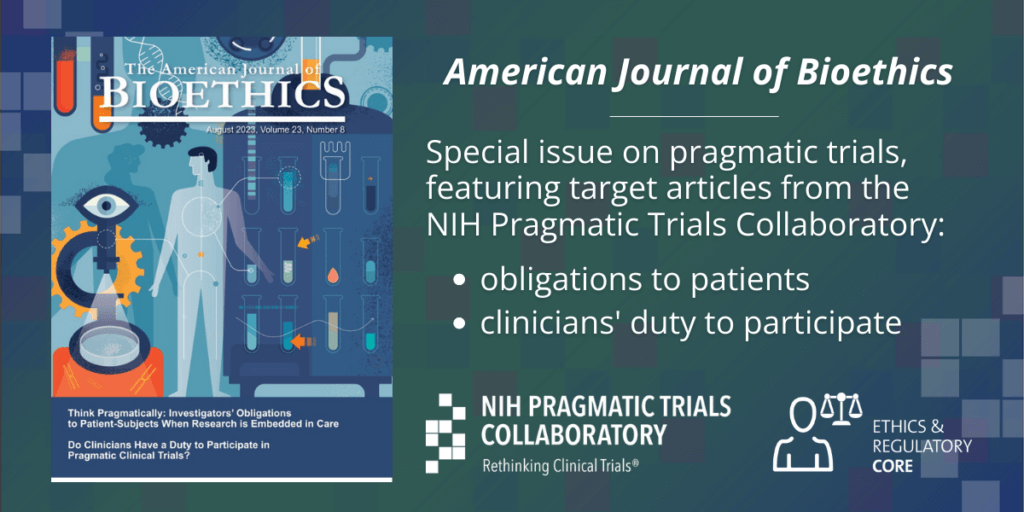
A graphic that includes the cover image from the August 2023 issue of the American Journal of Bioethics. The text in the graphic reads as follows: "American Journal of Bioethics Special issue on pragmatic trials, featuring target articles from the NIH Pragmatic Trials Collaboratory."When research and clinical care are deliberately integrated in an embedded pragmatic clinical trial, the nature and extent of investigators’ obligations to patient-subjects are blurred, as is the clinician’s duty to participate is such research. To address these questions, the American Journal of Bioethics (AJOB) recently published commentaries on 2 target articles in a special issue on pragmatic clinical trials. Both of the target articles for the special issue are from the NIH Pragmatic Trials Collaboratory’s Ethics and Regulatory Core.

Target Article #1

Think Pragmatically: Investigators’ Obligations to Patient-Subjects When Research Is Embedded in Care by Stephanie Morain and Emily Largent

  • The authors challenge the notion that the current ethical model can simply be extended to pragmatic research. Instead, the authors suggest a shift to a model that better reflects the team- and institution-based nature of both clinical care and embedded research.

Target Article #2

Do Clinicians Have a Duty to Participate in Pragmatic Clinical Trials? by Andrew Garland, Stephanie Morain, and Jeremy Sugarman

  • The authors argue that clinicians have a duty to participate in pragmatic research in usual care but suggest acceptable reasons to refuse, such as a badly designed trial, trial activities that violate the clinician’s conscience, or that the trial will impose excessive burdens on the clinician.

Some of the responses to the target articles are highlighted below.

Blurred Boundaries: Toward an Expanded Ethics of Research and Clinical Care
Megan C. Hailey and Nate Olson

  • The authors applaud the articles and offer a range of different research contexts where similar issues apply, including rare disease and genomics research.

Progressing From “Whether to” to “How to” Conduct Pragmatic Trials
Jonathan Casey, Todd Rice, and Matthew Smelner

  • The authors state that clinicians are confronted daily with clinical decisions where the best treatment is unknown and suggest that pragmatic trials are best situated to address the problem.

    “We believe that the US healthcare system has a basic choice to make: allow arbitrary variation in clinical care and continue to systematically expose patients to suboptimal or harmful therapies indefinitely or structure that variation through pragmatic trials to generate knowledge, reduce variation, and improve outcomes over time.”

Ethical Pragmatic Clinical Trials Require the Virtue of Cultivated Uneasiness
Joel Pacyna and Jon Tilburt

  • The authors suggest that softening the default requirement of documenting individual consent removes a primary tool that researchers rely on to ensure the ethical nature of their research. Cultivated uneasiness about waiving consent is warranted and will push researchers to fully examine their decisions and subsequent consequences.

Distinguishing Clinical and Research Risks in Pragmatic Clinical Trials: The Need for Further Stakeholder Engagement
Benjamin S. Wilfond, Sinem Toraman Turk, Stephanie A. Kraft, Elliott M. Weiss, Philip I. Tarr, David Schnadower, and Stephen B. Freedman

  • The authors present a case study involving complex interventions to support the target articles’ supposition that ethical frameworks for pragmatic clinical trials need to account for shortcomings in clinical care.

More-Than-Partial Entrustment in Pragmatic Clinical Trials
Henry S. Richardson

  • The author strongly supports the obligations of the investigators to report significant, actionable incidental findings about individuals.

End-to-End Integration of Pragmatic Trials Into Health Care Settings
Sarah M. Greene

  • The author agrees that pragmatic trials will provide invaluable evidence, but argues that trialists must take care not to interrupt the flow of clinical practice.

For more, see the 15 other commentaries in the special issue of AJOB and the Living Textbook chapter on Consent, Waiver of Consent, and Notification.

July 24, 2023: Bioethics Research Project Explores Data Sharing and Respect for Trial Participants

Headshot of Dr. Stepanie Morain
Dr. Stephanie Morain

At the NIH Pragmatic Trials Collaboratory Steering Committee’s annual meeting in May, Dr. Stephanie Morain discussed the results of a recent bioethics initiative to explore ethical considerations for data sharing in the context of pragmatic clinical trials. The project was supported by a supplemental grant award from the NIH through the NIH HEAL Initiative.

Morain and coauthors Juli Bolinger, Kevin Weinfurt, and Jeremy Sugarman published their work in an article in Clinical Trials and a report of stakeholder interviews in Learning Health Systems.  

With new data sharing requirements and expectations from funders, journals, and other stakeholders, Morain said the gaps in understanding related to data sharing in pragmatic clinical trials are relevant now more than ever. The supplement was an opportunity to better understand what data sharing policies exist and how well they align with pragmatic trials. 

“We suspected that pragmatic clinical trials might raise different challenges compared to sharing data from traditional explanatory trials,” she explained. 

Morain said that 2main reasons contributed to why data sharing may be different in the context of pragmatic clinical trials. First, many pragmatic trials use waivers or alterations of informed consent. But much existing ethical guidance for data sharing is based on the argument that sharing data is consistent with participants’ expectations or preferences.  

“If we didn’t get explicit permission from participants to participate in the trial, those assumptions [about expectations or preferences] may not hold,” she explained. 

The second key difference relates to the fact that pragmatic trials often use existing data from CMS or clinical records. It is often not new data generated for the research purposes, as in many traditional explanatory trials. The embedded nature of pragmatic trial data brings additional security and confidentiality concerns. 

The activities of the bioethics supplement were to:  

  • Conduct a systematic literature review to identify the specific features of pragmatic clinical trials that may alter the risk-benefit calculus for data sharing as compared to explanatory trials and other settings with ethically relevant similarities 
  • Through stakeholder interviews, explore data sharing in pragmatic trials as understood by those responsible for the oversight, generation, dissemination, and future use of data from pragmatic trials
  • Evaluate existing and proposed policies and guidance to promote data sharing

Morain highlighted four key insights from this work. 

More Data Needed on Patient Preferences 

The first takeaway was that more data are needed on patient preferences in the context of pragmatic clinical trials. 

During the qualitative interviews, stakeholders made assumptions based on irrelevant data from traditional explanatory trials. It is clear that many consider patient preferences important, and therefore, more information is needed in the context of pragmatic trials. 

“If we don’t actually have permission from the people about who these data relate, we then have to make decisions about either what we think they would prefer or what we think would be in their best interest,” she explained. “Both decisions rely on empirical data to justify them,” she said. 

Look Beyond Consent 

The second insight was that it may be necessary to look beyond consent.  

Many stakeholders in the research focused on consent as the main or only mechanism to demonstrate respect to participants. But Morain said it possible to look beyond informed consent processes to fulfill obligations of respect when sharing data from pragmatic clinical trials, particularly for trials not explicitly asking for consent.  

“Consent may be one way that we [researchers] demonstrate respect, but it’s not the only way,” she said. 

Healthcare Systems and Institutions Are Key Partners 

The third insight was that health systems and individual institutions are key partners. It may be important for them to be transparent that pragmatic research is underway and share findings with patients.

“Institutions are key partners in regards to what data can be shared, and how to do that in a way that maximizes the benefits of sharing but also protects both the patients and the health system,” Morain said.  

The Public Can’t Support What It Doesn’t Know Exists 

Finally, Morain said that the findings showed that the public can’t support sharing their data if they don’t know this type of research is happening. The medical field does a poor job explaining to patients how their information will be used.

She said that sharing information, even at the aggregate level, can be powerful. Even if informed consent is waived, health systems and institutions can find ways to communicate that pragmatic research is ongoing and highlight its value in advancing science.

“Something we have been advocating for is even if we are not asking for permission, we might still be able to notify,” she said. “Even if researchers don’t have to ask for participant permission, that doesn’t mean participants can’t be told.”

November 9, 2022: Ethics and Regulatory Grand Rounds Series Continues This Friday

Headshots of Stephanie Morain and Kayte Spector-BagdadyThis Friday’s PCT Grand Rounds will feature the next installment of our special series, Ethical & Regulatory Dimensions of Pragmatic Clinical Trials. Stephanie Morain and Kayte Spector-Bagdady will present “Data Sharing and Pragmatic Clinical Trials: Law and Ethics Amidst a Changing Policy Landscape.”

The Grand Rounds session will be held on Friday, November 11, 2022, at 1:00 pm eastern.

Morain is a core faculty member in the Berman Institute of Bioethics and an assistant professor of health policy and management in the Bloomberg School of Public Health, both at Johns Hopkins University. Spector-Bagdady is interim codirector of the Center for Bioethics and Social Sciences in Medicine and an assistant professor of obstetrics and gynecology at the University of Michigan Medical School. Both Morain and Spector-Bagdady are members of the NIH Collaboratory’s Ethics and Regulatory Core.

Join the online meeting.

This special Grand Rounds series features moderated webinar discussions with panels of experts. The sessions focus on a range of topics, including the ethics of data sharing; ethical and regulatory considerations in the design and conduct of pragmatic trials; pragmatic research involving patients with dementia; and the use of waivers and alterations of consent.

Read the full program.