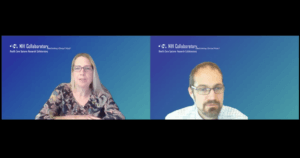
Speakers
Charles Bailey, MD, PhD
Department of Pediatrics
Perelman School of Medicine
University of Pennsylvania
Biomedical and Health Informatics
Children’s Hospital of Philadelphia
Keith Marsolo, PhD
Associate Professor
Department of Population Health Sciences
Duke Clinical Research Institute
Duke University School of Medicine
Keywords
PCORnet®; Data; Clinical Research Network; Patient-Centered Research; Common Data Model
Key Points
- PCORnet® is a clinical research network that connects communities (namely providers; researchers; patients, caregivers, and advocates) and data (EHR, claims, and patient-reported). It functions as a learning health system to help researchers generate answers that advance health outcomes.
- The network is made up of healthcare institutions, from large academic health centers to local community clinics. As of August 2025, PCORnet® had collated data from healthcare encounters in all 50 states, representing over 47 million people. There had been 57 PCORnet® studies and 991 publications supported by PCORnet® resources.
- To be useful, data have to be standardized across systems. Frequent data curation and a single language enabled by the PCORnet® Common Data Model (CDM) facilitates this. Data that are in the CDM and currently available for use in research include demographics, diagnoses, and vital signs. Data that may or may not be in the CDM and require additional work for research include immunizations, social determinants of health, and patient-reported outcomes.
- Quarterly, the PCORnet® team executes a data curation process. This includes a range of checks looking at data completeness; plausibility; persistence; and conformance to the PCORnet® CDM. Over the last decade, PCORnet® network performance has improved in terms of data mapping and latency.
- Researchers can approach the PCORnet® Front Door with both simple univariate and bivariate statistical questions – i.e. how often a particular medication is used within the PCORnet® population – and with prep-to-research queries, which may identify an eligible population and generate some information about how that population behaves.
- Once a team is running a PCORnet® study, they can submit queries for study-specific data extracts. This involves identifying a cohort and extracting patient-level data.
- In the near future, PCORnet® will include additional data visualization options to increase the ease of navigating complex results. The team is also working on a Query Tools repository that will show what other people have already asked about a given set of data.
- Because each study operates on specific variables and general characteristics do not predict specific characteristics, study-focused assessment of data fitness is critical.
- The presenters walked attendees through 5 different PCORnet® studies and how they utilized this data infrastructure in their projects.
Discussion Themes
There is no charge for Front Door queries; they are part of the research engagement process. However, prep-to-research queries are limited to those that can be turned around in a reasonable period of time; they don’t extend to statistical modeling or requests that involve asking sites to get new kinds of data. At the pilot level, researchers can execute custom queries that provide a deeper look at the data.
Linkage partners will depend on the needs of a study. For example, PCORnet® Studies have linked to claims data from Centers for Medicare & Medicaid Services, registries that collect lived experience information, and commercial vendors that perform specialty lab or image testing.
An advantage of using PCORnet® for pragmatic and prospective trials is the connection with the health system, local investigators, and data experts. These can serve as valuable resources during the design, recruitment, and analysis stages.
 In this Friday’s Rethinking Clinical Trials Grand Rounds, Charles Bailey of the University of Pennsylvania and Keith Marsolo of the Duke University School of Medicine will present
  In a new episode of the NIH Pragmatic Trials Collaboratory Podcast, Lesley Curtis and Keith Marsolo of the NIH Pragmatic Trials Collaboratory discuss the latest Living Textbook learning module,