Skip to content

COVID-19 Resources

Access the latest information on COVID-19 for clinical researchers
  • Home
  • About
    • NIH Collaboratory
      • Coordinating Center
      • NIH Collaboratory Trials
      • Core Working Groups
      • Steering Committee
      • Distributed Research Network
      • Our Impact
    • Living Textbook
      • Table of Contents
      • How to Use This Site
  • Resources
    • Data and Resource Sharing
    • Training Resources
    • Tools for Researchers
    • Publications
    • Knowledge Repository
  • Webinar
  • Podcast
  • News
    • News Feed
    • Calendar
    • Subscribe
return to home
Subscribe to Newsletter go to twitter feed go to linkedin go to blue sky feed
Search
NIH Collaboratory
Living Textbook of
Pragmatic Clinical Trials

COVID-19 Resources

Access the latest information on COVID-19 for clinical researchers
home button

Rethinking Clinical Trials

A Living Textbook of Pragmatic Clinical Trials

  • Design
    • What is a Pragmatic Clinical Trial?
    • Decentralized Pragmatic Clinical Trials
    • Developing a Compelling Grant Application
    • Experimental Designs and Randomization Schemes
    • Endpoints and Outcomes
    • Analysis Plan
    • Using Electronic Health Record Data
    • Building Partnerships and Teams to Ensure a Successful Trial
    • Intervention Delivery and Complexity
    • Patient Engagement
  • Data, Tools & Conduct
    • Assessing Feasibility
    • Acquiring Real-World Data
    • Assessing Fitness-for-Use of Real-World Data
    • Study Startup
    • Participant Recruitment
    • Monitoring Intervention Fidelity and Adaptations
    • Patient-Reported Outcomes
    • Clinical Decision Support
    • Mobile Health
    • Electronic Health Records–Based Phenotyping
    • Navigating the Unknown
  • Dissemination & Implementation
    • Data Sharing and Embedded Research
    • Dissemination Approaches for Different Audiences
    • Implementation
    • End-of-Trial Decision-Making
  • Ethics & Regulatory
    • Privacy Considerations
    • Identifying Those Engaged in Research
    • Collateral Findings
    • Consent, Disclosure, and Non-Disclosure
    • Data and Safety Monitoring
    • Ethical Considerations of Data Sharing in Pragmatic Clinical Trials
    • Ethics for AI and ML
    • IRB Responsibilities and Procedures

Introduction

CHAPTER SECTIONS

Acquiring Real-World Data


Section 1

Introduction

Expand Contributors

Keith A. Marsolo, PhD
Rachel Richesson, MS, PhD, MPH
W. Edward Hammond, PhD
Michelle Smerek, BS
Lesley Curtis, PhD

Contributing Editors
Karen Staman, MS
Damon M. Seils, MA

"Real-world data," as defined by the US Food and Drug Administration, are data relating to the health status of a patient or the delivery of healthcare services. Common sources of real-world data include electronic health records, administrative claims, patient-reported outcomes, patient-generated health data, and medical product and device registries, as well as databases relating to environmental factors or social determinants of health. Real-world data can be used to support a number of activities in pragmatic clinical trials, such as patient identification and recruitment, monitoring of outcomes, and ascertainment of endpoints.

Most real-world data are considered secondary data sources when used for research, because they were originally generated for another purpose and thus reflect the context of that activity (hence their "real-world" nature). Therefore, it is necessary to ensure that real-world data are fit for use before including them in a study. (See the Assessing Fitness for Use of Real-World Data Sources chapter of the Living Textbook.) This chapter outlines strategies for obtaining real-world data for use in research.

Next Section

SECTIONS

CHAPTER SECTIONS

sections

  1. Introduction
  2. Common Real-World Data Sources
  3. Data Formats
  4. Acquiring Electronic Health Record Data
  5. Acquiring Claims Data and CMS Research-Identifiable Files
  6. Acquiring Patient-Reported Data
  7. Gaining Permission to Use Real-World Data
  8. Methods of Access
  9. Case Study: The IMPACT-AFib Trial

Resources

The Big Picture: Healthcare Data and Interoperability
In this video module, Dr. Lesley Curtis explores how data flow into EHRs and move between systems, the role of data standards, and the barriers to building a more streamlined and connected healthcare system.
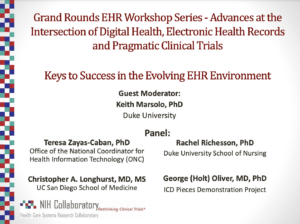

Screenshot from PCT Grand Rounds
Advances at the Intersection of Digital Health, Electronic Health Records, and Pragmatic Clinical Trials: Keys to Success in the Evolving EHR Environment
NIH Pragmatic Trials Collaboratory PCT Grand Rounds; June 26, 2020


Version History

December 3, 2025: Updated hyperlinks (changes made by G. Uhlenbrauck).

October 14, 2022: Made nonsubstantive changes to the text, added an image to the Resources sidebar, and added Seils as a contributing editor as part of the annual content update (changes made by D. Seils).

January 18, 2021: Added EHR Video module to the resource bar (changes made by K. Staman).

Published August 25, 2020.

current section :

Introduction

  1. Introduction
  2. Common Real-World Data Sources
  3. Data Formats
  4. Acquiring Electronic Health Record Data
  5. Acquiring Claims Data and CMS Research-Identifiable Files
  6. Acquiring Patient-Reported Data
  7. Gaining Permission to Use Real-World Data
  8. Methods of Access
  9. Case Study: The IMPACT-AFib Trial

Citation:

Marsolo KA, Richesson RL, Hammond WE, et al. Acquiring Real-World Data: Introduction. In: Rethinking Clinical Trials: A Living Textbook of Pragmatic Clinical Trials. Bethesda, MD: NIH Pragmatic Trials Collaboratory. Available at: https://rethinkingclinicaltrials.org/chapters/conduct/acquiring-real-world-data/introduction/. Updated December 3, 2025. DOI: 10.28929/178.

Footer Menu

  • How to Use This Site
  • About NIH Collaboratory
  • Enrollment Reporting
  • Grand Rounds
  • Funding Statement
Link to Twitter Link to LinkedIn Link to Blue Sky Link to NIH Collaboratory email

Reference in this Web site to any specific commercial products, process, service, manufacturer, or company does not constitute its endorsement or recommendation by the U.S. Government or National Institutes of Health (NIH). NIH is not responsible for the contents of any “off-site” Web page referenced from this server.

Log in
Privacy Statement
WordPress is a content management system and should not be used to upload any PHI as it is not an environment for which we exercise oversight, meaning you the author are responsible for the content you post. Please use this system accordingly. Site Map