 At the NIH Pragmatic Trials Collaboratory’s 2025 Annual Steering Committee Meeting, researchers discussed the obligations pragmatic trials researchers have to research participants, partnering healthcare systems, and each other after a trial is complete.
Panelists for the session included moderators Pearl O’Rourke and Jeremy Sugarman, cochairs of the NIH Collaboratory’s Ethics and Regulatory Core; Stephanie Morain, also from the Ethics and Regulatory Core; Hayden Bosworth from the Implementation Science Core; and Angelo Volandes, co–principal investigator for the ACP PEACE trial. They were joined by Andrea Cook from the BackInAction trial, Shruti Gohil from the INSPIRE trial, and Mike Ho from the Nudge trial and the Chat 4 Heart Health trial.
Morain introduced the ethical foundations for posttrial responsibilities, noting that the Declaration of Helsinki requires that “post-trial provisions must be arranged by sponsors and researchers to be provided…for all participants who still need an intervention identified as beneficial and reasonably safe in the trial.” The Declaration also states that “researchers have a duty to make publicly available the results of their research on human participants.”
Read more: Morain et al, “Post-Trial Responsibilities in Pragmatic Clinical Trials: Fulfilling the Promise of Research to Drive Real-World Change”
Bosworth encouraged attendees to think about sustainability as an integral part of the research process for pragmatic trials. “I may need to continue this intervention in some way, but that means I have to prepare for that even before I have the results,” he said.
Read more: Green et al, “Factors Affecting Post-trial Sustainment or De-implementation of Study Interventions: A Narrative Review”
Cook, Gohil, and Ho gave examples of how their research teams prepared for posttrial follow-up and implementation. In both BackInAction and INSPIRE, the investigators planned to provide cost-effectiveness information to the partnering healthcare systems to help them make the business case for sustaining the interventions. In Nudge, the investigators were working with partnering healthcare systems to understand how modifications to the intervention could improve adherence to future implementations.
Volandes shared his experience in the ACP PEACE trial, which tested a video decision aid for older patients with advanced cancer, by highlighting focus groups in which the study team asked trial participants what they felt the researchers owed to them after the study.
“They said, we love your tools but some don’t reflect who we are,” Volandes said. “So we went back and updated our tools to reflect the community served by the system, and to mention in the tool that this tool is a product of research conducted by patients in the community.
Volandes showed the modified video decision aid, which featured images and content to highlight that studies conducted in the healthcare system showed that participating patients found the tool to be helpful.
This summer, we are sharing highlights from the 2025 Annual Steering Committee Meeting. Access the complete collection of meeting materials.



 A
A  Even in minimal-risk studies that do not use the standard consent process, there may be value in informing participants about the research. Such notifications should be considered the default for clinical trials conducted under a waiver of informed consent, argue the authors of a new report from the NIH Pragmatic Trials Collaboratory.

 In an article
 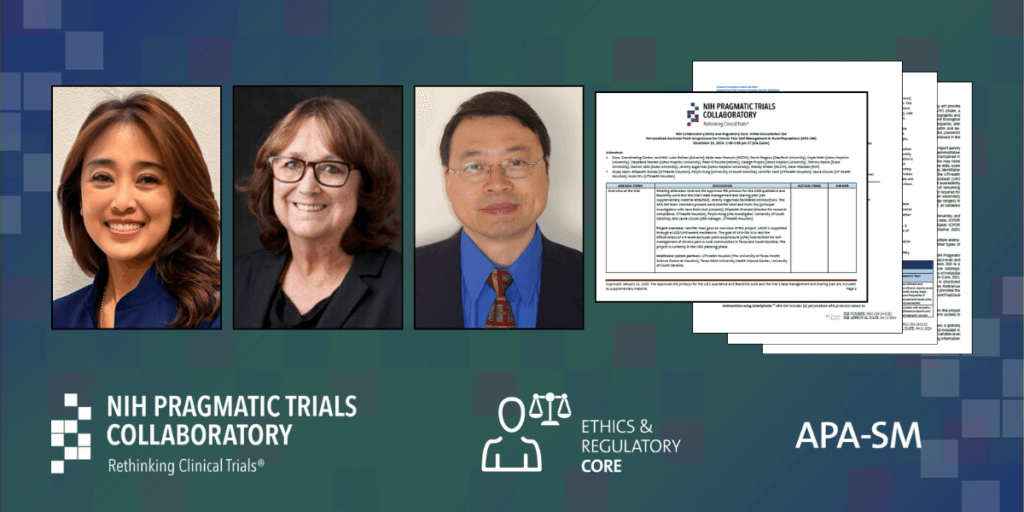 Ethics and regulatory onboarding documentation for one of the NIH Pragmatic Trials Collaboratory’s newest trials is now available. The documents include meeting minutes and supplementary materials summarizing recent discussions of ethics and regulatory issues associated with the APA-SM trial.
 In a new report from the NIH Pragmatic Trials Collaboratory, a team of bioethicists explores the ethical obligation to share aggregate results from pragmatic clinical trials with research participants. They conclude with recommendations for how to meet this obligation.