
February 24, 2026: Pragmatic Clinical Trials Offer Unique Opportunities to Study Implementation Processes and Outcomes

The interventions tested in pragmatic clinical trials are embedded into routine care practices, which offers opportunities to study implementation and sustainment outcomes.

In an article published online ahead of print in Implementation Science Communications, members of the NIH Pragmatic Trials Collaboratory’s Implementation Science Core share the results of a survey about the measurement of implementation outcomes in pragmatic trials.

Of the 32 NIH Collaboratory Trials, 29 completed the survey (91% response rate).

Main findings:

Across the trials, measurement was high for some constructs, including:

  • Reach (91%)
  • Adherence (76%)
  • Fidelity (93%)
  • Adaptations (69%)

However, evaluation for some constructs remains low:

  • Costs (31%)
  • Clinician adoption and representativeness (45%)
  • Anticipated sustainment (24%)
  • Actual sustainment (38%)

The authors suggest there is opportunity for growth in measuring some of these important implementation constructs.

“To benefit from the substantial investment into pragmatic clinical trials, we need to improve measurement of constructs that drive the implementation of evidence into routine care, including information about costs, sustainability, and sustainment,” the authors wrote.

Measurement of these constructs in future pragmatic trials could result in development of improved implementation strategies to increase the likelihood of effective implementation leading to equitable, sustainable, and scalable improvement in practice.

Read the full article.

For more information about implementation in pragmatic clinical trials, see the Living Textbook Chapter on Implementation.

January 27, 2026: Workshop Materials Available From ‘Dissemination and Implementation in Embedded Pragmatic Trials: Science-Powered Strategies to Sustain and Spread Effective Interventions’

Logo for the 18th Annual Conference on the Science of Dissemination and Implementation in HealthComplete materials are now available from the NIH Pragmatic Trials Collaboratory’s recent workshop, “Dissemination and Implementation in Embedded Pragmatic Trials: Science-Powered Strategies to Sustain and Spread Effective Interventions.”

The full-day workshop, held on December 14 at AcademyHealth’s 18th Annual Conference on the Science of Dissemination and Implementation in Health, introduced concepts in the design, conduct, and implementation of pragmatic clinical trials embedded in healthcare systems, with a focus on methods relevant to health services researchers. Presenters shared firsthand experiences and case studies from the NIH Collaboratory Trials. The learning objectives of the workshop included:

  • To identify areas of synergy between embedded pragmatic clinical trials and implementation research
  • To introduce participants to the unique characteristics and challenges of designing, conducting, and implementing pragmatic clinical trials embedded in diverse healthcare systems, and describe opportunities for integrating implementation research methods into these trials
  • To increase the capacity of health services researchers to address important clinical questions with embedded pragmatic clinical trials, and share lessons from implementation science for supporting intervention adoption, sustainment, scale-up, and/or deimplementation

Access the complete workshop materials, including slides, speaker biographies, and the full participant guide.

Grand Rounds September 19, 2025: Hurdles for the Delivery of Clinical Trials: Insights From the REMAP-CAP Trial in Europe (Denise van Hout, MD, PhD)

Speaker

Denise van Hout, MD, PhD
Postdoctoral Researcher
Julius Center for Health Sciences and Primary Care
University Medical Center Utrecht, the Netherlands

Keywords

Adaptive platform trial, Regulatory efficiency, REMAP-CAP, Study design, Study startup.

Key Points

  • Randomised Embedded Multifactorial Adaptive Platform trial for Community-Acquired Pneumonia (REMAP-CAP) began in 2016 as a data driven analysis of ethical, administrative, and logistical and ethical (EARL) delays in clinical trials studying respiratory infections. The goal was embedded trials that are flexible, efficient, and agile to provide clinicians with high-quality evidence to make the best treatment decisions.
  • REMAP-CAP is a global multifactorial adaptive platform trial with a master protocol that can investigate multiple interventions in different treatment domains for a single disease.
  • Over 8000 patients in REMAP-CAP were randomized to 44 interventions in 16 different treatment domains between January 2019 and June 2023. Patients could be randomized to more than 1 domain resulting in 15656 randomizations. Enrollment increased during the COVID-19 pandemic.
  • Dr. van Hout believes that to improve clinical trials, we should treat the challenges as a scientific problem and solve them with the same rigor.
  • Regulatory requirements and informed consent regulations differed among sites causing confusion for the researchers about what documents should be submitted with the contract and protocol in each country. Drug labeling requirements in some countries also slowed protocol approval. EARL processes also slowed trial initiation and patient enrollment.
  • It was clear that overall enrollment in the UK outpaced the other 257 sites worldwide. The UK had a shorter period of time to a fully signed study contract and protocol approval compared with sites in other countries (5 days in the UK compared with 183 days in non-UK countries). This quicker time to signed contract was accomplished by either accepting the contract as-is or rejecting the contract – without negotiating small details. The UK was also 3 months faster than non-UK countries at enrolling the first patient after study approval (1 month vs 4 months, respectively) leading to more enrollment and more research questions answered.
  • In January of 2022 the EU centralized regulatory submission to a single portal (CTIS) to ease and speed the process of starting a new trial.

Discussion Themes

Adaptive platform trials were uncommon before the COVID-19 pandemic, but their value became clear during the pandemic. After the pandemic, REMAP-CAP focuses on different treatment domains for pneumonia. Maintaining the infrastructure for an adaptive platform trial is difficult if there is not a clear need such as there was during the COVID-19 pandemic.

Centralizing approval for trials under one government body could speed the approval process for studies. During times of high need, prioritizing one or two good trials over a lot of smaller trials can also help speed the process.


Learn more about REMAP-CAP at https://www.remapcap.eu/

August 11, 2025: New Living Textbook Chapter Explores Implementation in Pragmatic Clinical Trials

The NIH Pragmatic Trials Collaboratory Implementation Science Core, led by Devon Check and Hayden Bosworth, has developed a new chapter on implementation to assist study teams with the complex process of using and studying implementation strategies to help implement research findings into clinical care. The chapter includes sections on:

Case studies are used to illustrate how pragmatic clinical trials embedded in healthcare systems use implementation frameworks, including examples from RAMP, BEST-ICU, STOP CRC, TSOS, ABATE, STEP-2, and GRACE.

For more, see our collection of chapters on Dissemination and Implementation, which includes chapters on Dissemination to Different Stakeholders, Data Sharing and Embedded Research, and End-of-Trial Decision-Making.

March 3, 2025: Intervention Complexity a Consistent Theme Across Pragmatic Trial Collaboratories

Headshot of Lindsay Ballengee
Lindsay Ballengee

In a survey of pragmatic clinical trials across 3 NIH research networks, the complexity of delivering nonpharmacological interventions was similar between pain-related trials and non–pain-related trials. However, pain trials tended to have more intervention components, add more new tasks, and require modifications to existing workflows.

The results of the study were published online ahead of print in Contemporary Clinical Trials Communications.

The researchers surveyed study team members from trials in the NIH Pragmatic Trials Collaboratory, the IMPACT Collaboratory, and the Pain Management Collaboratory. All 3 programs support pragmatic clinical trials embedded in healthcare systems, including trials of nonpharmacological interventions for pain.

Though the trials examined in the study had similar intervention complexity, pain trials had slightly greater complexity overall, and the study teams for these trials reported needing to make more adaptations in workflows during the trial to improve the intervention’s fit or effectiveness in real-world settings.

Read the full report.

“Change in workflow was an important consideration for intervention delivery for all trials in our study,” wrote lead author Lindsay Ballengee and her coauthors. “Future research should capture detailed, real-time information about the nature of intervention delivery complexity, adaptations, and implementation success to help improve delivery of nonpharmacologic pain interventions,” she wrote. Ballengee is a research fellow with the NIH Pragmatic Trials Collaboratory.

October 22, 2024: Registration Opens for Pragmatic Trials Workshop at AcademyHealth–NIH Dissemination & Implementation Conference

AcademyHealth D&I Conference logoThe NIH Pragmatic Trials Collaboratory will offer a full-day workshop at the 17th Annual Conference on the Science of Dissemination and Implementation in Health in Arlington, Virginia. The workshop, “Dissemination & Implementation in Embedded Pragmatic Trials: Getting the Timing Right in Real-World Research,” will introduce concepts in the design, conduct, and implementation of pragmatic clinical trials embedded in healthcare systems, with a particular focus on methods relevant to health services researchers.

The learning objectives of the workshop include:

  • To identify key areas of synergy between pragmatic trials and implementation research
  • To introduce attendees to the unique characteristics and challenges of designing, conducting, and implementing pragmatic clinical trials embedded within diverse health care systems, and to describe opportunities for integrating implementation research methods into pragmatic trials
  • To increase the capacity of health services researchers to address important clinical questions with embedded pragmatic clinical trials and share lessons from implementation science for supporting intervention adoption, sustainment, scale-up, and/or deimplementation

The theme of this year’s D&I conference is “Moving Fast and Slow: Optimizing the Pace of Implementation.” The annual conference is cohosted by the NIH and AcademyHealth.

WORKSHOP DETAILS AND REGISTRATION
Sunday, December 8, 10:00 am-6:00 pm
Crystal Gateway Marriott, Arlington, Virginia

October 3, 2024: JAMA Commentary Highlights Gap Between Research Results and Implementation Decisions

Headshots of Richard Platt, Hayden Bosworth, and Greg SimonIn a JAMA Viewpoint published online this week, leaders from the NIH Pragmatic Trials Collaboratory discuss the discordance between the results of pragmatic clinical trials and the implementation of those results in healthcare settings, even in settings that championed the work.
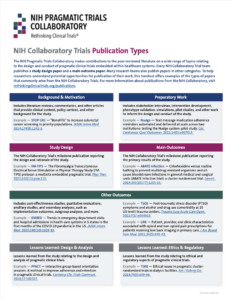
Coauthors Richard Platt, Hayden Bosworth, and Gregory Simon posit that, to provide evidence that healthcare systems leaders will actually use, changes are necessary:

  • Trials need to be faster (2 to 3 years)
  • Trials should consider outcomes that healthcare system leaders care about (such as costs and subgroup analyses)
  • The evidence required for change should be at the level that healthcare system leaders use (such as not necessarily rejecting the null hypothesis at P < .05 but also considering results of Bayesian methods and interim analyses)

Read the full article.

“We believe it is possible to make pragmatic clinical trials of policies and procedures more useful to delivery systems by accommodating their priorities, introducing flexibility in the level of evidence trials require, shortening the duration of planning and implementation, addressing system leaders’ interest in multiple outcomes and subgroup analyses, encouraging modification of protocols during the implementation phase, and by providing timely interim analyses that can guide decisions about continuing or modifying an intervention,” the authors wrote.

This work was based on an NIH Pragmatic Trials Collaboratory workshop held in 2023, Getting the Right Evidence to Decision-Makers Faster. The workshop explored the critical cycle of evidence generation to decision by healthcare system leaders to implement the findings of pragmatic clinical trials conducted within healthcare systems.

Platt is a cochair of the NIH Collaboratory’s Distributed Research Network and the Harvard Pilgrim Health Care Institute Distinguished Professor of Population Medicine at the Harvard Pilgrim Health Care Institute and Harvard Medical School. Bosworth is a cochair of the Implementation Science Core and a professor in population health sciences at Duke University. Simon is the chair of the Health Care Systems Interactions Core and a senior investigator at the Kaiser Permanente Washington Health Research Institute.

View the full workshop materials.

Grand Rounds July 26, 2024: Interventions for Optimization of Guideline-Directed Medical Therapy for Heart Failure (Gregg C. Fonarow, MD, FACC, FAHA, FHFSA)

Speaker

Gregg C. Fonarow, MD, FACC, FAHA, FHFSA
Eliot Corday Professor of Cardiovascular Medicine and Science
Director, Ahmanson-UCLA Cardiomyopathy Center
Codirector, UCLA Preventative Cardiology Program
UCLA Division of Cardiology

Keywords

Heart failure; HFrEF; guideline-directed medical therapy; implementation; systematic review

Key Points

  • Despite the availability of effective therapies for heart failure (HF), a large number of eligible patients are not receiving one or more evidence-based, guideline-recommended therapies. This implementation gap has stymied improvements in morbidity and mortality.
  • The benefits of evidence-based heart failure medications are cumulative. If all therapies are used, there is a relative risk reduction of 74.0% and an absolute risk reduction of 25.9%. Simultaneous or rapid initiation of therapies reduces HF hospitalizations, rehospitalizations, and mortality.
  • Reasons for underutilization of Guideline-Directed Medical Therapy (GDMT) for heart failure include a lack of systems to reliably implement therapies; gaps in knowledge and awareness of guidelines; therapeutic inertia; and insufficient urgency.
  • Dr. Fonarow’s team conducted a systematic review of interventions for the optimization of GDMT, including 28 randomized clinical trials with an aggregate sample of over 19,000 patients. They found that the initiatives that used interdisciplinary teams, largely comprised of nurses and pharmacists, most consistently led to improvements in GDMT. Clinician education, electronic health record initiatives, and patient interventions, on the other hand, resulted in no or modest improvements in GDMT.
  • Implementation of GDMT needs to improve in all clinical settings. Programs that successfully implement GDMT often have access to current and accurate data on treatment outcomes; administrative and clinician support; use care maps and pathways; and use data to provide feedback. There is also a need for further implementation science innovation and testing.


Discussion Themes

– Do you still see lack of education as a major problem that needs to be approached differently, or should we really be focusing on something else? I do think it need to be further studied. I think our educational efforts around the clinician need to center on the really practical aspects, on what the common pitfalls are in trying to apply and uptitrate these medications. Interdisciplinary teams and cross-discipline education are critically important. [The study results] don’t mean that education shouldn’t be part of further interventions, but I think we need to look at what’s truly going to see a meaningful increase in medication titration and persistence of GDMT.

The polypill could address some of the clinical inertia issues and patient resistance. Patients hate it when you keep adding on four different medications and you’re increasing the doses. Is it being studied in this context? There is work going on, editorials have been written about it, the concept has been laid out. There are small pilot studies that have been done. There are challenges; is titration necessary? You’ll need a series of polypills to uptitrate, or you’ll get the therapy started and then you’ll bring them together as a polypill. One thing I do want to highlight, though, is that starting medications simultaneously defeats that patient question of, “Why are you adding this extra medication? Are the prior medications not working?” It’s a different mindset upfront: “Here are these four medications you’re going to be on.”


Tags

#pctGR, @Collaboratory1

May 16, 2024: Journal Peer Reviewers Are Familiar With Pragmatic Trials, Want More on Implementation

According to a report from the NIH Pragmatic Trials Collaboratory Coordinating Center, journal editors and peer reviewers were familiar with pragmatic clinical trials and their designs and analytic approaches, but they often asked for more information about intervention implementation.

The report was published this week in the Living Textbook of Pragmatic Clinical Trials.

The report’s authors invited the principal investigators of the first several completed NIH Collaboratory Trials to confidentially share the journal peer reviews of manuscripts reporting the trials’ main outcomes. They independently reviewed the peer reviews of the manuscripts to note common questions and themes.

“We did not generally observe that reviewers were unfamiliar with pragmatic clinical trials or had difficulty understanding the design and analytic approaches of the studies,” the authors reported. Instead, they found that the reviewers in many cases requested more information about implementation outcomes, implementation strategies, and intervention content.

Although many of the NIH Collaboratory Trial teams have published separate implementation-focused papers, the report suggests that reviewers may want or expect some of this information to be included with the report of primary study outcomes to aid in the interpretation of results.

Read the full report.

May 13, 2024: Ongoing Funding Opportunity Supports Studies of Implementation and Sustainability of Interventions

NIH logoAn ongoing funding opportunity from the National Institutes of Health (NIH) is supporting dissemination and implementation research in health. The purpose of the funding opportunity is “to support studies that will identify, develop, and/or test strategies for overcoming barriers to the adoption, adaptation, integration, scale-up, and sustainability of evidence-based interventions, practices, programs, tools, treatments, guidelines, and policies.”

Posttrial sustainment and deimplementation of study interventions has been a focus of the NIH Collaboratory’s Implementation Science Core. In a recent article, investigators from 6 of the program’s completed pragmatic clinical trials summarized the posttrial interpretation of their trials’ results and considered the factors that influenced the sustainment or deimplementation of the studies’ interventions.

The article was published early this year in the Journal of General Internal Medicine.

Three lessons emerged from the review:

  • Ineffective interventions may be sustained if they have other measured or perceived benefits.
  • Effective interventions may not be sustained if they require significant resources.
  • Alignment with policy incentives is essential for achieving sustainment and scale-up of effective interventions.

Read about the NIH funding opportunity for research that supports the dissemination and implementation of evidence-based interventions.