

October 15, 2024: Case Study Describes a Reassessment of Sample Size in an Ongoing Cluster Randomized Trial

FM-TIPS logoA new case study from the NIH Pragmatic Trials Collaboratory highlights an interim reassessment of sample size during an ongoing cluster randomized trial. The case study was published this week in the Living Textbook of Pragmatic Clinical Trials.

Researchers in cluster randomized trials must account for potential correlation between clusters in the design and analysis of their trial by estimating the intraclass correlation when calculating the target sample size. Often they use preliminary data from the planned enrollment sites to estimate the correlation. However, when preliminary data are unavailable at the time of study design, they may use interim data collected during the trial itself to reassess the trial’s sample size.

The contributors of the case study focus on FM-TIPS, an NIH Collaboratory Trial, to describe an approach to conducting an interim reassessment of sample size in an ongoing trial. Read the full case study.

FM-TIPS is examining whether the addition of transcutaneous electrical nerve stimulation to routine physical therapy improves movement-evoked pain compared with physical therapy alone among patients with fibromyalgia. The trial is supported by the National Institute of Arthritis and Musculoskeletal and Skin Diseases through the NIH HEAL Initiative. Learn more about FM-TIPS.

The contributors of the case study include members of the FM-TIPS study team and leaders of the NIH Collaboratory’s Biostatistics and Study Design Core. David-Erick Lafontant is a statistician, Bridget Zimmerman is a clinical professor of biostatistics, and Emine Bayman is an associate professor of biostatistics—all at the University of Iowa. Megan McCabe is an assistant professor of biostatistics at the University of Alabama at Birmingham. Patrick Heagerty is a professor of biostatistics at the University of Washington. Liz Turner is an associate professor of biostatistics and bioinformatics at Duke University.

August 19, 2024: Ethics Core and Biostatistics Core Guide Newest Trials Through Planning Phase

Leaders of 2 of the NIH Pragmatic Trials Collaboratory’s long-standing Core Working Groups recently shared updates from their work with the newest cohort of NIH Collaboratory Trials. We spoke with them during the NIH Collaboratory’s 2024 Annual Steering Committee Meeting in May.

Over the last year, the Ethics and Regulatory Core engaged in a formal onboarding process with the program’s 9 newest pragmatic trials, consulting with the investigators about their trial planning and implementation. Cochairs Stephanie Morain and Pearl O’Rourke summarized several of the ongoing and emerging challenges.

“One of the challenges we’re continuing to see is understanding what are the appropriate duties that institutions and investigators have in the context of a [pragmatic clinical trial],” said Morain. “One concrete area is in data and safety monitoring. What kinds of issues need to be monitored as adverse events? How do we think about them as being related to the trial vs relating to the background care?” she added.

Onboarding documentation from the Ethics and Regulatory Core’s consultations with the NIH Collaboratory Trials is available on our Data and Resource Sharing page.

We also spoke with Liz Turner and Patrick Heagerty, cochairs of the Biostatistics and Study Design Core. They have spent the past year advising the NIH Collaboratory Trial investigators on key study design challenges.

“Many of these studies have individually randomized patients but then they’re studying implementation pathways when they implement through a specific person that puts them in groups—these are individually randomized group treatment trials,” said Heagerty. “Several of the studies didn’t see that, and so we helped them see it and we helped them work through how to adapt their analysis and modify their sample size work to ensure the trial was properly sized,” he explained.

In addition to consultations with the NIH Collaboratory Trials, the Biostatistics and Study Design Core continues to develop and innovate pragmatic trials methodology.

Learn more about the Core Working Groups.

November 29, 2023: Special Biostatistics Series Continues With Guidelines for Stepped-Wedge Trials

In this Friday’s PCT Grand Rounds, Jim Hughes of the University of Washington will continue our special series, Advances in the Design and Analysis of Pragmatic Clinical Trials, with his presentation, “Guidelines for Design and Analysis of Stepped-Wedge Trials.” The session will be held on Friday, December 1, at 1:00 pm eastern.

Hughes is a professor emeritus of biostatistics at the University of Washington. This session’s moderator, Patrick Heagerty, is a professor of biostatistics at the University of Washington and a cochair of the NIH Pragmatic Trials Collaboratory’s Biostatistics and Study Design Core.

Join the online meeting.

This special Grand Rounds series will include additional moderated webinar discussions that bring together biostatisticians, clinical trials methodologists, and investigators to discuss challenges and share lessons learned in the design, implementation, and analysis of pragmatic trials. Download the series flyer and see the full schedule below.

All sessions are free and open to the public; no registration is required.

Grand Rounds Biostatistics Series December 1, 2023: Guidelines for Design and Analysis of Stepped-Wedge Trials (Jim Hughes, PhD; Moderator: Patrick Heagerty, PhD)

Speaker: James P. Hughes, PhD
Professor Emeritus of Biostatistics, University of Washington

Moderator: Patrick J. Heagerty, PhD
Professor of Biostatistics, University of Washington

Topic: Guidelines for Design and Analysis of Stepped-Wedge Trials

Date: Friday, December 1, 2023, 1:00-2:00 p.m. ET

To join the online meeting:

Click the Zoom Meeting link below:
https://duke.zoom.us/j/97816533886?pwd=MnRQUUVpTnpnZnF6MTFIdmRkazJpZz09
Meeting ID: 978 1653 3886
Passcode: 551930

One tap mobile

+13092053325,,97816533886#,,,,*551930# US
+13126266799,,97816533886#,,,,*551930# US (Chicago)
Find your local number: https://duke.zoom.us/u/awmkz1RlD

Audio Dial in Options

US:  1-309-205-3325
International: https://duke.zoom.us/u/abvw6X2hYV

Meeting ID: 978 1653 3886
Passcode: 551930

August 16, 2022: Biostatistics Core Develops Tools and Strategies for Common Research Challenges

Head shot of Dr. Patrick HeagertyHead shot of Dr. Liz TurnerIn an interview at the NIH Pragmatic Trials Collaboratory’s annual Steering Committee meeting and 10th anniversary celebration, we asked Dr. Liz Turner and Dr. Patrick Heagerty to reflect on the role of the Biostatistics and Study Design Core Working Group in helping the NIH Collaboratory Trial teams design their trials and analyze the data, and to discuss their focus for the Core's future contributions to pragmatic clinical trials.

Based on your experience working with the NIH Collaboratory Trials, what are some of the common challenges of the Core?

Given the pragmatic nature of the NIH Collaboratory Trials, most use a design that involves some kind of clustering of outcomes. This could be a cluster randomized design or an individually randomized group treatment trial. As a consequence, nearly all projects face the challenge of how to account for clustering in both the design and analysis of the trial.

For the NIH Collaboratory Trials that use a cluster randomized design, one of the most common challenges is deciding between a stepped-wedge design and a standard parallel-arm design. The Core’s recommendation is clear: only use a stepped-wedge design if you have to! Likewise, only use a cluster randomized design if you have to and, if possible, use an individually randomized design. Nevertheless, a cluster randomized design is often the design of choice to address a pragmatic research question, and a stepped-wedge cluster randomized design may be the only way to perform a randomized evaluation of an intervention (for example, when all centers wish to receive the intervention in order to agree to participate in the trial).

From an analysis perspective, common challenges involve how to handle missing outcome data and how to handle longitudinal (that is, repeated) measures data. For both design and analysis, as you can imagine, the COVID-19 pandemic has posed huge challenges, including how to handle the disruption of an ongoing stepped-wedge trial (as in the GGC4H NIH Collaboratory Trial). In short, clustering of outcomes is the biggest theme (and challenge) across the NIH Collaboratory Trials.

What strategies have NIH Collaboratory Trials used to overcome these barriers?

A common strategy used by the NIH Collaboratory Trials to overcome these barriers has been to leverage what we call the “Core group process.” This dynamic process is driven by the NIH Collaboratory Trials and supported by the Core, together with NIH Collaboratory leadership. The process is centered around the monthly Core meeting to which all NIH Collaboratory Trial teams are invited and that involves all Core members. These meetings provide dedicated time for each study team to provide project updates and elicit feedback from the Core and the other NIH Collaboratory Trial teams. In particular, all the study teams are invited to present at least once during the UG3 planning phase and on multiple occasions during the UH3 implementation phase. Core members are also available for ad hoc, smaller group meetings, as requested. What this process allows is for the NIH Collaboratory Trials to present challenges and for us to jointly identify solutions.

How are the NIH Collaboratory Trials’ experiences with the Core helping the field of pragmatic research?

Through the challenges and ideas that have been brought to the Core, the NIH Collaboratory Trials have pushed the field of pragmatic research. In particular, through the Core group process, they have pushed the Core to solve methodological challenges and provide tools to tackle the design issues that arise in the changing research landscape.
Thumbnail image of the COVID-19 checklist

A key example of the Core’s methodological work was inspired by the STOP CRC NIH Collaboratory Trial and is related to the design and analysis choices faced in the unique context of embedded pragmatic trials. This example addresses a common challenge in embedded pragmatic trials, namely how to handle varying cluster sizes, something that arises in so many of the NIH Collaboratory Trials. The research, recently published in Contemporary Clinical Trials, highlights that a seemingly natural analysis in this context may produce a biased inference about intervention effectiveness, which is clearly problematic.

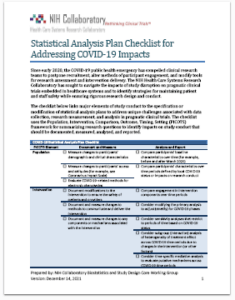
The second example is the Core’s recently published Statistical Analysis Plan Checklist for Addressing COVID-19 Impacts. Development of this tool was inspired by the many challenges faced by the NIH Collaboratory Trials as a result of the COVID-19 pandemic, such as delayed recruitment (as in the BackInAction NIH Collaboratory Trial) and adjustments to how interventions were delivered (as in the ACP PEACE NIH Collaboratory Trial).

What do you think the Core can contribute over the next decade?

The Core has a lot to contribute over the next decade. A key goal is to ensure we are building and diversifying the next generation of statisticians who are experts in pragmatic trials and who can engage deeply in the design and analysis of pragmatic trials embedded in healthcare systems.

To achieve this, we need to continue to bring trainees into the Core, as we have done over the past 6 years, through funded graduate research assistant positions. By doing this, we should be able to not only build the next generation of pragmatic trial experts but also build scholarship in pragmatic trial methodology by identifying methodological gaps needed to be filled so the NIH Collaboratory Trials study teams—and pragmatic trialists in the broader research community—have the best methods available to them.

The opportunity to participate in a cross-institution working group such as ours is surprisingly rare. As a consequence, we are in a unique position to not only build the next generation of experts but also to strength our own collective expertise and knowledge by learning from each other’s perspectives.

December 16, 2021: NIH Collaboratory Publishes COVID-19 Checklist for Statistical Analysis Plans in Pragmatic Trials

Thumbnail image of the COVID-19 checklistA new tool from the NIH Collaboratory assists investigators in identifying impacts of the COVID-19 public health emergency on ongoing pragmatic clinical trials. The Statistical Analysis Plan Checklist for Addressing COVID-19 Impacts summarizes impacts on trial conduct that study teams should document, measure, analyze, and report.

The new checklist was developed by the NIH Collaboratory’s Biostatistics and Study Design Core Working Group. Since the beginning of the COVID-19 pandemic, many of the NIH Collaboratory Trials have had to postpone recruitment, alter methods of participant engagement, and modify tools for research assessment and intervention delivery.

The leaders of the Biostatistics Core, Dr. Patrick Heagerty and Dr. Liz Turner, spoke in a recent interview about the impacts of the pandemic on the NIH Collaboratory Trials. Early next year, the Coordinating Center will report the results of a survey of the study teams about their experiences with these impacts.

Download the Statistical Analysis Plan Checklist for Addressing COVID-19 Impacts.

August 26, 2021: Li Receives PCORI Award to Study Methods for Cluster Randomized Trials

Headshot of Dr. Fan Li
Dr. Fan Li

Dr. Fan Li, a longtime member of the NIH Collaboratory’s Biostatistics and Study Design Core, has received approval for a $1 million grant award from the Patient-Centered Outcomes Research Institute (PCORI) to develop methods and software for designing cluster randomized trials. Li is an assistant professor of biostatistics in the Yale School of Public Health.

The study, entitled “New Methods for Planning Cluster Randomized Trials to Detect Treatment Effect Heterogeneity,” will contribute new methods, guidance, and user-friendly software for planning parallel and stepped-wedge cluster randomized trials to enable confirmatory “heterogeneity of treatment effect” (HTE) analyses with sufficient statistical power.

HTE occurs when there is systematic variation in treatment effect across predefined patient or provider subgroups that can arise due to diverse practices, varying responses to treatment, or differing vulnerability to certain diseases, among other reasons. While understanding of HTE has been a recognized goal in individually randomized trials, methods for planning cluster randomized trials with HTE analyses are limited. This PCORI-funded study will expand the current cluster randomized design toolbox to accommodate confirmatory HTE analysis and meet a growing interest in better understanding how patient- and provider-level characteristics moderate the impact of new care innovations in pragmatic trials.

The award has been approved pending completion of a business and programmatic review by PCORI staff and issuance of a formal award contract.

Joining Li on the research team are coinvestigators Dr. Patrick Heagerty of the University of Washington, Dr. Rui Wang of Harvard Medical School and the Harvard Pilgrim Health Care Institute, and Dr. Denise Esserman of the Yale School of Public Health. Heagerty and Wang are members of the NIH Collaboratory’s Biostatistics and Study Design Core. The team will work closely with other NIH Collaboratory colleagues and stakeholders, including Dr. Adrian Hernandez of Duke University, Dr. Jerry Jarvik of the University of Washington, and Dr. Richard Platt of Harvard Medical School and the Harvard Pilgrim Health Care Institute.

August 19, 2021: Biostatistics Core Helps Projects ‘Roll With the Punches’ of the Pandemic

Leaders of the NIH Collaboratory’s Biostatistics and Study Design Core Working Group spoke in a recent interview about the impacts of the COVID-19 pandemic on the NIH Collaboratory Trials, including the 2 newest projects, BeatPain Utah and GRACE.

“BeatPain Utah and GRACE are fascinating studies, as all our NIH Collaboratory Trials are, and are giving us lots of food for thought at the Biostatistics Core,” said Dr. Liz Turner, associate professor of biostatistics and bioinformatics at Duke University and a cochair of the Core. View the full video.

The 2 studies “have been pretty well positioned to roll with some of the distancing required or the lack of in-person visits,” said Dr. Patrick Heagerty, professor of biostatistics at the University of Washington and the other cochair of the Core. “The BeatPain project had a remote delivery from the beginning, so I think the impact of COVID was not as dramatic as it’s been for other projects. But GRACE, where acupuncture is part of it, they have to figure out what are the elements of the research protocol they can do remotely but still need to get folks in person to do that acupuncture,” Heagerty said.

“There really have been some considerable challenges for several of the other NIH Collaboratory Trials,” said Turner. “Good examples of these challenges are those faced by 2 stepped-wedge cluster randomized trials, ACP PEACE and PRIM-ER. …They had to really restructure the design and respond very quickly to what was happening in practice out in the field. Interestingly, on the flip side, the disruptions last spring in 2020 did provide opportunities to address other research questions and perhaps generate other interesting evidence,” Turner said.

(Learn more about the ACP PEACE study’s COVID-19 supplement: “Can a Primary Care Telehealth Intervention Change the Paradigm for Advance Care Planning?”)

Heagerty and Turner also described ongoing projects of the Core to support pragmatic research, including guidance on longitudinal analysis in randomized trials, considerations for studies with multiple outcomes, and handing of studies with variable cluster sizes. Learn more about the Biostatistics and Study Design Core.


Screen shot of interview with Patrick Heagerty and Liz Turner