


Decentralized Pragmatic Clinical Trials
Section 1
What Is a Decentralized Trial?
A decentralized trial is a “clinical study in which some or all of the study-related activities occur at a location separate from the investigator’s location,” according to the Food and Drug Omnibus Reform Act (Consolidated Appropriations Act 2023). Aspects of a clinical trial that can be decentralized include participant engagement, recruitment, consent, study interventions and procedures, collection of patient-reported outcomes, and follow-up. Most NIH Collaboratory Trials have decentralized elements, as we describe in more detail in Section 2.
In a decentralized trial, trial-related activities may take place at other locations besides a centralized trial site, such as the home, a local pharmacy, community centers, local providers offices, and mobile units. In this sense, these trials are “centralized” around the patient and not a specific site. This can potentially make it easier for people to participate, especially those in rural areas or with transportation barriers.
Over the past several years, a variety of factors have accelerated the need for decentralized trials, including:
- COVID-19
- A push to make trials more accessible
- Increased speed of science
- Greater desire for environmentally conscious trials
- Need to be flexible in a rapidly changing world
Fully remote trials have no visits to a site, and all aspects of the trial are conducted remotely. For example, the ADAPTABLE study (Johnston et al 2016), conducted through PCORnet, aimed to find the best aspirin dose to prevent heart attacks and strokes in people living with heart disease. The study used the electronic health record (EHR) to identify patients to approach for the trial. Patients provided consent through an electronic portal, bought their own aspirin, and longitudinal patient-reported outcomes were collected directly from participants via a web portal.
Trials can also be partially decentralized, using a hybrid approach where one or more aspects of the trial are conducted remotely. Such remote methods include telehealth visits, remote collection of patient-reported outcome measures, and connected sensors or wearable devices (Tenaerts et al 2024).
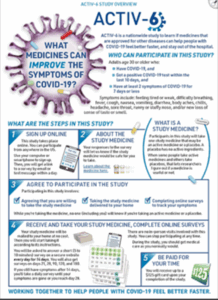
ACTIV-6 is an example of a decentralized trial with a hybrid or “click and mortar” approach (ACTIV-6 Study Group 2023). The trial focused on two questions about patients with COVID-19:
- How do we help people feel better faster?
- How do we prevent hospitalizations or death?
Patients were identified through study sites or could self-identify by calling a hotline or via the study website. Recruitment materials included a flyer, brochure, study website, and other websites such as government COVID-19 websites. All study medications were mailed, but patients could choose to receive them and be seen in the clinic or remotely, based on their preferences. The trial enrolled patients from all 50 states, and 26,000 patients engaged with the online portal.
ACTIV-6 Informational Flyer
Decentralized trials are enabled by digital health technologies and local providers. Digital health technologies that support decentralized trials include electronic consent, telehealth, mobile devices, EHR-based web portals, and remote patient monitoring technologies. Local providers can include home health nurses, primary care physicians, and local pharmacies. These local providers can all play a role in moving a trial into a patient’s community (Regan-Udall Foundation 2023).
Decentralized trials are not only more convenient for trial participants, but they can even provide a positive return on investment for the trial by reducing overhead and creating efficiencies. However, there are special considerations to ensure safe and accurate conduct of these trials in such a way that all populations can benefit from them. This space is evolving and will require continued discussion, guidance, and sharing.
During the COVID-19 pandemic, several regulatory authorities around the world introduced guidance on decentralized trials. The US Food and Drug Administration (FDA) guidance provides information about decentralized trial design, remote trial visits, digital health technologies, roles and responsibilities, informed consent, and institutional review board oversight (US Department of Health and Human Services 2024). It also suggests that additional considerations are needed for the data management plan, monitoring plan, safety plan, task log, and case report forms in these trials.
The European Medicines Agency (EMA) guidance (European Medicines Agency 2022) emphasizes the importance of the patient voice and features an extensive discussion on the need for investigator oversight.
This chapter will cover the decentralized elements that are used in pragmatic clinical trials (PCTs), community health considerations, and the vigilance needed to assure data quality, particularly as it relates to adherence with the study drug, outcomes ascertainment, and event monitoring.
SECTIONS
Resources
FDA Guidance: Decentralized Clinical Trials for Drugs, Biological Products, and Devices

CTTI Recommendations for Planning Decentralized Trials
REFERENCES
European Medicines Agency. 2022. Recommendation Paper on Decentralised Elements in Clinical Trials. https://health.ec.europa.eu/system/files/2023-03/mp_decentralised-elements_clinical-trials_rec_en.pdf. Accessed July 2025.
Johnston A, Jones WS, Hernandez AF. 2016. The ADAPTABLE trial and aspirin dosing in secondary prevention for patients with coronary artery disease. Curr Cardiol Rep. 18(8):81. doi: 10.1007/s11886-016-0749-2. PMID: 27423939.
Reagan-Udall Foundation. Good Clinical Practice: Considerations for Trials with Pragmatic or Decentralized Feature. https://reaganudall.org/news-and-events/events/good-clinical-practice-considerations-trials-pragmatic-or-decentralized. Accessed January 2024.
Tenaerts P, Hernandez AF, Lipset C. 2024. Clinical trial site readiness for decentralized trials – fitting trials into today’s world. J Clin Trans Sci. 8(1):e43. doi:10.1017/cts.2024.17. PMID: 38476244.
The Accelerating Covid-19 Therapeutic Interventions and Vaccines (ACTIV)-6 Study Group. 2023. ACTIV-6: Operationalizing a decentralized, outpatient randomized platform trial to evaluate efficacy of repurposed medicines for COVID-19. J Clin Trans Sci. 7(1):e221. doi:10.1017/cts.2023.644. PMID: 38028354.
US Department of Health and Human Services. 2024. Conducting Clinical Trials With Decentralized Elements Guidance for Industry, Investigators, and Other Interested Parties. https://www.fda.gov/media/167696/download. Accessed July 2025.
United States Congress. Consolidated Appropriations Act, 2023. https://www.congress.gov/117/bills/hr2617/BILLS-117hr2617enr.pdf. Accessed September 2025.
ACKNOWLEDGEMENTS
The Ethics and Regulatory Core Working Group of the NIH Collaboratory contributed to this work through discussions and edits to the text. Key contributors include Pearl O'Rourke, Joseph Ali, and Jeremy Sugarman.