Welcome the new UG3 and R01 NIH Collaboratory Trials; provide introductions and an overview of the NIH Collaboratory program; hear from the new UG3 and R01 project teams; and discuss lessons learned from the seasoned NIH Collaboratory Trial investigators.
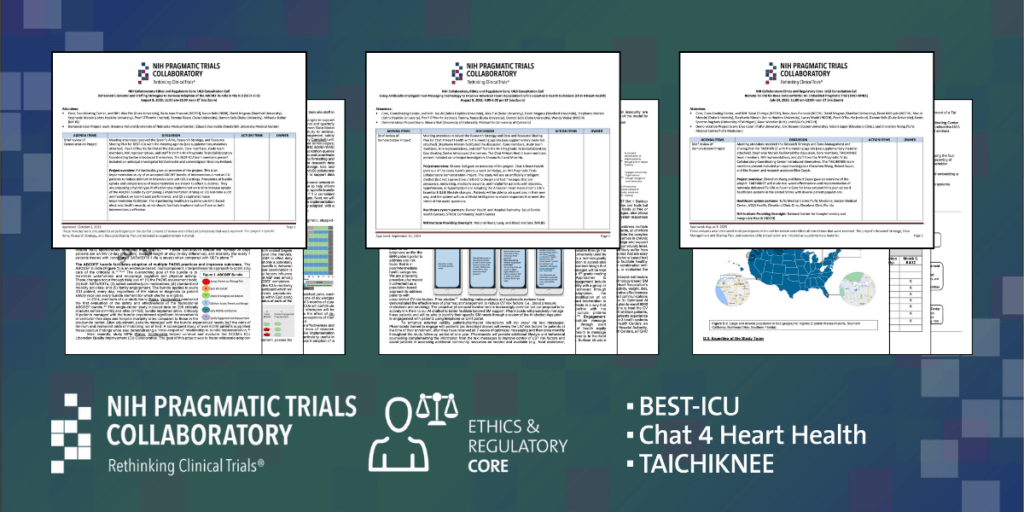
Ethics and regulatory onboarding documentation for the NIH Pragmatic Trials Collaboratory’s newest NIH Collaboratory Trials is now available. The documents include meeting minutes and supplementary materials summarizing recent discussions of ethics and regulatory issues associated with the BEST-ICU, Chat 4 Heart Health, and TAICHIKNEE studies.
The consultations took place by video conference and included representation from the studies’ principal investigators, members of the NIH Collaboratory’s Ethics and Regulatory Core, NIH staff, and NIH Collaboratory Coordinating Center personnel. All of the projects are in their 1-year planning phase.
BEST-ICU will explore the prevention of health impairments exacerbated by health disparities in the intensive care unit (ICU) through the application of the ABCDEF bundle, a multicomponent, evidence-based intervention to improve team-based care. The objective of the study is to evaluate 2 strategies grounded in behavioral economic theory and implementation science to increase ABCDEF bundle adoption and, in turn, address known health disparities in the ICU.
Chat 4 Heart Health will use a patient-level randomized pragmatic trial to test the comparative effectiveness of 3 text messaging delivery strategies that have been shown to improve individuals’ self-management health behaviors, including physical activity and medication adherence. The study findings will provide evidence regarding the best population-based strategy for universal delivery to engage all patients with health disparities in self-management to improve the American Heart Association’s “Life’s Essential 8” measures for improving and maintaining cardiovascular health.
TAICHIKNEE will compare the effects of web-based tai chi interventions versus routine care for individuals experiencing knee pain due to osteoarthritis. The practice of tai chi integrates physical, psychosocial, and behavioral components and has exhibited clinically significant improvements in chronic knee osteoarthritis pain conditions. The results of the study will inform widespread adoption of mind-body approaches for knee osteoarthritis, which affects more than 32.5 million individuals in the United States, across healthcare systems.
We are excited to welcome I CAN DO Surgical ACP (Improving Completion, Accuracy, and Dissemination of Surgical Advanced Care Planning) to our portfolio of innovative NIH Collaboratory Trials. This project is supported within the NIH Pragmatic Trials Collaboratory by a grant from the National Institute on Aging (NIA).
Despite advance care planning (ACP) being incorporated into national quality metrics and society guidelines for surgical care for older adults, effective integration of ACP into the presurgical phase remains uncommon. Efforts to date have mostly focused on improving surgeons' use of ACP, but barriers remain significant, including lack of ACP familiarity, lack of appropriate patient-facing ACP tools, and lack of time dedicated to conversations around ACP during the presurgical period.
The I CAN DO Surgical ACP team has designed and tested a theory-based, interactive ACP patient-facing technology solution (PREPARE) based on the new ACP paradigm of preparing people for communication and medical decision-making. By including PREPARE in the electronic health record presurgery workflow for older adults and including automated reminders, the team expects that they can empower patients and surgical teams to engage in ACP discussions. The results of this study are the first step in ensuring optimal and patient-aligned medical decisions and communications for older adults undergoing surgery.
Dr. Elizabeth Wick, Dr. Genevieve Melton-Meaux, and Dr. Rebecca Sudore will serve as the co–principal investigators for I CAN DO Surgical ACP. Dr. Wick is a colorectal surgeon at the University of California, San Francisco Medical Center. Dr. Melton-Meaux is a professor of surgery, the senior associate dean of health informatics and data science, and the director of the Center for Learning Health System Sciences in the Institute for Health Informatics at the University of Minnesota. Dr. Sudore is a professor of medicine, the director of the Innovation and Implementation Center in Aging and Palliative Care, and a geriatrician at the University of California, San Francisco.
This new NIH Collaboratory Trial is the third trial in the NIH Collaboratory portfolio to study an intervention designed to improve ACP, following PROVEN and ACP PEACE.
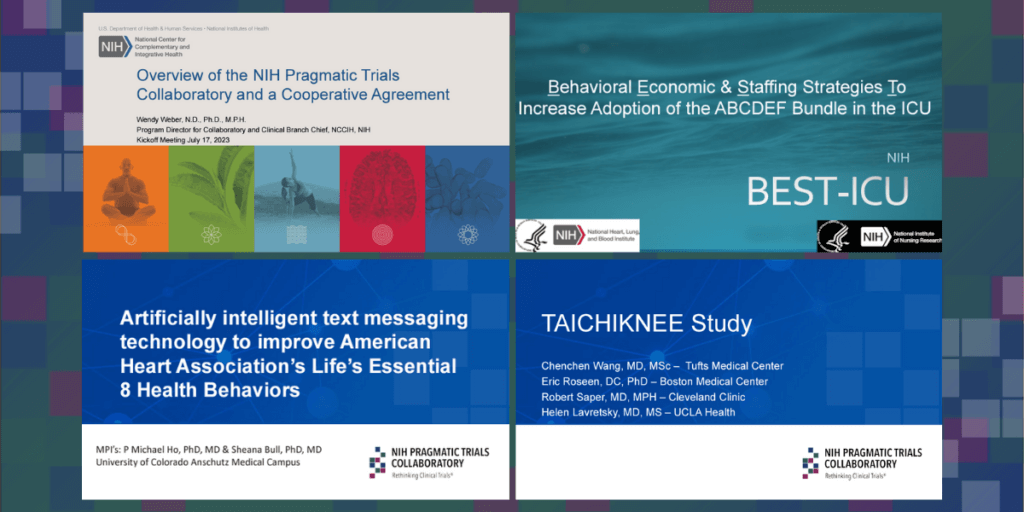
Leaders of the NIH Pragmatic Trials Collaboratory hosted an onboarding meeting for the program's 3 newest NIH Collaboratory Trials. The projects joined the program under the UG3 cooperative agreement mechanism to support a 1-year planning phase in preparation for potential transition to a UH3 implementation phase.
During the session, NIH Collaboratory leaders provided an overview of the program, the cooperative agreement support mechanism, and the program's policies and guidance documents. The new NIH Collaboratory Trial investigators shared their aims for the UG3 planning phase. Finally, a panel of experienced NIH Collaboratory Trial investigators shared the lessons they learned from implementation of their studies.
The BEST-ICU NIH Collaboratory Trial will evaluate strategies grounded in behavioral economic theory and implementation science to increase adoption of the ABCDEF critical care bundle and address known health disparities in mechanical ventilation and symptom management practices in intensive care units. The project is supported by a cooperative agreement from the National Heart, Lung, and Blood Institute.
The Chat 4 Heart Health NIH Collaboratory Trial will test the comparative effectiveness of implementing text messaging delivery strategies that have been shown to improve an individual's self-management health behaviors, including physical activity and medication adherence. The project is supported by a cooperative agreement from the National Heart, Lung, and Blood Institute.
The TAICHIKNEE NIH Collaboratory Trial will compare the effects of web-based tai chi interventions vs routine care for persons experiencing knee pain due to osteoarthritis. The project is supported by a cooperative agreement from the National Center for Complementary and Integrative Health.
Christine Goertz, DC, PhD Professor in Musculoskeletal Research Vice Chair for Implementation of Spine Health Innovations Department of Orthopaedic Surgery Duke University
Adam Goode, DPT, PhD Associate Professor in Orthopaedic Surgery Vice Chair of Clinical Research and Epidemiology Department of Orthopaedic Surgery Duke University
The IMPACt-LBP trial’s project goal is to implement the American College of Physicians low back pain (LBP) guideline by evaluating the impact of the Primary Spine Practitioner (PSP) model in three academic Health Care Systems (HCS). The study then evaluates the model’s effectiveness by comparing the intervention to usual medical care.
The American College of Physicians guideline states that “physicians and patients should treat acute, sub-acute and chronic LBP with non-drug therapies.” The Primary Spine Provider (PSP) model is a multi-disciplinary collaborative care model that includes Doctors of Chiropractic (DC) and physical therapists (PT) as first line care for LBP. Their treatment approaches will focus on non-pharmacological approaches recommended by the guideline, including spinal manipulation and exercise.
The IMPACt-LBP study design is a pragmatic, multi-site, two-arm cluster-randomized trial with randomization at the primary care provider (PCP) clinic level. It includes 22 family medicine, primary care and general internal medicine clinics affiliated with Duke University, the University of Iowa or Dartmouth-Hitchcock health systems. The study team plans to enroll 1,800 adult patients with a primary complaint of LBP who contacted a participating primary care clinic to make an appointment with a primary care provider.
The study pathway involves a patient contacting a primary care clinic and then being transferred to an IMPACt-LBP scheduling assistant who provides a scripted introduction to the study and a baseline survey. Patients in the usual care arm clinics are then scheduled to see a PCP. Patients at the intervention care arm clinics are introduced to a DC or PT appointment option, while still being able to select a PCP appointment.
The study’s primary endpoints are a change in PROMIS physical function from baseline to 3 months and change in PROMIS pain interference from baseline to 3 months. The study is also composed of an enrolled cohort of patients that agree to complete PRO surveys for pain interference and functional status for primary analysis. There is also a longitudinal cohort of EHR data for all patients at participating PCP clinics to assess utilization and other broad outcomes.
The study has enrolled 187 patients since enrollment began in March 2023, and the study team has pulled together its initial lessons learned.
In terms of administrative and regulatory lessons learned, the team reflected that the integration of PT/DC at the forefront of the patient experience is often different from many typical processes. There have also been hiring challenges related to the current job market, as well as regulatory challenges related to consent waivers and IRBs.
Presenters also shared challenges regarding scheduling and patient insurance coverage. While not anticipated, it was also necessary to have dedicated research staff to ensure adequate recruitment. Additionally, the study team noted that patients do not all enter the health system the same way, which is an ongoing challenge.
Differences in Cauda Equina screening by sites, which required a protocol amendment, proved to be another challenge.
There were also lessons learned regarding data collection, as many sites are not collecting and integrating PRO outcomes to a sufficient degree for the study. The study is now using two REDCap systems to collect data, which increases the potential for data entry errors.
From a clinical perspective, the team learned the importance of keeping providers up to date on the study progress in an efficient and streamlined way and experienced unforeseen difficulties with engaging with community PSPs.
Patient-specific issues encountered include: patients don’t want to be approached about research during an acute pain episode; many patients have concerns about co-pays to see PT/DC; sometimes patients have multiple reasons for a PCP visit; and patients are sometimes frustrated after going through the HCS phone triage system
Discussion Themes
–How has the experience been regarding dual oversight and a single IRB? There can be many challenges related to dual oversight and a single IRB. While the single IRB streamlines some steps, there are still different and specific processes at the different sites, which can create challenges and hurdles to overcome. With IMPACt-LBP, we have been able to move forward in an efficient manner; however, we have had a few additional steps that were not initially anticipated.
–Is working with large academic health systems a help or a hinderance? Academic health centers have the potential to drive change, so if we were able to pull it off at these sites, we felt that these interventions could be scaled to many different settings. We are learning together in real-time because we are trying to change how people think about clinical practice for low back pain. That is a real challenge. High-level administrators and clinicians are recognizing that there is a huge opportunity to provide better care for people with LBP and that we are attempting to implement evidence-based care pathways. Having this high-level support is critical and allows us to problem solve in real-time.
–Are you looking to engage with patients who have had imaging, and how does that impact the care path? We do have some sub-group analyses plans for the trial, not specific to imaging, but it is something we could consider. Inappropriate early imaging is included in our outcome measures, but we could consider some deeper work and analyses.
–Do you think that this intervention is sustainable? We think so because we are building a playbook for this. There is continued discussion as a nation about how we treat patients for low back pain, so we think there is potential. People care about this issue, so we feel that developing this evidence is a critical next step to promote change for better care.
Welcome the new UG3 NIH Collaboratory Trials; provide introductions and an overview of the NIH Collaboratory program; hear from the new UG3 project teams; and discuss lessons learned from the seasoned NIH Collaboratory Trials investigators.
In a new episode of our Rethinking Clinical Trials podcast, Dr. Julie Fritz speaks with host Dr. Adrian Hernandez about partnering with community health centers in the BeatPain Utah study. Fritz and colleague Dr. Guilherme Del Fiol presented on their experiences during the June 16 session of Grand Rounds.
BeatPain Utah, an NIH Collaboratory Trial, is studying real-world implementation of a telehealth physical therapy strategy for patients with chronic back pain in primary care clinics of federally qualified health centers. The study is supported by the NIH through the NIH Heal Initiative under an award from the National Institute of Nursing Research.
Fritz, who is the principal investigator for BeatPain Utah, is a distinguished professor of physical therapy and athletic training at the University of Utah.
The Grand Rounds session will be held on Friday, July 21, 2023, at 1:00 pm eastern.
IMPACt-LBP, an NIH Pragmatic Trials Collaboratory Trials, is a cluster randomized trial of a multidisciplinary collaborative team approach for low back pain vs usual care. The study will determine whether receiving first-line care from “primary spine practitioners” improves physical function, decreases pain and opioid prescriptions, improves patient satisfaction, and decreases costs and utilization of healthcare services.
Dr. Goertz is a professor in musculoskeletal research and the vice chair for implementation of spine health innovations in the Department of Orthopaedic Surgery, and Dr. Goode is an associate professor of orthopaedic surgery—both at Duke University.
The American Heart Association (AHA) identifies Life's Essential 8 (LE8) lifestyle factors as eating better, being more active, quitting tobacco, getting healthy sleep, managing weight, controlling cholesterol, managing blood sugar, and managing blood pressure. When uncontrolled, these lifestyle factors lead to common coexisting chronic conditions, morbidity, healthcare costs, and death. Patients who experience health disparities are disproportionately affected by cardiovascular diseases, have worse disease control, and suffer greater sequelae.
Chat 4 Heart Health will use a patient-level randomized pragmatic trial to test the comparative effectiveness of 3 text messaging delivery strategies that have been shown to improve an individual's self-management health behaviors, including physical activity and medication adherence. The study findings will provide evidence regarding the best population-based strategy for universal delivery to engage all patients with health disparities in self-management to improve the AHA's LE8.
Dr. Michael Ho and Dr. Sheana Bull will serve as the co–principal investigators for Chat 4 Heart Health. Dr. Ho is a professor of medicine at the University of Colorado School of Medicine. Dr. Bull is a professor and past chair of the Department of Community and Behavioral Health at the Colorado School of Public Health, as well as the director of the mHealth Impact Lab.
The Chat 4 Heart Health NIH Collaboratory Trial is supported within the NIH Pragmatic Trials Collaboratory by a grant from the National Heart, Lung, and Blood Institute (NHLBI).
Ho and Bull are experienced investigators in the NIH Collaboratory, and both serve currently as co-PIs on the Nudge NIH Collaboratory Trial.
Julie Fritz, PT, PhD, FAPTA Distinguished Professor, Department of Physical Therapy & Athletic Training
Associate Dean for Research, College of Health
University of Utah
Guilherme Del Fiol, MD, PhD Professor, Biomedical Informatics
University of Utah
Keywords
Community Health Centers; Low Back Pain; Physical Therapy Modalities; Primary Care; Telemedicine
Key Points
Clinical practice guidelines support nonpharmacologic care as first-line management of low back pain. However, persons in low-income and rural communities have significantly higher odds of receiving a prescription opioid for a new back pain diagnosis.
Use of nonpharmacologic pain treatments is lower in rural settings and for persons of Hispanic/Latino ethnicity. Many of these communities are served by federally qualified health centers that often lack options to provide accessible nonpharmacologic alternatives.
Clinical research can exacerbate disparities, because clinical trials typically are based in urban, academic medical centers, underrepresent diverse populations, and overlook community engagement strategies in trial planning and design.
BeatPain Utah, an NIH Pragmatic Trials Collaboratory Trial, is an embedded pragmatic clinical trial comparing the effectiveness of nonpharmacologic intervention strategies for patients with back pain seeking care in federally qualified health centers in Utah. The interventions include a telehealth strategy that provides a brief pain teleconsult along with phone-based physical therapy, and an adaptive strategy that provides the brief pain teleconsult first, followed by phone-based physical therapy among patients who are nonresponsive to treatment.
BeatPain Utah is using the Community-Engaged Dissemination and Implementation (CEDI) framework, which considers both social and technical factors in the implementation of health IT strategies, decentralizes the research methods and procedures, and grounds the implementation in a systematic, iterative mapping of how both clinic staff and patients interact with health IT.
Although there is evidence of a significant divide in the implementation of advanced health IT functions, low-resource settings can adopt advanced health IT with some assistance. Moreover, there is considerable opportunity to reduce inequities through increased adoption of telehealth strategies, given that 96% of people in low-resource communities have at least a text and voice phone.
Discussion Themes
Motivating patients to engage in self-management of health conditions is a challenge, irrespective of whether the intervention is delivered in person or remotely.
Designing interventions that can meet everyone’s needs can be a challenge in a study that involves rural/urban and racial/ethnic diversity. Implementation mapping at the beginning of the design process is key. This includes direct assessment of patients’ needs, such as by interviewing patients who seek care in the partnering clinics to understand their expectations and how they would think about a mode of care delivery, like telehealth, that is unfamiliar to them.
Another crucial element of the health equity–focused model is ensuring that the question at the heart of the research is of value to the clinics and their leadership. For every trial, one of the first important tasks is to reach out to the community health center leadership and see if they are interested. The clinic’s priorities should drive the design of the trial. “We have to be very accommodating to the needs of each [community health center] and respect their needs.”
How quickly can these types of studies proceed from trial completion to release of results? Especially in studies involving chronic conditions, having long-term follow-up data to answer the core effectiveness question in a hybrid trial means there could be a long wait for results. Researchers must also be prepared to consider the question of sustaining a service that many clinics in the study have come to rely on, even before the results are available.


 Ethics and regulatory onboarding documentation for the NIH Pragmatic Trials Collaboratory’s newest NIH Collaboratory Trials is now available. The documents include meeting minutes and supplementary materials summarizing recent discussions of ethics and regulatory issues associated with the BEST-ICU, Chat 4 Heart Health, and TAICHIKNEE studies.
 We are excited to welcome
  Leaders of the NIH Pragmatic Trials Collaboratory hosted an onboarding meeting for the program's 3 newest NIH Collaboratory Trials. The projects joined the program under the UG3 cooperative agreement mechanism to support a 1-year planning phase in preparation for potential transition to a UH3 implementation phase.
 In a new episode of our Rethinking Clinical Trials podcast, Dr. Julie Fritz speaks with host Dr. Adrian Hernandez about partnering with community health centers in the BeatPain Utah study. Fritz and colleague Dr. Guilherme Del Fiol presented on their experiences during the June 16 session of Grand Rounds.
 The NIH Collaboratory is excited to announce the addition of