July 3, 2025: OPTIMUM Team Identifies Facilitators of Participant Retention and Engagement

Headshot of Dr. Natalia Morone, principal investigator for OPTIMUM
Dr. Natalia Morone, principal investigator for OPTIMUM

Trust in their clinicians, positive interactions with study staff, and opportunities for social connection can improve recruitment, retention, and engagement with research participants, according to focus groups of participants in the OPTIMUM trial. These factors can be especially important for first-time research participants and for groups that are historically underrepresented in clinical trials.

The article was published online in Global Advances in Integrative Medicine and Health.

OPTIMUM, an NIH Collaboratory Trial, is studying the addition of mindfulness-based stress reduction to usual care for patients with chronic low back pain, compared with usual care alone, with the goal of improving pain outcomes and reducing opioid prescriptions. Patients in the control group were also offered free mindfulness sessions after the end of the 12-month follow-up period.

Understanding of randomized controlled trials and general research processes emerged as another important theme in the focus groups. In particular, appreciating the value of the control group in a randomized controlled trial can support participants’ ongoing engagement.

“Consistent, positive study staff interactions were particularly important for control group participants who were not immediately receiving the intervention that initially interested them in the trial,” the authors wrote.

The OPTIMUM trial, which is embedded in safety net hospitals and federally qualified health centers, includes a large number of first-time participants in research and patients from racial and ethnic groups that tend to be underrepresented in research. Understanding the needs and perspectives of first-time research participants and those from underrepresented groups can improve recruitment and retention strategies and help ensure the representativeness of study populations.

Read the full report.

OPTIMUM is supported within the NIH Pragmatic Trials Collaboratory through the NIH HEAL Initiative by a grant award administered by the National Center for Complementary and Integrative Health. Learn more about OPTIMUM.


August 5, 2024: NIH Collaboratory Leaders Reflect on Healthcare System and Patient Engagement Challenges and Lessons Learned

During the NIH Pragmatic Trials Collaboratory’s 2024 Annual Steering Committee Meeting in May, Greg Simon and Steve George sat down to discuss challenges and lessons learned from NIH Collaboratory Trials on healthcare system and patient engagement.

Simon said it is key for embedded pragmatic clinical trials to build long-term relationships with healthcare systems, starting with finding out what are the needs of the healthcare system, the clinicians, and the patients they care for, and then building trials that address the questions they care about.

But healthcare systems change rapidly, which can lead to challenges, such as turnover at different levels of leadership, including the top level of the healthcare system, the clinic management level, and the provider level.

“It is important for clinical trial investigators to think about how do I form relationships with those people who are likely to be here for a while? How do I form relationships at multiple levels with different people,” Simon said.

With patient engagement, George said the challenges have evolved with the NIH Collaboratory Trials. When the NIH Collaboratory started, the initial challenge was whether to do patient engagement or not. Today, patient engagement is more of an expectation for trials, so the questions have become more nuanced, George said. Now trials must consider at what phase of the trial are you going to do patient engagement; who are you going to involve; and are you going to do it throughout the trial?

The NIH Collaboratory’s Living Textbook includes a new chapter on Patient Engagement to help investigators think through these questions.

“One of the most effective resources is the reporting and the information sharing across trials. There are a lot of models of how this has been done. There are a lot of models of how I would do it differently if I did it again, and I think that open sharing is very powerful for people to see because people like examples,” George said.

Simon, a senior investigator at Kaiser Permanente Washington Health Research Institute, is the chair of the NIH Collaboratory’s Health Care Systems Interactions Core and a member of the Coordinating Center leadership team. George is the Laszlo Ormandy Distinguished Professor of Orthopaedic Surgery at Duke University.

Headshots of Dr. Gregory Simon and Dr. Steven George

May 20, 2024: BeatPain Utah and AIM-Back Trials Offer Insights Into Telehealth Delivery of Physical Therapy

Headshot of Dr. Julie Fritz
Dr. Julie Fritz, principal investigator for BeatPain Utah

In a new article, investigators from 2 pragmatic clinical trials of telehealth-delivered physical therapy share insights into the challenges they faced in implementing the study interventions, especially in historically underserved communities.

The article was published last month in Frontiers in Pain Research.

Telehealth delivery of nonpharmacologic pain management has expanded opportunities to overcome access barriers. However, telehealth delivery of physical therapy presents challenges related to technology, intervention adaptations, and cultural competence.

Both BeatPain Utah, an NIH Collaboratory Trial, and AIM-Back, a trial supported through the NIH-DOD-VA Pain Management Collaboratory, are pragmatic trials testing physical therapist–led telehealth interventions for persons with chronic low back pain who are from communities that experience healthcare disparities. In the new article, the investigators describe the challenges they encountered when implementing telehealth physical therapy programs in these communities. They also discuss strategies for overcoming barriers to improve access to telehealth physical therapy and reduce pain management disparities.

Read the full article.

BeatPain Utah is supported within the NIH Pragmatic Trials Collaboratory by a cooperative agreement from the National Institute of Nursing Research. Learn more about the NIH Collaboratory Trials.

February 13, 2024: New Chapter of Living Textbook Highlights Value of Patient Engagement and Provides Practical Strategies

Dr. Steven George

The NIH Pragmatic Trials Collaboratory published a new chapter in its Living Textbook of Pragmatic Clinical Trials. The chapter, Patient Engagement, describes principles and strategies for effectively engaging patient partners.

Because patients can provide valuable insights and perspectives about clinical care for specific conditions, they are key partners for pragmatic clinical trials. The chapter highlights the value of patient engagement and provides practical tactics for patient engagement throughout the life cycle of a pragmatic trial. It also recognizes potential barriers to patient engagement and case studies in the pragmatic trials context.

For more on partnership in pragmatic trials, see the chapters on Building Partnerships and Teams to Ensure a Successful Trial; Participant Recruitment; and Dissemination Approaches for Different Stakeholders.

Read more about the Living Textbook.

Grand Rounds June 16, 2023: BeatPain Utah: Partnering With Community Health Centers Within a Socio-Technical Framework (Julie Fritz, PT, PhD, FAPTA; Guilherme Del Fiol, MD, PhD)

Speakers

Julie Fritz, PT, PhD, FAPTA
Distinguished Professor, Department of Physical Therapy & Athletic Training
Associate Dean for Research, College of Health
University of Utah

Guilherme Del Fiol, MD, PhD
Professor, Biomedical Informatics
University of Utah

Keywords

Community Health Centers; Low Back Pain; Physical Therapy Modalities; Primary Care; Telemedicine

Key Points

  • Clinical practice guidelines support nonpharmacologic care as first-line management of low back pain. However, persons in low-income and rural communities have significantly higher odds of receiving a prescription opioid for a new back pain diagnosis.
  • Use of nonpharmacologic pain treatments is lower in rural settings and for persons of Hispanic/Latino ethnicity. Many of these communities are served by federally qualified health centers that often lack options to provide accessible nonpharmacologic alternatives.
  • Clinical research can exacerbate disparities, because clinical trials typically are based in urban, academic medical centers, underrepresent diverse populations, and overlook community engagement strategies in trial planning and design.
  • BeatPain Utah, an NIH Pragmatic Trials Collaboratory Trial, is an embedded pragmatic clinical trial comparing the effectiveness of nonpharmacologic intervention strategies for patients with back pain seeking care in federally qualified health centers in Utah. The interventions include a telehealth strategy that provides a brief pain teleconsult along with phone-based physical therapy, and an adaptive strategy that provides the brief pain teleconsult first, followed by phone-based physical therapy among patients who are nonresponsive to treatment.
  • BeatPain Utah is using the Community-Engaged Dissemination and Implementation (CEDI) framework, which considers both social and technical factors in the implementation of health IT strategies, decentralizes the research methods and procedures, and grounds the implementation in a systematic, iterative mapping of how both clinic staff and patients interact with health IT.
  • Although there is evidence of a significant divide in the implementation of advanced health IT functions, low-resource settings can adopt advanced health IT with some assistance. Moreover, there is considerable opportunity to reduce inequities through increased adoption of telehealth strategies, given that 96% of people in low-resource communities have at least a text and voice phone.

Discussion Themes

  • Motivating patients to engage in self-management of health conditions is a challenge, irrespective of whether the intervention is delivered in person or remotely.
  • Designing interventions that can meet everyone’s needs can be a challenge in a study that involves rural/urban and racial/ethnic diversity. Implementation mapping at the beginning of the design process is key. This includes direct assessment of patients’ needs, such as by interviewing patients who seek care in the partnering clinics to understand their expectations and how they would think about a mode of care delivery, like telehealth, that is unfamiliar to them.
  • Another crucial element of the health equity–focused model is ensuring that the question at the heart of the research is of value to the clinics and their leadership. For every trial, one of the first important tasks is to reach out to the community health center leadership and see if they are interested. The clinic’s priorities should drive the design of the trial. “We have to be very accommodating to the needs of each [community health center] and respect their needs.”
  • How quickly can these types of studies proceed from trial completion to release of results? Especially in studies involving chronic conditions, having long-term follow-up data to answer the core effectiveness question in a hybrid trial means there could be a long wait for results. Researchers must also be prepared to consider the question of sustaining a service that many clinics in the study have come to rely on, even before the results are available.

Tags

#pctGR, @Collaboratory1

May 11, 2023: Article Outlines Key Stakeholder Insights Related to Participant Data Sharing in Pragmatic Trials

Headshot of Dr. Stepanie Morain

A new article from the NIH Pragmatic Trials Collaboratory outlines stakeholder insights and ethical considerations related to sharing deidentified, participant-level data in pragmatic clinical trials. While there are numerous arguments for and against data sharing in the context of pragmatic trials, the report aims to address the gap in documented stakeholder perspectives.

The article was published this month in Learning Health Systems.

The authors, including members of the NIH Collaboratory’s Ethics and Regulatory Core, recruited stakeholders who represented a range of experiences. They then conducted 40 semistructured interviews focused on ethical considerations. The team identified 5 overarching themes after analyzing the interviews: (1) challenges in sharing data collected under a waiver or alteration of consent; (2) conflicting views regarding patient-subject preferences for data sharing; (3) identification of respect-promoting practices beyond consent; (4) concerns about elevated risks or burdens from sharing data; and (5) diverse views about the likely benefits resulting from sharing data.

A key insight was that a “one size fits all” model for promoting broader sharing of data from pragmatic trials is not feasible, and policies must be sensitive to the unique challenges that pragmatic trials present, such as variation among trials.

“Our data indicate unresolved tensions in how to fulfill this expectation for [pragmatic clinical trials],” the authors wrote. “Future work could inform efforts to tailor data-sharing policy and practice to reflect these and other challenges, including sharing experiences from trials that have successfully navigated these tensions.”

Lead author Stephanie Morain and co-authors Juli Bollinger, Kevin Weinfurt, and Jeremy Sugarman are members of the NIH Collaboratory’s Ethics and Regulatory Core. This work was supported within the NIH Pragmatic Trials Collaboratory by a supplemental grant award from the National Center for Complementary and Integrative Health.

Read the full report.

April 24, 2023: Webinar Will Highlight Meaningful Engagement of Patients and Communities in NIH HEAL Initiative Studies

HEAL Headliners: Engaging Patients and Communities in HEAL Research

An upcoming webinar in the NIH HEAL Initiative’s HEAL Headliners series will highlight the experiences of 2 projects in meaningfully engaging patients and community partners throughout the research process to ensure that the findings have the greatest public health impact. The webinar will be held on Friday, May 5, 2023, at 2:00 pm eastern.

Rosemarie Martin of Brown University and Linda Hurley of CODAC Behavioral Heathcare will report on a study of a systems-change approach for increasing use of medications for opioid use disorder across 7 probation and parole sites to improve linkage of justice-involved individuals to evidence-based treatment. In addition, Kirsten Johansen of Hennepin Healthcare will describe the role of patient and community engagement in the HOPE clinical trial of tailored patient-centered interventions to manage pain and reduce opioid use among patients receiving hemodialysis.

HEAL Headliners: Engaging Patients and Communities in HEAL Research
Venue: Live online via Zoom
Date and Time: May 5, 2023; 2:00 pm ET
Register free online

February 28, 2023: SMDM Will Host Webinar on Equity in Medical Decision Making

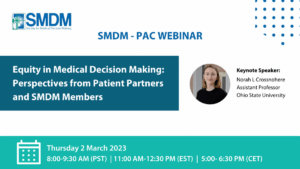
SMDM webinar information graphicThe Society for Medical Decision Making (SMDM) will host a free, live webinar on Thursday, March 2, to discuss equity and patient engagement. The webinar, “Equity in Medical Decision Making: Perspectives from Patient Partners and SMDM Members,” was organized by the SMDM Patient Advisory Council.

From the announcement:

In this webinar we will discuss equity, what it is and isn’t, the role of equity in medical decision making and gaps in the literature. There will be a keynote presentation defining equity in the context of medical decision making, followed by parallel break out rooms with moderated discussions on how equity relates to:

  • Shared decision making (SDM), including discussion of the role of health literacy and the importance of engaging patients in decisions in the way they can understand.
  • Patient Decision Aid (PtDA) development, including discussion of the importance of adapting PtDAs to ensure they meet the needs of end users.
  • Modelling including discussion of the importance of addressing equity in modelling to prevent bias in model-based medical decision making.

Equity in Medical Decision Making: Perspectives from Patient Partners and SMDM Members
Venue: Live online via Zoom
March 2, 2023; 11:00 am-12:30 pm ET
Register free online

Program

Welcome and Introductions – Jesse Jansen & Mary Politi

  • Keynote Presentation: “Definition of equity and how it impacts MDM” – Norah L Crossnohere
  • Break Out Room Discussion 1: Equity in shared decision-making conversations – Elisa Douglas & Frank Gavin
  • Break Out Room Discussion 2: Equity and accessibility in decision aids – Jesse Jansen & Karen Prantl
  • Break Out Room Discussion 3: Modelling: attending to equality and inclusion of biased on modelling – Anton Avanceña & Robin Wright-Jones

Keynote Speaker
Norah L Crossnohere
Assistant Professor at The Ohio State University
Norah L Crossnohere, PhD, is a patient-centered outcomes researcher. Her research areas include advancing methods for measuring patient and caregiver preferences; engaging patients to inform medical decision-making, and evaluating health information technologies.

  • Facilitators
    Mary C. Politi, Professor @Department of Surgery, School of Medicine, Washington University in St. Louis
  • Ashley Housten, Assistant Professor @Department of Surgery, School of Medicine, Washington University in St. Louis
  • Elisa E. Douglas, PhD, MSPH, Research Scientist @Decision Support Lab, Department of Health Services Research, The University of Texas MD Anderson Cancer Center
  • Frank Gavin, MA, Chair @Public Advisory Council Health Data Research Network Canada
  • Jesse Jansen, PhD, Associate Professor @Family Medicine, Family Medicine, School for Public Health and Prim Care, Fac. Health, Medicine and Life Sciences
  • Senator (Ret.) Robin Wright-Jones, Executive Director @The Empowerment Network, Inc
  • Karen Prantl, Policy officer @Needs assessment and patient participation Dutch Kidney Patients Association (NVN)
  • Anton Avanceña, Assistant Professor @The University of Texas at Austin

March 18, 2022: Early Treatment of COVID-19: The TOGETHER Adaptive Platform Trial (Edward Mills, PhD, FRCP; Craig Rayner, PharmD)

Speakers

Edward Mills PhD, FRCP
Professor, McMaster University

Craig R Rayner FRCP Edin PharmD MBA
Certara Distinguished Scientist
Adjunct Associate Professor, Monash University

Keywords

COVID-19; Ivermectin; TOGETHER trial; Patient engagement; Adaptive platform trial

Key Points

  • The TOGETHER trial is a randomized adaptive platform trial investigating 11 different treatments for COVID-19 including Ivermectin.
  • Initial in vitro experiments of Ivermectin in April of 2020 showed promising results, but many of those original papers were later retracted.
  • The TOGETHER trial used PBPK modelling to determine trial dose regimen. The trial started with 1 dose and later moved to 3 doses.
  • The primary outcome of the TOGETHER trial was emergency room visits due to COVID-19 or hospitalization due to the progression of COVID-19.
  • No evidence was found of treatment effect for ivermectin compared to placebo, but a small treatment effect cannot be ruled out. It may have an effect for a subgroup of patients.

Discussion Themes

A low confidence interval could signal that the trial was stopped too early.

Building trust within the community is key to the success of a trial. Recruitment is difficult if the patients don’t trust the trial or researchers.

Read more about the TOGETHER trial.


 Tags

#pctGR, @Collaboratory1

March 11, 2022: Understanding a Patient’s Daily Experience Through Mobile Devices and Wearables: Lessons Learned From the 8,000 Patient MIPACT Study and Implementation in a National Pragmatic Trial (Sachin Kheterpal, MD, MBA; Jessica Golbus, MD; Nicole Pescatore, MPH)

Speakers

Sachin Kheterpal, MD, MBA
Professor of Anesthesiology
Associate Dean for Research IT
PI for MIPACT and Co-PI for THRIVE University of Michigan

Jessica Golbus, MD
Clinical Instructor, Cardiovascular Medicine
Co-I for MIPACT
University of Michigan

Nicole Eyrich, MPH
MIPACT Clinical Research Project Manager University of Michigan

Keywords

MIPACT; Patient-reported outcomes; Virtual recruitment; Cohort Identification Toolkit; VALENTINE study; THRIVE study; Wearable data research; Propofol

Key Points

  • The MIPACT study combined patient reported outcome data with electronic health record data and data collected from wearable devices.
  • The MIPACT study followed over 7,000 participants for 3 years. Both in-person and virtual recruitment had similar success rates. Participant diversity was a priority during recruitment.
  • The VALENTINE Study was a prospective randomized controlled study using mobile wearable devices to enhance cardiac rehabilitation.
  • Older participants in the VALENTINE study were receptive and capable of using wearable technology to assist data collection for the study.
  • THRIVE is pragmatic clinical trial studying Propofol anesthesia in 22 states and 2 countries.

Discussion Themes

Economic barriers to participation may be present when using wearable device technology as an inclusion criteria for a study. There are various methods to reduce these barriers, such as providing participants with the wearable device and a minimal data plan.

There may be limits to the types of participant reported outcomes that can be collected remotely. Ideally, participants will decide what data researchers will have access to.

Read more about MIPACT, VALENTINE, and THRIVE study.  Read results from MIPACT and VALENTINE.


 Tags

#pctGR, @Collaboratory1