The Grand Rounds session will be held on Friday, April 12, 2024, at 1:00 pm eastern.
Grudzen is a professor of emergency medicine at Weill Cornell Medical College and the Fern Grayer Chair in Oncology Care and the Patient Experience and division head of supportive and acute care services at the Memorial Sloan Kettering Cancer Center.
PRIM-ER, an NIH Collaboratory Trial, is a stepped-wedge, cluster randomized trial testing a multidisciplinary primary palliative care intervention in a diverse mix of emergency departments in the United States. The study is supported within the NIH Pragmatic Trials Collaboratory by a cooperative agreement from the National Institute on Aging. Read more about PRIM-ER.
Dr. Miguel Vazquez, principal investigator for ICD-Pieces
A primary care intervention for patients with coexisting chronic kidney disease, type 2 diabetes, and hypertension did not reduce the hospitalization rate for these patients when compared to usual care, according to the ICD-Pieces study.
The results of the study were published this week in the New England Journal of Medicine.
ICD-Pieces, an NIH Collaboratory Trial, was a cluster randomized, pragmatic clinical trial testing an intervention that used an electronic health record–based algorithm and practice facilitators in 141 primary care practices. The study team randomly assigned more than 11,000 adults to receive either the intervention or usual care. The large, diverse study population—of whom 20% were Black and almost 20% were Hispanic or Latino—was representative of the population with chronic kidney disease, type 2 diabetes, and hypertension in the United States.
In the intervention group, the study team used an algorithm to identify patients in the electronic health record in real time. Practice facilitators then worked with the participating primary care providers and patients to meet blood pressure targets, promote use of appropriate medications, achieve goals for blood glucose control, and engage in other guideline-directed care. The intervention period lasted 12 months, and the primary outcome was hospitalization for any reason.
At the end of the study, the hospitalization rates were similar between the intervention group and the usual care group. Rates of key secondary outcomes, such as emergency department visits and cardiovascular events, were also similar between the groups.
“Although we did not observe a difference in the primary outcome, we believe the study is an important step in advancing our understanding of how to conduct pragmatic trials embedded in healthcare systems,” said Dr. Miguel Vazquez, the principal investigator for ICD-Pieces and a professor of internal medicine at UT Southwestern Medical Center in Dallas.
The study team identified and enrolled a large number of patients, including a large proportion of patients who are members of racial and ethnic groups that are usually underrepresented in clinical trials, Vazquez explained. Moreover, the intervention was delivered across 4 large healthcare systems using a variety of electronic health record systems, there was fidelity in intervention delivery, and there was robust capture of outcomes in a diverse population with multiple chronic conditions.
Vazquez also emphasized the value of conducting the ICD-Pieces study as an NIH Collaboratory Trial.
“The opportunity to work within the NIH Pragmatic Trials Collaboratory was essential for the successful completion of our trial,” Vazquez said. “Access to the expertise from the Coordinating Center and ongoing interactions with investigators from other projects provided critical knowledge to conduct our study embedded in large health systems,” he added.
ICD-Pieces is supported within the NIH Pragmatic Trials Collaboratory by a cooperative agreement from the National Institute of Diabetes and Digestive and Kidney Diseases.
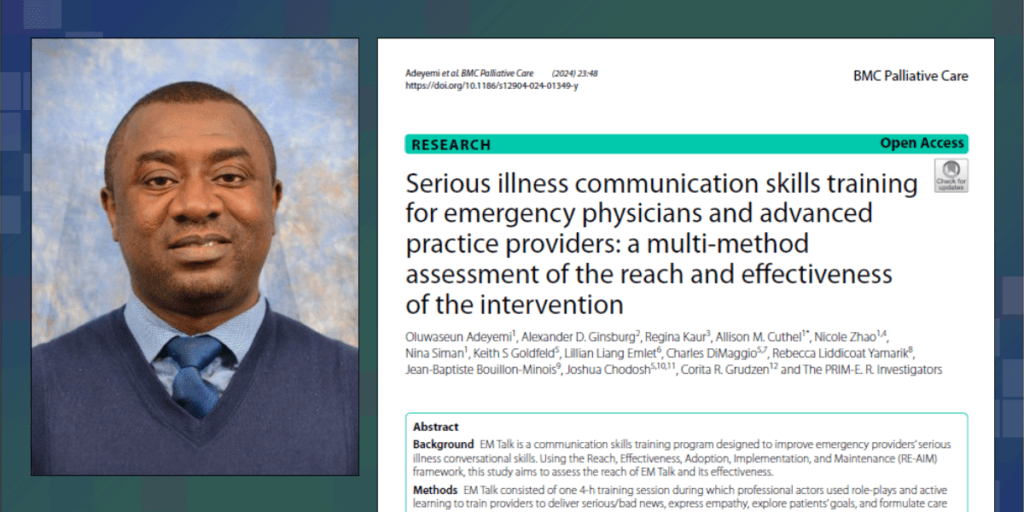
Communication skills training using the EM Talk model reached a high proportion of clinicians in participating emergency departments and improved their serious illness conversation skills, according to a qualitative study conducted as part of the PRIM-ER trial. The observed reach and effectiveness of the training program has the potential to improve use of these skills in clinical practice.
PRIM-ER, an ongoing NIH Collaboratory Trial, is a stepped-wedge, cluster randomized trial testing a multidisciplinary primary palliative care intervention in a diverse mix of emergency departments in the United States. The intervention consists of education, clinical decision support, and other elements and is intended to improve the delivery of goal-directed emergency care of older adults.
The PRIM-ER intervention includes, among other elements, communication skills training and simulation workshops for emergency medicine clinicians using the EM Talk training program. The program is designed to improve serious illness conversation skills for emergency medicine physicians and advanced practice providers.
The authors of the report, led by Oluwaseun Adeyemi of New York University, under the guidance of principal investigators Corita Grudzen and Keith Goldfeld, found that 85% of emergency medicine physicians and advanced practice providers across 33 emergency departments completed the EM Talk training. In course evaluations completed after the training, participants reported that the training improved their serious illness conversation skills and their attitude toward engaging patients in serious illness conversations. Participants also reported that the training encouraged them to commit to using these skills in clinical practice.
A previously published study by the PRIM-ER research team reported the reach and effectiveness of a related training program for emergency nurses.
PRIM-ER is supported within the NIH Pragmatic Trials Collaboratory by a cooperative agreement from the National Institute on Aging. Read more about PRIM-ER.
Injury survivors from racial and ethnic minority groups experienced greater improvements than White injury survivors in their posttraumatic stress disorder (PTSD) symptoms after receiving a stepped collaborative care intervention. This was the finding of a secondary analysis of data from the Trauma Survivors Outcomes and Support (TSOS) study, an NIH Collaboratory Trial led by principal investigator Doug Zatzick of the University of Washington.
The report was published online in Trauma Surgery & Acute Care Open.
In the TSOS study's main analysis, which was published in JAMA Surgery in 2021, the researchers saw a significant reduction in PTSD symptoms at 6 months in the intervention group compared with the control group. In the new secondary analysis, they saw that reduction in symptoms among racial and ethnic minority patients but not among White, non-Hispanic patients.
The findings "suggest that the previously reported 6-month treatment effects derive predominantly from intervention-related PTSD symptom improvements in non-white/Hispanic patients," wrote author Khadija Abu and colleagues from the University of Washington and the University of California, Los Angeles.
The TSOS study, an NIH Collaboratory Trial, was a stepped-wedge, cluster randomized pragmatic clinical trial testing the delivery of a stepped collaborative care intervention vs usual care for injured patients with PTSD symptoms and comorbid conditions. The study was conducted at 25 level I trauma centers in the United States. Of the 635 patients in the trial, 350 were from racial backgrounds other than White—including 218 patients who identified as African American, 15 as American Indian or Alaska Native, 8 as Asian or Pacific Islander, and 109 as multiple or other races. One-hundred two patients were Hispanic.
Patients in the control group received usual care plus nurse notification about their high level of distress. Patients in the intervention group received collaborative care consisting of evidence-based medication, cognitive behavioral therapy, and case management.
The study team proposed a few possible explanations for their findings:
In addition to its universal components, the TSOS intervention and referral elements consisted of tailored components designed to address the needs of a multicultural patient population by incorporating social determinants of health.
Collaborative care models include shared decision-making approaches, which are thought to enhance patients' engagement in care in racial and ethnic minority populations and other underserved groups.
In the year before their injury, almost half of the white, non-Hispanic patients in the study had accessed mental health services, compared with only about a quarter of the non-White and Hispanic patients, suggesting that participation in the study improved access to mental health care for patients in racial and ethnic minority groups.
A commentary accompanying the article praised the TSOS research team for "taking important steps to care for adverse sequelae associated with traumatic injury," and noted that "these first steps represent giant leaps for health equity" for underserved populations.
The TSOS study was supported within the NIH Pragmatic Trials Collaboratory by a cooperative agreement from the National Institute of Mental Health and by the NIH Common Fund through a cooperative agreement from the Office of Strategic Coordination within the Office of the NIH Director. Learn more about the NIH Collaboratory Trials.
Ethics and regulatory onboarding documentation is now available for RAMP, one of the NIH Pragmatic Trials Collaboratory's newest pragmatic clinical trials. The documents include meeting minutes and supplementary materials summarizing recent discussions of ethics and regulatory issues associated with the study.
The consultation took place by video conference and included representation from the study's principal investigator and study team, members of the NIH Collaboratory's Ethics and Regulatory Core, NIH staff, and NIH Collaboratory Coordinating Center personnel.
The goal of RAMP is to evaluate the use of a 12-week mind-body skills training program for patients with pain, including a one-on-one session with a “whole health coach” followed by 11 weekly group sessions to include prerecorded expert-led education videos, mind-body skills training and practice, and group discussions.
Ethics and regulatory onboarding documentation for 2 of the NIH Pragmatic Trials Collaboratory's newest trials is now available. The documents include meeting minutes and supplementary materials summarizing recent discussions of ethics and regulatory issues associated with the AIM-CP trial and the MOMs Chat & Care Study.
The consultations took place by video conference and included representation from the studies' principal investigators, members of the NIH Collaboratory's Ethics and Regulatory Core, NIH staff, and NIH Collaboratory Coordinating Center personnel.
AIM-CP will test a care management program to address inequities in access to nonpharmacological treatment for chronic pain in rural populations.
The MOMs Chat & Care Study will test the effectiveness of an integrated care model approach at 2 levels of intensity designed to facilitate timely, appropriate care for Black patients to reduce their risk for severe maternal morbidity.
In a new article from the NIH Pragmatic Trials Collaboratory, the BeatPain Utah study team describes the "implementation mapping" they used to plan for trial implementation. The comprehensive, systematic approach enabled the team to craft an implementation plan for a complex telehealth intervention and to identify outcomes for evaluating the success of the implementation strategies.
BeatPain Utah, an NIH Collaboratory Trial, is studying real-world implementation of a telehealth physical therapy strategy for patients with chronic back pain in primary care clinics of federally qualified health centers. During the 1-year planning phase described in the article, the study team developed a logic model, based in part on the Consolidated Framework for Implementation Research (CFIR), to identify contextual factors across several domains that could influence e-referral and telehealth implementation in the trial.
In this ongoing type 1 hybrid effectiveness-implementation trial, the implementation strategies developed through the mapping exercise are being evaluated as part of the trial.
BeatPain Utah is supported within the NIH Pragmatic Trials Collaboratory through the NIH HEAL Initiative under an award administered by the National Institute of Nursing Research. Learn more about BeatPain Utah.
Ethics and regulatory onboarding documentation is now available for iPATH, one of the NIH Pragmatic Trials Collaboratory's newest pragmatic clinical trials. The documents include meeting minutes and supplementary materials summarizing recent discussions of ethics and regulatory issues associated with the study.
The consultation took place by video conference and included representation from the study's principal investigator and study team, members of the NIH Collaboratory's Ethics and Regulatory Core, NIH staff, and NIH Collaboratory Coordinating Center personnel.
The goal of iPATH is to refine and implement an approach to practice transformation that was originally conceived and pilot-tested to support federally qualified health centers (FQHCs) in their pursuit of National Committee for Quality Assurance recognition as patient-centered medical homes for patients with type 2 diabetes. The study will include extensive qualitative work to identify implementation factors in FQHCs that are diverse in terms of geography, race/ethnicity, and diabetes control performance; and to customize and comprehensively evaluate the implementation approach.
Ethics and regulatory onboarding documentation for 2 of the NIH Pragmatic Trials Collaboratory's newest trials is now available. The documents include meeting minutes and supplementary materials summarizing recent discussions of ethics and regulatory issues associated with the ARBOR-Telehealth and I CAN DO Surgical ACP studies.
The consultations took place by video conference and included representation from the studies' principal investigators, members of the NIH Collaboratory's Ethics and Regulatory Core, NIH staff, and NIH Collaboratory Coordinating Center personnel. Both projects are in their planning phase.
ARBOR-Telehealth will evaluate the use of a telehealth physical therapy strategy for patients who present to primary care clinics with low back pain in rural communities. A secondary aim of the study is to compare the effectiveness of the study's risk-stratification approach.
I CAN DO Surgical ACP will identify a system-based approach to help older adults undergoing elective surgery engage in advance care planning. The project will leverage the existing electronic health record and patient portal, PREPARE for Your Care materials to assist patients with completion of advance care planning, virtual healthcare navigators, and electronic nudges. Another goal of the study is to understand digital engagement, language, and social drivers of health that drive engagement in the intervention.
A nudge is a strategic reminder that can help people adopt healthy behaviors, using principles from behavioral economics and cognitive psychology to improve behavior commitments, communicate social norms, and narrative stories. The Nudge study wanted to find out if nudges could help patients improve medication adherence by promoting behavioral change through positive reinforcement.
The Year 1, UG3 Phase, aims were to develop and program a nudge message library using iterative N of 1 studies to optimize content for a range of diverse patients. The second aim was to conduct a pilot intervention to demonstrate feasibility of delivering the intervention and preliminary effects in a 3 healthcare systems. The idea was to engage the patient, providers, and healthcare system leaders to design, refine, and implement the pilot.
In Years 2-5 (UH3 Phase) the aims were to conduct and evaluate a pragmatic patient-level randomized intervention across 3 healthcare systems to improve adherence to chronic cardiovascular (CV) medications. The second aim was to evaluate the intervention effectiveness using a mixed methods approach and apply the RE-AIM (reach, effectiveness, adoption, implementation, and maintenance) framework.
The study recruited adult patients diagnosed with 1 or more cardiovascular condition of interest, prescribed at least 1 or more medication of interest, with a refill gap of at least 7 days. Patiens were excluded if they had neither a landline or cell phone, were enrolled in hospice or palliative care, were non-English or Spanish speaking, and residing out of the state of Colorado.
Three healthcare delivery systems participated in the study: UC Health Clinics, Denver Health, and VA Eastern Colorado HCS Clinics.
Nudge used an opt out approach, with IRB approval because it was a low-risk intervention and having patients consent on a large scale would be challenging and might bias the sample to more adherent patients. Nudge sent an opt-out packet with an information sheet, an opt-out sheet and a self-addressed stamped envelope. There was also an option to complete a survey to share reasons for opting out. There were 4 weeks to return the opt-out form, and there was a text opt-out option once the program started.
More than 13,000 patients were considered eligible for the UH3 trial and more than 9,500 were randomized in the 4 arms, with about 2,300 patients in each of the arms. The 4 arms were usual care, generic text message arm, optimized text message arm that used behavioral theories that aligned with “nudge,” and a fourth arm that used a chat bot.
All of the intervention arms had a significant influence on refills but there was no different between the intervention arms. Patients could text back with clinical questions or questions about the study. About 50% of participants responded with a question, and 9.2% responded with a question for a clinical pharmacist.
Nudge also deployed a text message and survey to participants to get a sense for patient satisfaction with feedback on the study and text messages. The response rate was low but in general there were high levels of satisfaction with the intervention. No concerns were raised about privacy concerns or confusion about the messages.
Lessons learned: The text message intervention improved medication refill adherence, the effectiveness was consistent regardless of the type of message delivered, and the differential impact of the intervention across some patient groups. The opt out approach is feasible and drop out rate was lower than expected. Patients were generally satisfied with text messages, and patients who were non-white and Hispanic were more likely to remain in the study. Text messages can be implemented as a low-cost intervention to improve medication refill adherence across different healthcare systems with disperate EHR systems.
Discussion Themes
-Do you think the results support a text message nudge in most clinical trials and what is the cost effectiveness of this? This is a low-cost strategy and would be a great option to use as one of multiple strategies to use in clinical trials. The nudge can be very generally defined, the timing of the message for this kind of intervention is important. It’s not clear that this messaging may not be sufficient for other types of behavior, like changing diet, but for this type of action it was sufficient.
-What was your IRB? Our IRB was the Colorado Multiple Institutional review board. Messages included PHI but the study followed the institutional security protocols that allowed the intervention to be approved.
–How did the messages account for prescription dosage changes? Patients could reply with Done and the message reminders would stop. The study would then recalculate the gaps.





 Injury survivors from racial and ethnic minority groups experienced greater improvements than White injury survivors in their posttraumatic stress disorder (PTSD) symptoms after receiving a stepped collaborative care intervention. This was the finding of a secondary analysis of data from the Trauma Survivors Outcomes and Support (TSOS) study, an NIH Collaboratory Trial led by principal investigator Doug Zatzick of the University of Washington.
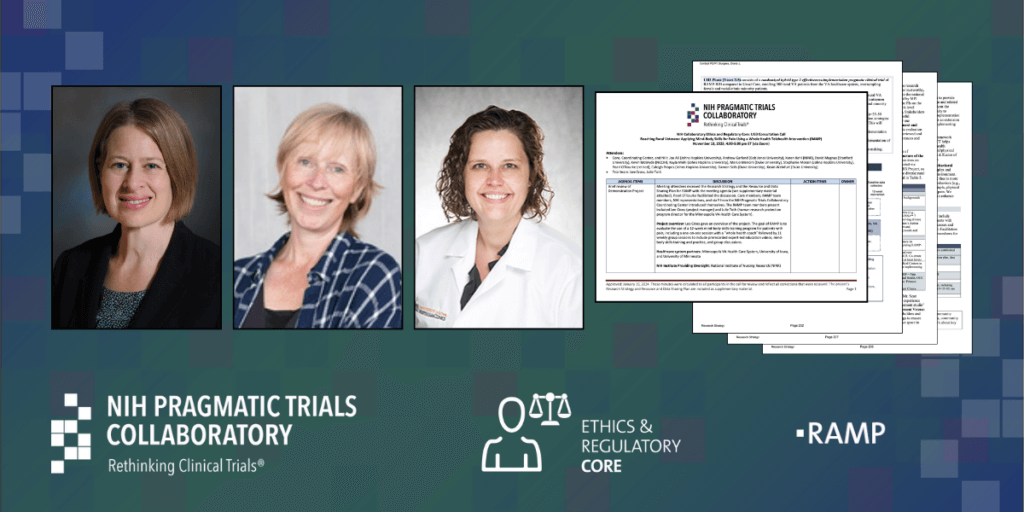 Ethics and regulatory onboarding documentation is now available for RAMP, one of the NIH Pragmatic Trials Collaboratory's newest pragmatic clinical trials. The documents include meeting minutes and supplementary materials summarizing recent discussions of ethics and regulatory issues associated with the study.
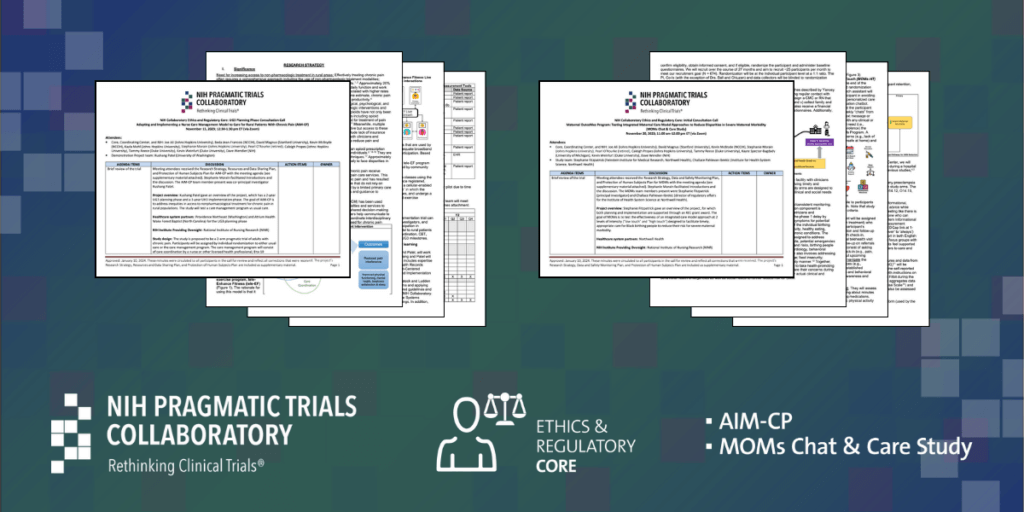 Ethics and regulatory onboarding documentation for 2 of the NIH Pragmatic Trials Collaboratory's newest trials is now available. The documents include meeting minutes and supplementary materials summarizing recent discussions of ethics and regulatory issues associated with the AIM-CP trial and the MOMs Chat & Care Study.
 In a new article from the NIH Pragmatic Trials Collaboratory, the BeatPain Utah study team describes the "implementation mapping" they used to plan for trial implementation. The comprehensive, systematic approach enabled the team to craft an implementation plan for a complex telehealth intervention and to identify outcomes for evaluating the success of the implementation strategies.
 Ethics and regulatory onboarding documentation is now available for iPATH, one of the NIH Pragmatic Trials Collaboratory's newest pragmatic clinical trials. The documents include meeting minutes and supplementary materials summarizing recent discussions of ethics and regulatory issues associated with the study.
 Ethics and regulatory onboarding documentation for 2 of the NIH Pragmatic Trials Collaboratory's newest trials is now available. The documents include meeting minutes and supplementary materials summarizing recent discussions of ethics and regulatory issues associated with the ARBOR-Telehealth and I CAN DO Surgical ACP studies.