Grand Rounds July 11, 2025: Novel Approaches to Recruiting Clinical Sites for Embedded Pragmatic Clinical Trials: Insights from the AIM-Back Trial (Trevor Lentz, PT, PhD and Tyler Cope, PT, DPT, ACT)

Speakers

Trevor Lentz, PT, PhD
Tyler Cope, PT, DPT, ACT
Duke Clinical Research Institute
Duke Department of Population Health Sciences
Durham Veterans Administration

Keywords

AIM-Back; Clinical site recruitment; Cluster randomized trial; Low back pain; Recruitment funnel

Key Points

  • Low back pain is an impactful condition that is more common in the veteran population. Typical low back pain care involves imaging and pharmacologic treatments that don’t always resolve pain issues and may lead to more invasive injection-based or surgical measures that often don’t result in better outcomes.
  • Research has shown that non-drug treatments (eg, cognitive behavioral therapy [CBT], yoga, physical therapy [PT]) are effective but not often used.
  • The AIM-Back trial (Improving Veteran Access to Integrated Management of Back Pain), an embedded pragmatic cluster randomized trial, sought to restructure care practices in Veteran’s Administration (VA) healthcare systems to promote and facilitate 2 clinical non-drug pathways that are supported by established guidelines as first-line treatment for low back pain.
  • Two care pathways were developed in coordination with VA clinicians, veterans, and care givers: (1) Sequenced Care Pathway – This pathway provided an initial onsite physical therapy evaluation and treatment session followed by weekly telehealth physical activity training for 6 weeks. The patient then saw the physical therapist again and was either discharged or provided with 6 weeks of training in psychologically-informed practices to help patients manage pain. (2) Pain Navigator Pathway – In this pathway, a local site clinician who was trained by the study team as a pain navigator discussed and facilitated alternative treatments for low back pain (eg, PT, yoga, CBT, massage). Patient follow up at both 6 and 12 weeks assessed progress and outcomes.
  • AIM-Back used a novel and intentional recruitment method, borrowing the concept of the business sales funnel, to generate as many site leads as possible. The recruitment process was systematic involving a 3 step framework: (1) Identify leads, (2) Approach leads, (3) Engage and select sites.
  • In step 1, leads were identified through Warm Market methods (sites known to the researchers), by Leveraging Data (evaluating lists of providers for potential fit), and through traditional Promotional Outreach efforts (advertising through networks and listservs). AIM-Back identified 184 leads from 53 VA healthcare systems.
  • Step 2 involved approaching leads through email messages. AIM-Back learned that promoting the trial in a way that helps clinicians solve their problems instead of asking clinicians to help with the research was more likely to yield the site. AIM-Back received responses from 23 VA healthcare systems.
  • In step 3, AIM-Back engaged personnel at all levels, from leadership to clinicians, to assess feasibility and buy-in at the site. AIM-Back selected 19 participant sites within 10 VA healthcare systems.
  • The Promotional Outreach strategy proved most effective with 9 (47.4%) of sites resulting from this strategy. The Leveraging Data strategy netted 6 (31.6%) sites, and 4 (21.1%) sites came from the Warm Market strategy. Site recruitment took approximately 3.6-3.8 months on average.
  • 17 sites enrolled 1817 Veterans with most sites (n=16) meeting or exceeding the minimum enrollment goal. When sites chose not to participate, they cited a reluctance to change their existing programs, a lack of clinicians or resources, or they were already participating in similar trials.

Discussion Themes

AIM-Back messaging evolved over the course of recruitment from a more traditional trial marketing email to an email that was more personal, short, and leveraged the standing of Duke University. This more personal approach to recruitment led to better relationships with sites during the trial.

Project management software can be helpful for tracking follow up with site leads and communication during the recruitment process.

One overall goal of AIM-Back was to set up a new clinical program that could continue after the end of the trial. Sites were given training materials for the centralized study components and support from AIM-Back was stepped down slowly. Sites that chose to continue the intervention trained a physical activity/whole health coach and a PT for the psychologically informed PT portion of the intervention.

Indicators of a potentially successful site included qualitative components that reflect a high level of engagement such as high interest and excitement in the study along with a sufficient patient population.

Read more about the AIM-Back trial design.
Grand Rounds August 23, 2024: Improving Quality of Life in COPD and Heart Failure: Unpacking a Successful Multicomponent Virtual Team Intervention (David B. Bekelman, MD, MPH; Lyndsay DeGroot PhD, RN, CNE)

Speakers

David B. Bekelman, MD, MPH
Professor of Medicine and Psychiatry
Rocky Mountain Regional VAMC and University of Colorado Division of General Internal Medicine

Lyndsay DeGroot PhD, RN, CNE
Postdoctoral Fellow
University of Colorado
Anschutz Medical
Campus School of Medicine

Keywords

COPD; Heart Failure; Collaborative Care; Palliative Care

Key Points

  • Heart failure (HF) and Chronic Obstructive Pulmonary Disease (COPD) are common illnesses that share a number of symptoms, including persistent breathlessness and fatigue; depression; and anxiety.
  • Though HF and COPD patients could benefit from palliative care prior to the end of life, there aren’t enough palliative care specialists to provide care to the patient population.
  • ADAPT is a virtual intervention built on a collaborative care team approach. A nurse and social worker provide direct patient care and meet weekly with a collaborative care team – consisting of a primary care physician, palliative care specialist, and as-needed cardiologist and pulmonologist – to review individual cases.
  • The research team’s primary aim was to determine the effect of ADAPT on participant quality of life, measured using the FACT-G scale.
  • They concluded that a nurse and social worker palliative telecare team demonstrated early, persistent, clinically meaningful improvements in quality of life for high-risk outpatients with COPD, HF, and Interstitial Lung Disease.
  • The ADAPT virtual care model leveraged a team of nurses, social workers, and physicians across two large VA health systems to increase the reach of palliative care to common, serious non-cancer illnesses.
  • The intervention was relatively inexpensive, but implementing a multifaceted, personnel-intensive program posed its own challenges.
  • Future directions include investigating the intervention effect on utilization outcomes and end-of-life outcomes; adapting the model for patients with advanced liver or renal disease; testing other implementation and dissemination strategies; and investigating how to improve adoption.

Discussion Themes

The mortality rate in the population they enrolled was lower than expected. This may be because it is more difficult to enroll very sick patients from an outpatient population.

This study was designed to test the effect of the intervention on quality of life, an outcome that has a significant impact on patients. However, securing funding for work like this can be a challenge, as the program is not designed to reduce costs (unlike interventions that aim to reduce hospitalizations).

There is a need for creative solutions when it comes to funding this model; the research team is looking to collaboration with community partners and examples set by other, similar projects.

January 2, 2024: NINR Announces Funding Opportunity to Address Social Needs Through Healthcare-Community Partnerships

The National Institute of Nursing Research (NINR) has published a funding opportunity for research to develop and expand interventions and programs that leverage existing or create new healthcare-community partnerships to address unmet social needs among individuals and families and adverse social determinants of health within communities—especially in populations that experience health disparities.

Read the full announcement for more information about the funding opportunity and details on eligibility, research objectives, key dates, application review, and award administration.

  • Letter of intent due date: February 21, 2024
  • Application due date: March 22, 2024

NINR will hold a pre-application webinar for prospective applicants on February 15, 2024, from 1:00 to 2:00 pm ET. NIH staff will provide an overview of the funding opportunity and answer questions from potential applicants. Registration is required.

Grand Rounds June 16, 2023: BeatPain Utah: Partnering With Community Health Centers Within a Socio-Technical Framework (Julie Fritz, PT, PhD, FAPTA; Guilherme Del Fiol, MD, PhD)

Speakers

Julie Fritz, PT, PhD, FAPTA
Distinguished Professor, Department of Physical Therapy & Athletic Training
Associate Dean for Research, College of Health
University of Utah

Guilherme Del Fiol, MD, PhD
Professor, Biomedical Informatics
University of Utah

Keywords

Community Health Centers; Low Back Pain; Physical Therapy Modalities; Primary Care; Telemedicine

Key Points

  • Clinical practice guidelines support nonpharmacologic care as first-line management of low back pain. However, persons in low-income and rural communities have significantly higher odds of receiving a prescription opioid for a new back pain diagnosis.
  • Use of nonpharmacologic pain treatments is lower in rural settings and for persons of Hispanic/Latino ethnicity. Many of these communities are served by federally qualified health centers that often lack options to provide accessible nonpharmacologic alternatives.
  • Clinical research can exacerbate disparities, because clinical trials typically are based in urban, academic medical centers, underrepresent diverse populations, and overlook community engagement strategies in trial planning and design.
  • BeatPain Utah, an NIH Pragmatic Trials Collaboratory Trial, is an embedded pragmatic clinical trial comparing the effectiveness of nonpharmacologic intervention strategies for patients with back pain seeking care in federally qualified health centers in Utah. The interventions include a telehealth strategy that provides a brief pain teleconsult along with phone-based physical therapy, and an adaptive strategy that provides the brief pain teleconsult first, followed by phone-based physical therapy among patients who are nonresponsive to treatment.
  • BeatPain Utah is using the Community-Engaged Dissemination and Implementation (CEDI) framework, which considers both social and technical factors in the implementation of health IT strategies, decentralizes the research methods and procedures, and grounds the implementation in a systematic, iterative mapping of how both clinic staff and patients interact with health IT.
  • Although there is evidence of a significant divide in the implementation of advanced health IT functions, low-resource settings can adopt advanced health IT with some assistance. Moreover, there is considerable opportunity to reduce inequities through increased adoption of telehealth strategies, given that 96% of people in low-resource communities have at least a text and voice phone.

Discussion Themes

  • Motivating patients to engage in self-management of health conditions is a challenge, irrespective of whether the intervention is delivered in person or remotely.
  • Designing interventions that can meet everyone’s needs can be a challenge in a study that involves rural/urban and racial/ethnic diversity. Implementation mapping at the beginning of the design process is key. This includes direct assessment of patients’ needs, such as by interviewing patients who seek care in the partnering clinics to understand their expectations and how they would think about a mode of care delivery, like telehealth, that is unfamiliar to them.
  • Another crucial element of the health equity–focused model is ensuring that the question at the heart of the research is of value to the clinics and their leadership. For every trial, one of the first important tasks is to reach out to the community health center leadership and see if they are interested. The clinic’s priorities should drive the design of the trial. “We have to be very accommodating to the needs of each [community health center] and respect their needs.”
  • How quickly can these types of studies proceed from trial completion to release of results? Especially in studies involving chronic conditions, having long-term follow-up data to answer the core effectiveness question in a hybrid trial means there could be a long wait for results. Researchers must also be prepared to consider the question of sustaining a service that many clinics in the study have come to rely on, even before the results are available.

Tags

#pctGR, @Collaboratory1

June 14, 2023: BeatPain Utah Pragmatic Trial Featured in This Friday’s PCT Grand Rounds

Headshots of Dr. Julie Fritz and Dr. Guilherme Del FiolIn this Friday’s PCT Grand Rounds, Julie Fritz and Guilherme Del Fiol of the University of Utah will present “BeatPain Utah Pragmatic Clinical Trial: Partnering With Community Health Centers Within a Socio-Technical Framework.”
The Grand Rounds session will be held on Friday, June 16, 2023, at 1:00 pm eastern.

BeatPain Utah, an NIH Collaboratory Trials, is studying real-world implementation of a telehealth physical therapy strategy for patients with chronic back pain in primary care clinics of federally qualified health centers. The study is supported by the NIH through the NIH Heal Initiative under an award from the National Institute of Nursing Research.

Dr. Fritz is a distinguished professor of physical therapy and athletic training and Dr. Del Fiol is a professor of biomedical informatics—both at the University of Utah.

Join the online meeting.

May 17, 2022: NIH and Program Leaders Discuss PRISM’s Role in NIH HEAL Initiative

In an interview at the NIH Pragmatic Trials Collaboratory Steering Committee’s annual meeting in April, Dr. Rebecca Baker, Dr. Adrian Hernandez, and Dr. Wendy Weber discussed how the PRISM program and the NIH HEAL Initiative are working together to answer questions about pain management and the national opioid public health crisis.

Baker is the director of the NIH HEAL Initiative, and Hernandez is co-principal investigator of the NIH Pragmatic Trials Collaboratory Coordinating Center, for which Weber is the NIH Project Officer.

“I think the PRISM program is a great piece of the NIH HEAL initiative,” said Weber. “The HEAL initiative has everything from basic science all the way up to what PRISM is doing, which is taking these effective interventions and actually figuring out how do you put them into the healthcare system.”

The Helping to End Addiction Long-term Initiative (NIH HEAL Initiative) is an aggressive, trans-agency effort to speed scientific solutions to stem the national opioid public health crisis. It has launched more than 600 different research projects, totaling a more than $2 billion investment.

The PRISM program (Pragmatic and Implementation Studies for the Management of Pain to Reduce Opioid Prescribing) is a component of the NIH HEAL Initiative, and the NIH Pragmatic Trials Collaboratory serves as the PRISM Resource Coordinating Center, supporting large-scale embedded pragmatic clinical trials to determine the effectiveness of non-opioid interventions for pain.

“When we talk about learning in the healthcare system, this is an area that we see is going to have continuous learning, and so, as there are new options for pain management, how do you get them implemented into practice, what are the gaps, what else is needed for these areas,” said Hernandez. “This becomes a hallmark of what we are aiming to do for the NIH Pragmatic Trials Collaboratory.”

PRISM and the NIH HEAL Initiative have developed common measures across studies in order to create a HEAL data ecosystem that will allow investigators to do meta-analyses with shared outcome measures across studies.

“One thing that we’ve learned through HEAL, especially in our focus on pain, but also for addiction, is that these conditions don’t exist in isolation, so people rarely have just pain—they have pain plus other health conditions,” said Baker. “Being able to study that in a pragmatic way and iterate around different types of patients enriches the knowledge that comes out of the study and then enables clinicians to provide great care, too.”

Through key partnerships with the NIH Pragmatic Trials Collaboratory, PRISM, and other federal partners, the NIH HEAL Initiative is now integrating the experience of patients at the outset of studies and focusing on health disparities and health inequity issues.

“If we just conduct research, publish the papers, go to academic meetings and discuss them, we’re not going to have the impact we’re hoping to have through this initiative, and so the next phase is continuing to expand our research into these domains that we weren’t able to start with at the beginning but also continue to build those partnerships for dissemination and implementation,” said Baker.

View the full interview.

See the complete materials from the 2022 Steering Committee meeting.

March 10, 2022: New Guidance From IMPACT Collaboratory Provides Best Practices for Advancing Health Equity in Pragmatic Trials for Dementia

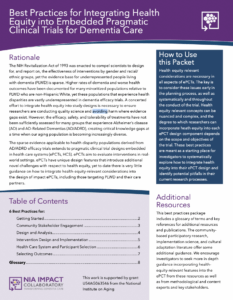
IMPACT Collaboratory DocumentThe NIA IMPACT Collaboratory has created an new document with Best Practices for Integrating Health Equity into Pragmatic Clinical Trials for Dementia Care

The IMPACT Collaboratory’s Leadership and Health Equity Team developed the document to bolster the inclusion of underrepresented people living with dementia in pragmatic trials embedded in healthcare systems, including trials that study Alzheimer disease and related dementias.

The packet provides a best practices for:

  • Getting started
  • Community stakeholder engagement
  • Design and analysis
  • Intervention design and implementation
  • Healthcare system and participant selection
  • Selecting outcomes

The NIA IMPACT Collaboratory is supported by a grant from the National Institute on Aging. Its mission is to advance care for persons with dementia and their caregivers in real-world settings by building national capacity to conduct pragmatic clinical trials that test interventions embedded in healthcare systems.

Read the full document.


January 11, 2022: New Funding Opportunities Support Investigators at All Levels in Pragmatic Clinical Research

Logo for the NIA IMPACT CollaboratoryThe NIA IMPACT Collaboratory announced 2 new funding opportunities for researchers at all levels who are interested in pragmatic clinical trials embedded in healthcare systems (ePCTs). They include career development awards for early-stage researchers and a scholars program for midlevel and senior researchers.

  • Career Development Award: The IMPACT Collaboratory will fund 2-year career development awards to support the development of early-stage researchers who are seeking careers conducting ePCTs for people living with Alzheimer disease or related dementias and their care partners. Applications are due March 18. An optional informational webinar will be held on February 1.
  • Health Care System Scholars Program – The IMPACT Collaboratory’s Health Care System Scholars Program offers midlevel and senior investigators an opportunity to develop ePCTs with healthcare systems interested in improving the care provided to people living with Alzheimer disease or related dementias and their care partners. Letters of intent are due February 8. An optional informational webinar will be held on January 20.

The NIA IMPACT Collaboratory is supported by a grant from the National Institute on Aging. Its mission is to advance care for persons with dementia and their caregivers in real-world settings by building national capacity to conduct pragmatic clinical trials that test interventions embedded in healthcare systems.

December 20, 2021: NIH Supplemental Funding Available for Bioethics Capacity Building

NIH logoThe NIH announced the availability of an administrative supplement to fund research on ethical considerations related to biomedical research and projects that support capacity building in bioethics.

Over the past 3 years, the NIH Office of the Director has partnered with NIH Institutes and Centers to support projects spanning the wide range of intersections between bioethics and biomedical research. The new funding opportunity applies to both basic and clinical research and supports a variety of research projects, from ethical considerations in emerging technologies to developing capacity to further engage research participants as partners in research. Applications will be accepted until March 17, 2022.

View the official notice.

December 14, 2021: A Year of New Insights From the NIH Collaboratory

Collage of journal coversNIH Collaboratory researchers in 2021 shared study results, generated new knowledge, and developed innovative research methods in pragmatic clinical trials. Their work included insights from the Coordinating Center and Core Working Groups, analyses from the NIH Collaboratory Distributed Research Network, and results and methodological approaches from the NIH Collaboratory Trials.

So far this year, the NIH Collaboratory has produced 3 dozen articles in the peer-reviewed literature, including the primary results of the PPACT and TSOS trials, the study design of the Nudge and OPTIMUM studies, insights into the COVID-19 pandemic from the EMBED and ACP PEACE studies, and more:

NIH Collaboratory Coordinating Center

NIH Collaboratory Distributed Research Network

ACP PEACE NIH Collaboratory Trial

BackInAction NIH Collaboratory Trial

EMBED NIH Collaboratory Trial

GRACE NIH Collaboratory Trial

HiLo NIH Collaboratory Trial

LIRE NIH Collaboratory Trial

Nudge NIH Collaboratory Trial

OPTIMUM NIH Collaboratory Trial

PPACT NIH Collaboratory Trial

PRIM-ER NIH Collaboratory Trial

PROVEN NIH Collaboratory Trial

SPOT NIH Collaboratory Trial

TSOS NIH Collaboratory Trials