June 23, 2025: How to Choose Patient-Reported Outcome Measures in Pragmatic Clinical Trials?

Living Textbook iconA new section of the Living Textbook of Pragmatic Clinical Trials describes considerations for choosing patient-reported outcome measures in pragmatic clinical trials.

“Where possible, investigators are encouraged to use measures with adequate support for validity that are in the public domain,” the authors wrote.

The authors provide a set of questions to guide investigators in choosing appropriate measures. For example, investigators may want to understand whether the patient-reported outcome is in electronic health records, is in the public domain, and is valid for the use case in question.

The considerations were developed by members of the NIH Pragmatic Trials Collaboratory’s Patient-Centered Outcomes Core in collaboration with the Health Care Systems Interactions Core, the Electronic Health Records Core, and colleagues at the NIH.

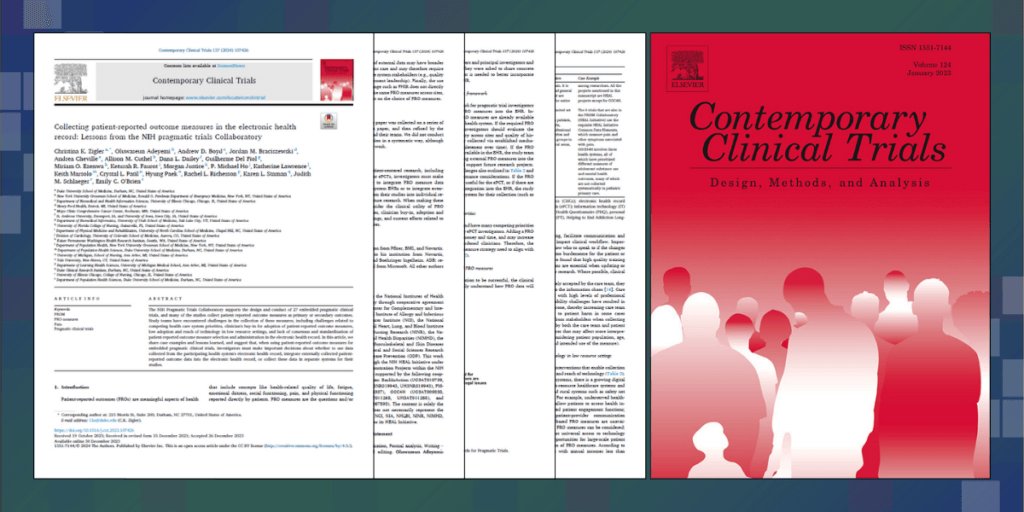
January 8, 2024: Pragmatic Trials Researchers Share Lessons From Collecting Patient-Reported Outcomes in the Electronic Health Record

In a new article from the NIH Pragmatic Trials Collaboratory, investigators from 6 of the program’s pragmatic clinical trials share case examples of the challenges they encountered in collecting patient-reported outcomes (PROs) in their trials and the strategies they used to address them.

The article was published this week in Contemporary Clinical Trials.

PRO measures reflect meaningful aspects of health and provide information about outcomes that are experienced uniquely by the patient, such as pain intensity, fatigue, and satisfaction with social roles. The challenges described by the authors include:

  • competing healthcare system priorities
  • clinician buy-in for adoption of PRO measures
  • low adoption and reach of technology in low-resource settings
  • lack of consensus and standardization of PRO selection and administration in the electronic health record

The authors suggest that, given the multiple barriers, study teams may need to use separate data collection systems or integrate externally collected PRO data into the electronic health record.

“When using patient-reported outcome measures for embedded pragmatic clinical trials investigators must make important decisions about whether to use data collected from the participating health system’s electronic health record, integrate externally collected patient-reported outcome data into the electronic health record, or collect these data in separate systems for their studies.”

Learn more about the NIH Collaboratory Trials.

This work was a collaboration between the Electronic Health Records Core and the Patient-Centered Outcomes Core of the NIH Pragmatic Trials Collaboratory.

October 12, 2023: GRACE Team Shares Lessons About Monitoring Signals of Suicidality in Pragmatic Clinical Trials

In a new article published this week in Contemporary Clinical Trials Communications, the GRACE DNIH Collaboratory Trial team recommends that suicidality should be monitored in pragmatic clinical trials that measure depression as an outcome. The work builds on their experience conducting research involving patients with sickle cell disease and on previous work from the NIH Pragmatic Trials Collaboratory’s Ethics and Regulatory Core.

The authors offer 7 recommendations to address ethical considerations in the development of protocols, procedures, and monitoring activities related to suicidality in depressed patients in a pragmatic clinical trial.

Recommendations:

  • Understand our responsibility to act
  • Define triggers for action
  • Examine responsibilities for action
  • Protect patient autonomy and privacy
  • Identify indirect and collateral participants
  • Mitigate the risk of bias
  • Integrate responses within the clinical practice and understand the sociotechnical considerations.

Severe depression symptoms such as suicidal ideation can be assessed in patients using the PHQ-9, a validated self-report instrument used to score depression severity by inquiring about the  presence and severity of depression, passive thoughts of death, and active ideas of self-harm.

For more, read the full article or the article Responding to Signals of Mental and Behavioral Health Risk in PCTs from the Ethics and Regulatory Core.

The GRACE is supported by the NIH through the NIH HEAL Initiative under an award administered by the National Center for Complementary and Integrative Health. Learn more about the GRACE trial.

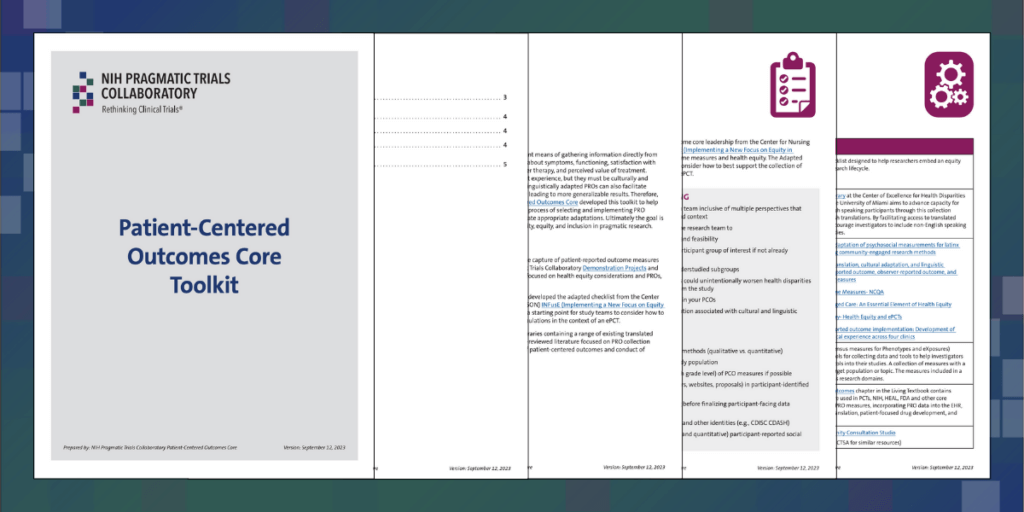
October 2, 2023: Patient-Centered Outcomes Core Develops Tool Kit to Promote Health Equity in PROs

The Patient-Centered Outcomes Core has developed a new tool kit to provide resources to support the capture of patient-reported outcome (PRO) measures in diverse study populations. The tool kit is intended for research teams conducting pragmatic clinical trials, including those participating in the NIH Pragmatic Trials NIH Collaboratory Trials.

This tool kit contains 3 sections:

  • Brief background about how PROs can provide critical information about the patient experience, but they must be culturally and linguistically appropriate to be valid.
  • A checklist focused on health equity considerations and PROs, which was adapted from the Center for Nursing Research at Duke University School of Nursing (DUSON) INFusE (Implementing a New Focus on Equity in Research) Checklist in order to focus on PRO measures and health equity.
  • An additional resources document that provides links to virtual libraries containing a range of existing translated and/or culturally adapted PRO measures, links to relevant peer-reviewed literature focused on PRO collection in pragmatic trials, and other tool kits to support equity in the collection of patient-centered outcomes and the conduct of pragmatic research.

For more information, see the Patient-Reported Outcomes chapter of the Living Textbook.

September 27, 2023: This Friday’s PCT Grand Rounds to Highlight PROTEUS Consortium

Headshots of Claire Snyder, Norah Crossnohere, and Anne SchusterIn this Friday’s PCT Grand Rounds, Claire Snyder of Johns Hopkins University and Norah Crossnohere and Anne Schuster, both of Ohio State University, will present “Navigating the Use of Patient-Reported Outcomes in Research and Practice: The PROTEUS Consortium.”

The Grand Rounds session will be held on Friday, September 29, 2023, at 1:00 pm eastern.

The PROTEUS Consortium provides tools and resources to assist researchers in the the use of patient-reported outcomes in clinical trials and clinical practice.

Snyder is a professor of medicine and the director of the Program for Building Lifestyle, Outcomes, and Care Services Research in Cancer (BLOCS) at Johns Hopkins University. Crossnohere is an assistant professor of medicine and Schuster is a research scientist at Ohio State University.

Join the online meeting.

Collecting and Sharing Patient-Reported Outcomes in the PPACT Trial

Collecting and Sharing Patient-Reported Outcomes in the PPACT Trial

Description

In this video, Dr. Lynn DeBar, PI of the PPACT trial describes how her team used electronic health records to collect and share patient-reported outcomes.

Biography

Headshot of Lynn DeBar, PhD, MPHLynn DeBar, PhD, MPH
Kaiser Permanente Washington Health Research
PPACT NIH Collaboratory Trial PI


Related

Incorporating PRO Data Into the EHR

View the full Grand Rounds video: Experiences From the Collaboratory PCTs.

Return to the complete collection of EHR Workshop video modules.

August 23, 2023: PCT Grand Rounds to Highlight a Pragmatic Trial of an EHR Display of Real-Time PRO Data

Headshot of Dr. Gabriela SchmajukIn this Friday’s PCT Grand Rounds, Gabriela Schmajuk of the University of California, San Francisco, will present “Pragmatic Trial of an EHR Application to Display Real-Time PRO Data: Successes and Challenges.”

The Grand Rounds session will be held on Friday, August 25, 2023, at 1:00 pm eastern.

Schmajuk is a professor of medicine at UCSF and the chief of rheumatology at the San Francisco VA Health Care System.

Join the online meeting.

June 14, 2023: IMPACt-LBP and INSPIRE Have Updated Study Snapshots, Ethics and Regulatory Documentation

Updated study snapshots and ethics and regulatory documentation are now available for the IMPACt-LBP and INSPIRE trials, both NIH Pragmatic Trials Collaboratory Trials.

Logo for the IMPACt-LBP NIH Collaboratory TrialIMPACt-LBP transitioned from the planning phase to the implementation phase in August. As part of the transition, the study team reviewed and updated the minutes of their initial consultation with the Ethics and Regulatory Core. The study is a cluster randomized trial evaluating the effect of first-contact patient referral to physical therapists and doctors of chiropractic for the treatment of low back pain. IMPACt-LBP is supported within the NIH Collaboratory under an award from the National Center for Complementary and Integrative Health.

  • Also available is an updated study snapshot for IMPACt-LBP.

Logo for the INSPIRE NIH Collaboratory TrialINSPIRE joined the NIH Collaboratory at the beginning of its implementation phase. The study team held its initial consultation with the Ethics Regulatory Core to review their approach to consent, data privacy, and the applicability of recent FDA guidance regarding clinical decision support software functions. INSPIRE consists of 2 cluster randomized trials that are using personalized clinical decision support to improve judicious antibiotic prescribing for non–critically ill patients hospitalized with abdominal infections or skin and soft tissue infections. The project is supported within the NIH Collaboratory under an award from the National Institute of Allergy and Infectious Diseases.

  • See also the study snapshot for INSPIRE.

March 15, 2023: In This Friday’s PCT Grand Rounds, PROs for Adverse Event Monitoring in Oncology

Headshot of Dr. Ethan BaschIn this Friday’s PCT Grand Rounds, Ethan Basch of the University of North Carolina at Chapel Hill will present “Patient-Reported Outcomes for Symptom and Adverse Event Monitoring in Oncology.” The Grand Rounds session will be held on Friday, March 17, 2023, at 1:00 pm eastern.

Basch is the Richard M. Goldberg Distinguished Professor of Medical Oncology in the UNC School of Medicine and a professor of health policy and management in the UNC Gillings School of Global Public Health. He led the National Cancer Institute’s initiative to develop a patient-reported adverse event monitoring system for use in clinical research (the “PRO-CTCAE”), and he is the study chair for multiple trials employing patient-reported endpoints.

Join the online meeting.

November 22, 2022: ADAPTABLE Points to Need for Better Integration of Patient-Reported Health Data Into Pragmatic Trials

Headshot of Dr. Emily O'BrienA concordance analysis from ADAPTABLE, a large pragmatic, comparative effectiveness trial, found low to moderate agreement between patient-reported health data and data derived from the electronic health record (EHR). The findings highlight the need for better integration of patient-reported health data into pragmatic research studies.

Results of the study were published in JAMA Cardiology.

Patient-reported health data can assist investigators in capturing clinical events in pragmatic clinical trials. However, little information is available about the fitness for use of patient-reported data in large-scale health research.

In this study, analysts evaluated the concordance of a set of variables that were both reported by patients through an online portal and available in the EHR as part of the trial. The validity of participant self-report varied by the method of data collection, the participant population, and the type of information collected. For example, patient report of clinical events had low sensitivity compared with EHR data for myocardial infarction, stroke, and major bleeding events. Coronary revascularization was the most concordant event by data source, but agreement was only moderate.

“As the use of direct-to-participant research designs grows, it’s important to understand how participant-reported data lines up with other data types,” said Emily O’Brien, an associate professor in population health sciences at Duke University and the lead author of the study.

“Our findings suggest that some caution is warranted in this space—especially if relying on participant report alone for capture of cardiovascular events—and we need more research on how to best design questions and set up participant portals to maximize validity of this type of data,” O’Brien said.

ADAPTABLE, the first major randomized comparative effectiveness trial conducted by the National Patient-Centered Clinical Research Network (PCORnet), seeks to determine the optimal dose of aspirin therapy for secondary prevention of atherosclerotic cardiovascular disease. The trial relies on both existing EHR data sources and patient-reported health data captured through an online portal.

This is the first study to assess validity of participant-reported health data collected through an online portal. The study’s results are consistent with prior evidence suggesting that the validity of participant-reported events varies by data collection modality, participant subgroup, and the type of information collected.

This work was supported by a supplemental grant award to the NIH Pragmatic Trials Collaboratory Coordinating Center from the National Center for Complementary and Integrative Health.

Read the full report in JAMA Cardiology.