January 12, 2026: Enhanced Acupuncture Strategy Found to Be Cost-Saving in Older Adults With Chronic Low Back Pain

Logo for the BackInAction trialAn economic evaluation from the BackInAction trial found that an enhanced course of acupuncture for older adults with chronic low back pain was cost-saving from both the Medicare and healthcare sector perspectives.

The article appears in the upcoming issue of Spine.

In a previously published report, the BackInAction research team established that acupuncture significantly improved pain and disability in patients aged 65 years and older. The new analysis shows the treatment also provides significant value to the healthcare system.

The cost-effectiveness analysis, led by Patricia Herman of the RAND Corporation, analyzed data for 672 participants across 3 large healthcare systems. The study compared 3 treatment strategies: a standard 12 -week course of acupuncture plus usual medical care; standard acupuncture enhanced with up to 6 maintenance sessions plus usual care; and usual care alone.

The research team found that enhanced acupuncture reduced annual back pain–related healthcare costs by an average of $491 per participant and reduced Medicare-reimbursed costs by $421 per participant compared with usual care alone. The savings were primarily driven by a significant reduction in non-acupuncture healthcare utilization.

BackInAction, an NIH Collaboratory Trial, was led by co–principal investigators Lynn DeBar of the Kaiser Permanente Center for Health Research and Andrea Cook of the Kaiser Permanente Washington Health Research Institute.

Read the full report.

Beyond financial savings, participants in the enhanced acupuncture group experienced:

  • Significant gains in quality-adjusted life-years, a standard measure of health-related quality of life
  • An 18.5 percentage-point increase in the number of participants achieving a clinically meaningful improvement in their disability scores

While standard acupuncture was slightly more expensive than usual care, the strategy’s incremental cost-effectiveness ratio of approximately $53,000 per quality-adjusted life-year suggests it may be cost-effective from the perspectives of Medicare and the healthcare sector.

The BackInAction team’s findings are particularly relevant in the context of the Medicare program’s decision in 2020 to begin covering acupuncture for chronic low back pain. The study suggests that the current Medicare benefit, which includes maintenance sessions, aligns with the most cost-effective and beneficial care for this population.

By including a variety of healthcare settings and older adults with multiple medical conditions, this pragmatic clinical trial’s results are intended to be highly generalizable and to inform future treatment policies for the millions of older people in the United States who experience chronic pain.

BackInAction was supported within the NIH Pragmatic Trials Collaboratory through the NIH HEAL Initiative by a grant from the National Center for Complementary and Integrative Health. Learn more about BackInAction.

December 8, 2025: New Podcast Explores Partnership Between Rural-Focused Research Network and BeatPain, an NIH Collaboratory Trial

In a new episode of the Rethinking Clinical Trials Podcast, Julie Fritz of the University of Utah and Sebastian Tong of the University of Washington expanded on key takeaways from their recent Grand Rounds presentation, “Integrating the BeatPain Study With PRaCTICe, a New Network Research Hub of the CARE for Health Initiative.”

Listen to the podcast. For alerts about new episodes, subscribe for free on Spotify, Amazon Music, Apple Podcasts, or SoundCloud.

In an effort to connect patients in rural areas with innovative care, the Primary Care Rural and Frontier Clinical Trials Innovation Center (PRaCTICe) partnered with BeatPain. In the podcast, Fritz and Tong discuss what made the partnership a good fit.

“The BeatPain study was meeting a need that clinicians that patients had identified: access to non-pharmacological treatments for chronic pain that are evidence-based in many places there just wasn’t access to physical therapy,” said Tong.

Roughly a year into their collaboration, PRaCTICe had referred 165 patients to the BeatPain team, 95% of which were rural residents. Fritz and Tong each shared some of their lessons learned around building trust and capacity in low resource settings.

“Local people who support what you’re doing, that you build relationships with so they know that you’re doing the best you can by the participants that come out of their clinics, I think that’s been key to building successful partnerships. Both at the clinical level and at the patient level,” said Fritz.

BeatPain Utah, an NIH Collaboratory Trial, is comparing the effectiveness of nonpharmacologic intervention strategies for patients with back pain seeking care in federally qualified health centers throughout the state of Utah.

Fritz is the principal investigator for BeatPain Utah and a distinguished professor of physical therapy and athletic training at the University of Utah. Tong is a co–principal investigator for AIM-CP, an NIH Collaboratory Trial, and an associate professor of family medicine at the University of Washington.

November 20, 2025: NOHARM Explores Patients’ and Nurses’ Experiences With a Perioperative Nonpharmacologic Pain Care Education Program

Headshots of Dr. Andrea Cheville and Dr. Jon Tilburt
Dr. Andrea Cheville and Dr. Jon Tilburt, principal investigators for NOHARM

In 2 recent studies, as part of the NOHARM trial, researchers explored the perspectives of patients and nurses on the implementation of a perioperative nonpharmacologic pain care education program.

One study, published in JMIR Nursing, evaluated inpatient nurses’ perceptions of barriers and facilitators to implementing the Healing After Surgery initiative. Healing After Surgery is a program embedded in the electronic health record (EHR) that provides education and support to patients for incorporating nonpharmacologic pain care techniques into their individualized perioperative pain management plans.

The researchers found that the nurses understood the benefits of the program but had difficulty implementing unfamiliar pain care techniques and prioritizing the initiative due to other clinical demands. Read the full report.

In the second study, published in BMC Complementary Medicine and Therapies, the researchers used semistructured qualitative interviews to explore patients’ experiences participating in the Healing After Surgery initiative. Among other things, they found that patients generally liked the program and felt that it aligned with their beliefs about wellness techniques and concerns about opioids. Read the full article.

NOHARM, an NIH Collaboratory Trial, is a stepped-wedge, cluster randomized trial testing an EHR-embedded, bundled intervention comprised of patient- and clinician-facing decision support components that enable patients to integrate nonpharmacologic pain care into their perioperative management. The study is supported within the NIH Pragmatic Trials Collaboratory by a grant award administered by the National Institute on Aging through the NIH HEAL Initiative.

Learn more about NOHARM.

November 10, 2025: NIH Pragmatic Trials Collaboratory Welcomes New Trials CARNATION and EquiP PC

We are excited to add 2 new NIH Collaboratory Trials to our portfolio of innovative pragmatic clinical trials embedded in healthcare systems.

CARNATION and EquiP PC are supported by the National Institute of Neurological Disorders and Stroke through the Pragmatic and Implementation Studies for the Management of Pain to Reduce Opioid Prescribing (PRISM) program, a component of the Helping to End Addiction Long-Term Initiative℠, or NIH HEAL Initiative℠, to address the opioid crisis.

Headshots of Dr. Lynn DeBar, Dr. Rachel Gold, and Dr. Nicole Cook
Dr. Lynn DeBar, Dr. Rachel Gold, and Dr. Nicole Cook, principal investigators for CARNATION

CARNATION (Coordinated Care Pain Management Technology Implementation) will partner with a national network of community health centers to test a multicomponent implementation support intervention designed to enable community health centers’ systematic use of electronic health record technologies for coordinating primary care–based pain care that is congruent with integrative pain management. This type 3 hybrid effectiveness-implementation trial will generate urgently needed empirical evidence for how to make integrative pain management strategies available in community health centers, where limited resources present barriers to the delivery and coordination of such care.

Lynn DeBar, Rachel Gold, and Nicole Cook will serve as the co–principal investigators of the CARNATION trial. DeBar, who led the NIH Collaboratory Trials BackInAction and PPACT, is a distinguished investigator at the Kaiser Permanente Center for Health Research. Gold is a senior investigator and the program director of chronic disease, preventive health, and wellness at OCHIN. Cook is also a research investigator at OCHIN.

Headshots of Dr. Kari Stephens and Dr. Rodger Kessler
Dr. Kari Stephens and Dr. Rodger Kessler, principal investigators for EquiP PC

EquiP PC (Equitable Primary Care for Pain Care) will test the effectiveness of an adapted behavioral health integration toolkit to improve chronic pain care. The trial will assess outcomes such as reduced pain interference, improved integrated behavioral health, implementation success, and access to care with the goal of expanding access to high-quality, team-based chronic pain care in primary care settings.

The co–principal investigators of EquiP PC are Kari Stephens and Rodger Kessler. Stephens is a licensed clinical psychologist and a professor in family medicine at the University of Washington. Kessler is vice president for innovation at the DARTNet Institute.

These 2 new NIH Collaboratory Trials will extend the mission of the NIH Pragmatic Trials Collaboratory to strengthen the national capacity to implement cost-effective, large-scale research studies that engage healthcare delivery organizations as research partners. To date, the program has supported 36 NIH Collaboratory Trials covering a range of clinical areas and spanning a dozen NIH Institutes and Centers.

September 15, 2025: In BackInAction Pragmatic Trial, Acupuncture Improved Back Pain–Related Disability in Older Adults

Headshots of Dr. Lynn DeBar and Dr. Andrea Cook
Dr. Lynn DeBar and Dr. Andrea Cook, co–principal investigators for BackInAction

Older patients with chronic low back pain who receive acupuncture treatment have greater improvements in pain and disability compared with patients who receive usual care alone, according to the BackInAction trial.

The results of the study were published online in JAMA Network Open.

BackInAction, an NIH Collaboratory Trial, compared standard and enhanced courses of acupuncture with usual care alone in adults aged 65 years and older with chronic low back pain. Previous studies found acupuncture to be a safe and effective treatment for chronic low back pain in adults, and the American College of Physicians recommends the treatment as first-line therapy. However, few studies, and no large-scale randomized trials, have examined the safety and efficacy of acupuncture in older adults specifically.

“We worked hard to involve adults in multiple regions of the country so that participant demographics were consistent with the US census for older adults,” Lynn DeBar told the NIH. “And we worked with licensed acupuncturists in the community, who are most likely to deliver these services,” she said. DeBar is a senior investigator at the Kaiser Permanente Center for Health Research and a co–principal investigator for BackInAction.

The study team randomly assigned 800 patients to 1 of 3 groups: (1) a standard 12-week course of acupuncture plus usual medical care; (2) standard acupuncture enhanced with 4 to 6 maintenance sessions plus usual care; or (3) usual care alone. The study was conducted in 4 healthcare systems in the Pacific Northwest, Northern California, and New York, including a network of federally qualified health centers in an urban setting, 2 integrated health insurance and care delivery systems serving broad geographic regions, and a fee-for-service system serving a relatively urban and suburban population.

Logo for the BackInAction trial

At 6 months and 12 months after treatment, patients in both the standard and enhanced acupuncture groups experienced significantly greater reductions in pain and pain-related disability than patients in the usual care group. The improvements did not differ significantly between the standard and enhanced courses of acupuncture.

Read the full article.

“Older adults often are dealing with other medical problems in addition to back pain,” said co–principal investigator Andrea Cook, senior biostatistics investigator at the Kaiser Permanente Washington Health Research Institute. “Acupuncture offers a less invasive option that has a better safety profile than a lot of the common treatments for back pain in older adults,” she said.

BackInAction is supported within the NIH Pragmatic Trials Collaboratory through the NIH HEAL Initiative by a grant from the National Center for Complementary and Integrative Health. Learn more about BackInAction.

February 25, 2025: NIH HEAL Initiative to Host Webinar on Morphine Milligram Equivalent (MME) Online Calculator

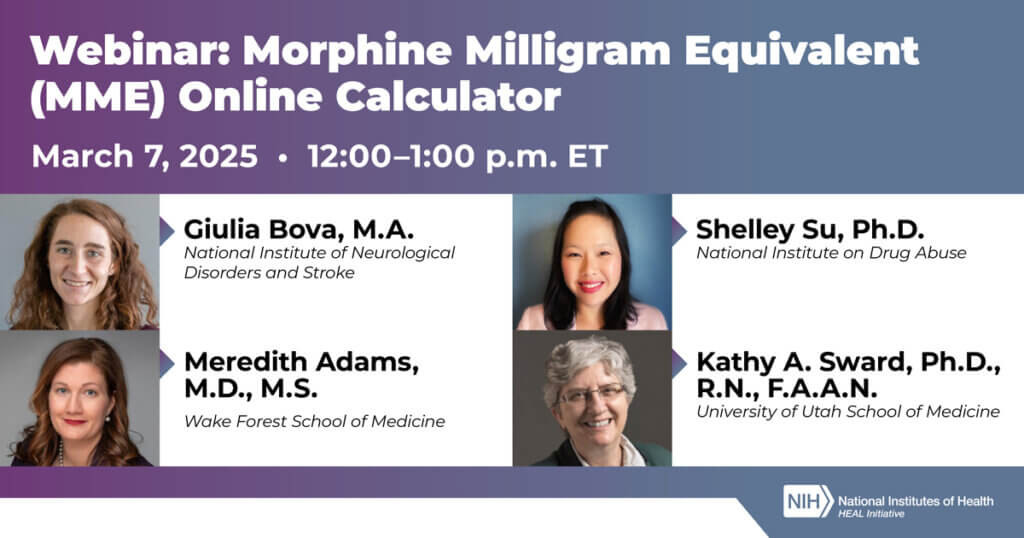
Webinar: Morphine Milligram Equivalent (MME) Online CalculatorThe NIH HEAL Initiative’s Common Data Elements (CDE) program this week announced the release of an online tool to calculate morphine milligram equivalents (MME), a standardized metric for reporting prescribed opioid use. In a webinar scheduled for Friday, March 7, speakers from the CDE program will explain the tool, demonstrate how researchers can use the tool to calculate MMEs for research purposes, and answer questions from researchers about the use of the tool for calculating and reporting MME data.

Standardizing approaches to data collection remains a critical challenge in pain research. The CDE program mandated collection of MME data in all NIH HEAL Initiative–funded research in 2023.

Webinar information: Friday, March 7, 2025; 12:00-1:00 pm ET. Registration is required to attend the webinar.

Ten of the NIH Collaboratory Trials are supported by funding from the NIH HEAL Initiative through the Pragmatic and Implementation Studies for the Management of Pain to Reduce Opioid Prescribing (PRISM) program. They explore a range of interventions to improve implementation of pain management strategies and reduce inappropriate prescribing of opioids.

October 24, 2024: APA-SM Trial Joins the NIH Pragmatic Trials Collaboratory

APA-SM InvestigatorsThe NIH Pragmatic Trials Collaboratory is pleased to welcome APA-SM (Personalized Auricular Point Acupressure for Chronic Pain Self-Management in Rural Populations) to its portfolio of innovative NIH Collaboratory Trials. The new project is supported by an award from the National Institute of Neurological Disorders and Stroke, with administrative oversight from the National Center for Complementary and Integrative Health.

The APA-SM study team will conduct a pragmatic, hybrid effectiveness-implementation trial of a 4-week auricular point acupressure intervention for self-management of chronic pain in rural communities in Texas and South Carolina. The primary outcomes include pain intensity, pain interference, and function. Key secondary outcomes are based on the HEAL Clinical Pain Core Common Data Elements. The study team will also evaluate implementation outcomes, cost-effectiveness, and predictive factors for treatment response.

Jennifer Kawi, Jane Bolin, and Hulin Wu will serve as the principal investigators for APA-SM. Kawi is a Lee and Joseph Jamail Distinguished Professor in the Cizik School of Nursing at the University of Texas Health Science Center at Houston (UTHealth Houston). Bolin is Regents Professor Emerita and a senior professor in the College of Nursing at Texas A&M University. Wu is the Betty Wheless Trotter Professor and Chair of the Department of Biostatistics and Data Science, professor of biomedical informatics, and director of the Center for Big Data in Health Sciences at UTHealth Houston.

Funding for APA-SM is provided through the Pragmatic and Implementation Studies for the Management of Pain to Reduce Opioid Prescribing (PRISM) program, a component of the Helping to End Addiction Long-Term Initiative℠, or NIH HEAL Initiative℠, to address the opioid crisis.

Learn more about the APA-SM trial.

July 24, 2024: NIH HEAL Initiative Seeks Feedback by the End of July

NIH Heal Initiative logoThe NIH HEAL Initiative issued a request for information seeking feedback on the initiative’s future strategic research priorities to address opioid use disorder, overdose, and pain.

The NIH HEAL Initiative℠, or Helping to End Addiction Long-Term Initiative℠, invites you to submit feedback to shape strategic research priorities that will guide the initiative’s future efforts to find scientific solutions to the urgent public health challenges of opioid use disorder, overdose, and pain. HEAL welcomes feedback from all interest groups, including people with living/lived experience, caregivers, researchers, the private sector, community-based organizations, health care providers, professional societies, advocacy groups, patient communities, and other members of the public.

Nine of the NIH Collaboratory Trials are supported by funding from the NIH HEAL Initiative. They explore a range of interventions to improve implementation of pain management strategies and reduce inappropriate prescribing of opioids.

Respondents are asked to share their feedback by email by July 31, 2024, to HEALquestion@od.nih.gov with “HEAL RFI” in the subject line.

Read the request for information.

July 3, 2024: NIH HEAL Initiative Seeks Feedback on Strategic Research Priorities for Opioid Use Disorder and Pain

NIH Heal Initiative logoThe NIH HEAL Initiative issued a request for information seeking feedback on the initiative’s future strategic research priorities to address opioid use disorder, overdose, and pain.

The NIH HEAL Initiative℠, or Helping to End Addiction Long-Term Initiative℠, invites you to submit feedback to shape strategic research priorities that will guide the initiative’s future efforts to find scientific solutions to the urgent public health challenges of opioid use disorder, overdose, and pain. HEAL welcomes feedback from all interest groups, including people with living/lived experience, caregivers, researchers, the private sector, community-based organizations, health care providers, professional societies, advocacy groups, patient communities, and other members of the public.

Nine of the NIH Collaboratory Trials are supported by funding from the NIH HEAL Initiative. They explore a range of interventions to improve implementation of pain management strategies and reduce inappropriate prescribing of opioids.

Respondents are asked to share their feedback by email by July 31, 2024, to HEALquestion@od.nih.gov with “HEAL RFI” in the subject line.

Read the request for information.

June 13, 2024: Burgess to Present Results of LAMP Trial, Precursor of NIH Collaboratory’s RAMP Trial

Headshot of Dr. Diana Burgess
Dr. Diana Burgess

Diana Burgess, a co–principal investigator of the NIH Pragmatic Trials Collaboratory’s RAMP trial, will present the results of the precursor LAMP trial as part of the Veterans Affairs (VA) Health Systems Research Cyberseminars series.

The Learning to Apply Mindfulness to Pain (LAMP) trial is a multisite pragmatic clinical trial that compared 2 approaches for delivering mindfulness-based interventions via telehealth for veterans with chronic pain. Both interventions improved pain functioning and important biopsychosocial outcomes over 12 months when compared with usual care among veterans with chronic pain and high levels of psychiatric comorbidity. These approaches to delivering mindfulness-based interventions could help accelerate the implementation of nonpharmacologic pain treatment in the VA healthcare system and other healthcare systems.

Results From the Learning to Apply Mindfulness to Pain (LAMP) Study: A Pragmatic Clinical Trial
VA HSR Cyberseminars
Registration for the webinar is required.
Date and time: Thursday, June 20, 2024; 12:00-1:00 pm ET

Burgess is also a co–principal investigator of Reaching Rural Veterans: Applying Mind-Body Skills for Pain Using a Whole Health Telehealth Intervention (RAMP), an NIH Collaboratory Trial. RAMP will test the delivery of a modified version of the LAMP interventions for veterans in rural communities. Learn more about RAMP.

Burgess is the director of the VA Advanced Fellowship Program in Health Services Research in the Center for Care Delivery and Outcomes Research (CCDOR), the director of the VA’s QUERI Complementary and Integrative Health Evaluation Center (CIHEC), and a professor of medicine at the University of Minnesota.