March 10, 2022: New Guidance From IMPACT Collaboratory Provides Best Practices for Advancing Health Equity in Pragmatic Trials for Dementia

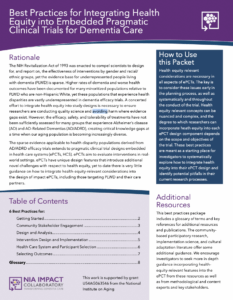
IMPACT Collaboratory DocumentThe NIA IMPACT Collaboratory has created an new document with Best Practices for Integrating Health Equity into Pragmatic Clinical Trials for Dementia Care

The IMPACT Collaboratory’s Leadership and Health Equity Team developed the document to bolster the inclusion of underrepresented people living with dementia in pragmatic trials embedded in healthcare systems, including trials that study Alzheimer disease and related dementias.

The packet provides a best practices for:

  • Getting started
  • Community stakeholder engagement
  • Design and analysis
  • Intervention design and implementation
  • Healthcare system and participant selection
  • Selecting outcomes

The NIA IMPACT Collaboratory is supported by a grant from the National Institute on Aging. Its mission is to advance care for persons with dementia and their caregivers in real-world settings by building national capacity to conduct pragmatic clinical trials that test interventions embedded in healthcare systems.

Read the full document.

 

October 26,2021: New Article Examines Justice and Equity in Pragmatic Clinical Trials

Learning Health Systems

In a new article published recently in Learning Health Systems, colleagues from the Pain Management Collaboratory examined challenges related to justice and equity in pragmatic clinical trials (PCTs) on pain management.

Based on our experience with PCTs in health systems that serve military and veteran populations,  we suggest it is particularly important to recognize that: (a) some individuals with chronic pain are vulnerable to injustice, (b) structural and sociocultural challenges that exist within health systems can complicate chronic pain research, and (c) PCTs involving NPTs [nonpharmalogical treatments] provide one lens through which injustices may be identified and addressed with the proactive input of a broad range of stakeholders.

Broadly engaging diverse stakeholders throughout the lifecycle of a PCT will take creativity, and the authors suggest specific strategies to enhance justice and equity for different phases of a PCT, including conduct and design, recruitment, selection and implementation of interventions, and stakeholder engagement .

Within learning health systems, principles of continuous learning and feedback to improve care can potentially be put to use not only to secure value in healthcare, but also to support evidence development to guide equitable practice.

Read the full article.