February 28, 2023: SMDM Will Host Webinar on Equity in Medical Decision Making

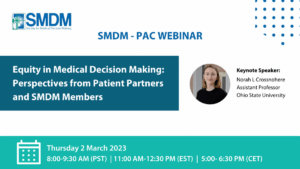
SMDM webinar information graphicThe Society for Medical Decision Making (SMDM) will host a free, live webinar on Thursday, March 2, to discuss equity and patient engagement. The webinar, “Equity in Medical Decision Making: Perspectives from Patient Partners and SMDM Members,” was organized by the SMDM Patient Advisory Council.

From the announcement:

In this webinar we will discuss equity, what it is and isn’t, the role of equity in medical decision making and gaps in the literature. There will be a keynote presentation defining equity in the context of medical decision making, followed by parallel break out rooms with moderated discussions on how equity relates to:

  • Shared decision making (SDM), including discussion of the role of health literacy and the importance of engaging patients in decisions in the way they can understand.
  • Patient Decision Aid (PtDA) development, including discussion of the importance of adapting PtDAs to ensure they meet the needs of end users.
  • Modelling including discussion of the importance of addressing equity in modelling to prevent bias in model-based medical decision making.

Equity in Medical Decision Making: Perspectives from Patient Partners and SMDM Members
Venue: Live online via Zoom
March 2, 2023; 11:00 am-12:30 pm ET
Register free online

Program

Welcome and Introductions – Jesse Jansen & Mary Politi

  • Keynote Presentation: “Definition of equity and how it impacts MDM” – Norah L Crossnohere
  • Break Out Room Discussion 1: Equity in shared decision-making conversations – Elisa Douglas & Frank Gavin
  • Break Out Room Discussion 2: Equity and accessibility in decision aids – Jesse Jansen & Karen Prantl
  • Break Out Room Discussion 3: Modelling: attending to equality and inclusion of biased on modelling – Anton Avanceña & Robin Wright-Jones

Keynote Speaker
Norah L Crossnohere
Assistant Professor at The Ohio State University
Norah L Crossnohere, PhD, is a patient-centered outcomes researcher. Her research areas include advancing methods for measuring patient and caregiver preferences; engaging patients to inform medical decision-making, and evaluating health information technologies.

  • Facilitators
    Mary C. Politi, Professor @Department of Surgery, School of Medicine, Washington University in St. Louis
  • Ashley Housten, Assistant Professor @Department of Surgery, School of Medicine, Washington University in St. Louis
  • Elisa E. Douglas, PhD, MSPH, Research Scientist @Decision Support Lab, Department of Health Services Research, The University of Texas MD Anderson Cancer Center
  • Frank Gavin, MA, Chair @Public Advisory Council Health Data Research Network Canada
  • Jesse Jansen, PhD, Associate Professor @Family Medicine, Family Medicine, School for Public Health and Prim Care, Fac. Health, Medicine and Life Sciences
  • Senator (Ret.) Robin Wright-Jones, Executive Director @The Empowerment Network, Inc
  • Karen Prantl, Policy officer @Needs assessment and patient participation Dutch Kidney Patients Association (NVN)
  • Anton Avanceña, Assistant Professor @The University of Texas at Austin
March 10, 2022: New Guidance From IMPACT Collaboratory Provides Best Practices for Advancing Health Equity in Pragmatic Trials for Dementia

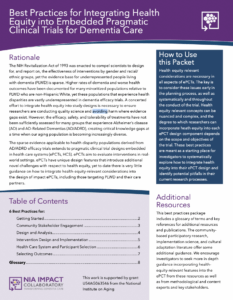
IMPACT Collaboratory DocumentThe NIA IMPACT Collaboratory has created an new document with Best Practices for Integrating Health Equity into Pragmatic Clinical Trials for Dementia Care

The IMPACT Collaboratory’s Leadership and Health Equity Team developed the document to bolster the inclusion of underrepresented people living with dementia in pragmatic trials embedded in healthcare systems, including trials that study Alzheimer disease and related dementias.

The packet provides a best practices for:

  • Getting started
  • Community stakeholder engagement
  • Design and analysis
  • Intervention design and implementation
  • Healthcare system and participant selection
  • Selecting outcomes

The NIA IMPACT Collaboratory is supported by a grant from the National Institute on Aging. Its mission is to advance care for persons with dementia and their caregivers in real-world settings by building national capacity to conduct pragmatic clinical trials that test interventions embedded in healthcare systems.

Read the full document.


October 26,2021: New Article Examines Justice and Equity in Pragmatic Clinical Trials

Learning Health Systems

In a new article published recently in Learning Health Systems, colleagues from the Pain Management Collaboratory examined challenges related to justice and equity in pragmatic clinical trials (PCTs) on pain management.

Based on our experience with PCTs in health systems that serve military and veteran populations,  we suggest it is particularly important to recognize that: (a) some individuals with chronic pain are vulnerable to injustice, (b) structural and sociocultural challenges that exist within health systems can complicate chronic pain research, and (c) PCTs involving NPTs [nonpharmalogical treatments] provide one lens through which injustices may be identified and addressed with the proactive input of a broad range of stakeholders.

Broadly engaging diverse stakeholders throughout the lifecycle of a PCT will take creativity, and the authors suggest specific strategies to enhance justice and equity for different phases of a PCT, including conduct and design, recruitment, selection and implementation of interventions, and stakeholder engagement .

Within learning health systems, principles of continuous learning and feedback to improve care can potentially be put to use not only to secure value in healthcare, but also to support evidence development to guide equitable practice.

Read the full article.

October 20, 2021: HCSRN Calls for Abstracts and Panel Presentations for 2022 Annual Conference

The Health Care Systems Research Network (HCSRN) is accepting abstracts and panel presentation submissions for the HCSRN 2022 Annual Conference until November 5, 2021. This year’s meeting will be held in Pasadena, California, from April 12 to 14, 2022.

Read complete submission information here.

The HCSRN is a 19-member research network focused on supporting research institutes aligned with healthcare delivery systems. The HCSRN’s mission is to improve individual and population health through research that connects the resources and capabilities of learning healthcare systems.

Learn more about the HCSRN here.

From its founding in 1994, the HCSRN has hosted an annual conference geared toward bringing together a diverse group of researchers, study managers, clinicians, funding agency personnel, and patient-partners to promote collaboration and share findings about research in the real-world care delivery setting. This year’s meeting will focus on “Promoting Collaboration and Partnerships to Advance Health Equity.”

Topic areas for abstracts and panel presentations include:

• Addiction Science/Substance Use
• Cancer
• Cardiovascular Disease
• Chronic Conditions, Multi-Morbidity & Aging Populations
• COVID-19
• Data Science, Informatics & Data Models
• Epidemiology & Surveillance
• Genomics & Precision Medicine
• Health Equity & Social Needs
• Health Care Delivery & Coverage
• Health Policy
• Implementation Science
• Learning Health Systems
• Maternal, Child & Family Health
• Mental Health
• Methods, Design & Analytic Tools
• Patient, Clinician & Health Systems Engagement
• Population Health Improvement
• Technology and Digital Health

July 30, 2021: Inclusion of Diverse Participants in Pragmatic Clinical Trials: Diversity in the PCT Ecosystem – How Do We Develop a Pipeline of Diverse Investigators and Leaders in PCTs? (Lesley Curtis, PhD; Marie A. Bernard, MD; George A. Mensah, MD, FACC; Natalia Morone, MD, MS)

Speakers

Panelists:

Marie A. Bernard, MD
Acting NIH Chief Officer for Scientific Workforce Diversity
Deputy Director, National Institute on Aging
National Institutes of Health

George A. Mensah, M.D., FACC
Director, Center for Translation Research and Implementation Science
National Heart, Lung, and Blood Institute (NHLBI)
Office of the Director, National Institutes of Health (NIH)

Natalia Morone, MD, MS
Associate Professor
Boston University School of Medicine
Department of Medicine
General Internal Medicine

Guest Moderator:

Lesley Curtis, PhD
Professor in Population Health Sciences
Department of Population Health Sciences
Duke University School of Medicine

Topic

Inclusion of Diverse Participants in Pragmatic Clinical Trials: Diversity in the PCT Ecosystem – How Do We Develop a Pipeline of Diverse Investigators and Leaders in PCTs?

Keywords

Diverse research faculty; NIH UNITE; CEED; Health equity; Structural racism; Inclusion

Key Points

  • The NIH UNITE initiative was founded to address and correct structural racism in biomedical research both within NIH policies and practices and in research communities outside NIH.
  • The NIH will focus on health equity by providing multiple funding opportunities that address structural racism and its effects on minority health disparity.
  • The NIH will consider the diversity of the research team when deciding grant scoring, and fund the FIRST initiative which will transform the research community to create a culture of inclusion.
  • Creating and sustaining diverse researchers and research teams is critical to supporting and encouraging diversity and inclusion in pragmatic clinical trials.
  • CEED: Career Education and Enhancement for Health Care Research Diversity seeks to foster a more diverse environment by giving under represented post docs and early career faculty, mentorship and networking opportunities.

Discussion Themes

The CEED program has made a significant impact for its participants in the number of papers published and likelihood to hold an assistant professor position.

Primary care providers and community health workers are valuable to clinical research, and funding opportunities need to be provided to these groups performing important work.

Networks should be created for early career underrepresented groups in order to develop the next generation of Pragmatic Clinical Trial scientists.

Read more about developing diversity research teams at NIH UNITE, FIRST, and CEED.

Tags

#pctGR, @Collaboratory1