The National Institutes of Health (NIH) is requesting public input on its proposal to establish harmonized and transparent policy requirements for protecting human participant research data. Specifically, NIH proposes to:
Establish policy requirements for which data should be controlled-access under NIH data sharing policies
Revise the NIH Genomic Data Sharing Policy to simplify and harmonize requirements
The Grand Rounds session will be held on Friday, April 19, 2024, at 1:00 pm eastern.
The YODA Project promotes open science, research transparency, and the sharing of clinical research data to support healthcare research. Through the project, researchers can request access to deidentified participant-level clinical trial data and research reports.
Ross is a professor of medicine and public health at Yale University and codirector of the YODA Project.
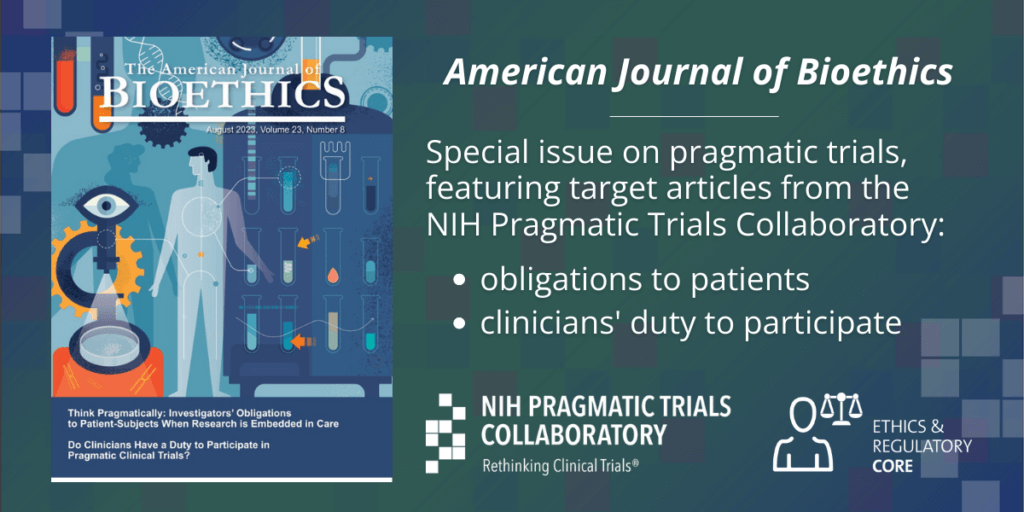
In an article published this month in the American Journal of Bioethics, FDA Commissioner Robert Califf and coauthors suggest that—despite the potential of embedded pragmatic research to generate information to improve clinical practice and public health policy—it is still relatively uncommon in US healthcare.
“Simply stated, what we are currently doing does not work, and in the face of declining health status we lack answers to critical questions about what we should be doing in health care and public health practice.”
The authors state 3 major obstacles:
Inadequate data systems: Electronic health records are not designed for research use, and are driven by billing codes and reimbursement structures.
Data sharing malaise: We have failed to develop a convincing paradigm for sharing individual-level data from routine healthcare delivery
Current oversight: Research oversight is still not designed to facilitate embedded pragmatic clinical trials or research using real-world evidence.
The authors suggest that achieving a learning health system will require
More collaboration between health systems and businesses involved in healthcare
More innovative structures for data sharing across institutions
Incentives for building the sophisticated infrastructure necessary to enable this work
Considerations from the bioethics community about how best to foster this research while respecting all those who participate
At the NIH Pragmatic Trials Collaboratory Steering Committee’s annual meeting in May, Dr. Stephanie Morain discussed the results of a recent bioethics initiative to explore ethical considerations for data sharing in the context of pragmatic clinical trials. The project was supported by a supplemental grant award from the NIH through the NIH HEAL Initiative.
Morain and coauthors Juli Bolinger, Kevin Weinfurt, and Jeremy Sugarman published their work in an article in Clinical Trials and a report of stakeholder interviews in Learning Health Systems.
With new data sharing requirements and expectations from funders, journals, and other stakeholders, Morain said the gaps in understanding related to data sharing in pragmatic clinical trials are relevant now more than ever. The supplement was an opportunity to better understand what data sharing policies exist and how well they align with pragmatic trials.
“We suspected that pragmatic clinical trials might raise different challenges compared to sharing data from traditional explanatory trials,” she explained.
Morain said that 2main reasons contributed to why data sharing may be different in the context of pragmatic clinical trials. First, many pragmatic trials use waivers or alterations of informed consent. But much existing ethical guidance for data sharing is based on the argument that sharing data is consistent with participants’ expectations or preferences.
“If we didn’t get explicit permission from participants to participate in the trial, those assumptions [about expectations or preferences] may not hold,” she explained.
The second key difference relates to the fact that pragmatic trials often use existing data from CMS or clinical records. It is often not new data generated for the research purposes, as in many traditional explanatory trials. The embedded nature of pragmatic trial data brings additional security and confidentiality concerns.
The activities of the bioethics supplement were to:
Conduct a systematic literature review to identify the specific features of pragmatic clinical trials that may alter the risk-benefit calculus for data sharing as compared to explanatory trials and other settings with ethically relevant similarities
Through stakeholder interviews, explore data sharing in pragmatic trials as understood by those responsible for the oversight, generation, dissemination, and future use of data from pragmatic trials
Evaluate existing and proposed policies and guidance to promote data sharing
Morain highlighted four key insights from this work.
More Data Needed on Patient Preferences
The first takeaway was that more data are needed on patient preferences in the context of pragmatic clinical trials.
During the qualitative interviews, stakeholders made assumptions based on irrelevant data from traditional explanatory trials. It is clear that many consider patient preferences important, and therefore, more information is needed in the context of pragmatic trials.
“If we don’t actually have permission from the people about who these data relate, we then have to make decisions about either what we think they would prefer or what we think would be in their best interest,” she explained. “Both decisions rely on empirical data to justify them,” she said.
Look Beyond Consent
The second insight was that it may be necessary to look beyond consent.
Many stakeholders in the research focused on consent as the main or only mechanism to demonstrate respect to participants. But Morain said it possible to look beyond informed consent processes to fulfill obligations of respect when sharing data from pragmatic clinical trials, particularly for trials not explicitly asking for consent.
“Consent may be one way that we [researchers] demonstrate respect, but it’s not the only way,” she said.
Healthcare Systems and Institutions Are Key Partners
The third insight was that health systems and individual institutions are key partners. It may be important for them to be transparent that pragmatic research is underway and share findings with patients.
“Institutions are key partners in regards to what data can be shared, and how to do that in a way that maximizes the benefits of sharing but also protects both the patients and the health system,” Morain said.
The Public Can’t Support What It Doesn’t Know Exists
Finally, Morain said that the findings showed that the public can’t support sharing their data if they don’t know this type of research is happening. The medical field does a poor job explaining to patients how their information will be used.
She said that sharing information, even at the aggregate level, can be powerful. Even if informed consent is waived, health systems and institutions can find ways to communicate that pragmatic research is ongoing and highlight its value in advancing science.
“Something we have been advocating for is even if we are not asking for permission, we might still be able to notify,” she said. “Even if researchers don’t have to ask for participant permission, that doesn’t mean participants can’t be told.”
At the NIH Pragmatic Trials Collaboratory Steering Committee Meeting in May, we interviewed Dr. Adrian Hernandez about how to better promote data sharing. Hernandez is a co–principal investigator of the program’s Coordinating Center and the executive director of the Duke Clinical Research Institute.
“We have to change the incentive structure because we still have barriers for sharing data. It’s not being done as often as we need it to be, especially with healthcare system trials,” Hernandez said.
Data sharing is important because it increases transparency, reproducibility, and secondary uses of medical research and is good for society. It also has to potential to advance public health, maximize investment, accelerate learning, and foster collaboration.
One of the first steps to improving data sharing is to increase patient understanding and encourage participation.
People are unaware of what’s possible for reusing data—generating new ideas, tackling different health issues that have not been addressed. People don’t realize that their data can have an expansive use.
The incentives for data sharing are different for researchers, clinicians, and healthcare system leaders.
“For researchers, data sharing efforts could be more readily recognized by linking data sets to [digital object identifiers] in publications. Reuse of data can also be part of recognition for promotion and tenure,” Hernandez said. “For healthcare systems to be more engaged in data sharing, they can promote that they are trying to advance knowledge through research activities and by sharing data.”
The barriers to sharing data include lack of trust and the possibility of misuse.
“People get worried about their data being monetized without their permission, and there are concerns about privacy and being re-identified, and that this somehow will cause harm to people individually,” Hernandez said. He noted that the ethical responsibility to share data generated by publicly funded research must be balanced against the need to protect patient privacy and scientific integrity.
For more information, see the article on data sharing and embedded research in the Annals of Internal Medicine, in which authors from the NIH Collaboratory suggest that data sharing policies must not dissuade healthcare system participation. There is also a Living Textbook chapter on Data Sharing and Embedded Research.
In the days ahead, we will share more interviews with program leaders from the 2023 Steering Committee meeting. All of the materials from the 2023 Steering Committee meeting are now available.
In an interview at the NIH Pragmatic Trials Collaboratory Steering Committee Meeting in May, Keith Marsolo, PhD, Co-Chair of the Electronic Health Records Core, reflected on data sharing experiences from the program and factors affecting the meaningful re-use of data.
Keith Marsolo, PhD
“The data sharing experiences from the NIH Pragmatic Trials Collaboratory Trials have been fairly limited. Most studies have only had one or two requests for data. I think part of the impetus for the new NIH Data Management and Sharing Policy is to spur additional re-use of research data, ” Marsolo said. He elaborated that the scientific goals for data sharing include transparency, reproducibility, validation, new generative science, and respecting the contribution of participants.
Data that can be shared include scientific data (raw data, analytic dataset, etc) and metadata (protocol, analytic code, statistical analysis plan, etc). “If we are going to share data, we want it to be useful. For new science, you likely need the raw data. For reproducibility, you need a lot of types of data. Study teams can be more upfront about the data and metadata that can be shared and the use cases they can support,” Marsolo said.
Because data from pragmatic trials are collected as part of routine care, there are restrictions as the data contain not only personal health data but also data about the healthcare system, so what can actually be shared may be limited. Overall, Marsolo suggests that more information is needed about what data can be shared and how this translates into the goals for re-use.
“I think if we’re not clear about what limitations of the data are, there could be a mismatch between expectations of what we can get from these data and what’s actually achievable,” Marsolo said.
With regards to resources needed for data sharing, Marsolo stated, “There might be funding that needs to be allocated to promote data sharing. For example, PCORI [The Patient-Centered Outcomes Research Institute] has a model where they allocate funding specifically for data sharing and dissemination.”
The EHR Core can help to promote data sharing by working to provide examples on how to navigate data sharing and outlining different approaches for pragmatic trials. NIH can provide additional guidance on how to handle datasets with restrictions—what to share, for what purpose, and at what cost.
For more information, Marsolo and colleagues published an article on data sharing in which the authors suggest that data sharing is not rising to its potential, and that more guidance is needed to prevent data sharing from becoming a “box-checking exercise.” There is also a Living Textbook chapter on Data Sharing and Embedded Research.
All of the materials from the 2023 Steering Committee meeting are now available.
Taunton Paine, Director of the NIH Scientific Data Sharing Policy Division
At the annual NIH Pragmatic Trials Collaboratory Steering Committee meeting in May, we interviewed Taunton Paine, director of the NIH Scientific Data Sharing Policy Division, about the NIH’s new Data Management & Sharing Policy, which took effect in 2023.
Under the new policy, all NIH-funded research requires a submission plan that describes how, where, and when data will be shared.
“We want to advance the rigor and reproducibility of research and promote public trust in research,” Paine said. He highlighted some key points to help researchers comply with the new policy:
Scope: The policy applies to all NIH-supported research generating scientific data of sufficient quality to validate and replicate research.
When: Share data no later than publication or end of award (for data underlying findings not published in peer-reviewed journals).
“The number one thing I would recommend for investigators is to look at sharing.nih.gov for guidance on how to write a data management and sharing plan, example plans, guidance about repositories, and frequently asked questions,” Paine said.
One key difference between the new policy and the 2003 Data Sharing Policy is that there is much more guidance and support.
“The new data management and sharing policy has a lot more guidance about what we are asking people to do and what’s acceptable. It also has information about monitoring and compliance mechanisms,” Paine said
NIH Pragmatic Trials Collaboratory leadership advocated for data sharing in an article in the Annals of Internal Medicine, suggesting that data sharing is not rising to its potential. At the Steering Committee meeting, investigators from the NIH Collaboratory Trials reviewed their trials’ data sharing plans and discussed potential barriers, a process that the program has used to bring planning for data sharing to the forefront.
In the coming weeks, we will share more interviews with program leaders from the 2023 Steering Committee meeting. All of the materials from the 2023 Steering Committee meeting are now available.
A new article from the NIH Pragmatic Trials Collaboratory outlines stakeholder insights and ethical considerations related to sharing deidentified, participant-level data in pragmatic clinical trials. While there are numerous arguments for and against data sharing in the context of pragmatic trials, the report aims to address the gap in documented stakeholder perspectives.
The authors, including members of the NIH Collaboratory’s Ethics and Regulatory Core, recruited stakeholders who represented a range of experiences. They then conducted 40 semistructured interviews focused on ethical considerations. The team identified 5 overarching themes after analyzing the interviews: (1) challenges in sharing data collected under a waiver or alteration of consent; (2) conflicting views regarding patient-subject preferences for data sharing; (3) identification of respect-promoting practices beyond consent; (4) concerns about elevated risks or burdens from sharing data; and (5) diverse views about the likely benefits resulting from sharing data.
A key insight was that a “one size fits all” model for promoting broader sharing of data from pragmatic trials is not feasible, and policies must be sensitive to the unique challenges that pragmatic trials present, such as variation among trials.
“Our data indicate unresolved tensions in how to fulfill this expectation for [pragmatic clinical trials],” the authors wrote. “Future work could inform efforts to tailor data-sharing policy and practice to reflect these and other challenges, including sharing experiences from trials that have successfully navigated these tensions.”
Lead author Stephanie Morain and co-authors Juli Bollinger, Kevin Weinfurt, and Jeremy Sugarman are members of the NIH Collaboratory’s Ethics and Regulatory Core. This work was supported within the NIH Pragmatic Trials Collaboratory by a supplemental grant award from the National Center for Complementary and Integrative Health.
The NIH Pragmatic Trials Collaboratory published a new chapter of its Living Textbook of Pragmatic Clinical Trials this week. The chapter, “Ethical Considerations of Data Sharing in Pragmatic Clinical Trials,” describes human subjects research regulations that may impact sharing data from embedded pragmatic clinical trials (ePCTs) and the ethical considerations for respecting the interests of patients who become ePCT participants.
When data are collected with a waiver or alteration of informed consent, as is often the case in ePCTs, a person may be unaware they are participating in research and therefore could not have consented to have their data used in future research. This suggests need for investigators and health systems to consider additional ways to fulfill the ethical obligation of respecting patient-participants when sharing their data from PCTs.
From left to right: Keith Marsolo, Kevin Weinfurt, Karen Staman, and Bradley Hammill
In an article published today in the Annals of Internal Medicine, leaders of the NIH Pragmatic Trials Collaboratory suggest that data sharing is not rising to its potential, and that more guidance is needed to prevent data sharing from becoming a “box-checking exercise.”
“NIH should consider guidance to help investigators and NIH institutional centers understand what needs to be shared, for what reason, and at what cost.”
The authors suggest that for data to be useful for new generative science or for reproducibility, the NIH should provide guidance regarding 5 important questions:
What data should be shared and for what purpose?
What do we mean by reproducibility?
What metadata should be shared?
What is needed for generative science?
What are the immediate and ongoing resources needed to support data sharing?
The authors state that the moral and scientific arguments for data sharing are clear: it promotes transparency, honors the participation of individuals, and enables new discoveries. They also state that more work is needed to make data sharing a meaningful exercise.
“We hope that ultimately, data sharing will be conducted not simply to meet a requirement by a funder or a journal, but towards a goal of generating meaningful, re-usable data that can help us better understand and protect public health.”


 The National Institutes of Health (NIH) is requesting public input on its proposal to establish harmonized and transparent policy requirements for protecting human participant research data. Specifically, NIH proposes to:
 In an article published this month in the American Journal of Bioethics, FDA Commissioner Robert Califf and coauthors suggest that—despite the potential of embedded pragmatic research to generate information to improve clinical practice and public health policy—it is still relatively uncommon in US healthcare.