March 2, 2026: Registration Opens for Pragmatic Trials Workshop at SCT 47th Annual Meeting

Registration open, Innovations in Embedded Pragmatic Clinical Trials, a workshop at the Society for Clinical Trials 47th Annual MeetingThe NIH Pragmatic Trials Collaboratory will offer a preconference workshop at the Society for Clinical Trials 47th Annual Meeting in Phoenix. Registration for the workshop is now open.

The half-day workshop, “Innovations in Embedded Pragmatic Clinical Trials,” will introduce concepts in the design, conduct, and implementation of pragmatic clinical trials embedded in healthcare systems.

The workshop will provide an introduction to opportunities for embedded healthcare systems research, along with strategies for conducting patient-centered clinical trials that provide real-world evidence necessary to inform improvements in healthcare delivery. The workshop format is as follows:

  • A series of didactic presentations, each with ample time for attendee Q & A with presenters. Firsthand experiences with embedded pragmatic clinical trials and case studies from the NIH Collaboratory Trials will support and illustrate the topics presented.
  • A small group learning activity in which attendees work together to problem-solve real challenges encountered in embedded pragmatic clinical trials.
  • An interactive, facilitated panel discussion with experienced principal investigators from the NIH Collaboratory Trials.

Goals of the workshop:

  1. Describe the characteristics and utility of embedded pragmatic clinical trials
  2. Introduce attendees to the unique opportunities and challenges of designing, conducting, and implementing pragmatic trials within healthcare systems
  3. Explain how the latest information capabilities can be employed in embedded pragmatic trials to address important public health questions

The theme of this year’s SCT Annual Meeting is “Advancing Public Health: Clinical Trials in an Era of Cutting-Edge Information Capabilities.” The conference brings together the clinical trials community from academia, the pharmaceutical and device industries, government agencies, medical groups and centers, and clinical research entities.

WORKSHOP DETAILS AND REGISTRATION
Sunday, May 17, 1:00-5:00 pm
Arizona Grand Resort & Spa, Phoenix, Arizona

Dissemination and Implementation in Embedded Pragmatic Trials: Science-Powered Strategies to Sustain and Spread Effective Interventions: AcademyHealth (December 2025)

December 14, 2025: The NIH Pragmatic Trials Collaboratory hosted a workshop at AcademyHealth's 18th Annual Conference on the Science of Dissemination and Implementation in Health. The workshop introduced concepts in the design, conduct, and implementation of pragmatic clinical trials embedded in healthcare systems, with a focus on methods relevant to health services researchers.

Agenda and Slides

Morning Sessions

Welcome and Opening Remarks
Emily O'Brien, PhD

Session 1: Embedded Pragmatic Clinical Trials (ePCTs) and Hybrid Effectiveness-Implementation Trials: Similarities and Differences
Hayden Bosworth, PhD

Session 2: Design and Analysis Considerations
Qilu Yu, PhD

Session 3: Measuring Effectiveness and Implementation Outcomes
Angelo Volandes, MD, MPH

Session 4: ePCTs in Context: Small Group Work Followed by Panel Discussion With NIH Collaboratory Trial PIs
Moderator: Emily O'Brien, PhD
*This session includes case study presentations.

Afternoon Sessions

Session 5: Pilot and Feasibility Testing
Lanay Mudd, PhD

Session 6: Ethical and Regulatory Considerations and Posttrial Obligations
Stephanie Morain, PhD, MPH

Session 7: Engaging and Aligning With Health System and Community Partners
Hayden Bosworth, PhD

Session 8: Posttrial Sustainment or Deimplementation of Study Interventions
Vince Mor, PhD

Session 9: ePCTs in Context: Small Group Work Followed by Panel Discussion With NIH Collaboratory Trial PIs
Moderator: Stephanie Morain, PhD, MPH
*This session includes case study presentations.

Session 10: Writing a Compelling Grant Application
Beda Jean-Francois, PhD

Closing Remarks
Beda Jean-Francois, PhD


Digging Into Dilemmas of Pragmatic Clinical Trials: NIH-Hosted Workshop (November 2025)

November 4-5, 2025: This 2-day workshop focused on the perspectives of providers, healthcare systems, regulators, and payers that can inform better approaches to research embedded in healthcare delivery. A series of panels discussed considerations for research in healthcare systems across a variety of communities; platform trials as an emerging method; implications of pragmatic trials with null findings for future pragmatic research; and the role of pragmatic trials in comparative effectiveness research of artificial intelligence algorithms.

Agenda, Slides, and Recordings

Day 1: November 4

Welcome and Introduction

Wendy Weber, ND, PhD, MPH*
Helene Langevin, MD*
Presented by: Lesley Curtis, PhD

Keynote: Landscape of Healthcare in America: Gaps and Opportunities (That Researchers Need to Hear)

David Zaas, MD, MBA

Session 1: Understanding Needs and Priorities of Health Systems Across Communities

Moderator: Cherise Harrington, PhD, MPH

Panel:

  • Aimee Eden, PhD, MPH*
  • Rachel Gold, PhD, MPH
  • Caleb Holtzer, MD, MPH
  • Ann Sheehy, MD, MS*
  • Sebastian Tong, MD, MPH

Session 2: Realizing the Potential of Platform Trials

Moderator: Adrian Hernandez, MD, MHS

Panel:

  • Marianne Kearney Chase
  • Martin Landray, MB ChB, PhD
  • Gregory Levin, PhD
  • Christopher Lindsell, PhD
  • Bijoy Menon, MBBS, MD, DM, MSc

Summary and Concluding Remarks

Lesley Curtis, PhD
Cherise Harrington, PhD, MPH
Adrian Hernandez, MD, MHS
Wendy Weber, ND, PhD, MPH*

Day 2: November 5

Welcome and Introduction

Wendy Weber, ND, PhD, MPH*
Helene Langevin, MD*
Presented by: Kevin Weinfurt, PhD

Session 3: What Do We Learn From Null Pragmatic Trials?

Presenter: Kevin Weinfurt, PhD

Moderator: Josephine Briggs, MD

Panel:

  • Corita Grudzen, MD, MSHS
  • Michael Ho, MD, PhD
  • Vincent Mor, PhD
  • Miguel Vazquez, MD

Session 4: What Is the Role of ePCTs in the Age of Artificial Intelligence?

Moderator: Emily O'Brien, PhD

Panel:

  • Adrian Hernandez, MD, MHS
  • Michael Ho, MD, PhD
  • Rohan Khera, MD, MS
  • Edward Melnick, MD, MHS
  • Jeremy Sugarman, MD, MPH, MA
  • Kenneth Wiley, PhD*


Summary and Concluding Remarks

Josephine Briggs, MD
Lesley Curtis, PhD
Emily O'Brien, PhD
Wendy Weber, ND, PhD, MPH*
Kevin Weinfurt, PhD

*Participated in workshop planning but unable to attend the live event due to the federal government shutdown.

September 29, 2025: Registration Opens for Pragmatic Trials Workshop at AcademyHealth–NIH Dissemination & Implementation Conference

Logo for the 18th Annual Conference on the Science of Dissemination and Implementation in HealthThe NIH Pragmatic Trials Collaboratory will offer a full-day workshop at the 18th Annual Conference on the Science of Dissemination and Implementation in Health in National Harbor, Maryland. The workshop, “Dissemination & Implementation in Embedded Pragmatic Trials: Science-Powered Strategies to Sustain and Spread Effective Interventions,” will introduce concepts in the design, conduct, and implementation of pragmatic clinical trials embedded in healthcare systems, with a particular focus on methods relevant to health services researchers.
The learning objectives of the workshop include:

  • To identify key areas of synergy between pragmatic trials and implementation research
  • To introduce attendees to the unique characteristics and challenges of designing, conducting, and implementing pragmatic clinical trials embedded within diverse health care systems, and to describe opportunities for integrating implementation research methods into pragmatic trials
  • To increase the capacity of health services researchers to address important clinical questions with embedded pragmatic clinical trials and share lessons from implementation science for supporting intervention adoption, sustainment, scale-up, and/or deimplementation

The theme of this year’s D&I conference is “Realizing the Benefits of Dissemination & Implementation Science.” The annual conference is cohosted by the NIH and AcademyHealth.

WORKSHOP DETAILS AND REGISTRATION
Sunday, December 14, 10:00 am-6:00 pm
Gaylord National, National Harbor, Maryland
Information and registration: https://academyhealth.org/page/2025-di-adjunct-events

Dissemination and Implementation in Embedded Pragmatic Trials: Getting the Timing Right in Real-World Research: AcademyHealth (December 2024)

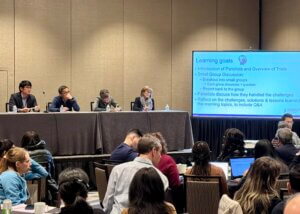
A photo from the 2024 AcademyHealth D&I Workshop showing panelists at a dais answering questions from workshop participants.December 8, 2024: The NIH Pragmatic Trials Collaboratory hosted a workshop at AcademyHealth's 17th Annual Conference on the Science of Dissemination and Implementation in Health. The workshop introduced concepts in the design, conduct, and implementation of pragmatic clinical trials embedded in healthcare systems, with a focus on methods relevant to health services researchers.

Agenda and Slides

Morning Sessions

Welcome and Introduction
Emily O'Brien, PhD

Session 1: What Are Embedded Pragmatic Clinical Trials?
Beda Jean-Francois, PhD

Session 2: Trial Objectives and Design: An Overview of Hybrid Designs
Devon Check, PhD

Session 3: Engaging With Health System and Community Partners
Hayden Bosworth, PhD

Session 4: ePCTs in Context: Small Group Work and Panel Discussion With NIH Collaboratory Trial Investigators
Moderator: Angelo Volandes, MD, MPH
*This session includes case study presentations.

Afternoon Sessions

Session 5: Measuring Outcomes
Angelo Volandes, MD, MPH

Session 6: ePCT Design
Jonathan Moyer, PhD

Session 7: ePCT Analysis
Jonathan Moyer, PhD

Session 8: Pilot and Feasibility Testing
Beda Jean-Francois, PhD

Session 9: Ethical and Regulatory Oversight Considerations
Stephanie Morain, PhD, MPH

Session 10: Writing a Compelling Grant Application
Beda Jean-Francois, PhD

Session 11: ePCTs in Context: Small Group Work and Panel Discussion With NIH Collaboratory Trials Investigators
Moderator: Stephanie Morain, PhD, MPH
*This session includes case study presentations.

Closing Remarks
Emily O'Brien, PhD


December 3, 2024: Sharing Results With Research Participants Raises Special Considerations in Pragmatic Trials

Cover image of the journal Clinical TrialsIn a new report from the NIH Pragmatic Trials Collaboratory, a team of bioethicists explores the ethical obligation to share aggregate results from pragmatic clinical trials with research participants. They conclude with recommendations for how to meet this obligation.

The article was published online ahead of print in Clinical Trials.

There is growing appreciation of the importance of sharing aggregate results of clinical trials with research participants. However, this practice has not been examined in the context of pragmatic clinical trials, which have special features that may complicate the ethics and logistics of sharing aggregate results.

The report’s authors summarize the ethical arguments for sharing aggregate results and describe the features of pragmatic trials that may raise logistical and other barriers to disclosure. They also discuss the important role healthcare system partners play in sharing results from pragmatic trials.

The authors offer the following recommendations:

  • Sharing aggregate results with research participants should be the default, and decisions not to share should be justified
  • Planning for sharing aggregate results should begin early in the planning of the trial
  • The healthcare care systems in which the trial is embedded should be key partners in decisions about what and how to share
  • Proactive sharing of results from a pragmatic trial that was conducted under a waiver or alteration of consent, including an explanation for why consent was not obtained in the study, can promote trust in the investigators and their healthcare system partners

Read the full report.

The article was coauthored by members of the NIH Pragmatic Trials Collaboratory’s Ethics and Regulatory Core, including Stephanie Morain, Abigail Brickler, Joseph Ali, Caleigh Propes, and Kayla Mehl of Johns Hopkins University; Pearl O’Rourke, formerly of Partners HealthCare; Kayte Spector-Bagdady of the University of Michigan; Benjamin Wilfond of the Seattle Children’s Hospital; Vasiliki Rahimzadeh of the Baylor College of Medicine; and David Wendler of the NIH Clinical Center.

October 3, 2024: JAMA Commentary Highlights Gap Between Research Results and Implementation Decisions

Headshots of Richard Platt, Hayden Bosworth, and Greg SimonIn a JAMA Viewpoint published online this week, leaders from the NIH Pragmatic Trials Collaboratory discuss the discordance between the results of pragmatic clinical trials and the implementation of those results in healthcare settings, even in settings that championed the work.

Coauthors Richard Platt, Hayden Bosworth, and Gregory Simon posit that, to provide evidence that healthcare systems leaders will actually use, changes are necessary:

  • Trials need to be faster (2 to 3 years)
  • Trials should consider outcomes that healthcare system leaders care about (such as costs and subgroup analyses)
  • The evidence required for change should be at the level that healthcare system leaders use (such as not necessarily rejecting the null hypothesis at P < .05 but also considering results of Bayesian methods and interim analyses)

Read the full article.

“We believe it is possible to make pragmatic clinical trials of policies and procedures more useful to delivery systems by accommodating their priorities, introducing flexibility in the level of evidence trials require, shortening the duration of planning and implementation, addressing system leaders’ interest in multiple outcomes and subgroup analyses, encouraging modification of protocols during the implementation phase, and by providing timely interim analyses that can guide decisions about continuing or modifying an intervention,” the authors wrote.

This work was based on an NIH Pragmatic Trials Collaboratory workshop held in 2023, Getting the Right Evidence to Decision-Makers Faster. The workshop explored the critical cycle of evidence generation to decision by healthcare system leaders to implement the findings of pragmatic clinical trials conducted within healthcare systems.

Platt is a cochair of the NIH Collaboratory’s Distributed Research Network and the Harvard Pilgrim Health Care Institute Distinguished Professor of Population Medicine at the Harvard Pilgrim Health Care Institute and Harvard Medical School. Bosworth is a cochair of the Implementation Science Core and a professor in population health sciences at Duke University. Simon is the chair of the Health Care Systems Interactions Core and a senior investigator at the Kaiser Permanente Washington Health Research Institute.

View the full workshop materials.

August 29, 2024: HDRN Canada Pragmatic Trials Training Program Offers Open-Access Learning Modules

Schematic of the HDRN Canada Pragmatic Trials Training ProgramA virtual, asynchronous learning program that offers open-access modules to anyone interested in learning about the complex art of pragmatic clinical trial design and implementation is now available.

Every week, a new open-access module features essential resources and leading Canadian trialists discussing a key component of clinical trials.

The 2-year, pan-Canadian program—HDRN Canada Pragmatic Trials Training Program—follows a structured curriculum that covers 12 key components of clinical trials, from understanding the basics of trial design to trial implementation, statistical analysis, quality control and oversight, and other trial components.

More than 75 learners from across Canada have been admitted to this pan-Canadian program after a competitive selection process. Admitted learners enjoy access to monthly peer-group discussions, virtual conferences, and training on indigenous knowledge.

This program is funded by the Canadian Institutes of Health Research, coordinated by the Schulich School of Medicine & Dentistry at Western University, and an initiative of Health Data Research Network Canada.

Modules are available at pragmatictrialstraining.ca. The program story is available at https://tinyurl.com/2f9m9k3s. For more information, contact the Program Coordinating Team at pragmatictrialstraining@uwo.ca.

August 20, 2024: NIH Pragmatic Trials Collaboratory Launches New Self-Paced Learning Path on Pragmatic Trial Study Design

The Pragmatic Clinical Trial Study Design learning path is a self-paced, 1-hour course with expert-led content, reference materials, and knowledge checkpoints. Learners will gain insights into selecting the right study design, randomization, parallel vs stepped-wedge designs, and more. The learning path is free and you can earn a certificate for completing the course.The NIH Pragmatic Trials Collaboratory has launched a new interactive learning path that provides essential knowledge to research teams on how to choose the most appropriate study design for a pragmatic clinical trial.

The learning path is a series of self-paced training modules that include expert videos, reference materials, and knowledge checkpoints. Its content covers key information for designing a study, including:

  • Choosing between an explanatory or pragmatic study design
  • How to make decisions about randomization
  • Choosing between parallel and stepped-wedge design

The learning path features expert insights from Liz Turner, PhD, co-chair of the NIH Collaboratory’s Biostatistics and Study Design Core, adding to the program’s robust online training resources. This new tool is free and takes about 1 hour to complete. Learners will receive a certificate upon completing the course.

Head shot of Dr. Liz Turner
Liz Turner, PhD

“We created this innovative learning path to help research teams work through the many issues and considerations that come up in the design phase of a pragmatic trial,” Turner said. “It guides learners through the decision-making process for study design in a fun and fast-paced learning environment.”

“I hope research teams take advantage of this exciting new resource that answers common questions about pragmatic trial study design,”said Kevin Weinfurt, PhD, a co-principal investigator for the NIH Pragmatic Trials Collaboratory Coordinating Center. “Making informed decisions at the trial’s design stage is critical to ensure a trial can be successful in producing reliable evidence.”

To access the learning path, visit the learning module page to sign up. Simply click “get this course” and then “sign up” to create an account in our learning management system.

The NIH Pragmatic Trials Collaboratory Coordinating Center led the development of the study design learning path in partnership with Symphony Learning Partners.

Going From Zero to 100: Generating Evidence Through Pragmatic Research to Address Pressing Healthcare Issues: NIH-Hosted Workshop (July 2024)

July 15-16, 2024: This 2-day workshop focused on the preparatory actions researchers can undertake in the planning and application phase (Phase Zero) to ensure pragmatic clinical trials yield actionable evidence for a variety of settings. Key aspects include formulating the right research question and engaging with patients, funders, and healthcare system leaders. The workshop also addressed challenges in initiating trials across diverse settings, such as navigating data systems, site diversification, and reducing administrative burdens.

Agenda and Slides

Day 2: July 16

Welcome and Introduction

Wendy Weber, ND, PhD, MPH
Helene Langevin, MD

Keynote: Connecting Lab, Clinic and Community: Communities Advancing Research Equity (CARE) for Health™

Monica Bertagnolli, MD

Session 3: How to Use Data From Disparate Data Systems

Moderator: Keith Marsolo, PhD

Panel:

Session 4: Retrofitting, Reimagining, and Redesigning Health Care Systems to Reach Populations Most Affected by Health Inequities

Moderator: Rosa Gonzalez-Guarda, PhD, MPH, RN

Panel:

Session 5: Overcoming Administrative Burden in Pragmatic Research

Moderator: Adrian Hernandez, MD, MHS

Panel:

Summary and Concluding Remarks

Lesley Curtis, PhD
Rosa Gonzalez-Guarda, PhD, MPH, RN
Adrian Hernandez, MD, MHS
Keith Marsolo, PhD
Wendy Weber, ND, PhD, MPH