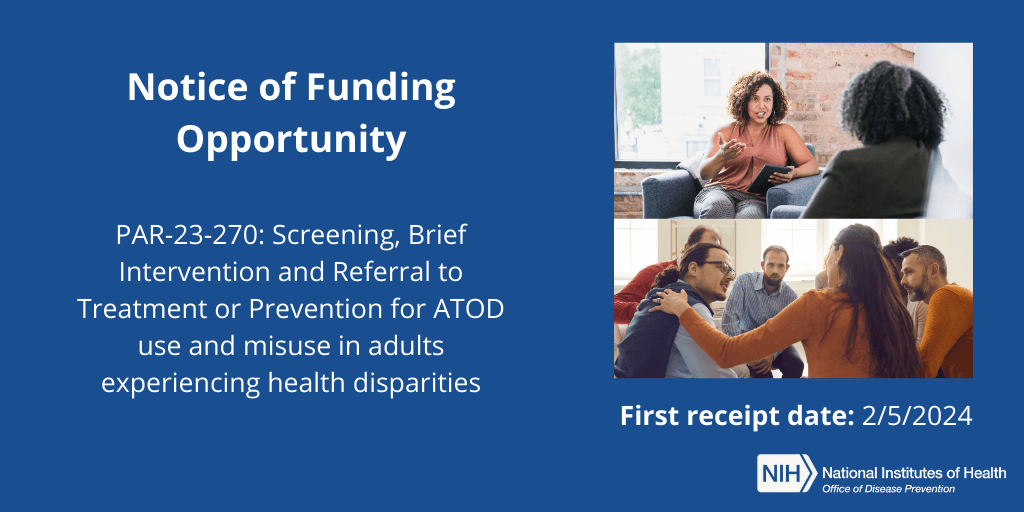
November 27, 2023: NIH Announces Funding Opportunity for Implementation Studies of Substance Use Treatment and Prevention in Populations That Experience Health Disparities

The National Institutes of Health’s Office of Disease Prevention (ODP) issued a new funding opportunity to support implementation studies in treatment and prevention for alcohol, tobacco, and other drugs use and misuse in adult populations that experience health disparities.

ODP and participating NIH Institutes and Centers are inviting applications for research projects that test innovative approaches to implementing screening, brief intervention, and referral to treatment or prevention for alcohol, tobacco, and other drugs use and misuse. This R01 funding opportunity will support clinical trial research that develops and prospectively tests implementation strategies that overcome barriers to prevention and treatment in diverse settings. Applicants are strongly encouraged to include in their proposals robust engagement with relevant healthcare and community partners and to examine organizational and system contexts.

The first receipt date for new applications is February 5, 2024.

Read the full funding opportunity.

June 22, 2020: NIH Offers Methods Webinar on Stepped-Wedge Cluster Randomized Trials

The NIH Office of Disease Prevention will continue its Methods: Mind the Gap webinar series on July 14 with “Overview of Statistical Models for the Design and Analysis of Stepped Wedge Cluster Randomized Trials.” Dr. Fan Li of Yale University, a longtime participant in the NIH Collaboratory’s Biostatistics and Study Design Core Working Group, will lead the webinar.

The Methods: Mind the Gap series explores research design, measurement, intervention, data analysis, and other methods of interest in prevention science. The July 14 session will address the stepped-wedge cluster randomized design, which has received increasing attention in pragmatic clinical trials (PCTs) and implementation science research. Since the design’s introduction, a variety of mixed-effects model extensions have been proposed for the design and analysis of PCTs. Dr. Li will provide a general model representation and discuss model extensions as alternative ways to characterize secular trends, intervention effects, and sources of heterogeneity. He will also review key model ingredients and clarify their implications for the design and analysis of stepped-wedge cluster randomized trials.

Register in advance to join the online presentation. Registration is required.

November 12, 2018: Participate in the NIH Office of Disease Prevention’s Research Expertise Survey

The National Institutes of Health (NIH) Office of Disease Prevention (ODP) needs your help to enhance the quality of research supported by the NIH. The ODP is building a directory of experts in research methods and study designs that can help NIH Scientific Review Officers identify the most appropriate reviewers for NIH research applications. Adding your name and expertise to the directory is easy – simply share your methodological and content area expertise by filling out the ODP’s Prevention Research Expertise Survey (PRES).


The survey covers 7 areas related (but not limited) to prevention research:

  • Study Design Topics
  • Research Methods
  • Content Topics
  • Settings
  • Populations
  • Regions
  • Income Categories

The PRES takes approximately 15-25 minutes and is strictly voluntary. Based on your skill set and interest, NIH or Department of Health and Human Services (HHS) staff may invite you to serve as a peer reviewer for research applications, or you may be asked to sit on a panel, committee, or workgroup; or to speak at a seminar or workshop. Your responses and information will not be shared with anyone outside of HHS.

The ODP believes the participation of highly qualified methods experts will enhance the quality of peer review; improve the rigor, reproducibility, and impact of research supported by the NIH; and ultimately lead to stronger clinical practice, health policy, and community health programs.

The ODP is the lead office at the NIH responsible for assessing, facilitating, and stimulating research in disease prevention and disseminating the results of this research to improve public health. For more information about the ODP and its work, visit the ODP website.

Thank you in advance for taking the survey – your participation helps improve the rigor, impact, and value of research supported by the NIH.