June 27, 2023: Reflections on Health Equity in the Pragmatic Trials Landscape From the Annual Steering Committee Meeting

Headshots of Anne Trontell and Ana Quiñones
Anne Trontell and Ana Quiñones

A focus of the 2023 NIH Pragmatic Trials Collaboratory Annual Steering Committee Meeting was health equity in embedded pragmatic clinical trials (ePCTs). In an interview during the meeting, Drs. Anne Trontell and Ana Quiñones reflected on health equity in the ePCT landscape.

Trontell, who is the associate director for comparative clinical effectiveness research at the Patient-Centered Outcomes Research Institute (PCORI), said that health equity is a key component of the patient-centered efforts underlying all of PCORI’s research.

“From its beginning, PCORI has dedicated research funding to address the unique needs of historically underserved populations. The achievement of health equity is one of PCORI’s 5 guiding National Priorities for Health,” said Trontell.

As a funder, PCORI directs funds to those who pursue health equity goals and targets specific requirements that are important to the development of equity-focused research, such as working with communities and emphasizing inclusivity and diversity in the institutions and participants in research.

“It is a multipronged effort, and one that we are very excited to participate in,” said Trontell.

Quiñones, who is the core lead for the NIA IMPACT Collaboratory Health Equity Team and an associate professor at Oregon Health & Science University, said she agrees that bringing health equity into ePCTs requires a team-based approach.

“We’ve learned that leaning on ‘health equity experts’ or relying on individuals to provide answers for big gaps in the research evidence base isn’t just unrealistic, it is probably not great practice either,” said Quiñones.

One thing the NIA IMPACT Collaboratory has done is ask everyone involved in the program to think about and contribute to the process. A resulting product of this requirement is a series of best-practice recommendations for integrating health equity into ePCTs for dementia that were created by asking experts from areas across the IMPACT Collaboratory to apply a health equity perspective to their area of expertise to collectively develop recommendations for some of the issues and hidden pitfalls.

“This doesn’t mean that you don’t need people who are deeply embedded and knowledgeable about the [health equity] work, and knowledgeable about the best scientific principles, asking questions, but it does mean that everybody is a participant in solving the problem, not just the health equity expert,” said Quiñones.

Trontell said that one way PCORI is supporting health equity is by funding the groundwork that can help researchers be successful, such as building relationships with diverse communities through its engagement awards. In addition, PCORI’s Phased Large Awards for Comparative Effectiveness Research (PLACER) opportunities fund a feasibility phase that supports study refinement, infrastructure establishment, stakeholder engagement, and feasibility testing of study operations, including the ability to recruit and enroll participants successfully.

“We have heard from our investigators that meaningful engagement deserves attention, effort, and time, so our engagement awards and PLACER funding opportunity offer upstream support for strong and diverse engagement to occur,” said Trontell.

Networks such as the NIA IMPACT Collaboratory and the NIH Pragmatic Trials Collaboratory have an important role to play in these efforts as well. Quiñones said these large research networks have opportunities to build synergies around common goals related to health equity and share knowledge and best practices.

Trontell agrees. “I’m a big fan of bringing people together to figure out something and to listen to each other, particularly when they have a shared goal and excitement around trading ideas and tips. That creates a real learning community.”

Learn more about the NIH Pragmatic Trials Collaboratory’s Health Equity Core and see the complete materials from the 2023 Steering Committee Meeting.

June 15, 2023: Regulatory Considerations for Clinical Decision Support Software in Pragmatic Trials Explored at Annual Steering Committee Meeting

This year’s annual Steering Committee meeting for the NIH Pragmatic Trials Collaboratory featured 2 special guests from the US Food and Drug Administration’s Digital Health Center of Excellence—Matthew Diamond, MD, PhD, Chief Medical Officer, and Sonja Fulmer, PhD, Acting Deputy Director. They joined to share information on the FDA’s approach to clinical decision support (CDS) software, including the agency’s recently released guidance, which helped stimulate a discussion on the associated considerations for embedded pragmatic clinical trials. Here we highlight some key takeaways from that discussion.

CDS is a broad term that encompasses a range of different functions, and there are several NIH Collaboratory Trials that are testing CDS software. Diamond explained that some digital health technologies, including some CDS software, meet the regulatory definition of a medical device while others do not. The FDA focuses its oversight on a subset of digital health technologies.

The new FDA guidance outlines criteria for determining which CDS are considered non-devices due to the CDS criteria in the 21st Century Cures Act. In addition to the CDS guidance, there are other policies that may apply to a digital health technology, so the FDA created a Digital Health Policy Navigator to help people find the relevant guidance for their situation. Further, the FDA encourages engagement early and often to understand how the regulations and policies apply to a particular product or technology.

If a software is the focus of FDA’s regulatory oversight, it does not mean the research cannot be done. In fact, research is essential to contribute to the body of evidence on the functioning of a device. The research just needs to go through the right processes. The goals of using the right processes for product review and research are to ensure that patients are protected during research and that the products that are ultimately marketed are safe and effective. The determination of whether an investigational device exemption (or IDE) is required is based on risk.

The details behind the implementation of digital health products matters a lot in these determinations. Subtle differences in the way that a product functions and the claims that are made about a product can make a big difference. Diamond stressed the importance of clearly defining the intended use of a product, including who it is intended for and what the user is supposed to do with information provided by the software. Fulmer highlighted the importance of transparency with stakeholders, including healthcare professionals, patients, and regulators.

For specific questions, the presenters encouraged researchers to reach out to the FDA’s digital health experts at DigitalHealth@fda.hhs.gov.

August 16, 2022: Biostatistics Core Develops Tools and Strategies for Common Research Challenges

Head shot of Dr. Patrick HeagertyHead shot of Dr. Liz TurnerIn an interview at the NIH Pragmatic Trials Collaboratory’s annual Steering Committee meeting and 10th anniversary celebration, we asked Dr. Liz Turner and Dr. Patrick Heagerty to reflect on the role of the Biostatistics and Study Design Core Working Group in helping the NIH Collaboratory Trial teams design their trials and analyze the data, and to discuss their focus for the Core's future contributions to pragmatic clinical trials.
Based on your experience working with the NIH Collaboratory Trials, what are some of the common challenges of the Core?

Given the pragmatic nature of the NIH Collaboratory Trials, most use a design that involves some kind of clustering of outcomes. This could be a cluster randomized design or an individually randomized group treatment trial. As a consequence, nearly all projects face the challenge of how to account for clustering in both the design and analysis of the trial.

For the NIH Collaboratory Trials that use a cluster randomized design, one of the most common challenges is deciding between a stepped-wedge design and a standard parallel-arm design. The Core’s recommendation is clear: only use a stepped-wedge design if you have to! Likewise, only use a cluster randomized design if you have to and, if possible, use an individually randomized design. Nevertheless, a cluster randomized design is often the design of choice to address a pragmatic research question, and a stepped-wedge cluster randomized design may be the only way to perform a randomized evaluation of an intervention (for example, when all centers wish to receive the intervention in order to agree to participate in the trial).

From an analysis perspective, common challenges involve how to handle missing outcome data and how to handle longitudinal (that is, repeated) measures data. For both design and analysis, as you can imagine, the COVID-19 pandemic has posed huge challenges, including how to handle the disruption of an ongoing stepped-wedge trial (as in the GGC4H NIH Collaboratory Trial). In short, clustering of outcomes is the biggest theme (and challenge) across the NIH Collaboratory Trials.

What strategies have NIH Collaboratory Trials used to overcome these barriers?

A common strategy used by the NIH Collaboratory Trials to overcome these barriers has been to leverage what we call the “Core group process.” This dynamic process is driven by the NIH Collaboratory Trials and supported by the Core, together with NIH Collaboratory leadership. The process is centered around the monthly Core meeting to which all NIH Collaboratory Trial teams are invited and that involves all Core members. These meetings provide dedicated time for each study team to provide project updates and elicit feedback from the Core and the other NIH Collaboratory Trial teams. In particular, all the study teams are invited to present at least once during the UG3 planning phase and on multiple occasions during the UH3 implementation phase. Core members are also available for ad hoc, smaller group meetings, as requested. What this process allows is for the NIH Collaboratory Trials to present challenges and for us to jointly identify solutions.

How are the NIH Collaboratory Trials’ experiences with the Core helping the field of pragmatic research?

Through the challenges and ideas that have been brought to the Core, the NIH Collaboratory Trials have pushed the field of pragmatic research. In particular, through the Core group process, they have pushed the Core to solve methodological challenges and provide tools to tackle the design issues that arise in the changing research landscape.

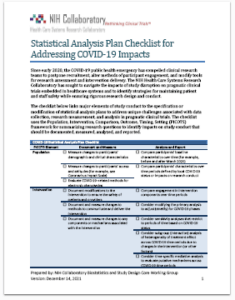
Thumbnail image of the COVID-19 checklist

A key example of the Core’s methodological work was inspired by the STOP CRC NIH Collaboratory Trial and is related to the design and analysis choices faced in the unique context of embedded pragmatic trials. This example addresses a common challenge in embedded pragmatic trials, namely how to handle varying cluster sizes, something that arises in so many of the NIH Collaboratory Trials. The research, recently published in Contemporary Clinical Trials, highlights that a seemingly natural analysis in this context may produce a biased inference about intervention effectiveness, which is clearly problematic.

The second example is the Core’s recently published Statistical Analysis Plan Checklist for Addressing COVID-19 Impacts. Development of this tool was inspired by the many challenges faced by the NIH Collaboratory Trials as a result of the COVID-19 pandemic, such as delayed recruitment (as in the BackInAction NIH Collaboratory Trial) and adjustments to how interventions were delivered (as in the ACP PEACE NIH Collaboratory Trial).

What do you think the Core can contribute over the next decade?

The Core has a lot to contribute over the next decade. A key goal is to ensure we are building and diversifying the next generation of statisticians who are experts in pragmatic trials and who can engage deeply in the design and analysis of pragmatic trials embedded in healthcare systems.

To achieve this, we need to continue to bring trainees into the Core, as we have done over the past 6 years, through funded graduate research assistant positions. By doing this, we should be able to not only build the next generation of pragmatic trial experts but also build scholarship in pragmatic trial methodology by identifying methodological gaps needed to be filled so the NIH Collaboratory Trials study teams—and pragmatic trialists in the broader research community—have the best methods available to them.

The opportunity to participate in a cross-institution working group such as ours is surprisingly rare. As a consequence, we are in a unique position to not only build the next generation of experts but also to strength our own collective expertise and knowledge by learning from each other’s perspectives.

July 26, 2022: Three NIH Collaboratory Trials Share Progress on Planning, Implementation, and Completion

At this year’s annual meeting of the NIH Pragmatic Trials Collaboratory Steering Committee, we interviewed investigators from 3 NIH Collaboratory Trials in different phases of the trial life cycle. IMPACt-LBP launched last fall and is completing its 1-year planning phase. ACP PEACE is nearing the end of its implementation phase. SPOT ended last year and published its main outcomes in February.

Learn more about these innovative NIH Collaboratory Trials in the brief video updates below.


Logo for the IMPACt-LBP NIH Collaboratory TrialIMPACt-LBP, currently in the 1-year planning phase, will evaluate implementation of the American College of Physicians guideline for low back pain, which involves multidisciplinary collaborative care that includes doctors of chiropractic and physical therapists. The study will measure the effects of first-contact patient referral to these clinicians on physical function, pain, opioid prescriptions, and other patient-level outcomes. The study is administered by the National Center for Complementary and Integrative Health with additional support from the National Institute of Arthritis and Musculoskeletal and Skin Diseases and the National Institute of Child Health and Human Development. The project is led by Drs. Christine Goertz, Adam Goode, and Hrishikesh Chakraborty of Duke University and Dr. Jon Lurie of Dartmouth Hitchcock Medical Center. Learn more about IMPACt-LBP.

Logo for the ACP PEACE NIH Collaboratory TrialACP PEACE, currently in the implementation phase, is testing an advance care planning program that combines clinician communication skills training and patient video decision aids. ACP PEACE is focused on patients with advanced cancer and their clinicians in oncology settings. The study is administered by the National Institute on Aging and is led by Drs. Angelo Volandes and James Tulsky of Harvard Medical School. Learn more about ACP PEACE.

SPOT NIH Collaboratory Trial logoSPOT, a recently completed pragmatic trial that published its main outcomes earlier this year, compared 2 low-intensity outreach programs—care management and dialectical behavior therapy skills training—to usual care in adults at risk of self-harm or suicidal behavior. The study was administered by National Institute of Mental Health and was led by Dr. Greg Simon of the Kaiser Permanente Washington Health Research Institute. Learn more about SPOT.


July 19, 2022: Three PRISM NIH Collaboratory Trials Share Latest Updates and Accomplishments

At the NIH Pragmatic Trials Collaboratory’s annual Steering Committee meeting this spring, we interviewed investigators from 3 of the PRISM NIH Collaboratory Trials to discuss their progress in the first year of study implementation. All of the studies began enrollment last year.

The PRISM program (Pragmatic and Implementation Studies for the Management of Pain to Reduce Opioid Prescribing) is a component of the NIH’s Helping to End Addiction Long-term (HEAL) Initiative. The PRISM NIH Collaboratory Trials are studying the real-world effectiveness of nonpharmacologic interventions for pain and assessing the implementation of these interventions to improve pain management and reduce reliance on opioids. The NIH Collaboratory Coordinating Center serves as the PRISM Resource Coordinating Center.

BeatPain Utah is a pragmatic trial of nonpharmacologic pain management interventions in primary care clinics of US federally qualified health centers in Utah. The interventions are designed to overcome barriers specific to rural and lower-income communities through innovative use of telehealth resources. The study is administered by the National Institute of Nursing Research and is being conducted by Dr. Julie Fritz of the University of Utah. Learn more about BeatPain Utah.

The GRACE trial is a hybrid effectiveness–implementation trial of guided relaxation and acupuncture for pain associated with chronic sickle cell disease in 3 large healthcare systems. The study is administered by the National Center for Complementary and Integrative Health and is being conducted by Drs. Ardith Doorenbos, Judith Schlaeger, Robert Molokie, and Miriam Ezenwa of the University of Illinois Chicago and Dr. Nirmish Shah of Duke University. Learn more about GRACE.

OPTIMUM is evaluating the impact of an innovative, group-based mindfulness program for patients with chronic low back pain in real-world clinical settings. Mindfulness is effective for the treatment of chronic low back pain but remains underutilized as it has not been regularly woven into outpatient clinical settings. The study is administered by National Center for Complementary and Integrative Health and is being conducted by Dr. Natalia Morone of Boston University and Boston Medical Center. Learn more about OPTIMUM.

See also our recent interviews with the principal investigators of our other PRISM NIH Collaboratory Trials:

Headshots of Julie Fritz, Ardith Doorenbos, and Natalia Morone

May 12, 2022: Current and Past Leaders of NIH Pragmatic Trials Collaboratory Reflect on the Past, Present, and Future

In an interview at the Steering Committee’s annual meeting in April, Dr. Wendy Weber, Dr. Josephine Briggs, and Dr. Catherine Meyers celebrate the success of the NIH Pragmatic Trials Collaboratory and look at the roadmap to its future.

In the Beginning…

The NIH Pragmatic Trials Collaboratory (then the NIH Health Care Systems Research Collaboratory) began as an NIH Common Fund–initiated program. According to Dr. Josephine Briggs, Director Emeritus of the National Center for Complementary and Integrative Health (NCCIH), the idea began with a recognition that “explanatory trials were often run in ways to demonstrate that an intervention worked with selected populations implemented in a very controlled environment… We really needed to test those interventional trials and see whether they really worked when generalized to a broader population likely to be using them to settings in which the intervention implementation wasn’t as tightly controlled.”

In 2012, the Common Fund awarded both the Coordinating Center and the first 7 NIH Collaboratory Trials (ABATE, BPMedTime, LIRE, PPACT, SPOT, STOP CRC, TiME).

The Present

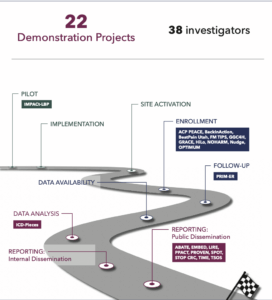
In its first 10 years, the NIH Pragmatic Trials Collaboratory has supported 22 NIH Collaboratory Trials involving 38 investigators.


Road map

Dr. Cathy Meyers, Director Emeritus of the NCCIH Office of Clinical and Regulatory Affairs stated that “The Coordinating Center has really been a scribe throughout this last decade of recording problems and, more importantly, their solutions, and has even, with the last wave of solicitations for applications, incorporated training.”

Living Textbook VisitorsMuch of this content is housed in Rethinking Clinical Trials®: A Living Textbook of Pragmatic Clinical Trials, a free online textbook developed and maintained by the NIH Collaboratory. Drawing on experiences from the program’s NIH Collaboratory Trials and community of experts, the Living Textbook provides guidance on each step of a pragmatic trial, from study design through applying results in the real world. The Living Textbook is continually updated and expanded as new information emerges. This new knowledge is also disseminated through the NIH Collaboratory’s Knowledge Repository and weekly Grand Rounds series.

Looking to the future

“There are now 8 different partnering institutions and centers that support the NIH Pragmatic Trials Collaboratory, and we are open to more,” said Dr. Wendy Weber, NCCIH Project Officer for the NIH Collaboratory.

When asked what she is looking forward to in the future, Dr. Weber stated that “There is a unique opportunity to look at trials that address health disparities. How do we solve what we know is a problem in the healthcare system? How can we design interventions to improve that. We do so much research documenting how much disparity there is. Let’s do something to actually improve that.”

Towards this end, the NIH released a request for applications (RFA) for new NIH Collaboratory Trial grants that address health disparities.  The RFA for this funding opportunity encourages applications that focus on improving health outcomes in populations that experience health disparities, such as higher rates of disease or mortality compared with the general population. Applications are due June 17, 2022. Letters of intent are due 30 days prior (May 17, 2022).

We will be sharing more insights form the 2022 NIH Pragmatic Trials Steering Committee Meeting over the coming weeks. All meeting materials are available online.

View the full interview.

About the NIH Pragmatic Trials Collaboratory

The NIH Pragmatic Trials Collaboratory Coordinating Center consists of the Duke Clinical Research Institute, the Harvard Pilgrim Health Care Institute, the Kaiser Permanente Washington Health Research Institute, the Johns Hopkins Berman Institute of Bioethics, the University of Washington, and the University of Michigan. The program is supported by the National Institutes of Health (NIH) through cooperative agreement U24AT009676 from the Office of Strategic Coordination within the Office of the NIH Director. It is also supported by the NIH through the NIH HEAL Initiative under award number U24AT010961. The content is solely the responsibility of the authors and does not necessarily represent the official views of the NIH or its HEAL Initiative. To learn more about the program, visit rethinkingclinicaltrials.org.


May 10, 2022: Pragmatic Trials Learn From Disruption in the COVID-19 Pandemic

In an interview at the NIH Pragmatic Trials Collaboratory Steering Committee’s annual meeting in April, Dr. Emily O’Brien and Dr. Adrian Hernandez discussed challenges for pragmatic trials during the COVID-19 pandemic and lessons for the future of the healthcare system.

“We certainly did see some degree of disruption, but I was impressed by the flexibility in the ability to adapt that all of our NIH Collaboratory Trial teams showed,” said O’Brien. “Some of them mentioned the support of having the Cores and consultations with experts in real time to be able to make adjustments,” she said.

O’Brien is a an associate professor in population health sciences at Duke University and a cochair of the NIH Collaboratory’s Patient-Centered Outcomes Core. Hernandez, the executive director of the Duke Clinical Research Institute, is a co–principal investigator of the program’s Coordinating Center. View the full interview.

O’Brien and her colleagues at the NIH Collaboratory Coordinating Center conducted a brief survey about the impacts of the pandemic on the NIH Collaboratory Trials, such as challenges they encountered, solutions they implemented, and any new measures the study teams started using.

“The impacts on the NIH Collaboratory Trials [included] research staff being redeployed to COVID-19 studies or clinician-scientists moving into predominantly clinical care roles as opposed to research roles,” O’Brien explained. “The most obvious impact of those changes was delays across projects. It took longer to get things done, to enroll patients. That was felt pretty universally by our projects, although there were several projects that were further along, had enrollment mechanisms that were in place and already up and running that were less impacted by those delays,” she said.

Some study teams also reported a renewed commitment from their partnering healthcare systems to work together as they encountered challenges in trial implementation.

Hernandez added, “For many studies, we thought they would actually stop. And for traditional trials, that’s what happened. But for [the NIH Collaboratory Trials], since they’re closer, more embedded within healthcare systems, part of the delivery process, they were able to flex because by nature they have to for any environment that changes.”

When asked what the COVID-19 pandemic has taught about what is needed for the future, Hernandez said, “It’s not too different than, say, what we have with the Defense Production Act…. What we need is essentially the equivalent of that, a ‘Pandemic Response Production Act,’ so that healthcare systems can be organized, coordinated to generate evidence around what’s needed for the response.”

May 5, 2022: Looking at the Landscape of National ePCT Initiatives in 2022

On April 20th and 21st, nearly 100 members of the NIH Pragmatic Trials Collaboratory met in Bethesda, Maryland, for the program’s annual Steering Committee Meeting. With 10 productive years of leading the way in embedded pragmatic clinical trials, the group had a lot to celebrate. Members led discussions on the history and evolution of pragmatic trials and shared thoughts for future priorities. In addition, leaders from five other pragmatic trial programs across the nation shared their experiences and lessons learned during a session entitled Looking at the Landscape of National ePCT Initiatives, which we recap here.

Anne Trontell, an Associate Director in the Clinical Effectiveness and Decision Science Program at the Patient-Centered Outcomes Research Institute (PCORI), spoke about PCORI’s experiences with pragmatic research initiatives. PCORI trials explore real-world decision-making about healthcare treatment options. Notable PCORI trials range in scope from asthma treatments for Black and Latinx Adults to comparative effectiveness trials of Aspirin dosing in cardiovascular disease (ADAPTABLE). Dr. Trontell stressed the value of relationships with diverse stakeholders before the start of a trial. This “prework” can help researchers better understand the issues facing research staff and participants as well as provide insight about the context, capacity, and resources available. See the slides from Dr. Trontell’s presentation for more information.


Robert Kerns, a Principal Investigator for the NIH-DoD-VA Pain Management Collaboratory Coordinating Center (PMC3), explained the intention of the program’s trials to inform future policy and practice regarding pain management in the VA or DOD. Dr. Kerns credits the PMC3 work groups, particularly the Biostatistics and Study Design Work Group, for the successful transition of their 11 trials to the implementation phase. PMC3 prioritized data harmonization among their trials. Use of common data collection measures and optimizing data collected from the EHR allows for easier data sharing and aggregation across projects. Building a community of trust among all stakeholders was key to the success of the projects. See slides from Dr. Kern’s presentation for more information.


Partha Bhattacharyya, Program Director for the National Institute on Aging and a lead developer of the National Institute on Aging IMbedded Pragmatic Alzheimer’s disease and AD-Related Dementias Clinical Trials (NIA IMPACT) Collaboratory, provided an overview of the project’s goals and accomplishments over the last 2 years. The NIA IMPACT Collaboratory supports the design and conduct of pragmatic trials for innovative dementia care. The program recognizes that understanding health system and patient experiences is essential for successful trials. Junior and senior investigators are recruited through a Faculty Scholars Program and embedded in the health systems to learn how the systems work. Stakeholders from healthcare systems and patient populations are also included in the process of developing research trials. See slides from Dr. Bhattacharyya’s presentation for more information.


Wendy Weber, Branch Chief for the NIH Clinical Research in Complementary and Integrative Health, introduced the NIH Helping to End Addiction Long-term (HEAL) Initiative. The program began in 2018 and provides $500 million dollars a year in funding for projects that enhance pain management or improve treatments for opioid misuse and addiction. The program has funded over 600 research projects and 26 programs including the Pragmatic and Implementation Studies for the Management of Pain to Reduce Opioid Prescribing (PRISM) program. The NIH Pragmatic Trials Collaboratory serves as the Resource Coordinating Center for PRISM. The PRISM trials focus on non-opioid interventions to manage pain and reduce reliance on opioids as well as identify effective strategies to implement evidence-based interventions. The HEAL Initiative aims to study pain and opioid use disorder as co-occurring conditions as well as promote health equity in research and treatment. See slides from Dr. Weber’s presentation for more information.


Gregory Simon, principal investigator of the Mental Health Research Network (MHRN), described the program’s mission to identify research questions that matter to stakeholders, find answers, and implement results for the benefit of real-world patients and providers. The MHRN began in 2010 and has now reached approximately 22 million patients in 14 health systems. Dr. Simon attributes the success of MHRN projects to longstanding, collaborative relationships with health plan and medical leaders, patient representatives, and IRBs. The project prioritizes the intersection of interests among patients, clinicians, health system leaders, and funders. See slides from Dr. Simon’s presentation for more information.


We will be sharing more insights form the 2022 NIH Pragmatic Trials Steering Committee Meeting over the coming weeks. All meeting materials are available online.

May 2, 2022: Califf Reflects on Origins and Impact of NIH Pragmatic Trials Collaboratory

In a keynote speech at the NIH Pragmatic Trials Collaboratory Steering Committee annual meeting, FDA Commissioner Dr. Rob Califf called for more and faster evidence generation. “We have to generate evidence more quickly and then insist that it gets used,” he said.

After his remarks, Califf joined Dr. Wendy Weber of the National Center for Complementary and Integrative Health to reflect on the origins and impact of the program. Califf was the first principal investigator of the program’s Coordinating Center, and Weber is the NIH program officer.

“We have a huge need for evidence, we have sources of data now that are digital and readily available,” Califf said. “So we should have consortia of investigators and patients who work together to get the answers as quickly as possible.

Califf noted that an important part of the original application for NIH funding was “a recognition that this was a startup and that it would be a work in progress.”

View the full interview.

Dr. Robert CaliffOn what has surprised him the most – “Patients and clinicians pretty readily grasp the need and the concept. They want to do it. The data part is a lot harder than most people thought. The technology has come a long way; we can do it now. Probably the hardest thing has actually been that the business models for health systems run counter to generating evidence. It’s something that we really haven’t overcome at this point.”

On opportunities for the program – “I think the program needs to keep the model that it has, but I’m hoping we can build in the incentive forces that are really needed to have it become, I will call it, ‘viral.’ We all want to know what the best treatment is, how to compare treatments, all the things that are involved in the network. Between FDA and NIH, and now CMS much more involved, and the interest of private industry, we could potentially really create the incentives that allow people to do what they now know how to do so well.”

On the legacy of the program – “I hope we’ll look back and say the Collaboratory and the things around the Collaboratory stimulated a new way of doing research that became the main way that we do research.”

See the complete materials from the 2022 Steering Committee meeting.

September 23, 2021: PCO Core Aims for Greater Consistency in Integrating Patient-Reported Outcomes in Research and Clinical Care

Leaders of the NIH Collaboratory’s Patient-Centered Outcomes (PCO) Core Working Group spoke in a recent Zoom-based interview about the Core’s latest accomplishments and ongoing collaborations with the NIH Collaboratory Trials.

“The purpose of the Core is to provide reusable and sustainable resources and tools to help project teams incorporate patient-centered outcomes and other patient-reported data in pragmatic clinical trials and the electronic health record,” said Dr. Emily O’Brien, an associate professor in population health sciences at Duke University and a cochair of the PCO Core.

“We address 3 components in any clinical research study: the needs of the clinician to provide care for the patient, the needs of the researcher, and the needs of the patient or the individual being treated,” added Dr. Christy Zigler, an assistant professor in population health sciences at Duke University and a cochair of the PCO Core. “To guide clinical researchers about PCO data collection, we usually think about 4 major considerations: adding IT infrastructure, deciding when PCOs are appropriate and choosing the best instrument, defining how to integrate PCO collection into the care process in a meaningful and appropriate way, and preparing for real-time reporting and statistical of PCO data,” Zigler said.

View the full video.

Last year, the PCO Core completed a survey of NIH Collaboratory Trials about cultural and linguistic adaptations of patient-centered outcome measures. The survey revealed significant barriers to researchers wanting to tailor instruments for their study populations.

“We wanted to know how and whether existing NIH Collaboratory Trials were adapting instruments for their populations of interest, either through translation, or cultural adaptation, or both,” said O’Brien. “This was really helpful to give us a sense of what barriers projects might encounter in the future… Planning ahead is critical, and having enough time and resources available to make these adaptations will be important for any projects that might benefit from having these adapted instruments available,” she said.

“We’re also thinking a lot about acceptability and burden of patient-centered outcomes,” said Dr. Zigler. “So we’re targeting PRISM NIH Collaboratory Trials within the first year of transition to implementation…and sending out a survey to gauge acceptability and burden at all levels, from the clinical care team, from the research side, and also from the patients themselves,” Zigler said.

Zigler and O’Brien also highlighted ongoing collaborations with the NIH Collaboratory’s other Core Working groups, including discussions with the Ethics and Regulatory Core about the ethical implications of integrating PCO data into clinical care and a consultation with the Electronic Health Records Core on integrating patient-centered and patient-reported outcomes into the electronic health record so that pragmatic clinical trial researchers can use them.

“Patient-centered outcomes data does not exist in a vacuum,” said O’Brien. “The data that are collected as part of NIH Collaboratory projects exist as part of both the larger study and also the larger health system within which the study is being conducted. So there are really clear connections between the PCO Core and the work that we do and all the other Cores, and those Cores have been a great resource for us as we’re advising projects on key issues that come up during the design and implementation phases of their studies,” she said.

View the full interview with Dr. Zigler and Dr. O’Brien.


Screen shot from video interview with Dr. Christy Zigler and Dr. Emily O'Brien