Grand Rounds April 11, 2025: Pridopidine in ALS: Results from the Healey Platform Trial (Jeremy M. Shefner, MD, PhD)

Speaker

Jeremy M. Shefner, MD, PhD
Professor of Neurology
Barrow Neurological Institute

Keywords

ALS; Platform Trial; Phase 2 Trial

Key Points

  • Amyotrophic Lateral Sclerosis, or ALS, is an age-related degenerative disease affecting the primary motor neurons in the brain and the alpha motor neurons in the spinal cord. It causes weakness in the limbs, breathing muscles, and facial muscles. Males are affected significantly more than females; 1 in 700 men will die of ALS.
  • The average survival after the onset of the first ALS symptom is about 4 years – a small improvement despite decades of clinical trials. Treatment modestly prolongs both survival, function, and quality of life for patients with ALS.
  • In the last decade, 2 drugs has been approved by the U.S. Food and Drug Administration (FDA) for use in patients with ALS. These drugs reached Phase 3 or approval on the basis of small trials; however, subsequent large multinational trials failed to meet their primary endpoints, leading to the withdrawal of one agent and a reduction in the use of another.
  • There is a robust pipeline of drugs in early development and a network of high-quality study sites. However, clinical evaluation is slow, for many reasons: the episodic nature of ALS requires new staffing and training for every trial; start-up is slow; participants wish to reduce placebo assignments as much as possible; and costs are excessive.
  • The HEALEY phase-2 platform trial was developed to meet the needs of the ALS community and with the ultimate goal of moving drugs that were more likely to succeed to phase 3. It’s intended to function as a perpetual trial, as patient-friendly as possible, with a broad set of inclusion criteria so that a placebo group can be shared between trials.
  • This approach has several advantages over traditional clinical trials: It reduces the number of participants who must be assigned to the placebo group; it cuts time; and it cuts costs. Since 2020, 7 drugs have gone through the pipeline.
  • One of these drugs is Pridopidine. Participants were randomized 3:1 to receive either Pridopidine or a placebo for 24 weeks. The primary outcomes were change in the ALS Functional Rating Scale-Revised (ALSFRS-R) total score and survival.
  • While Pridopidine was safe and well tolerated, there was no overall effect on the primary endpoint. However, potentially meaningful signals were seen suggesting efficacy in secondary endpoints, particularly measures of motor speech performance. And in participants with definite ALS and baseline time from symptom onset of 18 months or less – a prespecified group characterized by rapid disease progression – Pridopidine had a greater impact.
  • While sample sizes were small in the subgroup analyses, the magnitude of the effects seen – as well as their consistency – add to the body of evidence suggesting that Pridopidine may have an impact on patients with ALS. The results support further evaluation of pridopidine in a phase 3 study, which is currently being planned.

Discussion Themes

HEALEY is a phase 2 platform trial, so the anticipation is that drugs that show promise will go into larger trials. It’s important to note that the size of these individual arms are as large or larger than other treatment programs that have led to FDA approval in the past.

The research team’s inclusion criteria allows for a broad selection of participants, with disease onset up to 3 years and a minimal vital capacity of 50%. This is broader than other ALS trials, developed with the need for ALS patients to have access to a broader range of experimental therapeutics in mind.

Participants are drawn to this platform because there is a smaller chance that they’ll receive a placebo. However, they must be on board with receiving any of the drugs being studied. This is a different discussion than people are used to having in trial recruitment, where typically a single drug or drug combination is being studied. Investigators must explain that all of the drugs are viable options.

Adaptation is a challenge; changes to the protocol are a big commitment. After a change is made, data from the past placebo groups can’t be used.

April 24, 2024: Developments in Waivers and Alterations of Informed Consent in Minimal-Risk Research, in This Week’s PCT Grand Rounds

Dr. Lauren Milner, Dr. Jonathan Casey, and Dr. Matthew Semler

In this Friday's PCT Grand Rounds, Lauren Milner of the US Food and Drug Administration (FDA) and Jonathan Casey and Matthew Semler of Vanderbilt University will present "Waiver or Alteration of Informed Consent for Minimal Risk Clinical Investigations – FDA Regulation Development and Research Landscape."

The Grand Rounds session will be held on Friday, April 26, 2024, at 1:00 pm eastern.

Milner is a regulatory policy adviser in the FDA's Office of Clinical Policy. Casey is an assistant professor of medicine and the director of the coordinating center for the Pragmatic Critical Care Research Group at Vanderbilt University Medical Center. Semler is an associate professor of medicine and codirector of the Vanderbilt Center for Learning Healthcare at Vanderbilt University Medical Center.

Join the online meeting.

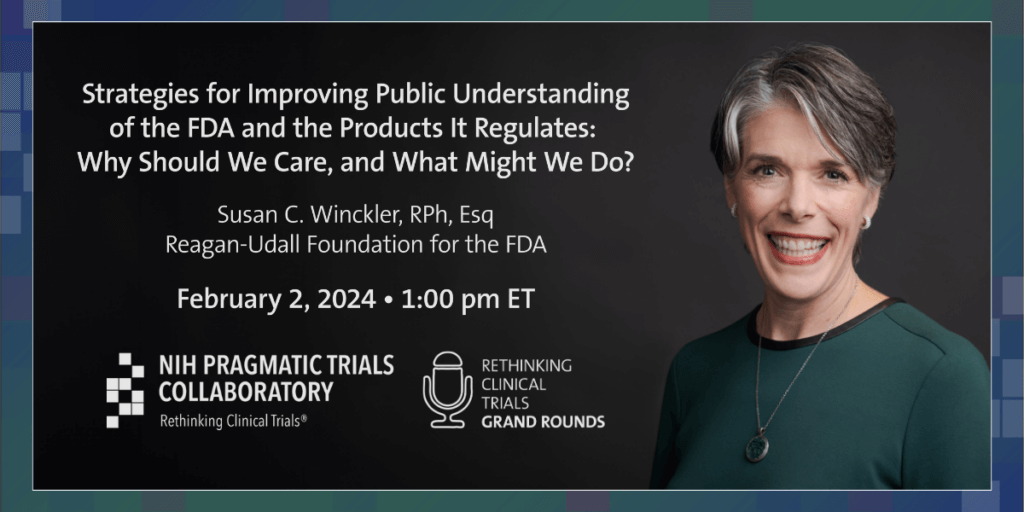
January 31, 2024: Improving the Public’s Understanding of the FDA, in This Week’s PCT Grand Rounds

In this Friday's PCT Grand Rounds, Susan Winckler of the Reagan-Udall Foundation for the FDA will present "Strategies for Improving Public Understanding of FDA and the Products It Regulates: Why Should We Care, and What Might We Do?"

The Grand Rounds session will be held on Friday, February 2, 2024, at 1:00 pm eastern.

Winckler is the chief executive officer of the Reagan-Udall Foundation for the FDA, a nonprofit organization created by Congress “to advance the mission of the FDA to modernize medical, veterinary, food, food ingredient, and cosmetic product development, accelerate innovation, and enhance product safety.”

Join the online meeting.

June 15, 2023: Regulatory Considerations for Clinical Decision Support Software in Pragmatic Trials Explored at Annual Steering Committee Meeting

This year’s annual Steering Committee meeting for the NIH Pragmatic Trials Collaboratory featured 2 special guests from the US Food and Drug Administration’s Digital Health Center of Excellence—Matthew Diamond, MD, PhD, Chief Medical Officer, and Sonja Fulmer, PhD, Acting Deputy Director. They joined to share information on the FDA’s approach to clinical decision support (CDS) software, including the agency’s recently released guidance, which helped stimulate a discussion on the associated considerations for embedded pragmatic clinical trials. Here we highlight some key takeaways from that discussion.

CDS is a broad term that encompasses a range of different functions, and there are several NIH Collaboratory Trials that are testing CDS software. Diamond explained that some digital health technologies, including some CDS software, meet the regulatory definition of a medical device while others do not. The FDA focuses its oversight on a subset of digital health technologies.

The new FDA guidance outlines criteria for determining which CDS are considered non-devices due to the CDS criteria in the 21st Century Cures Act. In addition to the CDS guidance, there are other policies that may apply to a digital health technology, so the FDA created a Digital Health Policy Navigator to help people find the relevant guidance for their situation. Further, the FDA encourages engagement early and often to understand how the regulations and policies apply to a particular product or technology.

If a software is the focus of FDA’s regulatory oversight, it does not mean the research cannot be done. In fact, research is essential to contribute to the body of evidence on the functioning of a device. The research just needs to go through the right processes. The goals of using the right processes for product review and research are to ensure that patients are protected during research and that the products that are ultimately marketed are safe and effective. The determination of whether an investigational device exemption (or IDE) is required is based on risk.

The details behind the implementation of digital health products matters a lot in these determinations. Subtle differences in the way that a product functions and the claims that are made about a product can make a big difference. Diamond stressed the importance of clearly defining the intended use of a product, including who it is intended for and what the user is supposed to do with information provided by the software. Fulmer highlighted the importance of transparency with stakeholders, including healthcare professionals, patients, and regulators.

For specific questions, the presenters encouraged researchers to reach out to the FDA’s digital health experts at DigitalHealth@fda.hhs.gov.

February 7, 2023: FDA Issues Draft Guidance for Use of Real-World Data in Externally Controlled Trials

The US Food and Drug Administration last week issued draft guidance for the use of “externally controlled clinical trials” to provide evidence of the safety and effectiveness of drugs and biologics. An externally controlled trial uses patient-level data from a source outside the clinical trial—such as a registry, electronic health records, or administrative claims data—to provide a historical or concurrent control group for the study.

Reviewers are asked to submit written comments on the draft guidance by May 2, 2023. Read the draft guidance.

Externally controlled trials can be useful when it would not be feasible or ethical to use an internal control in the study, such as in studies of populations with rare diseases. The FDA issued the draft guidance as part of a series of guidance documents under its Real-World Evidence Program to satisfy a mandate under the 21st Century Cures Act.

August 30, 2022: FDA Announces Webinar on Patient-Focused Drug Development Draft Guidance

FDA logoThe US Food and Drug Administration (FDA) will host a webinar on September 9 for industry, patient groups, and other interested stakeholders to discuss and answer questions about the draft guidance, Patient-Focused Drug Development: Selecting, Developing, or Modifying Fit-for-Purpose Clinical Outcome Assessments.

The draft guidance, known as “Guidance 3,” is the third of 4 methodological guidance documents for patient-focused drug development that describe how patients, caregivers, researchers, medical product developers, and others can collect and submit patient experience data and other relevant information to be used for medical product development and regulatory decision making. Guidance 3 discusses approaches to selecting, modifying, developing, and validating clinical outcome assessments to measure outcomes of importance to patients in clinical trials.

Register for the webinar at https://www.eventbrite.com/e/public-webinar-patient-focused-drug-development-pfdd-draft-guidance-3-tickets-397246183027.

Podcast July 8, 2022: FDA Draft Guidance on Real-World Evidence (John Concato, MD, MS, MPH)

This podcast continues the discussion with Dr. John Concato as he discusses the FDA draft guidance on real-word evidence. Click on the recording below to listen to the podcast.

Want to hear more? View the full Grand Rounds presentation.

For alerts about new episodes, subscribe free on Apple Podcasts or SoundCloud. Read the transcript.

June 24, 2022: FDA Draft Guidance on Real-World Evidence (John Concato, MD, MS, MPH)

Speaker

John Concato, MD, MS, MPH
Associate Director for Real-World Evidence Analytics
Office of Medical Policy (OMP)
Center for Drug Evaluation and Research (CDER)
Food and Drug Administration (FDA)


Keywords

Big data; Real-word evidence; Real-world data; 21st Century Cures Act; FDA Draft Guidance


Key Points

  • Big Data, a term first used in the 1990s, leverages modern technology to increase the quantity, forms, speed, and capability to manipulate large-scale data. Real-world data (RWD) is a term with specific regulatory implications referring to health care data routinely collected from a variety of sources. Real-world evidence (RWE) is clinical evidence derived from analysis of RWD regardless of study design.
  • Terminology is important in research work, and we should strive to be as precise as possible with the terminology we use.
  • With the 21st Century Cures Act of 2016, the FDA established a program to evaluate the potential use of real-world evidence to support new indications for drugs and satisfy post-approval study requirements.
  • In 2021, the FDA issued 4 draft guidance documents for Real-world data and Real-world evidence intended to guide the selection and management of data sources to appropriately address the study question and support decision-making for drug and biological products.

Discussion Themes

– Could real-world data sources be certified and preclude the need for submission of source data on a study specific basis? From the FDA point-of-view, while reliability can be more readily evaluated and would tend to be more stable, the relevance to a particular study could not be determined as easily.

– While there can be a reflex that says we can never be sure about major confounding, it should not be the miasma of the 21st century. A thoughtful approach that considers the characteristics that matter is the best approach.


Read Dr. Concato’s publication Randomized, observational, interventional, and real-world—What’s in a name? and the FDA Draft Guidance for RWD/RWE.

Tags

#pctGR, @Collaboratory1

June 22, 2022: FDA’s Draft Guidance on Real-World Evidence to Be Featured in Grand Rounds

Headshot of Dr. John ConcatoIn this Friday’s PCT Grand Rounds, Dr. John Concato of the US Food and Drug Administration will present “FDA Draft Guidance on Real-World Evidence.” The Grand Rounds session will be held on Friday, June 24, 2022, at 1:00 pm eastern.

Dr. Concato is the associate director for real-world evidence analytics in the Office of Medical Policy in the FDA’s Center for Drug Evaluation and Research.

Join the online meeting.