July 2, 2025: Researchers Share Tips for Embedding Pragmatic Trials Into Primary Care Settings

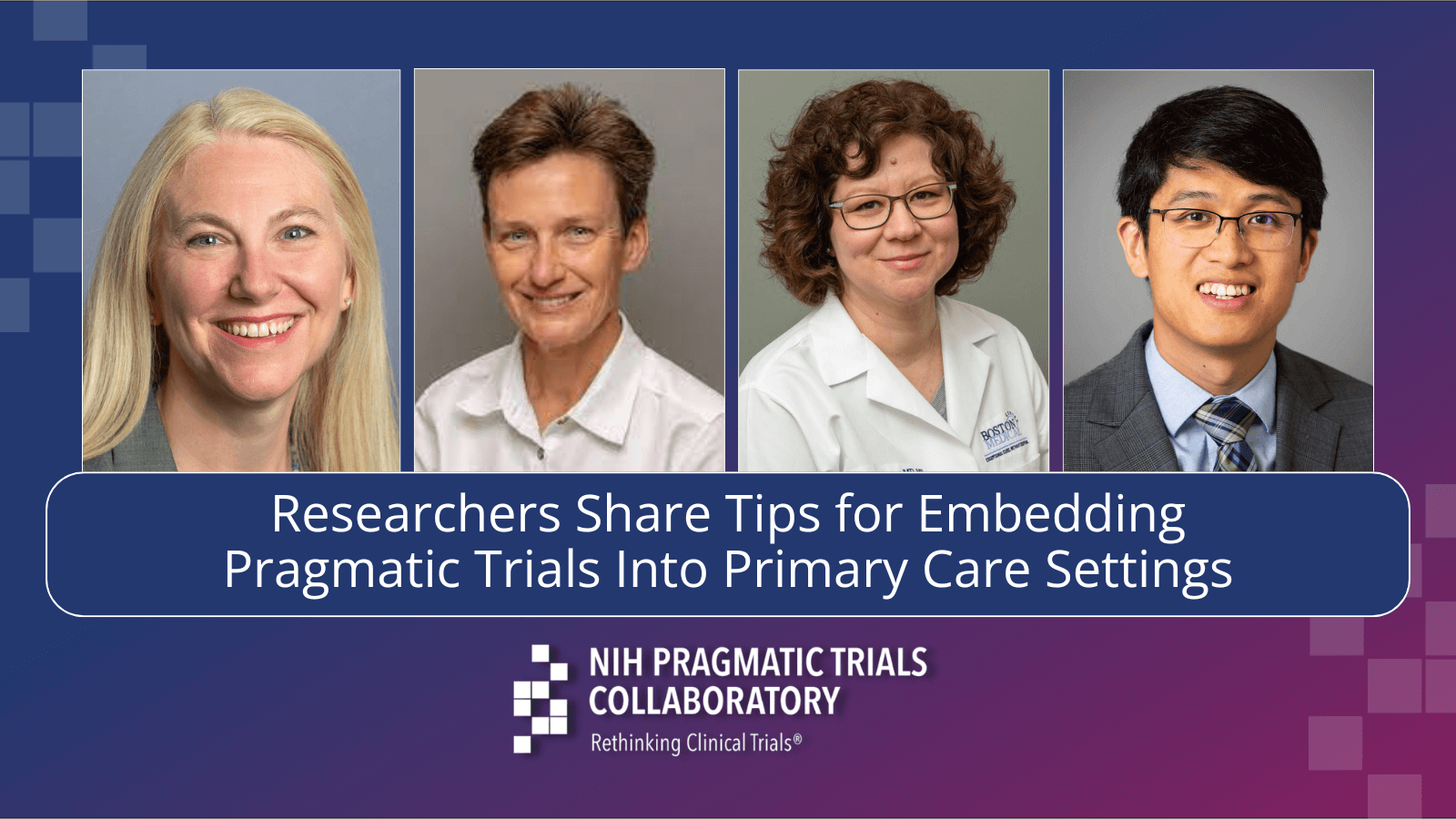
Headshots of Drs. Wendy Weber, Julie Fritz, Natalia Morone, and Sebastian TongAlthough the need for pragmatic research in primary care settings is great, conduct of pragmatic clinical trials in these settings remains nascent. In a session at the NIH Pragmatic Trials Collaboratory’s 2025 Annual Steering Committee Meeting, Wendy Weber of the National Center for Complementary and Integrative Health (NCCIH) led a discussion about how to expand pragmatic research into primary care settings.

The panelists included Julie Fritz, principal investigator (PI) for BeatPain Utah; Natalia Morone, PI for OPTIMUM; and Sebastian Tong, co-PI for AIM-CP. They shared some of the challenges of conducting research in primary care.

  • Primary care physicians have multiple competing demands for attention and focus, and a range of topics to cover in a single visit.
  • The expectation of being offered participation in clinical trials is lower in primary care than in specialty visits.
  • There are fewer resources that can be diverted to research in primary care, especially time and personnel.

Key Takeaways

How do we adapt pragmatic clinical trials to primary care?

Identify relevant and meaningful research questions

The panelists suggested that, when planning a trial, investigators should think about the primary care setting and consider what problems keep clinicians up at night. Research will be easier to implement if it helps alleviate these problems.

“In primary care, [primary care physicians] are looking at the entire person,” Tong said. “There has to be value added in how we care for the patients with the condition under study, either where the [physician] sees a difference in their patients’ lives or their own lives with respect to reduced burden,” he said.

The panelists also suggested that, for community health centers, there are certain conditions that are linked to data reporting standards, and aligning research with these standards will make studies easier to champion.

Adapt to different kinds of primary care settings

The panelists stressed the need for adaptably and flexibility in intervention delivery because all primary care settings are different. If  possible, researchers should tailor the workflow at each site in a way that is familiar to providers. the panelists also suggested that initial engagement by external researchers is best made with someone who is trusted at the site.

Some clinics, including community health centers, may be new to research and may need additional support. Many do not have an institutional review board or a Federalwide Assurance number, and many do not have experience using the electronic health record for research and developing data use agreements.

About the Trials

  • BeatPain Utah, supported by the National Institute of Nursing Research (NINR), is comparing the effectiveness of nonpharmacologic interventions delivered via telehealth for patients with back pain seeking care in federally qualified health centers in Utah.
  • OPTIMUM, supported by NCCIH, is assessing the impact of a group-based mindfulness intervention for patients with chronic back pain under usual care circumstances in the primary care setting.
  • AIM-CP, supported by NINR, is testing the implementation of a care management program to address disparate access to nonpharmacological treatments for chronic pain in rural populations.

This summer, we are sharing highlights from the 2025 Annual Steering Committee Meeting.  Access the complete collection of meeting materials.
June 25, 2024: NIH Collaboratory Leaders Discuss the Pragmatic Trials Landscape and the Future of the Program

Leaders of the NIH Pragmatic Trials Collaboratory met in Bethesda, Maryland, last month for the program’s 2024 Annual Steering Committee Meeting—an opportunity to network and hold rich discussions on key issues related to pragmatic research.

The program added 9 new trials in the past year. The Annual Steering Committee Meeting provided a collaborative space for new and seasoned NIH Collaboratory Trial investigators to share challenges and lessons learned in conducting their pragmatic trials. They shared methods for increasing patient engagement, overcoming challenges in trial implementation, and creating reusable infrastructure. Seasoned investigators also shared insights into planning for posttrial activities and transitioning to the next trial.

In an interview at the meeting, Coordinating Center co–principal investigators Adrian Hernandez, Lesley Curtis, and Kevin Weinfurt discussed the state of the program and the current pragmatic trials landscape.

“We have more trials working in rural populations,” noted Curtis. “Something that emerged [during the meeting] is the opportunity to bring the Cores together to tackle the issues we’ve been tackling, but with a focus on rural populations, which pose some unique challenges and opportunities,” she said.

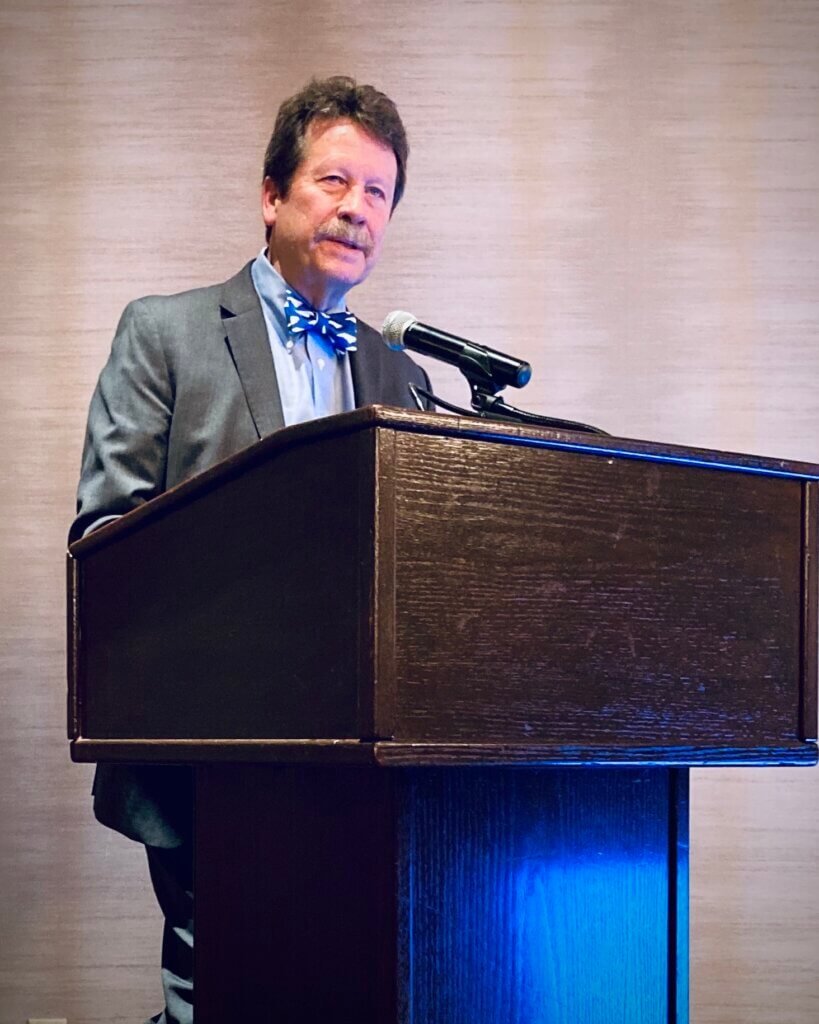
The meeting featured a fireside chat, moderated by Wendy Weber, NIH program officer for the NIH Pragmatic Trials Collaboratory, where NIH Director Monica Bertagnolli and FDA Commissioner Robert Califf shared their thoughts on how pragmatic research can help address the nation’s top health priorities. Bertagnolli highlighted an opportunity to bring pragmatic research into a primary care research network that can engage more patients in research. Califf stressed the importance of implementation science and how to maximize the evidence generated from pragmatic trials.

Weber and colleague Beda Jean-Francois of the National Center for Complementary and Integrative Health discussed the future of the NIH Collaboratory program and new directions for pragmatic research.

“I’m always amazed that there is more to learn, new frontiers, new directions—doing trials in rural communities, doing trials to address maternal morbidity,” Weber said as she reflected on key takeaways from the meeting. “We heard a challenge from the NIH Director during this meeting to think about primary care settings and how the NIH Collaboratory can help do those trials and take the lessons we’ve learned into that program,” she said.

Access the complete meeting materials from the 2024 Annual Steering Committee Meeting.

May 2, 2022: Califf Reflects on Origins and Impact of NIH Pragmatic Trials Collaboratory

In a keynote speech at the NIH Pragmatic Trials Collaboratory Steering Committee annual meeting, FDA Commissioner Dr. Rob Califf called for more and faster evidence generation. “We have to generate evidence more quickly and then insist that it gets used,” he said.

After his remarks, Califf joined Dr. Wendy Weber of the National Center for Complementary and Integrative Health to reflect on the origins and impact of the program. Califf was the first principal investigator of the program’s Coordinating Center, and Weber is the NIH program officer.

“We have a huge need for evidence, we have sources of data now that are digital and readily available,” Califf said. “So we should have consortia of investigators and patients who work together to get the answers as quickly as possible.

Califf noted that an important part of the original application for NIH funding was “a recognition that this was a startup and that it would be a work in progress.”

View the full interview.

Dr. Robert CaliffOn what has surprised him the most – “Patients and clinicians pretty readily grasp the need and the concept. They want to do it. The data part is a lot harder than most people thought. The technology has come a long way; we can do it now. Probably the hardest thing has actually been that the business models for health systems run counter to generating evidence. It’s something that we really haven’t overcome at this point.”
On opportunities for the program – “I think the program needs to keep the model that it has, but I’m hoping we can build in the incentive forces that are really needed to have it become, I will call it, ‘viral.’ We all want to know what the best treatment is, how to compare treatments, all the things that are involved in the network. Between FDA and NIH, and now CMS much more involved, and the interest of private industry, we could potentially really create the incentives that allow people to do what they now know how to do so well.”

On the legacy of the program – “I hope we’ll look back and say the Collaboratory and the things around the Collaboratory stimulated a new way of doing research that became the main way that we do research.”

See the complete materials from the 2022 Steering Committee meeting.

Podcast August 2, 2021: Diversity Workshop Series: Increasing Diversity in Pragmatic Clinical Trials (Dr. Boineau, Dr. Chambers, Dr. Curtis, Dr. O’Brien, Dr. Weber, Dr. Zimmerman)

This podcast summarizes the series on ‘Inclusion of Diverse Participants in Pragmatic Clinical Trials’ with a panel discussion with Dr. Robin Boineau, Dr. David Chambers, Dr. Lesley Curtis, Dr. Emily O’Brien, Dr. Wendy Weber, and Dr. Kanecia Zimmerman.

Click on the recording below to listen to the podcast.

Want to hear more? View the full Diversity workshop series Grand Rounds presentation from

May 14, 2021;  June 4, 2021; June 25, 2021; July 16, 2021; and July 30, 2021.

For alerts about new episodes, subscribe free on Apple Podcasts or SoundCloud.

Read the transcript.

July 26, 2021: NIH Collaboratory Leaders Discuss PRISM Projects, New Initiatives, and the Future of the Program

In a recent interview, Dr. Wendy Weber shared that the National Advisory Council for Complementary and Integrative Health has approved a concept for the NIH Collaboratory to continue with the support of NIH Institutes and Centers, as the program completes its term as an NIH Common Fund initiative.


“We’re quite excited for some new directions in where we’re going to head with this program, and really excited that we’ve identified a number of partners across the NIH as different Centers, Institutes, and Offices that want to continue this program and want to continue to do research embedded in healthcare systems,” Weber said.

Weber is the branch chief for the Clinical Research in Complementary and Integrative Health Branch in the Division of Extramural Research at the National Center for Complementary and Integrative Health (NCCIH) and serves as the program officer for the NIH Collaboratory.

“I think one new direction for us is looking at how do we address health disparities in healthcare systems, what types of interventions can actually improve those disparities and improve the quality of care so that we have less differences in the way patients are treated within the healthcare delivery system,” Weber said.

We interviewed Weber after the NIH Collaboratory’s annual steering committee meeting, along with Dr. Robin Boineau, the project scientist for the NIH Collaboratory, and Dr. Kevin Weinfurt, a professor in population health sciences at Duke University and a co–principal investigator for the NIH Collaboratory Coordinating Center. View the full interview.

The 3 leaders talked about the program’s newest NIH Collaboratory Trials—BeatPain Utah and GRACE—and their role in advancing the goals of the NIH Collaboratory. They also discussed focus areas for the coming year, including greater attention to implementation science outcomes, diversity in pragmatic trials, and lessons from the COVID-19 pandemic.

“[BeatPain Utah and GRACE] are helping the Collaboratory to learn how to design, analyze, and interpret adaptive designs,” said Weinfurt. “These are our 2 first trials where we’re using adaptive designs. One of the goals of the Collaboratory is to generate generalizable knowledge about how to do pragmatic trials, so we like these types of learning opportunities,” he said.

Boineau highlighted the Diversity Workshop Grand Rounds Series, which began in May and is ongoing. The series is focused on strategies for improving diversity in pragmatic clinical trials and is “an important next step to really think together about where we can go and what we can do to really build this community of investigators and participants,” Boineau said.


Screen shot of Dr. Wendy Weber interview
Dr. Wendy Weber of NCCIH, program officer for the NIH Collaboratory