June 25, 2024: NIH Collaboratory Leaders Discuss the Pragmatic Trials Landscape and the Future of the Program

Leaders of the NIH Pragmatic Trials Collaboratory met in Bethesda, Maryland, last month for the program’s 2024 Annual Steering Committee Meeting—an opportunity to network and hold rich discussions on key issues related to pragmatic research.

The program added 9 new trials in the past year. The Annual Steering Committee Meeting provided a collaborative space for new and seasoned NIH Collaboratory Trial investigators to share challenges and lessons learned in conducting their pragmatic trials. They shared methods for increasing patient engagement, overcoming challenges in trial implementation, and creating reusable infrastructure. Seasoned investigators also shared insights into planning for posttrial activities and transitioning to the next trial.

In an interview at the meeting, Coordinating Center co–principal investigators Adrian Hernandez, Lesley Curtis, and Kevin Weinfurt discussed the state of the program and the current pragmatic trials landscape.

“We have more trials working in rural populations,” noted Curtis. “Something that emerged [during the meeting] is the opportunity to bring the Cores together to tackle the issues we’ve been tackling, but with a focus on rural populations, which pose some unique challenges and opportunities,” she said.

The meeting featured a fireside chat, moderated by Wendy Weber, NIH program officer for the NIH Pragmatic Trials Collaboratory, where NIH Director Monica Bertagnolli and FDA Commissioner Robert Califf shared their thoughts on how pragmatic research can help address the nation’s top health priorities. Bertagnolli highlighted an opportunity to bring pragmatic research into a primary care research network that can engage more patients in research. Califf stressed the importance of implementation science and how to maximize the evidence generated from pragmatic trials.

Weber and colleague Beda Jean-Francois of the National Center for Complementary and Integrative Health discussed the future of the NIH Collaboratory program and new directions for pragmatic research.

“I’m always amazed that there is more to learn, new frontiers, new directions—doing trials in rural communities, doing trials to address maternal morbidity,” Weber said as she reflected on key takeaways from the meeting. “We heard a challenge from the NIH Director during this meeting to think about primary care settings and how the NIH Collaboratory can help do those trials and take the lessons we’ve learned into that program,” she said.

Access the complete meeting materials from the 2024 Annual Steering Committee Meeting.

August 14, 2023: Program Leaders Reflect on Cross-Core Collaboration and Opportunities for the Future

Headshots of Dr. Kevin Weinfurt and Dr. Greg Simon
From left: Kevin Weinfurt and Greg Simon

In an interview during the program’s Annual Steering Committee Meeting, Drs. Kevin Weinfurt and Greg Simon reflected on cross-Core collaboration within the NIH Pragmatic Trials Collaboratory and opportunities for growth in the future.

More than a decade ago, when the NIH Pragmatic Trials Collaboratory got its start, the focus was on identifying and answering the big questions in terms of how to do research embedded in routine healthcare, said Weinfurt, co–principal investigator of the NIH Collaboratory’s Coordinating Center. As a result, during the founding years, the NIH Collaboratory’s Core Working Groups primarily worked on addressing the big questions that were specific to each Core (eg, ethics and regulatory issues, electronic health record challenges).

After working through many of the early questions, the program’s approach has evolved in recent years.

“As we tackled some of the bigger questions, the new questions we wanted to answer required contributions from across the Cores to address questions in a more comprehensive way,” said Weinfurt.

Many of the new questions that came up for the Core Working Groups originated from the NIH Collaboratory Trials.

“So many of the decisions about pragmatic trials involve compromise,” said Simon, chair of the Health Care Systems Interactions Core. “It is interesting how that compromise is reflected in terms of how and when the Cores work together because each Core has a focus but also needs to account for how an issue in one area of a trial also affects another area.”

For example, Simon said, a project might have a question related to working with the healthcare system, and that question may overlap with ethics and regulatory and healthcare access issues.

These overlapping issues have resulted in more collaborative work across Cores, explained Simon. “It is important to have these groups that have a focus as long as you realize that there are no sharp boundaries.”

The NIH Collaboratory’s Coordinating Center plays an important role in keeping track of the issues that arise from individual projects and following up with the Steering Committee and Cores.

“There is a web of information that is communicated through the project managers and communications specialists that allows a lot of issues to surface,” said Weinfurt. “Our NIH leaders will often raise issues that they are seeing either within the NIH Collaboratory or on the horizon as something that might be of interest to discuss.”

Looking to the future, Weinfurt said he expects to see more and more opportunities for the Cores to collaborate, find solutions, and create generalizable knowledge, especially as the new Community Health Improvement and Implementation Science Cores ramp up.

“Both the Community Health Improvement and the Implementation Science Cores have a similar reach across all of the various issues that come up for trials. It may be the case that it is very rare to have a Core work alone on a topic in the future,” said Weinfurt.

These collaborations have already been productive, as highlighted by recent cross-Core products tackling important issues:

July 17, 2023: NIH Pragmatic Trials Collaboratory Welcomes First Class of Fellows

Headshots of Dr. Stephanie Ibemere and Dr. Kaitlyn McLeod
From left: Dr. Stephanie Ibemere and Dr. Kaitlyn McLeod

The NIH Pragmatic Trials Collaboratory is welcoming its first class of fellows in a new program for early-career investigators with a scholarly interest in pragmatic clinical trials.

"We are very excited to welcome the 2 inaugural fellows to the NIH Pragmatic Trials Collaboratory Fellowship Program and give them the education and tools that they need to launch their careers as pragmatic clinical trials investigators," said Dr. Rosa Gonzalez-Guarda, cochair of the NIH Collaboratory’s Fellowship Program and Health Equity Core.

Dr. Stephanie Ibemere is an assistant professor in the Duke University School of Nursing. Dr. Ibemere will work closely with the Implementation Science Core and the GRACE NIH Collaboratory Trial team during her fellowship year.

Dr. Kaitlyn McLeod is a resident physician in the Internal Medicine Residency Program at the University of Colorado. Dr. McLeod will work closely with the Community Health Improvement Core and the Nudge NIH Collaboratory Trial team during her fellowship year.

"We are delighted that Stephanie and Kaitlyn are joining the NIH Collaboratory as fellows, and we look forward to the insights they will bring to the Cores and NIH Collaboratory Trials," said Dr. Kevin Weinfurt, co–principal investigator of the Coordinating Center and cochair of the new Fellowship Program.

During the 1-year fellowship, which began July 1, 2023, fellows will become members of the NIH Collaboratory program and have access to a wide range of activities and opportunities. Fellows will be active participants in a Core Working Group that aligns with their interests and will also be given education on the fundamentals of designing and conducting successful pragmatic clinical trials.

Working with a NIH Collaboratory Trial investigator mentor and a Core leadership mentor from the NIH Collaboratory, each fellow will complete a project that contributes to the field of pragmatic trials, resulting in a new publishable product or resource. In addition, fellows will participate in the following activities:

  • Regular presentations and discussions with experienced pragmatic trial investigators and leaders in the field
  • Individualized coursework and mentorship
  • Guided research program
  • Professional development training
  • Presentation and publication opportunities
  • Training on health equity as it relates to pragmatic trials

Ibemere and McLeod joined leaders from the NIH Collaboratory and their mentors for a welcome and orientation meeting on July 6 to kick off their fellowship year.

May 12, 2022: Current and Past Leaders of NIH Pragmatic Trials Collaboratory Reflect on the Past, Present, and Future

In an interview at the Steering Committee’s annual meeting in April, Dr. Wendy Weber, Dr. Josephine Briggs, and Dr. Catherine Meyers celebrate the success of the NIH Pragmatic Trials Collaboratory and look at the roadmap to its future.

In the Beginning…

The NIH Pragmatic Trials Collaboratory (then the NIH Health Care Systems Research Collaboratory) began as an NIH Common Fund–initiated program. According to Dr. Josephine Briggs, Director Emeritus of the National Center for Complementary and Integrative Health (NCCIH), the idea began with a recognition that “explanatory trials were often run in ways to demonstrate that an intervention worked with selected populations implemented in a very controlled environment… We really needed to test those interventional trials and see whether they really worked when generalized to a broader population likely to be using them to settings in which the intervention implementation wasn’t as tightly controlled.”

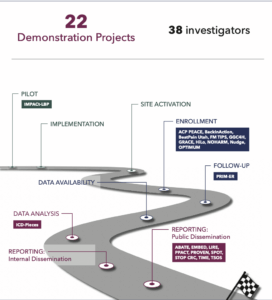
In 2012, the Common Fund awarded both the Coordinating Center and the first 7 NIH Collaboratory Trials (ABATE, BPMedTime, LIRE, PPACT, SPOT, STOP CRC, TiME).

The Present

In its first 10 years, the NIH Pragmatic Trials Collaboratory has supported 22 NIH Collaboratory Trials involving 38 investigators.


Road map

Dr. Cathy Meyers, Director Emeritus of the NCCIH Office of Clinical and Regulatory Affairs stated that “The Coordinating Center has really been a scribe throughout this last decade of recording problems and, more importantly, their solutions, and has even, with the last wave of solicitations for applications, incorporated training.”

Living Textbook VisitorsMuch of this content is housed in Rethinking Clinical Trials®: A Living Textbook of Pragmatic Clinical Trials, a free online textbook developed and maintained by the NIH Collaboratory. Drawing on experiences from the program’s NIH Collaboratory Trials and community of experts, the Living Textbook provides guidance on each step of a pragmatic trial, from study design through applying results in the real world. The Living Textbook is continually updated and expanded as new information emerges. This new knowledge is also disseminated through the NIH Collaboratory’s Knowledge Repository and weekly Grand Rounds series.

Looking to the future

“There are now 8 different partnering institutions and centers that support the NIH Pragmatic Trials Collaboratory, and we are open to more,” said Dr. Wendy Weber, NCCIH Project Officer for the NIH Collaboratory.

When asked what she is looking forward to in the future, Dr. Weber stated that “There is a unique opportunity to look at trials that address health disparities. How do we solve what we know is a problem in the healthcare system? How can we design interventions to improve that. We do so much research documenting how much disparity there is. Let’s do something to actually improve that.”

Towards this end, the NIH released a request for applications (RFA) for new NIH Collaboratory Trial grants that address health disparities.  The RFA for this funding opportunity encourages applications that focus on improving health outcomes in populations that experience health disparities, such as higher rates of disease or mortality compared with the general population. Applications are due June 17, 2022. Letters of intent are due 30 days prior (May 17, 2022).

We will be sharing more insights form the 2022 NIH Pragmatic Trials Steering Committee Meeting over the coming weeks. All meeting materials are available online.

View the full interview.

About the NIH Pragmatic Trials Collaboratory

The NIH Pragmatic Trials Collaboratory Coordinating Center consists of the Duke Clinical Research Institute, the Harvard Pilgrim Health Care Institute, the Kaiser Permanente Washington Health Research Institute, the Johns Hopkins Berman Institute of Bioethics, the University of Washington, and the University of Michigan. The program is supported by the National Institutes of Health (NIH) through cooperative agreement U24AT009676 from the Office of Strategic Coordination within the Office of the NIH Director. It is also supported by the NIH through the NIH HEAL Initiative under award number U24AT010961. The content is solely the responsibility of the authors and does not necessarily represent the official views of the NIH or its HEAL Initiative. To learn more about the program, visit rethinkingclinicaltrials.org.


May 11, 2022: MOTIFS Investigation of Collateral Findings in Pragmatic Trials Will Be Featured in PCT Grand Rounds

Head shots of Dr. Jeremy Sugarman, Dr. Stephanie Morain, Juli Bollinger, and Dr. Kevin WeinfurtIn this Friday’s PCT Grand Rounds, Dr. Jeremy Sugarman, Dr. Stephanie Morain, and Juli Bollinger of Johns Hopkins University and Dr. Kevin Weinfurt of Duke University will present “Ethics and Collateral Findings in Pragmatic Clinical Trials: Implications of a Multi-Method Exploration.” The Grand Rounds session will be held on Friday, May 13, at 1:00 pm eastern.

The team will present lessons from MOTIFS, a recently completed multi-method investigation of the ethical and regulatory implications of “collateral findings” in pragmatic clinical trials.

Join the online meeting.

February 14, 2022: IMPACT Collaboratory Grand Rounds to Highlight First Decade of NIH Pragmatic Trials Collaboratory

Headshots of Dr. Adrian Hernandez, Dr. Lesley Curtis, and Dr. Kevin Weinfurt
Dr. Adrian Hernandez, Dr. Lesley Curtis, and Dr. Kevin Weinfurt

This week’s NIA IMPACT Collaboratory Grand Rounds session will highlight the first decade of the NIH Pragmatic Trials Collaboratory. The Grand Rounds session—“Lessons From the First Decade of the NIH Pragmatic Trials Collaboratory”—will be held on Thursday, February 17, at 12:00 pm eastern.

The co–principal investigators of the NIH Pragmatic Trials Collaboratory Coordinating Center at Duke University—Drs. Adrian Hernandez, Dr. Lesley Curtis, and Dr. Kevin Weinfurt—will share lessons from the network’s portfolio of NIH Collaboratory Trials and discuss priorities for future research.

The NIA IMPACT Collaboratory is supported by a grant from the National Institute on Aging. Its mission is to advance care for persons with dementia and their caregivers in real-world settings by building national capacity to conduct pragmatic clinical trials that test interventions embedded in healthcare systems.

September 22, 2021: PCT Grand Rounds Explores Enabling Patient-Reported Outcome Measures in Clinical Trials

Headshots of Dr. Theresa Coles and Dr. Kevin Weinfurt
Dr. Theresa Coles (left) and Dr. Kevin Weinfurt

In this Friday’s PCT Grand Rounds, Dr. Theresa Coles and Dr. Kevin Weinfurt of Duke University will discuss the use of patient-reported outcome measures in clinical trials, using examples from cardiovascular trials.

The Grand Rounds session will be held on Friday, September 24, at 1:00 pm eastern. Join the online meeting.

For webinar recordings and slides from previous Grand Rounds sessions, see the Grand Rounds hub.

July 26, 2021: NIH Collaboratory Leaders Discuss PRISM Projects, New Initiatives, and the Future of the Program

In a recent interview, Dr. Wendy Weber shared that the National Advisory Council for Complementary and Integrative Health has approved a concept for the NIH Collaboratory to continue with the support of NIH Institutes and Centers, as the program completes its term as an NIH Common Fund initiative.


“We’re quite excited for some new directions in where we’re going to head with this program, and really excited that we’ve identified a number of partners across the NIH as different Centers, Institutes, and Offices that want to continue this program and want to continue to do research embedded in healthcare systems,” Weber said.

Weber is the branch chief for the Clinical Research in Complementary and Integrative Health Branch in the Division of Extramural Research at the National Center for Complementary and Integrative Health (NCCIH) and serves as the program officer for the NIH Collaboratory.

“I think one new direction for us is looking at how do we address health disparities in healthcare systems, what types of interventions can actually improve those disparities and improve the quality of care so that we have less differences in the way patients are treated within the healthcare delivery system,” Weber said.

We interviewed Weber after the NIH Collaboratory’s annual steering committee meeting, along with Dr. Robin Boineau, the project scientist for the NIH Collaboratory, and Dr. Kevin Weinfurt, a professor in population health sciences at Duke University and a co–principal investigator for the NIH Collaboratory Coordinating Center. View the full interview.

The 3 leaders talked about the program’s newest NIH Collaboratory Trials—BeatPain Utah and GRACE—and their role in advancing the goals of the NIH Collaboratory. They also discussed focus areas for the coming year, including greater attention to implementation science outcomes, diversity in pragmatic trials, and lessons from the COVID-19 pandemic.

“[BeatPain Utah and GRACE] are helping the Collaboratory to learn how to design, analyze, and interpret adaptive designs,” said Weinfurt. “These are our 2 first trials where we’re using adaptive designs. One of the goals of the Collaboratory is to generate generalizable knowledge about how to do pragmatic trials, so we like these types of learning opportunities,” he said.

Boineau highlighted the Diversity Workshop Grand Rounds Series, which began in May and is ongoing. The series is focused on strategies for improving diversity in pragmatic clinical trials and is “an important next step to really think together about where we can go and what we can do to really build this community of investigators and participants,” Boineau said.


Screen shot of Dr. Wendy Weber interview
Dr. Wendy Weber of NCCIH, program officer for the NIH Collaboratory