July 8, 2025: PRIM-ER Team Observes More Healthy Days at Home for Patients With Cancer Diagnosis

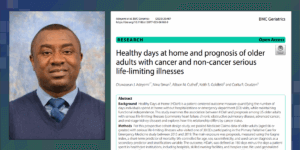
Headshot of Dr. Oluwaseun Adeyemi with screenshot of PRIM-ER article
Dr. Oluwaseun Adeyemi, lead author of the report

In an analysis of data on seriously ill older adults from emergency departments that participated in the PRIM-ER trial, poor prognosis was associated with fewer healthy days at home. However, a cancer diagnosis was associated with more healthy days at home.

The analysis was published online this month in BMC Geriatrics.

PRIM-ER, an NIH Collaboratory Trial, was a stepped-wedge, cluster randomized trial of a palliative care training program in emergency departments in the United States. The program consisted of training in palliative care, simulation-based communication workshops, clinical decision support tools, and audit and feedback.

In the new analysis of data for nearly 123,000 seriously ill older adults, worse prognosis was associated with a lower rate of healthy days at home for patients both with and without cancer. However, having a cancer diagnosis was associated with more healthy days at home. Demographic factors such as age and race/ethnicity were also associated with healthy days at home.

The authors of the report, led by Oluwaseun Adeyemi of New York University, under the guidance of principal investigators Corita Grudzen and Keith Goldfeld, believe this difference may be related to the “structured and comprehensive care pathways available to cancer patients, such as outpatient oncology services, home-based palliative care, and symptom management plans designed to minimize hospitalizations.”

“Our findings highlight the need for tailored care models, including enhanced outpatient services and home-based care to reduce hospitalizations and increase [healthy days at home] for patients with serious non-cancer illnesses,” the authors wrote.

Read the full article.

PRIM-ER was supported within the NIH Pragmatic Trials Collaboratory by a grant award from the National Institute on Aging. Learn more about PRIM-ER.

July 3, 2025: OPTIMUM Team Identifies Facilitators of Participant Retention and Engagement

Headshot of Dr. Natalia Morone, principal investigator for OPTIMUM
Dr. Natalia Morone, principal investigator for OPTIMUM

Trust in their clinicians, positive interactions with study staff, and opportunities for social connection can improve recruitment, retention, and engagement with research participants, according to focus groups of participants in the OPTIMUM trial. These factors can be especially important for first-time research participants and for groups that are historically underrepresented in clinical trials.

The article was published online in Global Advances in Integrative Medicine and Health.

OPTIMUM, an NIH Collaboratory Trial, is studying the addition of mindfulness-based stress reduction to usual care for patients with chronic low back pain, compared with usual care alone, with the goal of improving pain outcomes and reducing opioid prescriptions. Patients in the control group were also offered free mindfulness sessions after the end of the 12-month follow-up period.

Understanding of randomized controlled trials and general research processes emerged as another important theme in the focus groups. In particular, appreciating the value of the control group in a randomized controlled trial can support participants’ ongoing engagement.

“Consistent, positive study staff interactions were particularly important for control group participants who were not immediately receiving the intervention that initially interested them in the trial,” the authors wrote.

The OPTIMUM trial, which is embedded in safety net hospitals and federally qualified health centers, includes a large number of first-time participants in research and patients from racial and ethnic groups that tend to be underrepresented in research. Understanding the needs and perspectives of first-time research participants and those from underrepresented groups can improve recruitment and retention strategies and help ensure the representativeness of study populations.

Read the full report.

OPTIMUM is supported within the NIH Pragmatic Trials Collaboratory through the NIH HEAL Initiative by a grant award administered by the National Center for Complementary and Integrative Health. Learn more about OPTIMUM.

July 1, 2025: As Their Studies Wrap Up, Researchers Share Lessons for Pragmatic Trials

Headshots of Drs. Christine Goertz, Andrea Cook, Shruti Gohil, and Stacy SterlingA key feature of the NIH Pragmatic Trials Collaboratory is its culture of learning and knowledge sharing among investigators who are planning and conducting pragmatic clinical trials. In a session at the program’s 2025 Annual Steering Committee Meeting, a panel of investigators discussed their recently completed NIH Collaboratory Trials and their thoughts about future directions for pragmatic research.

The panelists included Andrea Cook, co–principal investigator (PI) for BackInAction; Shruti Gohil, lead investigator for INSPIRE; and Stacy Sterling, co-PI for GGC4H. Christine Goertz, a co-PI for IMPACt-LBP, moderated the discussion.

Key Takeaways

What do investigators wish they had known before starting a pragmatic trial? Sterling highlighted a need for ongoing engagement with partnering healthcare systems’ senior leaders to ensure they understand the challenges of adopting and sustaining the study intervention. Cook stressed the importance of educating site personnel about what it means to participate in the trial, including the potential for randomization to a usual care arm.

“We also included nonphysician clinicians in the education about the intervention, because they are often doing the steps being targeted by the intervention,” Gohil added.

How can we apply these lessons in future pragmatic trials? “Doing an embedded pragmatic trial is sort of like having a child: You really need the guidance of people who have gone before you and have real-life experience,” Goertz said.

The panelists proposed the development of more standardized materials for the consent process and other trial elements. They also discussed the need for broader dissemination strategies and new ways to promote implementation tools from trials with successful interventions.

Gohil described her research team’s commitment to developing a dissemination toolkit so people will understand how to approach implementation. She noted that, as soon as the trial was completed but before publication, the research team presented the results to the participating sites.

Greg Simon, the PI for SPOT and a member of the NIH Collaboratory Coordinating Center’s leadership team, stressed the importance of including research partners in dissemination.

“Don’t write the discussion section [of your study results paper] until you’ve talked with your healthcare system partners; they might have something to teach us about what the results mean,” he said.

About the Trials

  • BackInAction, supported by the National Center for Complementary and Integrative Health (NCCIH), is comparing standard and advanced courses of acupuncture with usual care for older adults with chronic low back pain.
  • GGC4H, supported by NCCIH, is testing the feasibility and effectiveness of implementing within healthcare systems the Guiding Good Choices program for caregivers of early adolescents to prevent common behavioral problems, such as substance use.
  • IMPACt-LBP, supported by NCCIH, is evaluating the effect of first-contact patient referral to physical therapists and doctors of chiropractic for low back pain.
  • INSPIRE, supported by the National Institute of Allergy and Infectious Diseases, used personalized clinical decision support to improve judicious antibiotic prescribing for non–critically ill patients hospitalized with abdominal infections or skin and soft tissue infections.
  • SPOT, supported by the National Institute of Mental Health, compared care management and dialectical behavior therapy skills training to usual care for adults at risk of self-harm or suicidal behavior.

This summer, we are sharing highlights from the 2025 Annual Steering Committee Meeting. Access the complete collection of meeting materials.

June 24, 2025: Study Design Paper Published for ARBOR-Telehealth

ARBOR-Telehealth logoThe study design paper for ARBOR-Telehealth has been published online in BMJ Open. Congratulations to the study team on reaching this important milestone for all NIH Collaboratory Trials!

The ARBOR-Telehealth study is evaluating the use of a telehealth physical therapy strategy for patients who present to primary care clinics with low back pain in rural communities. A secondary aim of the study is to compare the effectiveness of the study’s risk-stratification approach.

The study is being led by Richard Skolasky and Kevin McLaughlin of Johns Hopkins University and is supported by a grant award from the National Institute of Arthritis and Musculoskeletal and Skin Diseases.

Read the full study design paper.

June 12, 2025: Living Textbook Chapter Covers Consent, Disclosure, and Nondisclosure for Pragmatic Trials

A new chapter of the Living Textbook of Pragmatic Clinical Trials describes regulatory requirements for informed consent, waivers and alterations of consent, mechanisms for notification, and research participants’ perspectives on a variety of approaches to consent and notification—all with a focus on special considerations for pragmatic clinical trials.

For a variety of reasons, the  application of ethical principles and regulations regarding informed consent can be complex for pragmatic clinical trials. For example, pragmatic trials often use novel study designs, including cluster randomization, in which the unit of randomization may be a clinic, hospital, or healthcare system rather than the individual. Some pragmatic trials also use stepped-wedge designs, in which the study intervention is introduced to sites at different times.

The new chapter has 5 sections:

  • Section 1 discusses reasons why the application of ethical principles and regulations regarding informed consent can be complex for pragmatic trials.
  • Section 2 describes the regulatory requirements for informed consent.
  • Section 3 focuses on waivers and alterations of the informed consent process.
  • Section 4 provides examples of mechanisms for notifying participants about the trial when consent is not required.
  • Section 5 presents findings on research partners’ preferences regarding various approaches to research and consent.

The chapter was developed by members of the NIH Pragmatic Trials Collaboratory’s Ethics and Regulatory Core.

June 3, 2025: GGC4H Team Sees Good Intervention Fidelity With Virtual Delivery, but Faces Engagement Challenge

Headshots of Dr. Margaret Kuklinski and Dr. Stacy Sterling
Dr. Margaret Kuklinski and Dr. Stacy Sterling, co–principal investigators for GGC4H

In an evaluation conducted alongside the GGC4H trial, researchers assessed the intervention fidelity of a version of the Guiding Good Choices parenting program that was adapted for online delivery. They found that virtual delivery of the intervention was feasible but that retention of participants was a challenge.

The report was published in the Journal of Community Psychology.

GGC4H, an NIH Collaboratory Trial, is a pragmatic, cluster randomized clinical trial testing the feasibility and effectiveness of implementing within healthcare systems the Guiding Good Choices program for caregivers of adolescents aged 11 to 13 years to prevent common behavioral problems, such as substance use. The trial is the first large-scale implementation of the virtual adaptation of the Guiding Good Choices program, and of the program in pediatric primary care settings.

The researchers used attendance records, interventionist surveys and focus groups, and observer reports to examine attendance, dosage, adherence, quality of intervention delivery, and participant engagement in the program. They reported high marks for all of these outcomes but found that attendance was lower than expected.

Read the full report.

GGC4H is supported within the NIH Collaboratory by a grant award from the National Center for Complementary and Integrative Health. Learn more about GGC4H.

May 19, 2025: Latest Podcast Episode Features the Results of ACP PEACE

In a new episode of our Rethinking Clinical Trials Podcast, Drs. Angelo Volandes and James Tulsky speak with host Dr. Adrian Hernandez about the results of the ACP PEACE study.

Listen and subscribe to the podcast on SoundCloud or Apple Podcasts.

ACP PEACE, an NIH Collaboratory Trial, was a stepped-wedge, cluster randomized trial testing the delivery of a video decision aid to older patients with advanced cancer together with goals-of-care communication skills training to oncology clinicians in 3 healthcare systems. The results of the study were published this month in JAMA Network Open.

May 13, 2025: Video Decision Aid and Clinician Communication Training Boost Advance Care Planning in Oncology Clinics

Headshots of Dr. James Tulsky and Dr. Angelo Volandes
Dr. James Tulsky and Dr. Angelo Volandes, principal investigators for ACP PEACE

A video decision aid for older patients with advanced cancer, coupled with communication skills training for clinicians, led to higher rates of documented advance care planning in oncology clinics, according to the ACP PEACE study.

The results of the study were published in the May issue of JAMA Network Open.

Many older adults with advanced cancer do not discuss treatment preferences or goals of care with their clinicians. Lack of communication about patients’ preferences can lead to patients receiving care that does not match their values.

ACP PEACE, an NIH Collaboratory Trial, was a stepped-wedge, cluster randomized trial testing the delivery of a video decision aid to patients together with goals-of-care communication skills training to oncology clinicians in 3 healthcare systems. The study included 13,800 patients at 29 clinics. Each clinic was randomly assigned to either the intervention or usual care at the beginning of the study. Due to the stepped-wedge design of the trial, all clinics were exposed to the intervention by the end of the study.

Logo for the ACP PEACE Demonstration Project

The intervention included an evidence-based, patient-facing video decision aid available in 25 languages. It also included a communication training program to improve clinicians’ skills in delivering serious news, responding to emotion, and eliciting patients’ goals. The primary outcome was documentation of advance care planning in the electronic health record, which could include documentation of a goals-of-care conversation, palliative care, hospice, or limitation of life-sustaining treatments.

The proportion of patients with documentation of advance care planning was greater with the ACP PEACE intervention than with usual care. The difference was attributable to a greater proportion of patients in the intervention phase having a goals-of-care conversation. There were no significant differences between the intervention and usual care for the documentation of palliative care, hospice, or limitation of life-sustaining treatments.

Read the full article.

“By focusing concurrently on both clinicians and patients—giving clinicians the skills to have these difficult conversations and preparing patients to engage with them—we were able to increase the number of documented goals-of-care conversations,” said James Tulsky, the Poorvu Jaffe Chair in Supportive Oncology at the Dana-Farber Cancer Institute and a co–principal investigator for ACP PEACE.

“If we are going to achieve shared decision-making, we need to bring everyone onto the same page,” Tulsky said.

Angelo Volandes, the Anna Gundlach Huber Professor in Medicine at the Geisel School of Medicine at Dartmouth and a co–principal investigator for ACP PEACE, highlighted the logistical challenge of conducting a large pragmatic clinical trial across 3 major healthcare systems during the COVID-19 pandemic.

“What made it work was a shared commitment—from frontline clinicians to healthcare system leaders—to ensure that older adults with advanced cancer had the opportunity to reflect on their values and have those conversations documented,” Volandes said.

“This trial wasn’t just about changing documentation rates, it was about changing the culture of communication, at scale,” he added.

ACP PEACE is supported within the NIH Pragmatic Trials Collaboratory by a cooperative agreement from the National Institute on Aging.

Learn more about ACP PEACE.

May 7, 2025: Results of BackInAction Pragmatic Trial of Acupuncture in Low Back Pain, in This Week’s PCT Grand Rounds

Headshots of Dr. Andrea Cook, Dr. Lynn DeBar, and Dr. Patricia Herman
Dr. Andrea Cook, Dr. Lynn DeBar, and Dr. Paricia Herman

In this Friday’s PCT Grand Rounds, Andrea Cook, Lynn DeBar, and Patricia Herman will present “A Policy-Relevant Pragmatic Trial on Acupuncture Effectiveness for Low Back Pain in Older Adults: Clinical and Cost Outcomes and Lessons Learned.”

The Grand Rounds session will be held on Friday, May 9, 2025, at 1:00 pm eastern.

The speakers will present the results of BackInAction, an NIH Collaboratory Trial. BackInAction compared standard and advanced courses of acupuncture with usual care for older adults with chronic low back pain.

Cook is a senior biostatistics investigator at the Kaiser Permanente Washington Health Research Institute; DeBar is a distinguished investigator at the Kaiser Permanente Center for Health Research; and Herman is a senior behavioral scientist at RAND, codirector of the RAND Research Across Complementary and Integrative Health Institutions (REACH) Center, and a professor of policy analysis at the RAND School of Public Policy.

Join the online meeting.

April 22, 2025: New Report Highlights Value of Informing Participants About Research Conducted Under a Waiver of Consent

Even in minimal-risk studies that do not use the standard consent process, there may be value in informing participants about the research. Such notifications should be considered the default for clinical trials conducted under a waiver of informed consent, argue the authors of a new report from the NIH Pragmatic Trials Collaboratory.

The open-access article was published online ahead of print this week in Learning Health Systems.

Pragmatic clinical trials conducted in the context of routine healthcare often meet the regulatory criteria for a waiver or alteration of the standard informed consent process. In such cases, researchers and reviewers might assume there is no reason to communicate information about the study to participants. However, providing information to participants, even in minimal-risk research conducted with a waiver of consent, can promote important ethical values.

Experts from the NIH Collaboratory’s Ethics and Regulatory Core teamed up with investigators from several of the NIH Collaboratory Trials to describe methods of informing participants in minimal-risk research.

The investigators used a variety of notification approaches in their studies, including letters and email campaigns, posters in waiting rooms and other common areas, conversations with clinicians, and presentations at staff meetings. The amount of information provided to participants ranged from a general statement that research was being conducted at the institution to detailed information about the study in question.

“When a study is approved with a waiver of research consent, investigators and review committees should consider on a case-by-case basis what information, if any, to disclose to participants, and how it will be disclosed,” the authors wrote. The costs, benefits, and feasibility of these approaches vary from study to study.

Communicating information to participants can promote several important goals:

  • The ethical principle of respect for persons
  • Participants’ understanding of the study and of research in general
  • Participants’ understanding of their contributions to the research
  • Participants’ ability to voice and discuss any concerns about the study
  • Participant engagement in research
  • Trust in research and researchers

“Providing information to the participants should thus be the default for trials conducted under a waiver of research consent,” the authors wrote.

Read the full report.