Dr. Margaret Kuklinski and Dr. Stacy Sterling, co–principal investigators for GGC4H
In an evaluation conducted alongside the GGC4H trial, researchers assessed the intervention fidelity of a version of the Guiding Good Choices parenting program that was adapted for online delivery. They found that virtual delivery of the intervention was feasible but that retention of participants was a challenge.
The report was published in the Journal of Community Psychology.
GGC4H, an NIH Collaboratory Trial, is a pragmatic, cluster randomized clinical trial testing the feasibility and effectiveness of implementing within healthcare systems the Guiding Good Choices program for caregivers of adolescents aged 11 to 13 years to prevent common behavioral problems, such as substance use. The trial is the first large-scale implementation of the virtual adaptation of the Guiding Good Choices program, and of the program in pediatric primary care settings.
The researchers used attendance records, interventionist surveys and focus groups, and observer reports to examine attendance, dosage, adherence, quality of intervention delivery, and participant engagement in the program. They reported high marks for all of these outcomes but found that attendance was lower than expected.
GGC4H is supported within the NIH Collaboratory by a grant award from the National Center for Complementary and Integrative Health. Learn more about GGC4H.
In a new episode of our Rethinking Clinical Trials Podcast, Drs. Angelo Volandes and James Tulsky speak with host Dr. Adrian Hernandez about the results of the ACP PEACE study.
ACP PEACE, an NIH Collaboratory Trial, was a stepped-wedge, cluster randomized trial testing the delivery of a video decision aid to older patients with advanced cancer together with goals-of-care communication skills training to oncology clinicians in 3 healthcare systems. The results of the study were published this month in JAMA Network Open.
Dr. James Tulsky and Dr. Angelo Volandes, principal investigators for ACP PEACE
A video decision aid for older patients with advanced cancer, coupled with communication skills training for clinicians, led to higher rates of documented advance care planning in oncology clinics, according to the ACP PEACE study.
Many older adults with advanced cancer do not discuss treatment preferences or goals of care with their clinicians. Lack of communication about patients’ preferences can lead to patients receiving care that does not match their values.
ACP PEACE, an NIH Collaboratory Trial, was a stepped-wedge, cluster randomized trial testing the delivery of a video decision aid to patients together with goals-of-care communication skills training to oncology clinicians in 3 healthcare systems. The study included 13,800 patients at 29 clinics. Each clinic was randomly assigned to either the intervention or usual care at the beginning of the study. Due to the stepped-wedge design of the trial, all clinics were exposed to the intervention by the end of the study.
The intervention included an evidence-based, patient-facing video decision aid available in 25 languages. It also included a communication training program to improve clinicians’ skills in delivering serious news, responding to emotion, and eliciting patients’ goals. The primary outcome was documentation of advance care planning in the electronic health record, which could include documentation of a goals-of-care conversation, palliative care, hospice, or limitation of life-sustaining treatments.
The proportion of patients with documentation of advance care planning was greater with the ACP PEACE intervention than with usual care. The difference was attributable to a greater proportion of patients in the intervention phase having a goals-of-care conversation. There were no significant differences between the intervention and usual care for the documentation of palliative care, hospice, or limitation of life-sustaining treatments.
“By focusing concurrently on both clinicians and patients—giving clinicians the skills to have these difficult conversations and preparing patients to engage with them—we were able to increase the number of documented goals-of-care conversations,” said James Tulsky, the Poorvu Jaffe Chair in Supportive Oncology at the Dana-Farber Cancer Institute and a co–principal investigator for ACP PEACE.
“If we are going to achieve shared decision-making, we need to bring everyone onto the same page,” Tulsky said.
Angelo Volandes, the Anna Gundlach Huber Professor in Medicine at the Geisel School of Medicine at Dartmouth and a co–principal investigator for ACP PEACE, highlighted the logistical challenge of conducting a large pragmatic clinical trial across 3 major healthcare systems during the COVID-19 pandemic.
“What made it work was a shared commitment—from frontline clinicians to healthcare system leaders—to ensure that older adults with advanced cancer had the opportunity to reflect on their values and have those conversations documented,” Volandes said.
“This trial wasn’t just about changing documentation rates, it was about changing the culture of communication, at scale,” he added.
ACP PEACE is supported within the NIH Pragmatic Trials Collaboratory by a cooperative agreement from the National Institute on Aging.
The Grand Rounds session will be held on Friday, May 9, 2025, at 1:00 pm eastern.
The speakers will present the results of BackInAction, an NIH Collaboratory Trial. BackInAction compared standard and advanced courses of acupuncture with usual care for older adults with chronic low back pain.
Cook is a senior biostatistics investigator at the Kaiser Permanente Washington Health Research Institute; DeBar is a distinguished investigator at the Kaiser Permanente Center for Health Research; and Herman is a senior behavioral scientist at RAND, codirector of the RAND Research Across Complementary and Integrative Health Institutions (REACH) Center, and a professor of policy analysis at the RAND School of Public Policy.
Even in minimal-risk studies that do not use the standard consent process, there may be value in informing participants about the research. Such notifications should be considered the default for clinical trials conducted under a waiver of informed consent, argue the authors of a new report from the NIH Pragmatic Trials Collaboratory.
Pragmatic clinical trials conducted in the context of routine healthcare often meet the regulatory criteria for a waiver or alteration of the standard informed consent process. In such cases, researchers and reviewers might assume there is no reason to communicate information about the study to participants. However, providing information to participants, even in minimal-risk research conducted with a waiver of consent, can promote important ethical values.
Experts from the NIH Collaboratory’s Ethics and Regulatory Core teamed up with investigators from several of the NIH Collaboratory Trials to describe methods of informing participants in minimal-risk research.
The investigators used a variety of notification approaches in their studies, including letters and email campaigns, posters in waiting rooms and other common areas, conversations with clinicians, and presentations at staff meetings. The amount of information provided to participants ranged from a general statement that research was being conducted at the institution to detailed information about the study in question.
“When a study is approved with a waiver of research consent, investigators and review committees should consider on a case-by-case basis what information, if any, to disclose to participants, and how it will be disclosed,” the authors wrote. The costs, benefits, and feasibility of these approaches vary from study to study.
Communicating information to participants can promote several important goals:
The ethical principle of respect for persons
Participants’ understanding of the study and of research in general
Participants’ understanding of their contributions to the research
Participants’ ability to voice and discuss any concerns about the study
Participant engagement in research
Trust in research and researchers
“Providing information to the participants should thus be the default for trials conducted under a waiver of research consent,” the authors wrote.
Left to right: LungSMART investigators Drs. David Wetter, Guilherme Del Fiol, and Ken Kawamoto
Ethics and regulatory onboarding documentation for 2 of the NIH Pragmatic Trials Collaboratory’s newest studies is now available. The documents include meeting minutes and supplementary materials summarizing recent discussions of ethics and regulatory issues associated with the LungSMART trial and the STEP-2 trial.
The consultations took place by video conference and included representation from the study teams, members of the NIH Collaboratory’s Ethics and Regulatory Core, NIH staff, and NIH Collaboratory Coordinating Center personnel.
LungSMART will test telehealth interventions designed to address logistical barriers and hesitancy around completing lung cancer screening among patients receiving care in community health centers in Utah.
Left to right: STEP-2 investigators Drs. Rachel Winer, Amanda Petrik, and Jasmin Tiro
The STEP-2 trial will evaluate the comparative effectiveness and cost-effectiveness of in-clinic vs mailed distribution of human papillomavirus (HPV) self-sampling kits to improve cervical cancer screening rates among patients receiving care in community health centers in Oregon and Washington.
The TAICHIKNEE study randomized its first cohort of participants this month, and the intervention group began tai chi classes this week. Congratulations to the TAICHIKNEE team for reaching this important milestone!
TAICHIKNEE will compare the effects of web-based tai chi interventions versus routine care for individuals experiencing knee pain due to osteoarthritis. The practice of tai chi integrates physical, psychosocial, and behavioral components and has exhibited clinically significant improvements in chronic knee osteoarthritis pain. The results of the study will inform widespread adoption of mind-body approaches for knee osteoarthritis across healthcare systems.
TAICHIKNEE is supported within the NIH Pragmatic Trials Collaboratory through a cooperative agreement from the National Center for Complementary and Integrative Medicine. Learn more about TAICHIKNEE.
A program that used automated prompts to deliver patient-specific risk information to clinicians led to significant reductions in the use of extended-spectrum antibiotics for hospitalized patients, according to the INSPIRE trials.
The results of the trials were published online ahead of print in JAMA Internal Medicine and JAMA Surgery.
INSPIRE, an NIH Collaboratory Trial, consists of 2 cluster randomized trials that used personalized clinical decision support to improve judicious antibiotic prescribing for non–critically ill hospitalized patients with abdominal or skin and soft tissue infections.
Although fewer than 5% of such patients have an antibiotic-resistant infection, more than half receive extended-spectrum antibiotics. Tools to support judicious antibiotic prescribing are needed to curb the public health threat of antibiotic resistance. More than 2.8 million antimicrobial-resistant infections occur each year in the United States alone, and more than 35,000 people die as a result, according to the Centers for Disease Control and Prevention.
Conducted at 92 hospitals in the United States, INSPIRE compared routine care under hospital-based antibiotic stewardship programs with an enhanced program that added a predictive algorithm to reduce unnecessary prescribing of extended-spectrum antibiotics. The computerized provider order entry system at the intervention sites notified physicians when the antibiotic they selected was discordant with the estimated need for that antibiotic.
In the skin and soft tissue infections trial, which included 60,725 patients, the automated prompts reduced the use of empiric extended-spectrum antibiotics targeting Pseudomonas and multidrug-resistant gram-negative bacteria by 28% without increasing intensive care unit admissions or hospital length of stay. Read the full report in JAMA Internal Medicine.
Likewise, in the abdominal infection trial, among 105,004 patients, the prompts led to a 35% relative reduction in empiric extended-spectrum antibiotic days of therapy without increasing intensive care unit transfers or length of stay. Read the full report in JAMA Surgery.
In an invited commentary accompanying the JAMA Surgery report, Joshua Brown of the University of Pittsburgh Medical Center wrote, “Now that Gohil and colleagues have shown efficacy of their intervention, the next big question is how well it will scale to be implemented broadly.”
“These trials represent a major step forward for the field of antibiotic stewardship,” wrote Shinya Hasegawa and Daniel Livorsi of University of Iowa Health Care in an editorial in JAMA Network Open. “By next exploring the why behind the bundle’s success, strategies to replicate INSPIRE can be developed and tailored to a variety of hospital settings.”
Dr. Susan HuangDr. Richard Platt
INSPIRE is supported within the NIH Pragmatic Trials Collaboratory by a grant from the National Institute of Allergy and Infectious Diseases. Shruti Gohil of the University of California, Irvine, is INSPIRE’s lead investigator. Susan Huang of UC Irvine and Richard Platt of the Harvard Pilgrim Health Care Institute are the co–principal investigators.
The study design paper for IMPACt-LBP has been published online in BMJ Open. Congratulations to the study team on reaching this important milestone for all NIH Collaboratory Trials!
IMPACt-LBP is evaluating the effect of first-contact patient referral to physical therapists and doctors of chiropractic for low back pain. The study team is seeking to determine if initial contact with these “primary spine practitioners” will improve physical function and pain, decrease opioid prescriptions, improve patient satisfaction, and reduce the costs and use of health care services in patients with low back pain when compared with usual medical care.
The study is being led by Christine Goertz, Adam Goode, and Hrishikesh Chakraborty of Duke University and Jon Lurie of Dartmouth Hitchcock Medical Center and is supported by a grant award from the National Center for Complementary and Integrative Health.
Researchers from iPATH, an NIH Collaboratory Trial, described key considerations for integrating artificial intelligence tools into analyses of qualitative data.
The iPATH trial, led by principal investigator Sara Singer at Stanford University, will test the implementation of a practice transformation strategy for type 2 diabetes in federally qualified health centers in California, Massachusetts, Ohio, and Puerto Rico. In the first phase of the project, the study team is refining the strategy by conducting case studies with 12 health centers to identify organizational conditions and processes that promote or impede the effectiveness of diabetes care.
Interviews for the 12 case studies generated 170 hours of qualitative data plus related materials. The study team explored how rapidly evolving artificial intelligence tools, such as large language models, might enhance researchers’ handling of large qualitative datasets, including labor-intensive and time-consuming processes of transcription, coding, and analysis.



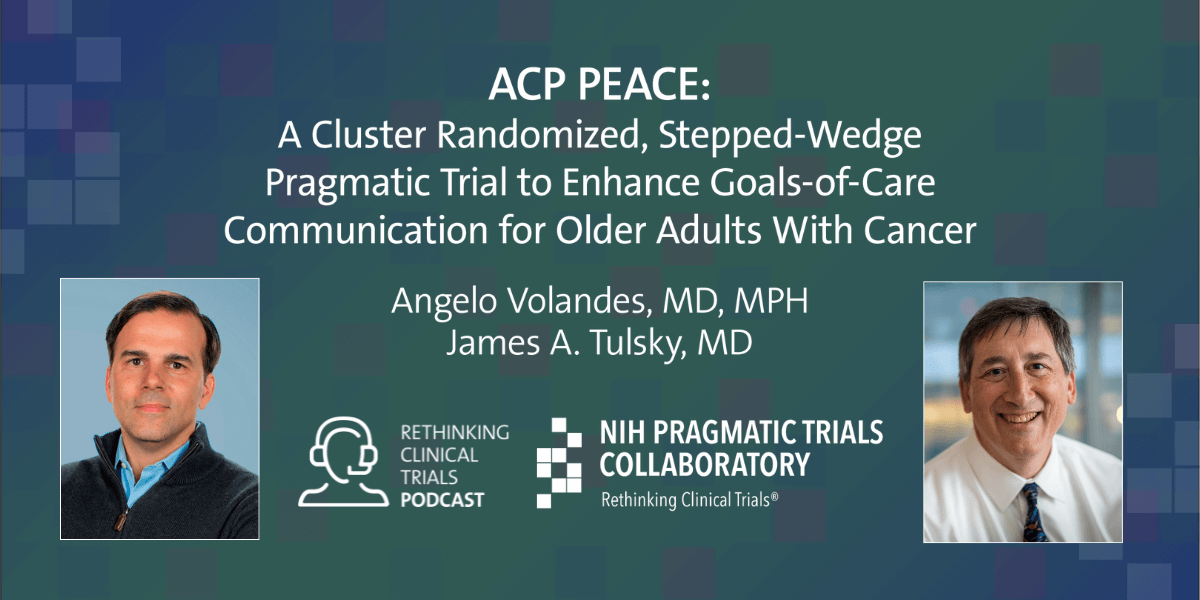 In a new episode of our Rethinking Clinical Trials Podcast, Drs. Angelo Volandes and James Tulsky speak with host Dr. Adrian Hernandez about the results of the ACP PEACE study.


 Even in minimal-risk studies that do not use the standard consent process, there may be value in informing participants about the research. Such notifications should be considered the default for clinical trials conducted under a waiver of informed consent, argue the authors of a new report from the NIH Pragmatic Trials Collaboratory.

 The TAICHIKNEE study randomized its first cohort of participants this month, and the intervention group began tai chi classes this week. Congratulations to the TAICHIKNEE team for reaching this important milestone!
 In the skin and soft tissue infections trial, which included 60,725 patients, the automated prompts reduced the use of empiric extended-spectrum antibiotics targeting Pseudomonas and multidrug-resistant gram-negative bacteria by 28% without increasing intensive care unit admissions or hospital length of stay.

 The study design paper for IMPACt-LBP has been