In this episode of the NIH Collaboratory podcast, Drs. Greg Simon and Lorella Palazzo discuss their recent Living Textbook Chapter, “End-of-Trial Decision-Making.”
Eduard Vasilevskis, MD, MPH
Professor of Medicine
Department of Medicine, Division of Hospital Medicine
University of Wisconsin-Madison
Michele C. Balas PhD, RN, CCRN-K, FCCM, FAAN
Associate Dean of Research
Dorothy Hodges Olson Distinguished Professor of Nursing
University of Nebraska Medical Center College of Nursing
With recent increases in survivorship for Intensive Care Unit (ICU) patients has come the rise of Post-ICU Syndrome, or PICS. PICS is characterized by cognitive and physical impairment; financial toxicity; and family impacts. Some of the factors associated with PICS are modifiable: Sedation use, for example, immobility, and mechanical ventilation.
A set of evidence-based best practices based on these modifiable factors are encapsulated in the ABCDEF Bundle: Assess, prevent, and manage pain; Both spontaneous awakening trials (SATs) and spontaneous breathing trials (SBTs); Choice of analgesia and sedation; Delirium: assess, prevent, and manage; Early exercise and mobility; and Family engagement.
In a study of 68 ICUs, patients treated with all elements of the ABCDEF bundle in a given day had better outcomes. The next day, they were 70% less likely to be on a mechanical ventilator; 65% less likely to be in a coma; and 40% less likely to be delirious. Though there wasn’t a significant impact on pain, the likelihood of being discharged from the hospital increased by 20%.
We have a safe and efficacious set of evidence-based practices that people can deliver in the ICU. However, many of them are not being delivered to critically ill patients. And they’re not being delivered due to numerous implementation challenges clinicians experience in everyday care.
The Behavioral Economic and Staffing Strategies to Increase Adoption of the ABCDEF Bundle in the Intensive Care Unit (BEST-ICU) study aims to evaluate 2 strategies grounded in behavioral economic and implementation science theory to increase adoption of the ABCDEF bundle. The strategies target a variety of ICU team members and known behavioral determinants of ABCDEF bundle performance.
BEST-ICU is ongoing. The hybrid type III effectiveness-implementation pragmatic trial will take place in 3 hospitals and 12 ICUs across 33 months. The study team will monitor fidelity through real-time monthly tracking of audit and feedback information and through direct observation by Registered Nurse (RN) Implementation Facilitators.
Over 3,000 work intensity surveys have already been completed, split between RNs and non-nurses. Given the intensive nature of these surveys and the dearth of studies investigating work intensity in the ICU, this alone will be a notable contribution to the literature.
The research team outlined some of their sticking points around dashboard development and data acquisition/sharing, as well as how they’ve addressed these challenges. Solutions included the standardization of definitions for bundle process elements and engagement of clinical, operational, and legal leadership from the University & Health system.
Discussion Themes
Patient-reported pain was the only outcome that didn’t improve following full implementation of ABCDEF bundle. Dr. Balas noted that patients who aren’t in a coma anymore can then report pain. Dr. Vasilevskis pointed out that the same goes for delirium, which is far preferable to coma from a mortality perspective.
Dr. Balas suggested that a patient who is more cognitively engaged and able to report pain is actually in a better spot, as it enables medical staff to treat them.
John Fortney, PhD Professor
Department of Psychiatry and Behavioral Sciences
University of Washington
Senior Research Career Scientist
HSR Center of Innovation for Veteran-Centered and Value-Driven Care
VA Puget Sound Health Care System
Pragmatic trials are primarily designed to determine the effectiveness of a clinical intervention under the usual conditions in which it will be applied. A hybrid-effectiveness implementation trial assesses both clinical effectiveness and implementation.
Dr. Fortney walked through the translational research pipeline, which flows from explanatory trials to pragmatic trials to implementation research. Ideally, the end product is improved processes and outcomes.
While the differences between explanatory, pragmatic, and implementation trials is well understood, the differences and similarities between pragmatic trials and hybrid type trials are not well understood.
Pragmatic Trials (PTs) and Hybrid Type 1 Trials (HT1) aim to test the effectiveness of clinical interventions, with patient outcomes as their primary outcomes. Hybrid Type 3 Trials (HT3) look at whether a given implementation strategy successfully promotes intervention uptake. Hybrid Type 2 Trials (HT2) compare two clinical interventions and one or two implementation strategies.
Whereas HT1s utilize artificial implementation strategies, PTs, HT2s, and HT3s utilize practical implementation strategies that they expect to be replicable outside of a research context.
Dr. Fortney provided resources, including a question tree and case examples, to aid researchers in identifying or choosing a trial type. He also provided several guidelines, including:
HT1 trial types should be used to determine whether a clinical intervention can be effective when delivered in routine care.
Pragmatic and HT2 trial types should be used to determine whether an evidence-based clinical intervention(s) is effective when delivered with practical implementation strategies in routine care.
HT2 and HT3 trial types should be used to determine whether practical and novel implementation strategies successfully promote the uptake of evidence-based clinical interventions.
Discussion Themes
The distinction between artificial implementation strategies and evidence-based, or practical, implementation strategies is not always black and white, and will often fall somewhere on the Artificial → Practical continuum.
This research team laid out some of the subtler differences in research objectives between study types, and the elements studies need to successfully address those objectives. Reviewers and researchers alike need to be careful in thinking these distinctions through and understanding them.
Gregg C. Fonarow, MD, FACC, FAHA, FHFSA Eliot Corday Professor of Cardiovascular Medicine and Science
Director, Ahmanson-UCLA Cardiomyopathy Center
Codirector, UCLA Preventative Cardiology Program
UCLA Division of Cardiology
Keywords
Heart failure; HFrEF; guideline-directed medical therapy; implementation; systematic review
Key Points
Despite the availability of effective therapies for heart failure (HF), a large number of eligible patients are not receiving one or more evidence-based, guideline-recommended therapies. This implementation gap has stymied improvements in morbidity and mortality.
The benefits of evidence-based heart failure medications are cumulative. If all therapies are used, there is a relative risk reduction of 74.0% and an absolute risk reduction of 25.9%. Simultaneous or rapid initiation of therapies reduces HF hospitalizations, rehospitalizations, and mortality.
Reasons for underutilization of Guideline-Directed Medical Therapy (GDMT) for heart failure include a lack of systems to reliably implement therapies; gaps in knowledge and awareness of guidelines; therapeutic inertia; and insufficient urgency.
Dr. Fonarow’s team conducted a systematic review of interventions for the optimization of GDMT, including 28 randomized clinical trials with an aggregate sample of over 19,000 patients. They found that the initiatives that used interdisciplinary teams, largely comprised of nurses and pharmacists, most consistently led to improvements in GDMT. Clinician education, electronic health record initiatives, and patient interventions, on the other hand, resulted in no or modest improvements in GDMT.
Implementation of GDMT needs to improve in all clinical settings. Programs that successfully implement GDMT often have access to current and accurate data on treatment outcomes; administrative and clinician support; use care maps and pathways; and use data to provide feedback. There is also a need for further implementation science innovation and testing.
Discussion Themes
– Do you still see lack of education as a major problem that needs to be approached differently, or should we really be focusing on something else? I do think it need to be further studied. I think our educational efforts around the clinician need to center on the really practical aspects, on what the common pitfalls are in trying to apply and uptitrate these medications. Interdisciplinary teams and cross-discipline education are critically important. [The study results] don’t mean that education shouldn’t be part of further interventions, but I think we need to look at what’s truly going to see a meaningful increase in medication titration and persistence of GDMT.
– The polypill could address some of the clinical inertia issues and patient resistance. Patients hate it when you keep adding on four different medications and you’re increasing the doses. Is it being studied in this context? There is work going on, editorials have been written about it, the concept has been laid out. There are small pilot studies that have been done. There are challenges; is titration necessary? You’ll need a series of polypills to uptitrate, or you’ll get the therapy started and then you’ll bring them together as a polypill. One thing I do want to highlight, though, is that starting medications simultaneously defeats that patient question of, “Why are you adding this extra medication? Are the prior medications not working?” It’s a different mindset upfront: “Here are these four medications you’re going to be on.”
The NIH Pragmatic Trials Collaboratory will offer a full-day workshop at the 16th Annual Conference on the Science of Dissemination and Implementation in Health in Arlington, Virginia. The workshop, “Dissemination & Implementation in Embedded Pragmatic Trials: Raising the Bar for Real-World Research,” will introduce concepts in the design, conduct, and implementation of pragmatic clinical trials embedded in healthcare systems, with a particular focus on methods relevant to health services researchers.
The learning objectives of the workshop include:
To identify key areas of synergy between pragmatic trials and implementation research
To introduce attendees to the unique characteristics and challenges of designing, conducting, and implementing pragmatic clinical trials embedded within diverse health care systems, and to describe opportunities for integrating implementation research methods into pragmatic trials
To increase the capacity of health services researchers to address important clinical questions with embedded pragmatic clinical trials and share lessons from implementation science for supporting intervention adoption, sustainment, scale-up, and/or deimplementation
The theme of this year’s D&I conference is “Raising Expectations for D&I Science: Challenges and Opportunities.” The annual conference is cohosted by the NIH and AcademyHealth.
WORKSHOP DETAILS AND REGISTRATION
Sunday, December 10, 10:00 am-6:00 pm
Gateway Marriott, Arlington, Virginia
Organizational culture, clinician training and support, the ability to link patients to ongoing treatment, and the ability to tailor implementation to each clinical site were key determinants of successful implementation of an intervention to promote buprenorphine initiation in emergency departments, according to a qualitative study conducted as part of the EMBED pragmatic clinical trial.
EMBED, an NIH Collaboratory Trial, was a cluster randomized trial across 21 emergency departments in 5 healthcare systems in the United States. The trial tested the effectiveness of a clinical decision support tool integrated into the electronic health record in improving rates of buprenorphine initiation in the emergency department for the treatment of opioid use disorder. The intervention led to a modest increase in buprenorphine initiation and little impact on patient outcomes.
A secondary aim of the study was to identify determinants of adopting, implementing, and maintaining the clinical decision support tool at the trial sites. Among the key determinants were:
establishing buprenorphine initiation as a cultural norm within healthcare organizations;
organizational commitment to implementing and sustaining the intervention;
clinician training and support on opioid use disorder and buprenorphine initiation in emergency departments;
availability of referral resources to link patients who were initiated on buprenorphine in the emergency to ongoing treatment; and
the ability to tailor the intervention to clinic workflows that fit the resources and characteristics of the local clinic.
EMBED was supported within the NIH Collaboratory by a cooperative agreement from the National Institute on Drug Abuse and received logistical and technical support from the NIH Collaboratory Coordinating Center. Read more about EMBED in the Living Textbook, and learn about the other NIH Collaboratory Trials.
The Grand Rounds session will be held on Friday, March 3, 2023, at 1:00 pm eastern.
Kuklinski is an associate professor of social work and the director of the Social Development Research Group in the University of Washington School of Social Work. Sterling is a senior research scientist in the Kaiser Permanente Division of Research.
The NIH Pragmatic Trials Collaboratory will offer a full-day workshop at the 15th Annual Conference on the Science of Dissemination and Implementation in Health in Washington, DC. The workshop, “Dissemination & Implementation Research Methods and Embedded Pragmatic Trials: Strategies for Designing Studies That Inform Care for Diverse Populations,” will introduce concepts in the design, conduct, and implementation of pragmatic clinical trials embedded in healthcare systems.
The learning objectives of the workshop include:
To identify key areas of synergy between pragmatic trials and implementation research
To introduce attendees to the unique characteristics and challenges of designing, conducting, and implementing pragmatic clinical trials embedded within diverse health care systems, and to describe opportunities for integrating implementation research methods into pragmatic trials
To increase the capacity of health services researchers to address important clinical questions with pragmatic clinical trials and share lessons from implementation science for increasing engagement of diverse participants
The theme of this year’s D&I conference is “(Re)Building Better Systems: Being Proactive, Nimble, and Responsive.” The annual conference is cohosted by the NIH and AcademyHealth.
WORKSHOP DETAILS AND REGISTRATION
Sunday, December 11, 8:00 am-4:45 pm
Walter E. Washington Convention Center, Washington, DC
The NIH Pragmatic Trials Collaboratory will offer a full-day workshop at the 15th Annual Conference on the Science of Dissemination and Implementation in Health in Washington, DC. The workshop, “Dissemination & Implementation Research Methods and Embedded Pragmatic Trials: Strategies for Designing Studies That Inform Care for Diverse Populations,” will introduce concepts in the design, conduct, and implementation of pragmatic clinical trials embedded in healthcare systems.
The learning objectives of the workshop include:
To identify key areas of synergy between pragmatic trials and implementation research
To introduce attendees to the unique characteristics and challenges of designing, conducting, and implementing pragmatic clinical trials embedded within diverse health care systems, and to describe opportunities for integrating implementation research methods into pragmatic trials
To increase the capacity of health services researchers to address important clinical questions with pragmatic clinical trials and share lessons from implementation science for increasing engagement of diverse participants
The theme of this year’s D&I conference is “(Re)Building Better Systems: Being Proactive, Nimble, and Responsive.” The annual conference is cohosted by the NIH and AcademyHealth.
WORKSHOP DETAILS AND REGISTRATION
Sunday, December 11, 8:00 am-4:45 pm
Walter E. Washington Convention Center, Washington, DC
In an interview at the NIH Pragmatic Trials Collaboratory Steering Committee’s annual meeting in April, Dr. Steven George discussed how to successfully implement an intervention in a pragmatic clinical trial and how intervention complexity affects implementation across various sites with different local contexts.
“Variation is everywhere, and you have to be willing to ride that wave. It is kind of like being out there waiting to catch a wave into shore, you’re not going to be able to pick how rough that surf is on any given day.”
Successfully implementing and delivering an intervention across multiple organizations is dependent on many factors, including the complexity of the intervention, the stability of the control, and barriers to and promoters of uptake.
Dr. George’s advice is to “Be willing to listen to patients, sites, and providers to help make what you envision for your trial work in a local environment. That flexibility is way to show respect with someone that you are collaborating with. They know their local environment, and if we’re going to ask them as pragmatic trialists to help deliver the intervention, we need to flexible.”


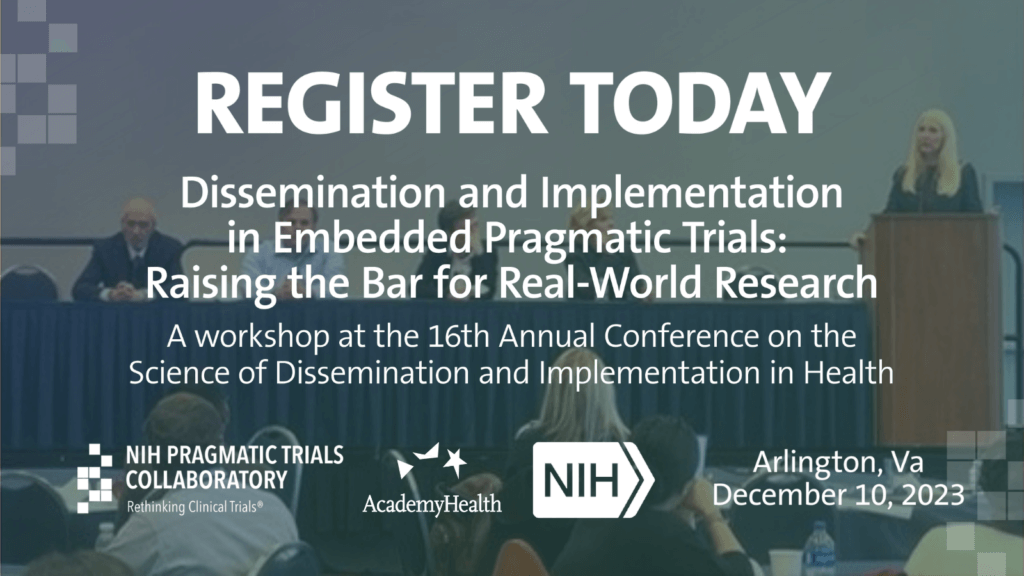 The NIH Pragmatic Trials Collaboratory will offer a full-day workshop at the 16th Annual Conference on the Science of Dissemination and Implementation in Health in Arlington, Virginia. The workshop, “Dissemination & Implementation in Embedded Pragmatic Trials: Raising the Bar for Real-World Research,” will introduce concepts in the design, conduct, and implementation of pragmatic clinical trials embedded in healthcare systems, with a particular focus on methods relevant to health services researchers.
 Organizational culture, clinician training and support, the ability to link patients to ongoing treatment, and the ability to tailor implementation to each clinical site were key determinants of successful implementation of an intervention to promote buprenorphine initiation in emergency departments, according to a qualitative study conducted as part of the EMBED pragmatic clinical trial.
 In this Friday’s PCT Grand Rounds, Dr. Margaret Kuklinski and Dr. Stacy Sterling will present
  The NIH Pragmatic Trials Collaboratory will offer a full-day workshop at the 15th Annual Conference on the Science of Dissemination and Implementation in Health in Washington, DC. The workshop, “Dissemination & Implementation Research Methods and Embedded Pragmatic Trials: Strategies for Designing Studies That Inform Care for Diverse Populations,” will introduce concepts in the design, conduct, and implementation of pragmatic clinical trials embedded in healthcare systems.