March 7, 2024: New Report Sets Out Posttrial Responsibilities in Pragmatic Clinical Trials

Headshot of Dr. Stepanie Morain
Dr. Stephanie Morain

In a new report from the NIH Pragmatic Trials Collaboratory, a team of bioethicists and implementation scientists argue for a “presumptive default” that the results of pragmatic clinical trials should be incorporated into healthcare delivery processes. This responsibility arises from a key rationale for conducting pragmatic trials: that they can facilitate uptake of their results by relevant decision-makers.

The open-access article was published this week in Learning Health Systems.

Much of the literature on posttrial responsibilities offers guidance on what is owed to research participants and broader communities at the conclusion of traditional explanatory clinical trials. Similar guidance is lacking for pragmatic trials.

The NIH Collaboratory researchers, led by Stephanie Morain of Johns Hopkins University, explore the distinct considerations that shape posttrial responsibilities in pragmatic trials. These include the responsibilities of the healthcare systems in which these trials are embedded, and decisions about implementation of interventions that show meaningful benefit after their integration into usual care settings, as well as deimplementation of those that do not.

Fulfilling this responsibility will require prospective planning by researchers, healthcare delivery system leaders, institutional review boards, and sponsors, so as to ensure that the knowledge gained from [pragmatic trials] does, in fact, influence real-world practice.

The article was coauthored by members of the NIH Collaboratory’s Ethics and Regulatory Core and Implementation Science Core, including Pearl O’Rourke, formerly of Partners HealthCare; Joseph Ali and Jeremy Sugarman of Johns Hopkins University; Vasiliki Rahimzadeh of the Baylor College of Medicine; and Devon Check and Hayden Bosworth of Duke University.

Read the full article.


February 26, 2024: In PRIM-ER Qualitative Study, EM Talk Program Improved Serious Illness Conversation Skills

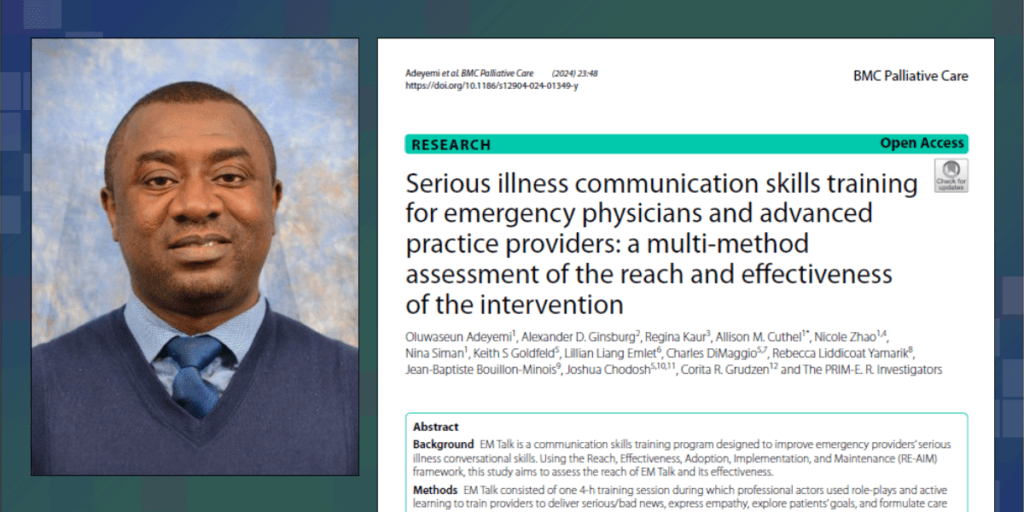
Dr. Oluwaseun Adeyemi, lead author of the report

Communication skills training using the EM Talk model reached a high proportion of clinicians in participating emergency departments and improved their serious illness conversation skills, according to a qualitative study conducted as part of the PRIM-ER trial. The observed reach and effectiveness of the training program has the potential to improve use of these skills in clinical practice.

The results of the study were published last week in BMC Palliative Care.

PRIM-ER, an ongoing NIH Collaboratory Trial, is a stepped-wedge, cluster randomized trial testing a multidisciplinary primary palliative care intervention in a diverse mix of emergency departments in the United States. The intervention consists of education, clinical decision support, and other elements and is intended to improve the delivery of goal-directed emergency care of older adults.

The PRIM-ER intervention includes, among other elements, communication skills training and simulation workshops for emergency medicine clinicians using the EM Talk training program. The program is designed to improve serious illness conversation skills for emergency medicine physicians and advanced practice providers.

The authors of the report, led by Oluwaseun Adeyemi of New York University, under the guidance of principal investigators Corita Grudzen and Keith Goldfeld, found that 85% of emergency medicine physicians and advanced practice providers across 33 emergency departments completed the EM Talk training. In course evaluations completed after the training, participants reported that the training improved their serious illness conversation skills and their attitude toward engaging patients in serious illness conversations. Participants also reported that the training encouraged them to commit to using these skills in clinical practice.

A previously published study by the PRIM-ER research team reported the reach and effectiveness of a related training program for emergency nurses.

PRIM-ER is supported within the NIH Pragmatic Trials Collaboratory by a cooperative agreement from the National Institute on Aging. Read more about PRIM-ER.

January 22, 2024: Your Pragmatic Trial Has Ended. Now What?

What happens to a pragmatic trial intervention after the study ends?

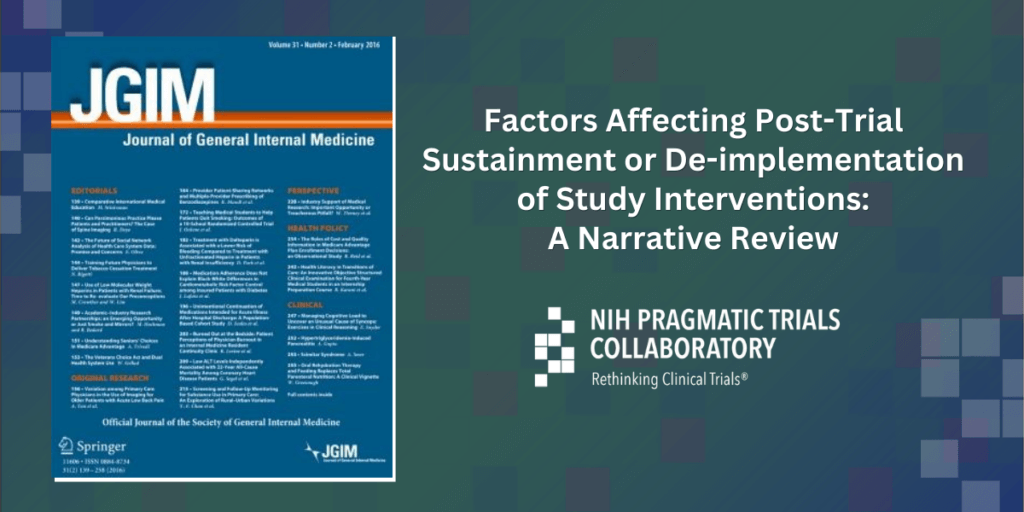
In a new article from the NIH Pragmatic Trials Collaboratory, investigators from 6 of the program's completed pragmatic clinical trials summarize the posttrial interpretation of their trials' results and consider the factors that influenced the sustainment or de-implementation of the studies' interventions.

The article was published online ahead of print this month in the Journal of General Internal Medicine.

Three lessons emerged from the review:

  • Ineffective interventions may be sustained if they have other measured or perceived benefits.
  • Effective interventions may not be sustained if they require significant resources.
  • Alignment with policy incentives is essential for achieving sustainment and scale-up of effective interventions.

Based on the experiences of the 6 case studies, the authors offer several recommendations to assist pragmatic trials researchers in considering the posttrial sustainment or de-implementation of their study interventions.

Read the full article.

This work was produced by members of the NIH Collaboratory's Implementation Science Core. The case studies in the article are from the ABATE Infection, LIRE, PPACT, PROVEN, STOP-CRC, and TSOS trials. Learn more about the NIH Collaboratory Trials.

January 11, 2024: BeatPain Utah Study Team Uses Implementation Mapping Approach to Plan Hybrid Trial

In a new article from the NIH Pragmatic Trials Collaboratory, the BeatPain Utah study team describes the "implementation mapping" they used to plan for trial implementation. The comprehensive, systematic approach enabled the team to craft an implementation plan for a complex telehealth intervention and to identify outcomes for evaluating the success of the implementation strategies.

The article was published this month in Implementation Science Communications.

BeatPain Utah, an NIH Collaboratory Trial, is studying real-world implementation of a telehealth physical therapy strategy for patients with chronic back pain in primary care clinics of federally qualified health centers. During the 1-year planning phase described in the article, the study team developed a logic model, based in part on the Consolidated Framework for Implementation Research (CFIR), to identify contextual factors across several domains that could influence e-referral and telehealth implementation in the trial.

In this ongoing type 1 hybrid effectiveness-implementation trial, the implementation strategies developed through the mapping exercise are being evaluated as part of the trial.

BeatPain Utah is supported within the NIH Pragmatic Trials Collaboratory through the NIH HEAL Initiative under an award administered by the National Institute of Nursing Research. Learn more about BeatPain Utah.

November 27, 2023: NIH Announces Funding Opportunity for Implementation Studies of Substance Use Treatment and Prevention in Populations That Experience Health Disparities

The National Institutes of Health’s Office of Disease Prevention (ODP) issued a new funding opportunity to support implementation studies in treatment and prevention for alcohol, tobacco, and other drugs use and misuse in adult populations that experience health disparities.

ODP and participating NIH Institutes and Centers are inviting applications for research projects that test innovative approaches to implementing screening, brief intervention, and referral to treatment or prevention for alcohol, tobacco, and other drugs use and misuse. This R01 funding opportunity will support clinical trial research that develops and prospectively tests implementation strategies that overcome barriers to prevention and treatment in diverse settings. Applicants are strongly encouraged to include in their proposals robust engagement with relevant healthcare and community partners and to examine organizational and system contexts.

The first receipt date for new applications is February 5, 2024.

Read the full funding opportunity.

Photo of Greg Simon

Swimming with the Sharks: Translation of Pragmatic Trial Results

Swimming with the Sharks: Translation of Pragmatic Trial Results

Description

To illustrate the importance of health system leader engagement, we gathered healthcare systems leaders for a panel modeled after the Shark Tank TV show. In the video, Dr. Greg Simon is tasked with convincing healthcare system leadership to invest in implementing the intervention from the Suicide Prevention Outreach Trial (SPOT).

Biography

Photo of Greg SimonGregory Simon, MD, MPH
Senior Investigator, Kaiser Permanente Washington Health Research Institute
SPOT NIH Collaboratory Trial PI
Health Care Systems Interactions Core Chair

Related

Deciding Who to Engage

View more content from the Disseminating, Implementing, and Sustaining Evidence-Based Practices into Clinical Care: NIH-Hosted Workshop.

Steven George, PT, PhD

Implementation and Intervention Complexity in Pragmatic Clinical Trials

Implementation and Intervention Complexity in Pragmatic Clinical Trials

Description

In this interview, Dr. Stephen George discusses how complexity can change as you work in partnership with the people who will be implementing the intervention. The complexity of an intervention has to be simple enough to be feasible in the context of the research setting.

Biography

Steven George, PT, PhDSteven George, PhD
Professor in Orthopaedic Surgery, Duke University


Related Content

Living Textbook: Intervention Delivery and Complexity

Read our news and view the full presentation.

Designing With Implementation in Mind

Designing With Implementation in Mind

Description

When designing a trail to be embedded within a health system, investigators should consider eventual implementation and sustainability at the outset. Key features discussed in the video include workflow, differences in potential delivery across different settings, and the value proposition for the healthcare system's leadership.

Speakers

Leah Tuzzio, MPH
Kaiser Permanente Washington Health Research Institute


Vince Mor, PhD
Florence Pirce Grant University Professor of Health Services, Policy and Practice, Professor of Health Services, Policy and Practice, Brown University
PROVEN NIH Collaboratory Trial co-PI

Related

Dissemination and Implementation 


August 3, 2023: NCI’s David Chambers Discusses Role of Implementation Science in Pragmatic Research

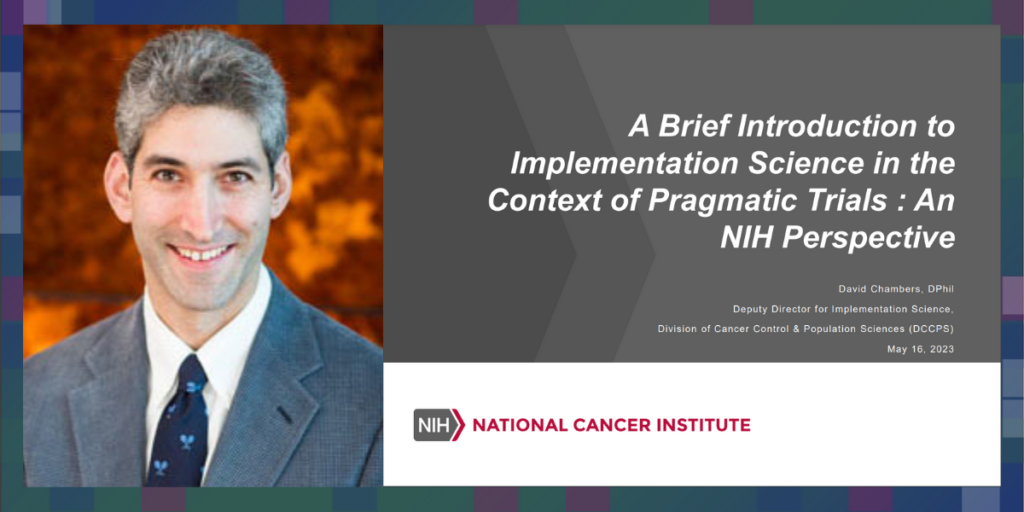
This year’s Annual Steering Committee Meeting for the NIH Pragmatic Trials Collaboratory featured implementation science as one of the topics of focus. In an interview after his keynote presentation, Dr. David Chambers, deputy director for implementation science at the National Cancer Institute, shared his thoughts on opportunities for implementation science in the context of pragmatic trials.

Why Implementation Science Is Important in Pragmatic Research

Chambers described the overlap between implementation science and pragmatic research and how this creates several benefits. Implementation science gives a heightened focus on how to get interventions to be as accessible, well used, and beneficial as possible to populations within the systems and communities in which people are seeking and receiving healthcare.

“The earlier researchers can think about their interventions being used beyond the trial, the better,” Chambers explained. “Implementation science helps to provide a lens for multiple levels of change that may be needed, including supports for patients and families, clinicians, clinics, systems, policymakers, and other key decision-makers.”

Furthermore, implementation science methods can save time in identifying barriers and facilitators for delivering interventions with high quality-knowledge which can be applied toward the ultimate use of interventions.

Chambers encourages researchers to embrace the dynamism that is reflected in our health systems, which is particularly apt for research conducted in the setting of routine care. “It is a given that there will be deviations from the design of an intervention and its implementation, so how can researchers learn from this?” he said.

In terms of sustaining an intervention, a more dynamic approach is needed to how the intervention and the context will change over time, he explained. “Too often we think of sustainment in terms of fixing things in their original state. Sustainment needs to think about how to build in evolution-medicine and our practices are evolving.”

Role of the NIH Pragmatic Trials Collaboratory
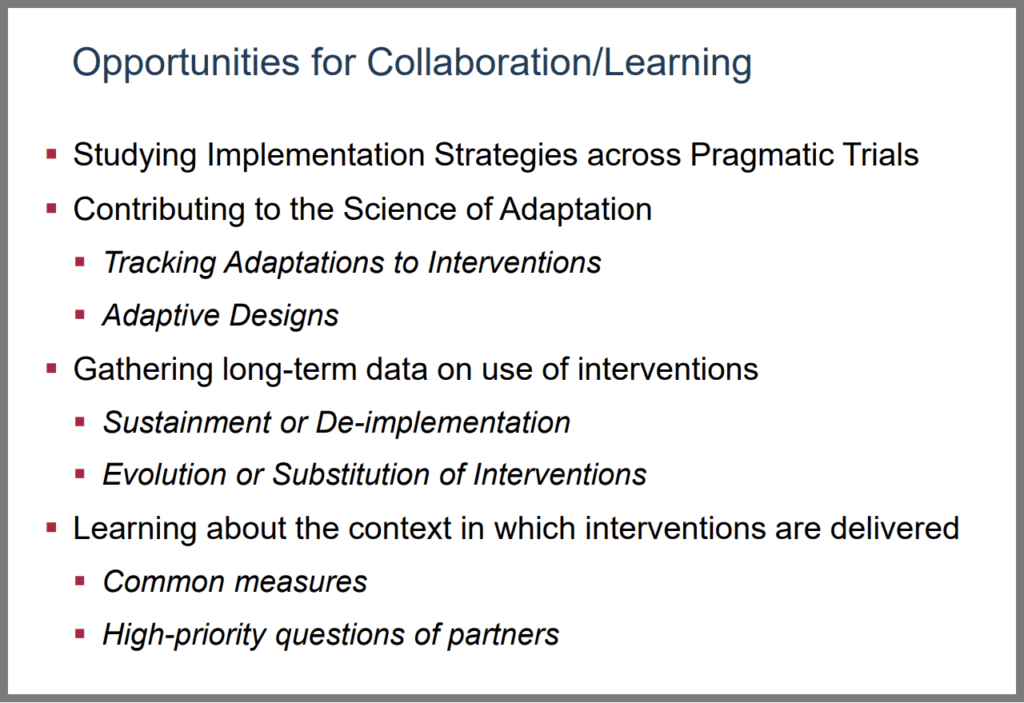
According to Chambers, the NIH Pragmatic Trials Collaboratory provides a natural setting for implementation activities because of the close partnerships between the investigative teams and the health systems and community settings where the research occurs. As a result, the program is poised for ongoing learning from the strategies health systems are using to implement a range of different interventions.

There is also an opportunity for pooling lessons across the NIH Collaboratory Trials, such as common measures that can be used to better characterize adaptation, understanding perspectives and needs of patients and clinicians, and approaches related to long-term sustainment or deimplementation of interventions.

Increasingly for NIH Collaboratory trials, issues related to implementation are baked into both the design of interventions and the approach used to test the interventions, which is a testament to the program’s ongoing progress in encouraging the use of implementation science concepts and methods.

Learn more about the NIH Collaboratory’s Implementation Science Core.

How NIH Is Advancing Implementation Science

For over 20 years, NIH has recognized the gaps in knowledge needed for successful implementation of evidence-based interventions. Across NIH institutes, centers, and offices, they have discussed the common challenges observed when investigators saw a positive result in their trial and were frustrated that it could not be replicated and scaled up in the real world.

NIH funds dissemination and implementation research grants and has a standing review panel, the Science of Implementation in Health and Healthcare, focused on this area where any applicant to NIH can suggest that their grant be reviewed. In addition, NIH supports training opportunities in the field and cohosts an annual scientific conference in partnership with AcademyHealth.

NIH continues to explore the interface between effectiveness and implementation, think about deimplementation, and work on tackling misinformation, all towards advancing how to better apply the evidence generated in research to optimize population health and healthcare.