August 29, 2024: HDRN Canada Pragmatic Trials Training Program Offers Open-Access Learning Modules

Schematic of the HDRN Canada Pragmatic Trials Training ProgramA virtual, asynchronous learning program that offers open-access modules to anyone interested in learning about the complex art of pragmatic clinical trial design and implementation is now available.

Every week, a new open-access module features essential resources and leading Canadian trialists discussing a key component of clinical trials.

The 2-year, pan-Canadian program—HDRN Canada Pragmatic Trials Training Program—follows a structured curriculum that covers 12 key components of clinical trials, from understanding the basics of trial design to trial implementation, statistical analysis, quality control and oversight, and other trial components.

More than 75 learners from across Canada have been admitted to this pan-Canadian program after a competitive selection process. Admitted learners enjoy access to monthly peer-group discussions, virtual conferences, and training on indigenous knowledge.

This program is funded by the Canadian Institutes of Health Research, coordinated by the Schulich School of Medicine & Dentistry at Western University, and an initiative of Health Data Research Network Canada.

Modules are available at pragmatictrialstraining.ca. The program story is available at https://tinyurl.com/2f9m9k3s. For more information, contact the Program Coordinating Team at pragmatictrialstraining@uwo.ca.

August 20, 2024: NIH Pragmatic Trials Collaboratory Launches New Self-Paced Learning Path on Pragmatic Trial Study Design

The Pragmatic Clinical Trial Study Design learning path is a self-paced, 1-hour course with expert-led content, reference materials, and knowledge checkpoints. Learners will gain insights into selecting the right study design, randomization, parallel vs stepped-wedge designs, and more. The learning path is free and you can earn a certificate for completing the course.The NIH Pragmatic Trials Collaboratory has launched a new interactive learning path that provides essential knowledge to research teams on how to choose the most appropriate study design for a pragmatic clinical trial.

The learning path is a series of self-paced training modules that include expert videos, reference materials, and knowledge checkpoints. Its content covers key information for designing a study, including:

  • Choosing between an explanatory or pragmatic study design
  • How to make decisions about randomization
  • Choosing between parallel and stepped-wedge design

The learning path features expert insights from Liz Turner, PhD, co-chair of the NIH Collaboratory’s Biostatistics and Study Design Core, adding to the program’s robust online training resources. This new tool is free and takes about 1 hour to complete. Learners will receive a certificate upon completing the course.

Head shot of Dr. Liz Turner
Liz Turner, PhD

“We created this innovative learning path to help research teams work through the many issues and considerations that come up in the design phase of a pragmatic trial,” Turner said. “It guides learners through the decision-making process for study design in a fun and fast-paced learning environment.”

“I hope research teams take advantage of this exciting new resource that answers common questions about pragmatic trial study design,”said Kevin Weinfurt, PhD, a co-principal investigator for the NIH Pragmatic Trials Collaboratory Coordinating Center. “Making informed decisions at the trial’s design stage is critical to ensure a trial can be successful in producing reliable evidence.”

To access the learning path, visit the learning module page to sign up. Simply click “get this course” and then “sign up” to create an account in our learning management system.

The NIH Pragmatic Trials Collaboratory Coordinating Center led the development of the study design learning path in partnership with Symphony Learning Partners.

Going From Zero to 100: Generating Evidence Through Pragmatic Research to Address Pressing Healthcare Issues: NIH-Hosted Workshop (July 2024)

July 15-16, 2024: This 2-day workshop focused on the preparatory actions researchers can undertake in the planning and application phase (Phase Zero) to ensure pragmatic clinical trials yield actionable evidence for a variety of settings. Key aspects include formulating the right research question and engaging with patients, funders, and healthcare system leaders. The workshop also addressed challenges in initiating trials across diverse settings, such as navigating data systems, site diversification, and reducing administrative burdens.

Agenda and Slides

Day 2: July 16

Welcome and Introduction

Wendy Weber, ND, PhD, MPH
Helene Langevin, MD

Keynote: Connecting Lab, Clinic and Community: Communities Advancing Research Equity (CARE) for Health™

Monica Bertagnolli, MD

Session 3: How to Use Data From Disparate Data Systems

Moderator: Keith Marsolo, PhD

Panel:

Session 4: Retrofitting, Reimagining, and Redesigning Health Care Systems to Reach Populations Most Affected by Health Inequities

Moderator: Rosa Gonzalez-Guarda, PhD, MPH, RN

Panel:

Session 5: Overcoming Administrative Burden in Pragmatic Research

Moderator: Adrian Hernandez, MD, MHS

Panel:

Summary and Concluding Remarks

Lesley Curtis, PhD
Rosa Gonzalez-Guarda, PhD, MPH, RN
Adrian Hernandez, MD, MHS
Keith Marsolo, PhD
Wendy Weber, ND, PhD, MPH

Patient-Centered Research in Real-World Settings: Essentials of Embedded Pragmatic Clinical Trials Workshop: Society for Clinical Trials (May 2024)

May 19, 2024: The NIH Pragmatic Trials Collaboratory hosted a preconference workshop, "Patient-Centered Research in Real-World Settings: Essentials of Embedded Pragmatic Clinical Trials,” at the 45th Annual Meeting of the Society for Clinical Trials in Boston. This training workshop introduces concepts in the design and implementation of embedded pragmatic clinical trials (ePCTs), and provides firsthand ePCT experiences and case studies from the NIH Collaboratory Trials.

Agenda and Slides

Welcome and Introduction
Emily O'Brien, PhD

Session 1: What Are Embedded PCTs (ePCTs)?
Wendy Weber, ND, PhD, MPH

Session 2: Engaging and Aligning With Health System and Community Partners
Emily O'Brien, PhD

Session 3: ePCT Design and Analysis
Jonathan Moyer, PhD

Session 4: Measuring Outcomes
Angelo Volandes, MD, MPH


Session 5: Overview of NIH Collaboratory Trials
*This presentation contains case studies

Session 6: ePCTs in Context Part 1: Small Group Work
Emily O'Brien, PhD

Session 7: ePCTs in Context Part 2: Panel Discussion with NIH Collaboratory Trial PIs
Moderator: Emily O'Brien, PhD
Panel: Vincent Mor, PhD; Angelo Volandes, MD, MPH

Closing Remarks
Emily O'Brien, PhD; Wendy Weber, ND, PhD, MPH


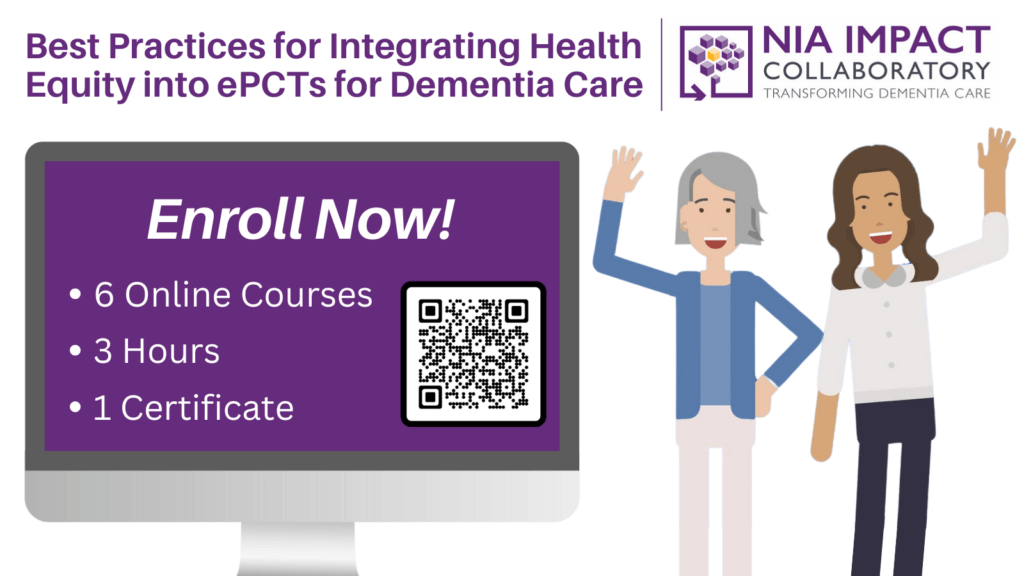
January 29, 2024: IMPACT Collaboratory Announces Health Equity Certificate Program for Pragmatic Trials Researchers

The NIA IMPACT Collaboratory announced a new online certificate program designed to empower researchers at all levels in integrating health equity considerations into embedded pragmatic clinical trials (ePCTs) for people living with dementia and their care partners.

Program Overview

This comprehensive training program, aligned with the IMPACT Collaboratory's "Best Practices for Integrating Health Equity into ePCTs for Dementia Care" document, equips researchers with the knowledge and skills to incorporate health equity considerations into design and research activities at every level of ePCTs for people living with dementia. The program covers 6 essential topic areas:

  • Getting started
  • Community Partner Engagement
  • Design and Analysis
  • Intervention Design and Implementation
  • Healthcare System and Participant Selection
  • Selecting Outcomes

Key Features

  • Free, accessible online training
  • Six courses, each including 2 to 5 brief and engaging videos
  • Self-paced learning, typically completed in 3 hours or less
  • Certificate upon successful completion of the program

Access the Training

Visit the IMPACT Collaboratory website for details and links to set up your free learning account. This account not only provides access to the health equity training program but also to other certificate programs and training materials.

The NIA IMPACT Collaboratory is supported by a grant from the National Institute on Aging.

Dissemination and Implementation in Embedded Pragmatic Trials: Raising the Bar for Real-World Research: AcademyHealth (December 2023)

December 10, 2023: The NIH Pragmatic Trials Collaboratory hosted a workshop at the 2023 AcademyHealth 16th Annual Conference on the Science of Dissemination and Implementation in Health. This training workshop introduces concepts in the design, conduct, and implementation of embedded pragmatic clinical trials (ePCTs), and provides firsthand ePCT experiences and case studies from the NIH Pragmatic Trials Collaboratory Trials.

Agenda and Slides

Morning Sessions

Welcome and Introduction

Emily O'Brien, PhD

Session 1: What Are Embedded Pragmatic Clinical Trials?
Emily O'Brien, PhD

Session 2: Objectives and Trial Design: An Overview of Hybrid Designs
Hayden Bosworth, PhD

Session 3: Engaging With Health System and Community Partners
Devon Check, PhD

Session 4: ePCTs in Context: Small Group Work Followed by Panel Discussion with NIH Collaboratory Trials PIs

Moderator: Emily O'Brien, PhD

*This session includes case study presentations.

Afternoon Sessions

Session 5: Measuring Outcomes
Christy Zigler, PhD, MSEd

Session 6: ePCT Design
Jonathan Moyer, PhD

Session 7: ePCT Analysis
Jonathan Moyer, PhD

Session 8: Pilot and Feasibility Testing
Beda Jean-Francois, PhD

Session 9: Ethical and Regulatory Oversight Considerations
Stephanie Morain, PhD, MPH

Session 10: Writing a Compelling Grant Application
Beda Jean-Francois, PhD

Session 11: ePCTs in Context: Small Group Work Followed by Panel Discussion with NIH Collaboratory Trials PIs

Moderator: Emily O'Brien, PhD

*This session includes case study presentations.

Concluding Remarks

Emily O'Brien, PhD


Case Studies

Examples from NIH Collaboratory Trials

November 28, 2023: Workshop Summary Now Available From ‘Getting the Right Evidence to Decision-Makers Faster’

The workshop summary is now available from the NIH Pragmatic Trials Collaboratory’s recent workshop, “Getting the Right Evidence to Decision-Makers Faster.” The 2-day workshop explored the critical cycle of evidence generation by researchers to decision-making by healthcare system leaders to implement the findings of pragmatic clinical trials conducted within healthcare systems.

The workshop included 4 panels:

  • Panel 1: How Have Health Systems Made Decisions Based on Evidence Collected in PCTs?

    • Panelists: Devon Check, Vincent Mor, Lynn DeBar, Kathryn Glassberg, Douglas Zatzick, Eileen Bulger, Susan Huang, Kenneth Sands, Edward Septimus; Moderator: Gregory Simon
  • Panel 2: How Do We Generate the Right Evidence to Support Decision-Makers?

    • Panelists: Kenneth Sands, Eileen Bulger, Edward Septimus, Amy Kilbourne, Rosa Gonzalez-Guarda, Patrick Heagerty; Moderator: Hayden Bosworth
  • Panel 3: Learning Faster

    • Panelists: Gloria Coronado, Natalia Morone, Corita Grudzen, Kevin Chan, Pearl O’Rourke, Cheryl Boyce, Andrea Cook; Moderator: Kevin Weinfurt
  • Panel 4: Potential Structures and Incentives for Faster Learning

    • Panelists: David Chambers, Wynne Norton, Tisha Wiley, Kenneth Sands, Edward Septimus, Gloria Coronado, Natalia Morone, Corita Grudzen; Moderator: Richard Platt

Access the complete workshop materials, including slides and videocast recordings, as well as the keynote presentation by Andrew Bindman, executive vice president and chief medical officer for Kaiser Permanente.

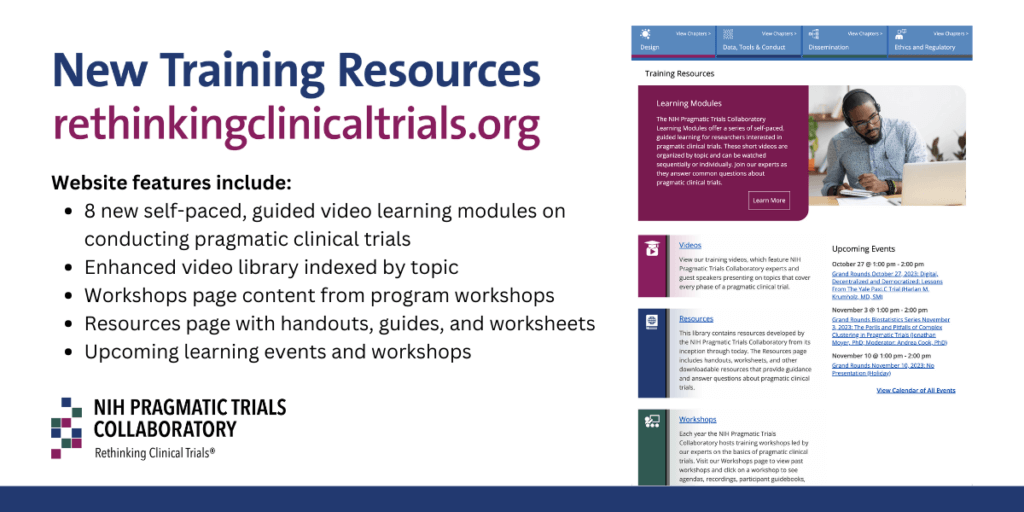
November 2, 2023: NIH Pragmatic Trials Collaboratory Launches New Online Training Resources

The NIH Pragmatic Trials Collaboratory has launched an enhanced training section of rethinkingclinicialtrials.org that includes a new series of video learning modules and reorganized and refreshed pragmatic clinical trials training resources.

The new training section features a series of 8 self-paced, guided video modules on topics that cover every phase of a pragmatic clinical trial. The learning modules feature NIH Pragmatic Trials Collaboratory experts and can be viewed as a series or individually, depending on the goals of the learner.

The revamped training section also includes a newly organized video library, a workshops page, and a resources page with a categorized index of the NIH Collaboratory’s handouts, guides, and worksheets. These new webpages allow learners to more easily find resources that match their interests through the addition of new filters, categories, and improved search functions.

“The NIH Pragmatic Trials Collaboratory has a wealth of resources that are now easier and more engaging to use,” said Kevin Weinfurt, PhD, a co-principal investigator for the NIH Pragmatic Trials Collaboratory Coordinating Center. “I look forward to seeing how learners engage with our enhanced content and hope that the resources inspire future pragmatic clinical trials.”

The NIH Pragmatic Trials Collaboratory Coordinating Center led the training resource enhancements in partnership with Symphony Learning Partners. Additional learning tools will be available in the coming months.

“I’m excited for learners to experience our enhanced training offerings, which include a wealth of knowledge we’ve generated as a program,” said Tammy Reece, MS, PMP, CCRA, program director of the NIH Pragmatic Trials Collaboratory Coordinating Center. “This is a unique online resource in the field of pragmatic research that will continue to expand.”

July 12, 2023: Workshop Materials Now Available From ‘Driving Tomorrow’s Outcomes Through Clinical Research in Real-World Settings’

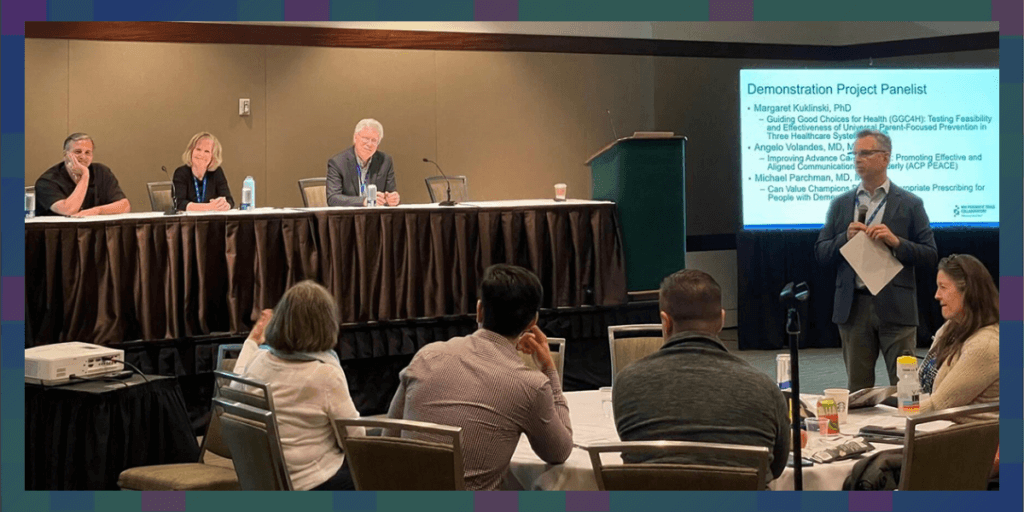
Photo of group discussion at the AcademyHealth WorkshopComplete materials are now available from the NIH Pragmatic Trials Collaboratory’s recent workshop, “Driving Tomorrow’s Outcomes Through Clinical Research in Real-World Settings.“
The 2-day workshop, held in June at the 2023 AcademyHealth Annual Research Meeting in Seattle, introduced concepts in the design, conduct, and implementation of pragmatic clinical trials embedded in healthcare systems, with a focus on methods relevant to health services researchers. Presenters shared firsthand experiences and case studies from the NIH Collaboratory Trials.

The learning objectives of the workshop included:

  • To clarify the definition of embedded pragmatic clinical trials and explain their utility.
  • To introduce attendees to the unique characteristics and challenges of designing, conducting, and implementing these trials within diverse healthcare systems.
  • To increase the capacity of health services researchers to address important clinical questions with pragmatic trials in real-world settings, driving tomorrow’s research outcomes.

Access the complete workshop materials, including slides, speaker biographies, and the full participant guide.

Driving Tomorrow’s Outcomes Through Clinical Research in Real-World Settings: Essentials of Embedded Pragmatic Clinical Trials: AcademyHealth (June 2023)

June 23-24, 2023: This workshop introduced concepts in the design, conduct, and implementation of embedded pragmatic clinical trials, with a focus on methods relevant to health services researchers, while providing firsthand experiences and case studies from the NIH Pragmatic Trials Collaboratory Trials.

Agenda and Slides

Day 1: June 23

Welcome and Opening Remarks

Kevin Weinfurt, PhD

Session 1: What are Embedded Pragmatic Clinical Trials (ePCTs)?
Wendy Weber, ND, PhD, MPH

Session 2: Engaging Stakeholders and Aligning With Health System Partners
Emily O’Brien, PhD

Session 3: Objectives and Trial Design: An Overview of Hybrid Designs
Hayden Bosworth, PhD

Session 4: Measuring Outcomes
Emily O’Brien, PhD

Session 5: ePCT Design
Patrick Heagerty, PhD

Session 6: ePCT Analysis
Patrick Heagerty, PhD

Session 7: ePCTs in Context: Small Group Work Followed by Panel Discussion with NIH Collaboratory Trial PIs
Moderator: Kevin Weinfurt, PhD
Panel: Margaret Kuklinski, PhD; Angelo Volandes, MD; Michael Parchman, MD

Closing Remarks

Kevin Weinfurt, PhD