In this Friday’s PCT Grand Rounds, Jonathan Moyer of the NIH Office of Disease Prevention will continue our special series, Advances in the Design and Analysis of Pragmatic Clinical Trials, with his presentation, “The Perils and Pitfalls of Complex Clustering in Pragmatic Trials.” The session will be held on Friday, November 3, at 1:00 pm eastern and will be moderated by Andrea Cook.
Moyer is a statistician in the NIH Office of Disease Prevention. He is a longtime member of the NIH Pragmatic Trials Collaboratory’s Biostatistics and Study Design Core. This session’s moderator, Andrea Cook, is a senior biostatistics investigator in the Kaiser Permanente Washington Health Research Institute.
This special Grand Rounds series will include additional moderated webinar discussions that bring together biostatisticians, clinical trials methodologists, and investigators to discuss challenges and share lessons learned in the design, implementation, and analysis of pragmatic trials. Download the series flyer and see the full schedule below.
In a new article published this week in Contemporary Clinical Trials Communications, the GRACE DNIH Collaboratory Trial team recommends that suicidality should be monitored in pragmatic clinical trials that measure depression as an outcome. The work builds on their experience conducting research involving patients with sickle cell disease and on previous work from the NIH Pragmatic Trials Collaboratory’s Ethics and Regulatory Core.
The authors offer 7 recommendations to address ethical considerations in the development of protocols, procedures, and monitoring activities related to suicidality in depressed patients in a pragmatic clinical trial.
Recommendations:
Understand our responsibility to act
Define triggers for action
Examine responsibilities for action
Protect patient autonomy and privacy
Identify indirect and collateral participants
Mitigate the risk of bias
Integrate responses within the clinical practice and understand the sociotechnical considerations.
Severe depression symptoms such as suicidal ideation can be assessed in patients using the PHQ-9, a validated self-report instrument used to score depression severity by inquiring about the presence and severity of depression, passive thoughts of death, and active ideas of self-harm.
The GRACE is supported by the NIH through the NIH HEAL Initiative under an award administered by the National Center for Complementary and Integrative Health. Learn more about the GRACE trial.
The NIH Pragmatic Trials Collaboratory will offer a full-day workshop at the 16th Annual Conference on the Science of Dissemination and Implementation in Health in Arlington, Virginia. The workshop, “Dissemination & Implementation in Embedded Pragmatic Trials: Raising the Bar for Real-World Research,” will introduce concepts in the design, conduct, and implementation of pragmatic clinical trials embedded in healthcare systems, with a particular focus on methods relevant to health services researchers.
The learning objectives of the workshop include:
To identify key areas of synergy between pragmatic trials and implementation research
To introduce attendees to the unique characteristics and challenges of designing, conducting, and implementing pragmatic clinical trials embedded within diverse health care systems, and to describe opportunities for integrating implementation research methods into pragmatic trials
To increase the capacity of health services researchers to address important clinical questions with embedded pragmatic clinical trials and share lessons from implementation science for supporting intervention adoption, sustainment, scale-up, and/or deimplementation
The theme of this year’s D&I conference is “Raising Expectations for D&I Science: Challenges and Opportunities.” The annual conference is cohosted by the NIH and AcademyHealth.
WORKSHOP DETAILS AND REGISTRATION
Sunday, December 10, 10:00 am-6:00 pm
Gateway Marriott, Arlington, Virginia
Matthew Prekker, MD, MPH Associate Professor of Emergency Medicine and Pulmonary and Critical Care Medicine
Hennepin County Medical Center
University of Minnesota Medical School
Jonathan Casey, MD, MSc Assistant Professor of Pulmonary and Critical Care
Vanderbilt University Medical Center
Director, Coordinating Center, Pragmatic Critical Care Research Group
Keywords
Critical Care Medicine, Pragmatic Trial, DEVICE, Laryngoscope
Key Points
Emergency tracheal intubation is a common and high-risk procedure. When the procedure is performed in the Operating Room complications are rare (2%); when performed in the Emergency Department and ICU complications are more common (40%). Failure to intubate on the first attempt occurs in 20-30% of tracheal intubations in the ED or ICU, and it is associated with life-threatening complications.
Two devices are commonly used to perform tracheal intubation, direct laryngoscope and video laryngoscope. A direct laryngoscope is used for approximately 80% of ED and ICU intubations worldwide, and current guidelines state that use of either a direct or video laryngoscope is acceptable.
The DEVICE trial hypothesized that the use of a video laryngoscope will increase the incidence of successful intubation on the first attempt. DEVICE, part of the Pragmatic Critical Care Research Group, was a multicenter, parallel-group, unblinded pragmatic, randomized trial compared the use of a video laryngoscope with the use of a direct laryngoscope for tracheal intubation of critically ill adults at 17 EDs and ICUs across U.S. The trial operated under an IRB waiver of informed consent with a patient information sheet.
Patients were randomized 1:1 in blocks of variable size, stratified by trial site with allocation concealed until randomization using opaque envelopes containing trial group assignment. For patients assigned to the video arm, clinicians used a video laryngoscope on the first attempt and used the screen to view the cords. For the direct arm, operators used direct laryngoscope on first attempt and could not have a camera or screen.
The primary outcome was successful intubation on the first attempt. The secondary outcomes were severe complications between induction and 2 minutes after intubation, such as severe hypoxemia, severe hypotension, new or increased vasopressor administration, cardiac arrest, or death.
After enrolling patients for 8 months, the data safety board recommended trial enrollment stop because the prespecified stopping criteria for efficacy had been met.
Nearly 2,000 patients were assessed for eligibility and 1,417 patients were enrolled. Successful intubation on the first attempt occurred in 85.1% for the video laryngoscope group and 70.8% in the direct laryngoscope group. There was an observed halving of failure with video laryngoscope use compared to direct laryngoscope use.
Learn more
Read more in the New England Journal of Medicine.
Discussion Themes
-Why did the RSI trial follow a different path – not a waiver of consent? There was not an opportunity for informed consent in DEVICE trial, when there was not a minute to spare for a procedure that takes 2 minutes to complete. For the RSI trial the FDA regulations had not been updated yet. We discussed doing RSI under waiver, we asked FDA a question and FDA said it could only be conducted under EFIC.
-If most intubations in the U.S. are done by direct laryngoscope (DL), what would the difference be since most of trainees are facile with video and many other clinicians are more comfortable with DL. Could the difference be the comfort of the operator? Our trial results don’t apply to operators who intubate thousands of times. The operators had less than 250 intubations. For the novice operator, VL cut rate of failure on the first attempt from 50% to 20% (3 to 4 patients). For moderately experienced operators, VL increased by 6%. For late career expert operators results of our trail may not apply.
The Grand Rounds session will be held on Friday, September 8, 2023, at 1:00 pm eastern.
Prekker is an associate professor of emergency medicine and pulmonary and critical care medicine at the University of Minnesota. Casey is an assistant professor of pulmonary and critical care at Vanderbilt University and the director of the coordinating center for the Pragmatic Critical Care Research Group.
The NIH Pragmatic Trials Collaboratory is launching a special Grand Rounds series to share advances in the design and analysis of pragmatic clinical trials.
Join us on the first Friday of each month, October through January, to hear the latest best practices and explore emerging questions with experts from the program’s Biostatistics and Study Design Core.
Over the past decade, the Core has worked with investigators to fine-tune study designs, develop rigorous analysis plans, and offer guidance to the broader community of researchers who are planning pragmatic trials. With this new Grand Rounds series, the Core is bringing together biostatisticians, clinical trials methodologists, and investigators to discuss challenges and share lessons learned in the design, implementation, and analysis of pragmatic trials.
The webinar series, Advances in the Design and Analysis of Pragmatic Clinical Trials, will kick off on Friday, October 6, at 1:00 pm ET with a presentation on design and analysis considerations for implementation trials by David Murray, NIH associate director for disease prevention and director of the NIH Office of Disease Prevention.
The series will include 3 additional moderated webinar discussions. These sessions will focus on a range of topics, including complex clustering, best practices in the design and analysis of stepped-wedge trials, and handling missing data in cluster randomized trials.
In an article published this month in the American Journal of Bioethics, FDA Commissioner Robert Califf and coauthors suggest that—despite the potential of embedded pragmatic research to generate information to improve clinical practice and public health policy—it is still relatively uncommon in US healthcare.
“Simply stated, what we are currently doing does not work, and in the face of declining health status we lack answers to critical questions about what we should be doing in health care and public health practice.”
The authors state 3 major obstacles:
Inadequate data systems: Electronic health records are not designed for research use, and are driven by billing codes and reimbursement structures.
Data sharing malaise: We have failed to develop a convincing paradigm for sharing individual-level data from routine healthcare delivery
Current oversight: Research oversight is still not designed to facilitate embedded pragmatic clinical trials or research using real-world evidence.
The authors suggest that achieving a learning health system will require
More collaboration between health systems and businesses involved in healthcare
More innovative structures for data sharing across institutions
Incentives for building the sophisticated infrastructure necessary to enable this work
Considerations from the bioethics community about how best to foster this research while respecting all those who participate
From left: Dr. Steven George, Dr. Vincent Mor, and Dr. Angelo Volandes
In an interview at this year’s NIH Pragmatic Trials Collaboratory Steering Committee annual meeting, Drs. Steven George, Vincent Mor, and Angelo Volandes discussed the complexity of intervention delivery in pragmatic clinical trials and the impact it can have on researchers’ ability to discern trial results.
“Without delving deeply into the way in which an intervention can be integrated into an operating system in all of its detail, you will probably make a mistake, and that mistake can impact whether or not your intervention achieves its intended results,” Mor said.
Intervention delivery complexity should be considered early on for pragmatic trials. It is shaped by such factors as new workflows, special training of frontline staff, and the number of components in the intervention.
“We need to understand how we get from point A to point B to point Z, and that’s not something that we do in traditional efficacy trials,” said Volandes.
To characterize this complexity, the NIH Pragmatic Trials Collaboratory worked with its NIH Collaboratory Trial investigators to understand critical drivers of complexity that affected investigators’ ability to implement their interventions and discern treatment effects. The resulting Intervention Delivery Complexity Calculator addresses 6 domains:
Internal factors pertain primarily to the intervention itself:
The degree to which the intervention requires reengineering of existing workflows and tasks
The number of components in the intervention
The level of familiarity or extra training needed for those delivering the intervention
External factors are related to intervention delivery at the systems level:
The degree to which intervention delivery is dependent on the setting in which it is implemented
The number of healthcare systems and clinics involved in delivering the intervention
The number of steps between the intervention and the intended outcome
“We as investigators probably don’t think enough about how health systems operate,” Mor said. “Thinking about intervention delivery complexity can help us start to think about things from an operations context.”
The new tool will be used as part of onboarding trials in the NIH Pragmatic Trials Collaboratory and the National Institute on Aging’s IMPACT Collaboratory, which is focused on pragmatic trials for people living with dementia. The tool can be used during the trial review and funding process all the way through sustainability efforts after a trial has been completed.
George explained, “Intervention delivery complexity is strongly linked to sustainability efforts. Even if you can implement an embedded intervention as part of a trial, if it has a lot of external domain complexity, the intervention could be vulnerable after the trial is completed.”
“By understanding the complexity of intervention delivery, investigators could start thinking about scaled down versions of an intervention, which could help with sustainability,” he added.
The tool was developed to enable conversations with investigators and their teams to think through delivery of the intervention, identify the most complex domains, and consider whether something can be done to reduce complexity.
“The tool moves the idea of complexity regarding delivery of the intervention from something that was an abstract concept to something with structure,” George said.
Future versions of the tool could address the relationship between intervention complexity and adaptations in trials to explore impacts on implementation outcomes. More complex interventions may require a greater number of adaptations to be implemented. Sources of adaptation can include service setting adaptations, target audience adaptations, and mode of delivery adaptations, but there is little understanding about who is making the changes and why.
The NIH this month published notice of a funding opportunity to support the next round of pragmatic clinical trials within the NIH-DoD-VA Pain Management Collaboratory (PMC).
The PMC was established in 2017 with an initial cohort of 11 pragmatic trials. The new funding opportunity leverages the experience, expertise, and leadership of the PMC Coordinating Center with a new round of pragmatic trials evaluating nonpharmacologic solutions to address pain and comorbid conditions in veterans, United States Armed Forces service members, and their families.
The NIH Institutes participating in this funding opportunity include the National Center for Complementary and Integrative Health (NCCIH) and the National Institute of Nursing Research (NINR). Applications may be cofunded by the Office of Disease Prevention (ODP) and the Office of Behavioral and Social Sciences Research (OBSSR).


 In this Friday’s PCT Grand Rounds, Jonathan Moyer of the NIH Office of Disease Prevention will continue our special series, Advances in the Design and Analysis of Pragmatic Clinical Trials, with his presentation, “The Perils and Pitfalls of Complex Clustering in Pragmatic Trials.” The session will be held on Friday, November 3, at 1:00 pm eastern and will be moderated by Andrea Cook.
 In a new article published this week in Contemporary Clinical Trials Communications, the GRACE DNIH Collaboratory Trial team recommends that suicidality should be monitored in pragmatic clinical trials that measure depression as an outcome. The work builds on their experience conducting research involving patients with sickle cell disease and on
 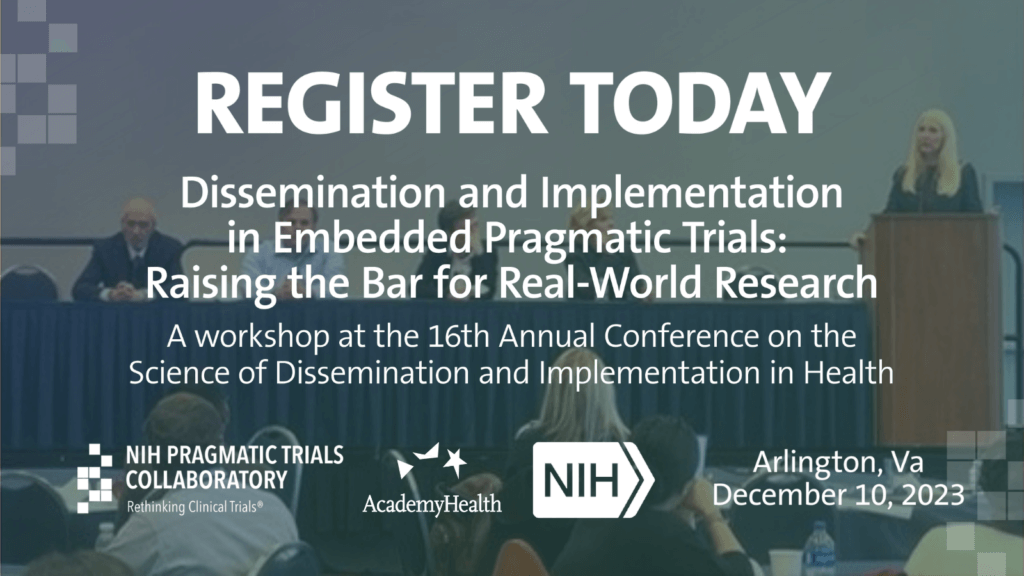 The NIH Pragmatic Trials Collaboratory will offer a full-day workshop at the 16th Annual Conference on the Science of Dissemination and Implementation in Health in Arlington, Virginia. The workshop, “Dissemination & Implementation in Embedded Pragmatic Trials: Raising the Bar for Real-World Research,” will introduce concepts in the design, conduct, and implementation of pragmatic clinical trials embedded in healthcare systems, with a particular focus on methods relevant to health services researchers.
 In this Friday’s PCT Grand Rounds, Matthew Prekker of the University of Minnesota and Jonathan Casey of Vanderbilt University will present
  The NIH Pragmatic Trials Collaboratory is launching a
  In an article published this month in the American Journal of Bioethics, FDA Commissioner Robert Califf and coauthors suggest that—despite the potential of embedded pragmatic research to generate information to improve clinical practice and public health policy—it is still relatively uncommon in US healthcare.
 In this Friday’s PCT Grand Rounds, Gabriela Schmajuk of the University of California, San Francisco, will present
 The NIH this month published notice of a funding opportunity to support the next round of pragmatic clinical trials within the NIH-DoD-VA Pain Management Collaboratory (PMC).