Ethical Considerations for Data Sharing in Pragmatic Trials
Description
Dr. Stephanie Morain of Johns Hopkins University discusses a supplemental grant award to the NIH Pragmatic Trials Collaboratory Coordinating Center to study the ethical issues that arise in data sharing in the context of pragmatic trials.
Biography
Stephanie Morain, PhD, MPH
Assistant Professor, Bloomberg School of Public Health, Johns Hopkins University
Ethics and Regulatory Core Co-chair
This Grand Rounds presentation was part of a special series, Ethical & Regulatory Dimensions of Pragmatic Clinical Trials. Drs. Pearl O’Rourke, Dave Wendler, Miguel Vazquez, and Michael Ho shared the difference between informing participants about research and the informed consent process.
Speakers
Pearl O’Rourke, MD (retired)
Harvard Medical School
Ethics and Regulatory Core Co-chair
Data Sharing and Pragmatic Clinical Trials: Law & Ethics Amidst a Changing Policy Landscape
Description
In this Grand Rounds presentation, Drs. Stephanie Morain and Kayte Spector-Bagdady share the substantial logistical burdens in preparing data for sharing, meaningful risks of reidentification, and concern for biased or misleading analyses.
Speakers
Stephanie Morain, PhD, MPH
Assistant Professor, Bloomberg School of Public Health, Johns Hopkins University
Ethics and Regulatory Core Co-chair
Kayte Spector-Bagdady, JD, MBioethics
Associate Director, Center for Bioethics & Social Sciences in Medicine
Assistant Professor of Obstetrics & Gynecology
University of Michigan Medical School
In an article published this month in the American Journal of Bioethics, FDA Commissioner Robert Califf and coauthors suggest that—despite the potential of embedded pragmatic research to generate information to improve clinical practice and public health policy—it is still relatively uncommon in US healthcare.
“Simply stated, what we are currently doing does not work, and in the face of declining health status we lack answers to critical questions about what we should be doing in health care and public health practice.”
The authors state 3 major obstacles:
Inadequate data systems: Electronic health records are not designed for research use, and are driven by billing codes and reimbursement structures.
Data sharing malaise: We have failed to develop a convincing paradigm for sharing individual-level data from routine healthcare delivery
Current oversight: Research oversight is still not designed to facilitate embedded pragmatic clinical trials or research using real-world evidence.
The authors suggest that achieving a learning health system will require
More collaboration between health systems and businesses involved in healthcare
More innovative structures for data sharing across institutions
Incentives for building the sophisticated infrastructure necessary to enable this work
Considerations from the bioethics community about how best to foster this research while respecting all those who participate
When research and clinical care are deliberately integrated in an embedded pragmatic clinical trial, the nature and extent of investigators’ obligations to patient-subjects are blurred, as is the clinician’s duty to participate is such research. To address these questions, the American Journal of Bioethics (AJOB) recently published commentaries on 2 target articles in a special issue on pragmatic clinical trials. Both of the target articles for the special issue are from the NIH Pragmatic Trials Collaboratory’s Ethics and Regulatory Core.
The authors challenge the notion that the current ethical model can simply be extended to pragmatic research. Instead, the authors suggest a shift to a model that better reflects the team- and institution-based nature of both clinical care and embedded research.
The authors argue that clinicians have a duty to participate in pragmatic research in usual care but suggest acceptable reasons to refuse, such as a badly designed trial, trial activities that violate the clinician’s conscience, or that the trial will impose excessive burdens on the clinician.
Some of the responses to the target articles are highlighted below.
Blurred Boundaries: Toward an Expanded Ethics of Research and Clinical Care
Megan C. Hailey and Nate Olson
The authors applaud the articles and offer a range of different research contexts where similar issues apply, including rare disease and genomics research.
Progressing From “Whether to” to “How to” Conduct Pragmatic Trials
Jonathan Casey, Todd Rice, and Matthew Smelner
The authors state that clinicians are confronted daily with clinical decisions where the best treatment is unknown and suggest that pragmatic trials are best situated to address the problem.
“We believe that the US healthcare system has a basic choice to make: allow arbitrary variation in clinical care and continue to systematically expose patients to suboptimal or harmful therapies indefinitely or structure that variation through pragmatic trials to generate knowledge, reduce variation, and improve outcomes over time.”
Ethical Pragmatic Clinical Trials Require the Virtue of Cultivated Uneasiness
Joel Pacyna and Jon Tilburt
The authors suggest that softening the default requirement of documenting individual consent removes a primary tool that researchers rely on to ensure the ethical nature of their research. Cultivated uneasiness about waiving consent is warranted and will push researchers to fully examine their decisions and subsequent consequences.
Distinguishing Clinical and Research Risks in Pragmatic Clinical Trials: The Need for Further Stakeholder Engagement
Benjamin S. Wilfond, Sinem Toraman Turk, Stephanie A. Kraft, Elliott M. Weiss, Philip I. Tarr, David Schnadower, and Stephen B. Freedman
The authors present a case study involving complex interventions to support the target articles’ supposition that ethical frameworks for pragmatic clinical trials need to account for shortcomings in clinical care.
More-Than-Partial Entrustment in Pragmatic Clinical Trials
Henry S. Richardson
The author strongly supports the obligations of the investigators to report significant, actionable incidental findings about individuals.
End-to-End Integration of Pragmatic Trials Into Health Care Settings
Sarah M. Greene
The author agrees that pragmatic trials will provide invaluable evidence, but argues that trialists must take care not to interrupt the flow of clinical practice.
On September 12, Joe Ali, a longtime member of the NIH Pragmatic Trials Collaboratory’s Ethics and Regulatory Core, will present “Advancing Justice and Equity in Pragmatic Clinical Trials.” The presentation is part of the Spotlight on Pain Management series of the VA HSR&D Cyberseminars.
VA HSR&D Cyberseminars: Spotlight on Pain Management “Advancing Justice and Equity in Pragmatic Clinical Trials”
September 12. 2023; 11:00 am-12:00 noon ET
Joe Ali, PhD
Johns Hopkins University
“Pragmatic clinical trials (PCTs) can help bring evidence‐based therapies to people living with pain and co‐occurring conditions, with an emphasis on developing insights that are relevant to patients, practitioners and others. However, in order to reach their potential within a diverse society, pain PCTs must thoughtfully consider how patient vulnerabilities and experiences of injustice and inequity might affect trial design and implementation. Drawing from the experiences and insights of the NIH‐DOD‐VA Pain Management Collaboratory, this seminar will situate the concepts of justice and equity within a pain PCT context, identifying challenges and offering strategies to potentially enhance the value of such trials for various key populations.”
Ali is an associate professor in the Johns Hopkins Bloomberg School of Public Health and the associate director for global programs at the Johns Hopkins Berman Institute of Bioethics. He is a member of the NIH Collaboratory’s Ethics and Regulatory Core.
At the NIH Pragmatic Trials Collaboratory Steering Committee’s annual meeting in May, Dr. Stephanie Morain discussed the results of a recent bioethics initiative to explore ethical considerations for data sharing in the context of pragmatic clinical trials. The project was supported by a supplemental grant award from the NIH through the NIH HEAL Initiative.
Morain and coauthors Juli Bolinger, Kevin Weinfurt, and Jeremy Sugarman published their work in an article in Clinical Trials and a report of stakeholder interviews in Learning Health Systems.
With new data sharing requirements and expectations from funders, journals, and other stakeholders, Morain said the gaps in understanding related to data sharing in pragmatic clinical trials are relevant now more than ever. The supplement was an opportunity to better understand what data sharing policies exist and how well they align with pragmatic trials.
“We suspected that pragmatic clinical trials might raise different challenges compared to sharing data from traditional explanatory trials,” she explained.
Morain said that 2main reasons contributed to why data sharing may be different in the context of pragmatic clinical trials. First, many pragmatic trials use waivers or alterations of informed consent. But much existing ethical guidance for data sharing is based on the argument that sharing data is consistent with participants’ expectations or preferences.
“If we didn’t get explicit permission from participants to participate in the trial, those assumptions [about expectations or preferences] may not hold,” she explained.
The second key difference relates to the fact that pragmatic trials often use existing data from CMS or clinical records. It is often not new data generated for the research purposes, as in many traditional explanatory trials. The embedded nature of pragmatic trial data brings additional security and confidentiality concerns.
The activities of the bioethics supplement were to:
Conduct a systematic literature review to identify the specific features of pragmatic clinical trials that may alter the risk-benefit calculus for data sharing as compared to explanatory trials and other settings with ethically relevant similarities
Through stakeholder interviews, explore data sharing in pragmatic trials as understood by those responsible for the oversight, generation, dissemination, and future use of data from pragmatic trials
Evaluate existing and proposed policies and guidance to promote data sharing
Morain highlighted four key insights from this work.
More Data Needed on Patient Preferences
The first takeaway was that more data are needed on patient preferences in the context of pragmatic clinical trials.
During the qualitative interviews, stakeholders made assumptions based on irrelevant data from traditional explanatory trials. It is clear that many consider patient preferences important, and therefore, more information is needed in the context of pragmatic trials.
“If we don’t actually have permission from the people about who these data relate, we then have to make decisions about either what we think they would prefer or what we think would be in their best interest,” she explained. “Both decisions rely on empirical data to justify them,” she said.
Look Beyond Consent
The second insight was that it may be necessary to look beyond consent.
Many stakeholders in the research focused on consent as the main or only mechanism to demonstrate respect to participants. But Morain said it possible to look beyond informed consent processes to fulfill obligations of respect when sharing data from pragmatic clinical trials, particularly for trials not explicitly asking for consent.
“Consent may be one way that we [researchers] demonstrate respect, but it’s not the only way,” she said.
Healthcare Systems and Institutions Are Key Partners
The third insight was that health systems and individual institutions are key partners. It may be important for them to be transparent that pragmatic research is underway and share findings with patients.
“Institutions are key partners in regards to what data can be shared, and how to do that in a way that maximizes the benefits of sharing but also protects both the patients and the health system,” Morain said.
The Public Can’t Support What It Doesn’t Know Exists
Finally, Morain said that the findings showed that the public can’t support sharing their data if they don’t know this type of research is happening. The medical field does a poor job explaining to patients how their information will be used.
She said that sharing information, even at the aggregate level, can be powerful. Even if informed consent is waived, health systems and institutions can find ways to communicate that pragmatic research is ongoing and highlight its value in advancing science.
“Something we have been advocating for is even if we are not asking for permission, we might still be able to notify,” she said. “Even if researchers don’t have to ask for participant permission, that doesn’t mean participants can’t be told.”
In an interview at the annual NIH Pragmatic Trials Collaboratory Steering Committee meeting, Dr. Lynn DeBar and Dr. Natalia Morone had a conversation about sharing trial results with participant partners. Both also participated in a discussion session about the challenges and value of results dissemination. DeBar is a principal investigator of the BackInAction and PPACT NIH Collaboratory Trials, and Morone is the principal investigator of the OPTIMUM NIH Collaboratory Trial.
They described sharing results as important now more than ever. Dissemination can be a feasible and respectful way to keep patients involved in the study. It can also combat misinformation and promote trust.
An Ethical Obligation
DeBar and Morone said they are often surprised by the number of research participants, particularly older patients, who participate in trials based on altruism or with the goal of contributing to advancing science.
“We have done focus groups about why people participate in research, and many times it is the altruism,” Morone said. “People want to help others, and they very specifically said they want to know what’s going on with the study.”
In this case, there may especially be a moral obligation to share results with patients.
“I think it’s an obligation because they were generous in giving us their time, but also, they requested it,” DeBar said. “I think we have that responsibility.”
Engaging With Community Advisory Boards
Both researchers highlighted how valuable community stakeholder insight is in how to best communicate results with patients. Community advisory boards can provide a wealth of information.
“Having materials vetted by folks that represent your population is really valuable,” Morone said. “As a physician, I will start using medical language with my patients, and as a researcher, I may use research language. It’s just so automatic.”
That’s why removing jargon and making results accessible is so important, and community experts can provide that necessary insight, Morone explained. Stakeholder perspectives may also change over time, so research teams should be flexible.
Morone recalled an instance when community advisory board representatives requested testimonials from participants on the research project’s website.
“When you have someone with lived experienced sharing the results, it just carries a weight that I do not [as a researcher],” Morone said.
DeBar highlighted that results can and can be presented in creative and engaging ways. Lay summaries, videos, and graphics can help complicated research results be more accessible.
Communicating Results Over Time
Especially in the context of pragmatic trials, and when trials take place over many years, teams should not wait until the end of the study to share information, they said.
“If they are informed, participants can be better partners,” DeBar explained.
Sharing results over the course of the study can be a mechanism for engaging participants. Even if individual data can’t be shared, aggregate data provides insight.
“We aren’t waiting to the end of the study. We are updating our website, and we send them newsletters with information because they ask us for it,” Morone said.
She noted that when patients are engaged and treated as partners in research, they will often be part of the dissemination efforts.
DeBar highlighted that sharing anecdotes, when they align with data, can be a powerful way to communicate results with participant partners.
“I like the phrase fact-congruent stories,” she said. “Those are the things that are really compelling to people. You definitely need the results of the study, but if it can be packaged in ways that really bring that to life, it makes a big difference.”
Updated study snapshots and ethics and regulatory documentation are now available for the IMPACt-LBP and INSPIRE trials, both NIH Pragmatic Trials Collaboratory Trials.
IMPACt-LBP transitioned from the planning phase to the implementation phase in August. As part of the transition, the study team reviewed and updated the minutes of their initial consultation with the Ethics and Regulatory Core. The study is a cluster randomized trial evaluating the effect of first-contact patient referral to physical therapists and doctors of chiropractic for the treatment of low back pain. IMPACt-LBP is supported within the NIH Collaboratory under an award from the National Center for Complementary and Integrative Health.
Read the updated ethics and regulatory documentation, including information about the study team’s approach to informed consent and collection of patient-reported outcome data.
Also available is an updated study snapshot for IMPACt-LBP.
INSPIRE joined the NIH Collaboratory at the beginning of its implementation phase. The study team held its initial consultation with the Ethics Regulatory Core to review their approach to consent, data privacy, and the applicability of recent FDA guidance regarding clinical decision support software functions. INSPIRE consists of 2 cluster randomized trials that are using personalized clinical decision support to improve judicious antibiotic prescribing for non–critically ill patients hospitalized with abdominal infections or skin and soft tissue infections. The project is supported within the NIH Collaboratory under an award from the National Institute of Allergy and Infectious Diseases.
A new article from the NIH Pragmatic Trials Collaboratory outlines stakeholder insights and ethical considerations related to sharing deidentified, participant-level data in pragmatic clinical trials. While there are numerous arguments for and against data sharing in the context of pragmatic trials, the report aims to address the gap in documented stakeholder perspectives.
The authors, including members of the NIH Collaboratory’s Ethics and Regulatory Core, recruited stakeholders who represented a range of experiences. They then conducted 40 semistructured interviews focused on ethical considerations. The team identified 5 overarching themes after analyzing the interviews: (1) challenges in sharing data collected under a waiver or alteration of consent; (2) conflicting views regarding patient-subject preferences for data sharing; (3) identification of respect-promoting practices beyond consent; (4) concerns about elevated risks or burdens from sharing data; and (5) diverse views about the likely benefits resulting from sharing data.
A key insight was that a “one size fits all” model for promoting broader sharing of data from pragmatic trials is not feasible, and policies must be sensitive to the unique challenges that pragmatic trials present, such as variation among trials.
“Our data indicate unresolved tensions in how to fulfill this expectation for [pragmatic clinical trials],” the authors wrote. “Future work could inform efforts to tailor data-sharing policy and practice to reflect these and other challenges, including sharing experiences from trials that have successfully navigated these tensions.”
Lead author Stephanie Morain and co-authors Juli Bollinger, Kevin Weinfurt, and Jeremy Sugarman are members of the NIH Collaboratory’s Ethics and Regulatory Core. This work was supported within the NIH Pragmatic Trials Collaboratory by a supplemental grant award from the National Center for Complementary and Integrative Health.


 Stephanie Morain, PhD, MPH
 Pearl O’Rourke, MD (retired)




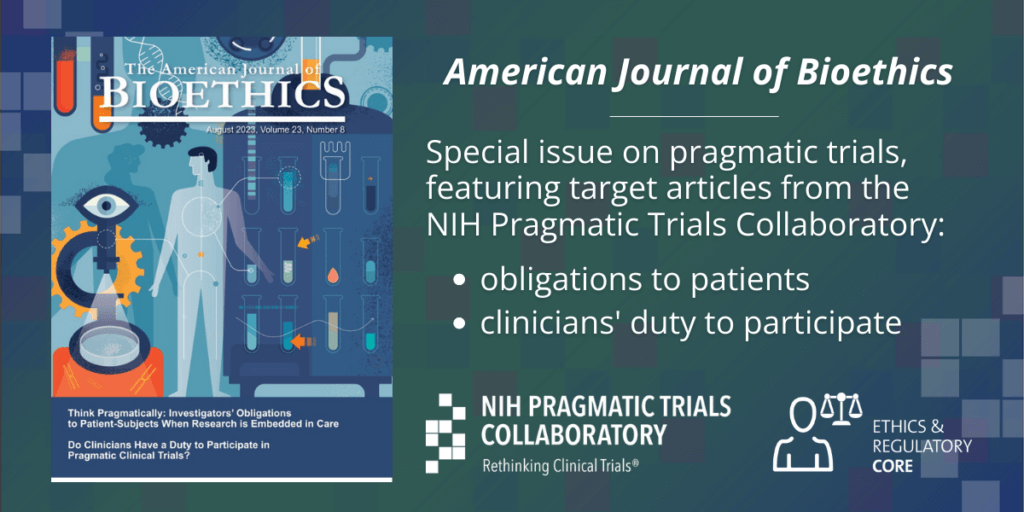 In an article published this month in the American Journal of Bioethics, FDA Commissioner Robert Califf and coauthors suggest that—despite the potential of embedded pragmatic research to generate information to improve clinical practice and public health policy—it is still relatively uncommon in US healthcare.
 On September 12, Joe Ali, a longtime member of the NIH Pragmatic Trials Collaboratory’s Ethics and Regulatory Core, will present “Advancing Justice and Equity in Pragmatic Clinical Trials.” The presentation is part of the Spotlight on Pain Management series of the VA HSR&D Cyberseminars.