January 23, 2024: Ethics Consultation Documents Now Available for RAMP Trial

Ethics and regulatory onboarding documentation is now available for RAMP, one of the NIH Pragmatic Trials Collaboratory's newest pragmatic clinical trials. The documents include meeting minutes and supplementary materials summarizing recent discussions of ethics and regulatory issues associated with the study.

The consultation took place by video conference and included representation from the study's principal investigator and study team, members of the NIH Collaboratory's Ethics and Regulatory Core, NIH staff, and NIH Collaboratory Coordinating Center personnel.

The goal of RAMP is to evaluate the use of a 12-week mind-body skills training program for patients with pain, including a one-on-one session with a “whole health coach” followed by 11 weekly group sessions to include prerecorded expert-led education videos, mind-body skills training and practice, and group discussions.

Ethics and regulatory documentation for all of the NIH Collaboratory Trials is available on our Data and Resource Sharing page.

January 16, 2024: Ethics Consultation Documents Now Available for AIM-CP and MOMs Chat & Care Study

Ethics and regulatory onboarding documentation for 2 of the NIH Pragmatic Trials Collaboratory's newest trials is now available. The documents include meeting minutes and supplementary materials summarizing recent discussions of ethics and regulatory issues associated with the AIM-CP trial and the MOMs Chat & Care Study.

The consultations took place by video conference and included representation from the studies' principal investigators, members of the NIH Collaboratory's Ethics and Regulatory Core, NIH staff, and NIH Collaboratory Coordinating Center personnel.

AIM-CP will test a care management program to address inequities in access to nonpharmacological treatment for chronic pain in rural populations.

The MOMs Chat & Care Study will test the effectiveness of an integrated care model approach at 2 levels of intensity designed to facilitate timely, appropriate care for Black patients to reduce their risk for severe maternal morbidity.

Ethics and regulatory documentation for all of the NIH Collaboratory Trials is available on our Data and Resource Sharing page.

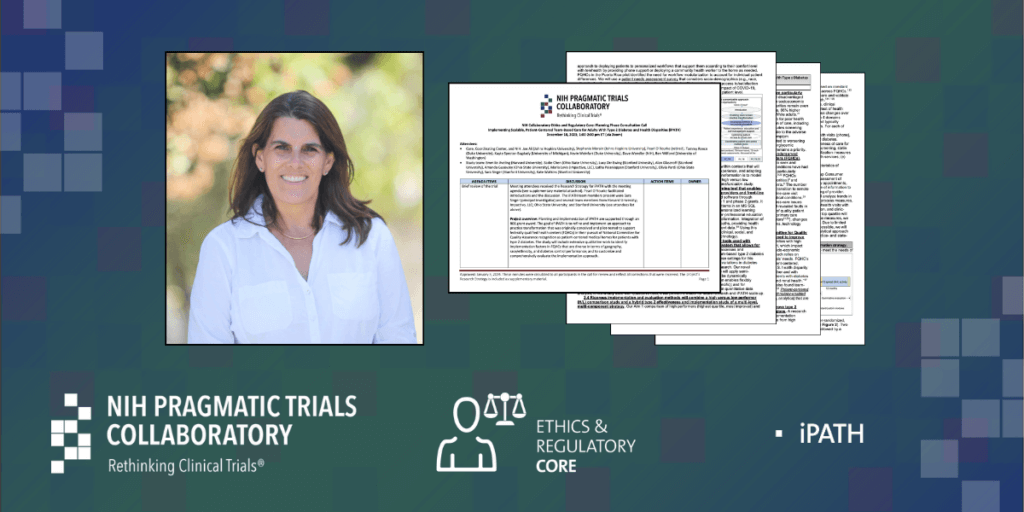
January 9, 2024: Ethics Consultation Documents Now Available for iPATH Trial

Ethics and regulatory onboarding documentation is now available for iPATH, one of the NIH Pragmatic Trials Collaboratory's newest pragmatic clinical trials. The documents include meeting minutes and supplementary materials summarizing recent discussions of ethics and regulatory issues associated with the study.

The consultation took place by video conference and included representation from the study's principal investigator and study team, members of the NIH Collaboratory's Ethics and Regulatory Core, NIH staff, and NIH Collaboratory Coordinating Center personnel.

The goal of iPATH is to refine and implement an approach to practice transformation that was originally conceived and pilot-tested to support federally qualified health centers (FQHCs) in their pursuit of National Committee for Quality Assurance recognition as patient-centered medical homes for patients with type 2 diabetes. The study will include extensive qualitative work to identify implementation factors in FQHCs that are diverse in terms of geography, race/ethnicity, and diabetes control performance; and to customize and comprehensively evaluate the implementation approach.

Ethics and regulatory documentation for all of the NIH Collaboratory Trials is available on our Data and Resource Sharing page.

December 18, 2023: Ethics Consultation Documents Now Available for ARBOR-Telehealth and I CAN DO Surgical ACP

Ethics and regulatory onboarding documentation for 2 of the NIH Pragmatic Trials Collaboratory's newest trials is now available. The documents include meeting minutes and supplementary materials summarizing recent discussions of ethics and regulatory issues associated with the ARBOR-Telehealth and I CAN DO Surgical ACP studies.

The consultations took place by video conference and included representation from the studies' principal investigators, members of the NIH Collaboratory's Ethics and Regulatory Core, NIH staff, and NIH Collaboratory Coordinating Center personnel. Both projects are in their planning phase.

ARBOR-Telehealth will evaluate the use of a telehealth physical therapy strategy for patients who present to primary care clinics with low back pain in rural communities. A secondary aim of the study is to compare the effectiveness of the study's risk-stratification approach.

I CAN DO Surgical ACP will identify a system-based approach to help older adults undergoing elective surgery engage in advance care planning. The project will leverage the existing electronic health record and patient portal, PREPARE for Your Care materials to assist patients with completion of advance care planning, virtual healthcare navigators, and electronic nudges. Another goal of the study is to understand digital engagement, language, and social drivers of health that drive engagement in the intervention.

Ethics and regulatory documentation for all of the NIH Collaboratory Trials is available on our Data and Resource Sharing page.

November 13, 2023: New Chapter of Living Textbook Explores Ethical Considerations for Artificial Intelligence and Machine Learning in Pragmatic Clinical Trials

The NIH Pragmatic Trials Collaboratory published a new chapter of its Living Textbook of Pragmatic Clinical Trials this week. The chapter, “Ethics and Equity for Artificial Intelligence and Machine Learning in Pragmatic Clinical Trials,” describes key considerations and challenges with leveraging artificial intelligence and machine learning in pragmatic clinical trials.

The chapter provides guidance on responsible conduct of pragmatic clinical trial research involving artificial intelligence and machine learning, including navigating the institutional review board approval process, considerations for data procurement and consent, and choices regarding what data are procured and how they are used to build equity-enhancing algorithmic models.

For more on the ethical considerations of ePCTs, see the chapters on Privacy ConsiderationsIdentifying Those Engaged in ResearchConsent, Waiver of Consent, and NotificationCollateral FindingsData and Safety Monitoring; and Ethical Considerations of Data Sharing in Pragmatic Clinical Trials.

The Stepped Wedge Cluster Randomized Trial: Friend or Foe?

The Stepped Wedge Cluster Randomized Trial: Friend or Foe?

Description

This Grand Rounds presentation was part of our special Grand Rounds series, Ethical & Regulatory Dimensions of Pragmatic Clinical Trials. Monica Taljaard and David Magnus present their lessons learned from using stepped-wedge designs in ePCTs.

Speakers

Monica Taljaard, PhD
Senior Scientist, Clinical Epidemiology Program, Ottawa Hospital Research Institute
Full Professor, Epidemiology and Community Medicine, University of Ottawa

David Magnus, PhD
Professor of Medicine and Biomedical Ethics and Professor of Pediatrics, Medicine, and by courtesy of Bioengineering
Director, Stanford Center for Biomedical Ethics
Associate Dean for Research


Related Content

Living Textbook: Stepped-Wedge Designs

Responding (or Not) to Signals of Potential Clinical Significance in Pragmatic Clinical Trials

Responding (or Not) to Signals of Potential Clinical Significance in Pragmatic Clinical Trials

Description

This Grand Rounds presentation was part of our special Grand Rounds series, Ethical & Regulatory Dimensions of Pragmatic Clinical Trials. Joe Ali, Tanya Matthews, and Leslie Crofford discuss what to do when data in a pragmatic clinical trial includes information that might signal physical, mental health or behavioral health risks to patient-subjects (e.g. substance use, depression, anxiety, suicidality).

Speakers

Joseph Ali, JD
Assistant Professor, Dept. of International Health
Johns Hopkins Bloomberg School of Public Health
Core Faculty & Associate Director for Global Programs
Johns Hopkins Berman Institute of Bioethics

Tanya Matthews, PhD
HRPP Director
Kaiser Permanente Washington


Leslie J. Crofford, MD
Wilson Family Chair in Medicine
Professor of Medicine and Pathology, Microbiology & Immunology
Chief, Division of Rheumatology
Vanderbilt University Medical Center


Related Content

Living Textbook: How Are PRO Measures Used?

Headshot of Dr. Emily Largent

Ethical Considerations When Vulnerable Populations are Subjects in Pragmatic Trials

Ethical Considerations When Vulnerable Populations are Subjects in Pragmatic Trials

Description

This Grand Rounds presentation was part of a special series, Ethical & Regulatory Dimensions of Pragmatic Clinical Trials. Emily Largent explains that while it is ethically acceptable and imperative to enroll vulnerable subjects in research, we must also think about their vulnerability in systematic ways so that we know not only what they are vulnerable to but how we can protect them.

Speaker

Headshot of Dr. Emily LargentEmily A. Largent, JD, PhD, RN
Emanuel & Robert Hart Assistant Professor of Medical Ethics and Health Policy
Department of Medical Ethics and Health Policy
University of Pennsylvania Perelman School of Medicine


Related Content

Living Textbook: Data and Safety Monitoring

October 12, 2023: GRACE Team Shares Lessons About Monitoring Signals of Suicidality in Pragmatic Clinical Trials

In a new article published this week in Contemporary Clinical Trials Communications, the GRACE DNIH Collaboratory Trial team recommends that suicidality should be monitored in pragmatic clinical trials that measure depression as an outcome. The work builds on their experience conducting research involving patients with sickle cell disease and on previous work from the NIH Pragmatic Trials Collaboratory’s Ethics and Regulatory Core.

The authors offer 7 recommendations to address ethical considerations in the development of protocols, procedures, and monitoring activities related to suicidality in depressed patients in a pragmatic clinical trial.

Recommendations:

  • Understand our responsibility to act
  • Define triggers for action
  • Examine responsibilities for action
  • Protect patient autonomy and privacy
  • Identify indirect and collateral participants
  • Mitigate the risk of bias
  • Integrate responses within the clinical practice and understand the sociotechnical considerations.

Severe depression symptoms such as suicidal ideation can be assessed in patients using the PHQ-9, a validated self-report instrument used to score depression severity by inquiring about the  presence and severity of depression, passive thoughts of death, and active ideas of self-harm.

For more, read the full article or the article Responding to Signals of Mental and Behavioral Health Risk in PCTs from the Ethics and Regulatory Core.

The GRACE is supported by the NIH through the NIH HEAL Initiative under an award administered by the National Center for Complementary and Integrative Health. Learn more about the GRACE trial.

October 10, 2023: Ethics Consultation Documents Now Available for BEST-ICU, Chat 4 Heart Health, and TAICHIKNEE

Ethics and regulatory onboarding documentation for the NIH Pragmatic Trials Collaboratory’s newest NIH Collaboratory Trials is now available. The documents include meeting minutes and supplementary materials summarizing recent discussions of ethics and regulatory issues associated with the BEST-ICU, Chat 4 Heart Health, and TAICHIKNEE studies.

The consultations took place by video conference and included representation from the studies’ principal investigators, members of the NIH Collaboratory’s Ethics and Regulatory Core, NIH staff, and NIH Collaboratory Coordinating Center personnel. All of the projects are in their 1-year planning phase.

BEST-ICU will explore the prevention of health impairments exacerbated by health disparities in the intensive care unit (ICU) through the application of the ABCDEF bundle, a multicomponent, evidence-based intervention to improve team-based care. The objective of the study is to evaluate 2 strategies grounded in behavioral economic theory and implementation science to increase ABCDEF bundle adoption and, in turn, address known health disparities in the ICU.

Chat 4 Heart Health will use a patient-level randomized pragmatic trial to test the comparative effectiveness of 3 text messaging delivery strategies that have been shown to improve individuals’ self-management health behaviors, including physical activity and medication adherence. The study findings will provide evidence regarding the best population-based strategy for universal delivery to engage all patients with health disparities in self-management to improve the American Heart Association’s “Life’s Essential 8” measures for improving and maintaining cardiovascular health.

TAICHIKNEE will compare the effects of web-based tai chi interventions versus routine care for individuals experiencing knee pain due to osteoarthritis. The practice of tai chi integrates physical, psychosocial, and behavioral components and has exhibited clinically significant improvements in chronic knee osteoarthritis pain conditions. The results of the study will inform widespread adoption of mind-body approaches for knee osteoarthritis, which affects more than 32.5 million individuals in the United States, across healthcare systems.

Ethics and regulatory documentation for all of the NIH Collaboratory Trials is available on our Data and Resource Sharing page.