April 22, 2025: New Report Highlights Value of Informing Participants About Research Conducted Under a Waiver of Consent

Even in minimal-risk studies that do not use the standard consent process, there may be value in informing participants about the research. Such notifications should be considered the default for clinical trials conducted under a waiver of informed consent, argue the authors of a new report from the NIH Pragmatic Trials Collaboratory.

The open-access article was published online ahead of print this week in Learning Health Systems.

Pragmatic clinical trials conducted in the context of routine healthcare often meet the regulatory criteria for a waiver or alteration of the standard informed consent process. In such cases, researchers and reviewers might assume there is no reason to communicate information about the study to participants. However, providing information to participants, even in minimal-risk research conducted with a waiver of consent, can promote important ethical values.

Experts from the NIH Collaboratory’s Ethics and Regulatory Core teamed up with investigators from several of the NIH Collaboratory Trials to describe methods of informing participants in minimal-risk research.

The investigators used a variety of notification approaches in their studies, including letters and email campaigns, posters in waiting rooms and other common areas, conversations with clinicians, and presentations at staff meetings. The amount of information provided to participants ranged from a general statement that research was being conducted at the institution to detailed information about the study in question.

“When a study is approved with a waiver of research consent, investigators and review committees should consider on a case-by-case basis what information, if any, to disclose to participants, and how it will be disclosed,” the authors wrote. The costs, benefits, and feasibility of these approaches vary from study to study.

Communicating information to participants can promote several important goals:

  • The ethical principle of respect for persons
  • Participants’ understanding of the study and of research in general
  • Participants’ understanding of their contributions to the research
  • Participants’ ability to voice and discuss any concerns about the study
  • Participant engagement in research
  • Trust in research and researchers

“Providing information to the participants should thus be the default for trials conducted under a waiver of research consent,” the authors wrote.

Read the full report.

January 14, 2025: Ethics Consultation Documents Now Available for APA-SM Trial

Headshots of Dr. Jennifer Kawi, Dr. Jane Bolin, and Dr. Hulin WuEthics and regulatory onboarding documentation for one of the NIH Pragmatic Trials Collaboratory’s newest trials is now available. The documents include meeting minutes and supplementary materials summarizing recent discussions of ethics and regulatory issues associated with the APA-SM trial.

The consultations took place by video conference and included representation from the study team, members of the NIH Collaboratory’s Ethics and Regulatory Core, NIH staff, and NIH Collaboratory Coordinating Center personnel.

APA-SM will test a 4-week auricular point acupressure intervention for self-management of chronic pain in rural communities in South Carolina and Texas. The study will also include implementation outcomes, a cost-effectiveness analysis, and an evaluation of predictive factors for treatment response.

APA-SM is supported through the NIH HEAL Initiative with administrative oversight by the National Center for Complementary and Integrative Health and the National Institute of Neurological Disorders and Stroke.

Ethics and regulatory documentation for all of the NIH Collaboratory Trials is available on our Data and Resource Sharing page.

August 17, 2023: American Journal of Bioethics Publishes Special Issue on Pragmatic Clinical Trials

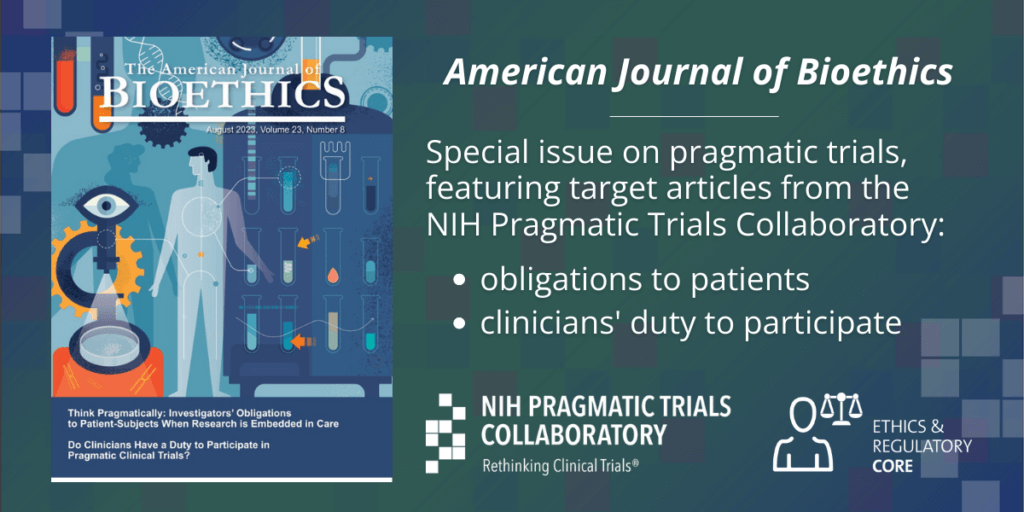
A graphic that includes the cover image from the August 2023 issue of the American Journal of Bioethics. The text in the graphic reads as follows: "American Journal of Bioethics Special issue on pragmatic trials, featuring target articles from the NIH Pragmatic Trials Collaboratory."When research and clinical care are deliberately integrated in an embedded pragmatic clinical trial, the nature and extent of investigators’ obligations to patient-subjects are blurred, as is the clinician’s duty to participate is such research. To address these questions, the American Journal of Bioethics (AJOB) recently published commentaries on 2 target articles in a special issue on pragmatic clinical trials. Both of the target articles for the special issue are from the NIH Pragmatic Trials Collaboratory’s Ethics and Regulatory Core.

Target Article #1

Think Pragmatically: Investigators’ Obligations to Patient-Subjects When Research Is Embedded in Care by Stephanie Morain and Emily Largent

  • The authors challenge the notion that the current ethical model can simply be extended to pragmatic research. Instead, the authors suggest a shift to a model that better reflects the team- and institution-based nature of both clinical care and embedded research.

Target Article #2

Do Clinicians Have a Duty to Participate in Pragmatic Clinical Trials? by Andrew Garland, Stephanie Morain, and Jeremy Sugarman

  • The authors argue that clinicians have a duty to participate in pragmatic research in usual care but suggest acceptable reasons to refuse, such as a badly designed trial, trial activities that violate the clinician’s conscience, or that the trial will impose excessive burdens on the clinician.

Some of the responses to the target articles are highlighted below.

Blurred Boundaries: Toward an Expanded Ethics of Research and Clinical Care
Megan C. Hailey and Nate Olson

  • The authors applaud the articles and offer a range of different research contexts where similar issues apply, including rare disease and genomics research.

Progressing From “Whether to” to “How to” Conduct Pragmatic Trials
Jonathan Casey, Todd Rice, and Matthew Smelner

  • The authors state that clinicians are confronted daily with clinical decisions where the best treatment is unknown and suggest that pragmatic trials are best situated to address the problem.

    “We believe that the US healthcare system has a basic choice to make: allow arbitrary variation in clinical care and continue to systematically expose patients to suboptimal or harmful therapies indefinitely or structure that variation through pragmatic trials to generate knowledge, reduce variation, and improve outcomes over time.”

Ethical Pragmatic Clinical Trials Require the Virtue of Cultivated Uneasiness
Joel Pacyna and Jon Tilburt

  • The authors suggest that softening the default requirement of documenting individual consent removes a primary tool that researchers rely on to ensure the ethical nature of their research. Cultivated uneasiness about waiving consent is warranted and will push researchers to fully examine their decisions and subsequent consequences.

Distinguishing Clinical and Research Risks in Pragmatic Clinical Trials: The Need for Further Stakeholder Engagement
Benjamin S. Wilfond, Sinem Toraman Turk, Stephanie A. Kraft, Elliott M. Weiss, Philip I. Tarr, David Schnadower, and Stephen B. Freedman

  • The authors present a case study involving complex interventions to support the target articles’ supposition that ethical frameworks for pragmatic clinical trials need to account for shortcomings in clinical care.

More-Than-Partial Entrustment in Pragmatic Clinical Trials
Henry S. Richardson

  • The author strongly supports the obligations of the investigators to report significant, actionable incidental findings about individuals.

End-to-End Integration of Pragmatic Trials Into Health Care Settings
Sarah M. Greene

  • The author agrees that pragmatic trials will provide invaluable evidence, but argues that trialists must take care not to interrupt the flow of clinical practice.

For more, see the 15 other commentaries in the special issue of AJOB and the Living Textbook chapter on Consent, Waiver of Consent, and Notification.

January 20, 2021: New Article Explores Ethical Obligation to Monitor Signals of Behavioral and Mental Health Risk in Pragmatic Trials

In a new Contemporary Clinical Trialslsarticle, members of the Ethics and Regulatory Core of the NIH Pragmatic Trials Collaboratory explore the ethical obligation of investigators to address signals of behavioral and mental health risk in pragmatic clinical trials.

The article was published online ahead of print in Contemporary Clinical Trials and will appear in a forthcoming special issue on pragmatic and virtual trials.

Some pragmatic trials collect sensitive data that could signal distress, such as suicidal ideation, opioid use disorder, or depression. Investigators have an ethical obligation to monitor these signals and identify in advance if, when, and how such signals will trigger a response. Using examples from the NIH Collaboratory Trials, the authors offered preliminary recommendations and identified opportunities for future work.

The NIH Collaboratory Trials discussed in the article are supported by the PRISM program—Pragmatic and Implementation Studies for the Management of Pain to Reduce Opioid Prescribing. The projects are studying the real-world effectiveness of nonpharmacologic interventions to improve pain management and reduce reliance on opioids.

Read the full article.

The PRISM program is a part of the Helping to End Addiction Long-Term Initiative℠, or NIH HEAL Initiative℠. The NIH Pragmatic Trials Collaboratory Coordinating Center serves as the PRISM Resource Coordinating Center.

September 23, 2021: PCO Core Aims for Greater Consistency in Integrating Patient-Reported Outcomes in Research and Clinical Care

Leaders of the NIH Collaboratory’s Patient-Centered Outcomes (PCO) Core Working Group spoke in a recent Zoom-based interview about the Core’s latest accomplishments and ongoing collaborations with the NIH Collaboratory Trials.

“The purpose of the Core is to provide reusable and sustainable resources and tools to help project teams incorporate patient-centered outcomes and other patient-reported data in pragmatic clinical trials and the electronic health record,” said Dr. Emily O’Brien, an associate professor in population health sciences at Duke University and a cochair of the PCO Core.

“We address 3 components in any clinical research study: the needs of the clinician to provide care for the patient, the needs of the researcher, and the needs of the patient or the individual being treated,” added Dr. Christy Zigler, an assistant professor in population health sciences at Duke University and a cochair of the PCO Core. “To guide clinical researchers about PCO data collection, we usually think about 4 major considerations: adding IT infrastructure, deciding when PCOs are appropriate and choosing the best instrument, defining how to integrate PCO collection into the care process in a meaningful and appropriate way, and preparing for real-time reporting and statistical of PCO data,” Zigler said.

View the full video.

Last year, the PCO Core completed a survey of NIH Collaboratory Trials about cultural and linguistic adaptations of patient-centered outcome measures. The survey revealed significant barriers to researchers wanting to tailor instruments for their study populations.

“We wanted to know how and whether existing NIH Collaboratory Trials were adapting instruments for their populations of interest, either through translation, or cultural adaptation, or both,” said O’Brien. “This was really helpful to give us a sense of what barriers projects might encounter in the future… Planning ahead is critical, and having enough time and resources available to make these adaptations will be important for any projects that might benefit from having these adapted instruments available,” she said.

“We’re also thinking a lot about acceptability and burden of patient-centered outcomes,” said Dr. Zigler. “So we’re targeting PRISM NIH Collaboratory Trials within the first year of transition to implementation…and sending out a survey to gauge acceptability and burden at all levels, from the clinical care team, from the research side, and also from the patients themselves,” Zigler said.

Zigler and O’Brien also highlighted ongoing collaborations with the NIH Collaboratory’s other Core Working groups, including discussions with the Ethics and Regulatory Core about the ethical implications of integrating PCO data into clinical care and a consultation with the Electronic Health Records Core on integrating patient-centered and patient-reported outcomes into the electronic health record so that pragmatic clinical trial researchers can use them.

“Patient-centered outcomes data does not exist in a vacuum,” said O’Brien. “The data that are collected as part of NIH Collaboratory projects exist as part of both the larger study and also the larger health system within which the study is being conducted. So there are really clear connections between the PCO Core and the work that we do and all the other Cores, and those Cores have been a great resource for us as we’re advising projects on key issues that come up during the design and implementation phases of their studies,” she said.

View the full interview with Dr. Zigler and Dr. O’Brien.
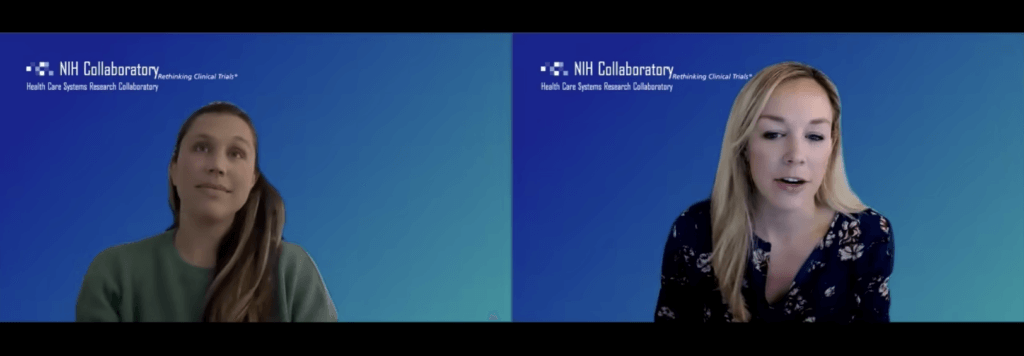
 

Screen shot from video interview with Dr. Christy Zigler and Dr. Emily O'Brien

August 18, 2021: MOTIFS Explores Patients’ Reactions to Notifications of Collateral Findings

Cover the the Journal of General Internal MedicinePatients’ reactions to a letter notifying them about collateral findings from a pragmatic clinical trial were unrelated to who signed the letter, the type of collateral finding, or the letter’s level of detail about the trial, according to a new study from the NIH Collaboratory.

The article was published online ahead of print in the Journal of General Internal Medicine.

Collateral findings of pragmatic clinical trials are findings, whether discovered intentionally or unintentionally, that do not address the trial’s research question but may have implications for the health of patients in the trial. For example, when collecting data from electronic health records for a pragmatic trial, the researchers might detect the use of contraindicated medications in some patients. It is uncertain how best to notify patients of these findings.

Researchers from the NIH Collaboratory’s Ethics and Regulatory Core Working Group and colleagues from the Johns Hopkins Berman Institute of Bioethics conducted a survey experiment in which participants were randomly assigned to respond to 1 of 16 hypothetical scenarios. In each scenario, the participant read a letter notifying them of a collateral finding from a pragmatic clinical trial and asking them to contact their doctor immediately. The scenarios differed by who signed the letter, the type of collateral finding, and whether the letter included a detailed description of the pragmatic trial.

Participants’ reactions to the letter and their intention to contact their doctor immediately were not affected significantly by who signed the letter or whether the pragmatic trial was described in the letter. Participants’ reported level of understanding was generally lower for versions of the letter that included a description of the trial.

Read the full report.

This work was supported within the National Institutes of Health (NIH) Health Care Systems Research Collaboratory by the NIH Common Fund through a cooperative agreement from the Office of Strategic Coordination within the Office of the NIH Director. Supplemental funding for this work was provided by the National Center for Complementary and Integrative Health. The aim of the supplement, Management of Trial Incidental Findings Study (MOTIFS), is to develop an empirically informed, ethically sound approach to managing incidental findings in pragmatic clinical trials.

July 14, 2021: New Resource from the Ethics and Regulatory Core

The Collaboratory’s Ethics and Regulatory Core has recently explored issues around data monitoring in pragmatic clinical trials (PCTs). Important considerations for data monitoring in this context are related to the design, intent, and operational features specific to PCTs. Data Monitoring in Pragmatic Clinical Trials: Points to Consider suggests a set of key areas to evaluate:

  • Composition of Data Monitoring Committees
  • Use of health systems records data
  • Study design and statistical analysis
  • Monitoring adherence
  • Futility
  • Safety
  • Efficacy

“Finding ways to describe and disseminate experiences with PCT DMCs should be encouraged in an effort to improve practices and policies.” (Ethics and Regulatory Core)

September 22, 2020: New Article Highlights Ethical and Regulatory Challenges of Conducting PCTs

Cover of Ethics & Human ResearchA recent article in Ethics & Human Research describes the experience and management of regulatory noncompliance during the conduct of a large, multisite embedded pragmatic clinical trial (ePCT). The Trauma Survivors Outcomes and Support (TSOS), an NIH Collaboratory Trial, was a stepped-wedge, cluster-randomized clinical trial of a collaborative care intervention for injured patients with symptoms of posttraumatic stress disorder in 25 level 1 trauma centers in the United States. The article, Ethical and Regulatory Concerns in Pragmatic Clinical Trial Monitoring and Oversight, was coauthored by members of the TSOS study team, the Collaboratory’s Ethics and Regulatory Core, and colleagues.

The authors describe how the study encountered variabilities in participant tracking across sites, which led to a study-wide internal audit and corrective action. The study team implemented a revision of the participant tracking system and retrained site staff in new procedures. Based on the lessons learned, the authors offer recommendations for future PCTs and relevant stakeholders, including institutional review boards, data safety and monitoring boards, institutions, and trial sponsors.

Among the recommendations:

  • Use a single IRB of record to streamline regulatory processes and reduce variability among research sites.
  • Standardize research procedures but allow for real-world flexibility; this could include real-time, workflow-integrated study logging that captures and documents provider turnover and regulatory training compliance.
  • Implement thorough, specific, and practical training in procedures, especially around participant enrollment and tracking.
  • Ensure that research procedures, monitoring and oversight plans, and training are study specific to account for unique issues, contexts, and needs.

Thoughtful planning, communication, and development and dissemination of standardized procedures remain hallmarks of successful research operations both to advance biomedical research and to ensure appropriate safeguards for its participants. –Roberts et al.

July 16, 2020: New Publication Describes Unexpected Complications of Certificates of Confidentiality for Pragmatic Clinical Trials

Judith Carrithers and Jeremy Sugarman, co-chairs of the NIH Collaboratory’s Ethics and Regulatory Core, recently published an article in the journal Learning Health Systems that examines the NIH’s Certificate of Confidentiality (CoC) policy for NIH-funded human subjects research. Since October 1, 2017, the CoC is issued automatically and applies to all biomedical, behavioral, clinical, and other research funded wholly or in part by the NIH that “collects or uses identifiable sensitive information.”

In their review of the CoC policy, the authors describe unanticipated challenges of applying the policy to pragmatic clinical trials, where the focus is on embedding research interventions in clinical care and which relies on existing data in electronic health records (EHRs). The authors identify 3 issues that are especially problematic in embedded pragmatic clinical trial (ePCT) settings and which may jeopardize the progress of learning health systems:

  • Whether the EHR may be populated with research data that may be sensitive or stigmatizing without explicit consent from subjects
  • Incomplete protections for sensitive data in the EHR
  • Requirements for notifying subjects about the policy’s provisions

The authors urge the NIH to provide formal guidance on the CoC policy as it pertains to ePCTs. Read the full publication online.

“Special attention should be paid to pragmatic research that populates the electronic health record with research data as well as research conducted without explicit consent.” – Sugarman and Carrithers

March 31, 2020: Engagement in PCTs: Considerations from the Collaboratory’s Ethics and Regulatory Core

A new document from the Ethics and Regulatory Core is available that provides considerations around determining which individuals or groups are engaged in research in pragmatic clinical trials (PCTs). Developed for investigators designing and conducting PCTs as well as institutional review boards overseeing them, the document introduces these questions in relation to research subjects, study team members, and service providers:

  • Which individuals/groups are included in the research?
  • Are these individuals/groups research subjects, study team members, or service providers?
  • Why does it matter how the individuals/groups are categorized for the research?

Download Engagement in Research for Pragmatic Clinical Trials.