The study design paper for the MOMs Chat & Care Study has been published online ahead of print in Contemporary Clinical Trials. Congratulations to the study team on reaching this important milestone for all NIH Collaboratory Trials!
The MOMs Chat and Care Study is testing the effectiveness of an integrated care model approach at 2 levels of intensity designed to facilitate timely, appropriate care for Black birthing people to reduce their risk for severe maternal morbidity. Patients in both study arms will receive close clinical and behavioral health monitoring and navigation to timely care and services.
The study is being led by Stephanie Fitzpatrick at the Feinstein Institutes for Medical Research and is supported by an R01 grant award from the National Institute of Nursing Research.
Researchers with PRIM-ER, an NIH Collaboratory Trial, published 2 innovative statistical techniques for evaluating intervention effects in stepped-wedge, cluster randomized trials. The new models, which use Bayesian methods, outperformed traditional analytic methods and other Bayesian approaches in simulations and real-world applications.
In cluster randomized trials with stepped-wedge designs, the clusters are randomized into several groups, and all groups start the trial in the control condition. Groups of clusters cross over to the intervention condition on a staggered timeline, and all groups receive the intervention before the end of the trial.
Stepped-wedge designs can be advantageous when simultaneous rollout of the intervention to all clusters is infeasible, or when withholding the intervention from any cluster would be unethical, or when there is a risk of contamination between intervention subjects and control subjects. However, stepped-wedge designs can also introduce confounding by time, as the intervention is rolled out to clusters in waves. Temporal trends during the study can influence the study’s outcomes.
The PRIM-ER researchers tested 2 new Bayesian hierarchical penalized spline models to improve the estimation of intervention effects in stepped-wedge trials. The first model focuses on immediate intervention effects and accounts for large numbers of clusters and time periods. The second model extends the first by accounting for time-varying intervention effects. The researchers applied both models to data from PRIM-ER.
PRIM-ER tested a multidisciplinary primary palliative care intervention in a diverse mix of emergency departments in the United States to improve the delivery of goal-directed emergency care of older adults. The study was supported by the National Institute on Aging. Learn more about PRIM-ER.
New study snapshots and updated ethics and regulatory documentation are now available for the AIM-CP, ARBOR-Telehealth, and RAMP trials. The 3 NIH Collaboratory Trials, all supported through the NIH HEAL Initiative℠, or Helping to End Addiction Long-Term Initiative℠, reflect a special emphasis on developing strategies for the management of chronic pain in rural and remote populations. The trials have transitioned from the UG3 planning phase to the UH3 implementation phase.
“There are many known disparities between urban and rural populations,” said Karen Kehl, a program director at the National Institute of Nursing Research (NINR), in an interview at the NIH Pragmatic Trials Collaboratory’s 2024 Annual Steering Committee Meeting. “And when we talk about chronic pain, we know that there’s a higher incidence and a higher severity of pain in rural populations, and yet they don’t have access to many of the effective solutions that we have,” Kehl added.
AIM-CP
AIM-CP is testing the implementation of a care management program to address disparate access to nonpharmacological treatments for chronic pain in rural populations. The principal investigators are Sebastian Tong and Kushang Patel of the University of Washington. The study is supported by NINR.
ARBOR-Telehealth is evaluating the use of a telehealth physical therapy strategy for patients who present to primary care clinics with low back pain in rural communities. The principal investigators are Richard Skolasky and Kevin McLaughlin of Johns Hopkins University. The study is supported by the National Institute of Arthritis and Musculoskeletal and Skin Diseases.
RAMP is evaluating the use of a 12-week mind-body skills training program for rural veterans with pain within the VA’s Whole Health initiative, including a one-on-one session with a Whole Health coach followed by 11 weekly group sessions to include prerecorded expert-led education videos, mind-body skills training and practice, and group discussions. The principal investigators are Diana Burgess and Roni Evans of the University of Minnesota and Katherine Hadlandsmyth of the University of Iowa. The study is supported by NINR.
Dr. Corita Grudzen and Dr. Keith Goldfeld, principal investigators for PRIM-ER
An evidence-based training program to improve the capacity of emergency department care teams to communicate with seriously ill older patients about palliative care did not lead to lower rates of hospital admission, according to the results of the PRIM-ER trial.
More than three-quarters of seriously ill older adults in the United States will visit an emergency department in their last 6 months of life. Palliative care specialists are not always available in emergency departments, and emergency clinicians may lack the training or tools to assist older adults who have serious, life-limiting illness in making complex medical decisions.
PRIM-ER, an NIH Collaboratory Trial, was a stepped-wedge, cluster randomized trial of a palliative care training program in 29 emergency departments in the United States. The program consisted of training in palliative care, simulation-based communication workshops, clinical decision support tools, and audit and feedback.
The study team, led by Corita Grudzen at Memorial Sloan Kettering Cancer Center and Keith Goldfeld at New York University, evaluated the initial emergency department visits of nearly 99,000 older adults with serious, life-limiting illness before and after implementation of the training program. The primary outcome was hospital admission from the emergency department. Secondary outcomes included subsequent healthcare use and survival.
There was no difference in the rate of hospital admission for seriously ill older adults after emergency department staff received the palliative care training intervention. The intervention also did not have an effect on subsequent health care use or short-term mortality.
“Our complex, multicomponent intervention designed to embed palliative care skills in emergency medicine practice for patients with serious, life-limiting illness did not show an effect on hospital admission, subsequent health care use, or short-term mortality,” said Grudzen, an emergency medicine physician and palliative care specialist. “Despite this, the development, implementation, and testing of primary palliative care interventions remain a priority, given the workforce shortages in hospice and palliative medicine,” Grudzen said.
An important and unanticipated experience in the conduct of the PRIM-ER trial between 2018 and 2022 was the COVID-19 public health emergency. Strain placed on the healthcare system by the pandemic limited the ability of home care and hospice agencies to accept patients and narrowed the referral options available to emergency department clinicians. These impacts may have influenced the trial’s results.
PRIM-ER was supported within the NIH Pragmatic Trials Collaboratory by a grant award from the National Institute on Aging.
“The NIH Collaboratory is a critical resource for the conduct of pragmatic trials,” Grudzen said. “The faculty willingly share their expertise in all aspects of pragmatic trial design, conduct, and analysis. Their recommendations are the rare combination of cutting edge, practical, and battle tested. The program’s additional electronic and virtual resources are invaluable to growing the pragmatic trial community,” she said.
Ethics and regulatory onboarding documentation for one of the NIH Pragmatic Trials Collaboratory’s newest trials is now available. The documents include meeting minutes and supplementary materials summarizing recent discussions of ethics and regulatory issues associated with the APA-SM trial.
The consultations took place by video conference and included representation from the study team, members of the NIH Collaboratory’s Ethics and Regulatory Core, NIH staff, and NIH Collaboratory Coordinating Center personnel.
APA-SM will test a 4-week auricular point acupressure intervention for self-management of chronic pain in rural communities in South Carolina and Texas. The study will also include implementation outcomes, a cost-effectiveness analysis, and an evaluation of predictive factors for treatment response.
APA-SM is supported through the NIH HEAL Initiative with administrative oversight by the National Center for Complementary and Integrative Health and the National Institute of Neurological Disorders and Stroke.
Ethics and regulatory documentation for all of the NIH Collaboratory Trials is available on our Data and Resource Sharing page.
In a new report from the NIH Pragmatic Trials Collaboratory, a team of bioethicists explores the ethical obligation to share aggregate results from pragmatic clinical trials with research participants. They conclude with recommendations for how to meet this obligation.
There is growing appreciation of the importance of sharing aggregate results of clinical trials with research participants. However, this practice has not been examined in the context of pragmatic clinical trials, which have special features that may complicate the ethics and logistics of sharing aggregate results.
The report’s authors summarize the ethical arguments for sharing aggregate results and describe the features of pragmatic trials that may raise logistical and other barriers to disclosure. They also discuss the important role healthcare system partners play in sharing results from pragmatic trials.
The authors offer the following recommendations:
Sharing aggregate results with research participants should be the default, and decisions not to share should be justified
Planning for sharing aggregate results should begin early in the planning of the trial
The healthcare care systems in which the trial is embedded should be key partners in decisions about what and how to share
Proactive sharing of results from a pragmatic trial that was conducted under a waiver or alteration of consent, including an explanation for why consent was not obtained in the study, can promote trust in the investigators and their healthcare system partners
The article was coauthored by members of the NIH Pragmatic Trials Collaboratory’s Ethics and Regulatory Core, including Stephanie Morain, Abigail Brickler, Joseph Ali, Caleigh Propes, and Kayla Mehl of Johns Hopkins University; Pearl O’Rourke, formerly of Partners HealthCare; Kayte Spector-Bagdady of the University of Michigan; Benjamin Wilfond of the Seattle Children’s Hospital; Vasiliki Rahimzadeh of the Baylor College of Medicine; and David Wendler of the NIH Clinical Center.
Lung cancer is the leading cause of cancer-related deaths in the United States, but only 6.5% of eligible individuals were screened for lung cancer in 2020. Moreover, there are significant disparities in lung cancer screening related to race/ethnicity and socioeconomic status.
The LungSMART team will conduct a sequential multiple-assignment randomized trial (SMART) in community health centers in Utah to test telehealth interventions designed to address logistical barriers and hesitancy around completing lung cancer screening. The new project is supported by a grant award from the National Cancer Institute, a first for the NIH Pragmatic Trials Collaboratory.
David Wetter, Guilherme Del Fiol, and Ken Kawamoto will serve as the principal investigators for LungSMART. Wetter is the Jon M. and Karen Huntsman Presidential Professor, director of the Center for Health Outcomes and Population Equity, senior director for cancer health equity science at the Huntsman Cancer Institute, and director of community and stakeholder engagement at the Clinical and Translational Sciences Institute; Del Fiol is professor and vice chair of biomedical informatics; and Kawamoto is professor and vice chair of clinical informatics—all at the University of Utah.
Drawing on experiences from the NIH Collaboratory Trials, authors of a new article in Contemporary Clinical Trials describe the challenges they encountered when relying on data from the electronic health record (EHR) to monitor outcomes and deliver interventions in pragmatic clinical trials embedded in healthcare systems.
“Teams need to be aware of—and perhaps proactively investigate—possible changes to EHR systems and data that will affect the delivery of interventions and the integrity and safety of pragmatic clinical trials,” the authors wrote.
The challenges can create delays and unanticipated work that require creativity and collaboration, and include:
Rapid technology evolution: Over the course of a years-long trial, technology can become outdated.
EHR updates: Periodic, routine updates may change the way data are represented, captured, or computed, causing the logic of the intervention delivery tool to function differently or not function at all.
Switching EHR systems: Smaller clinics may switch EHR systems midtrial, causing disruptions in the research.
“We have learned that preparing for changes in the EHR by anticipating their effects, adapting, and reducing impact on the intervention is an important component in conducting embedded pragmatic clinical trials,” the authors wrote.
(Left to right) Authors Stephanie Morain, Kayla Mehl, and Caleigh Propes
In a new commentary, members of the NIH Pragmatic Trials Collaboratory’s Ethics and Regulatory Core explore the potential of pragmatic trials to improve demographic representativeness and health equity in clinical research. The article, “Untapped Potential? Representativeness in Pragmatic Clinical Trials,” was published online ahead of print in JAMA.
Authors Caleigh Propes, Kayla Mehl, and Stephanie Morain review early experiences with pragmatic trials and describe the challenges researchers face in achieving representative enrollment:
Pragmatic trials are embedded in unjust healthcare systems
Pragmatic trials often rely on electronic health record systems for data collection
As in traditional clinical trials, site selection in pragmatic trials tends to be biased toward better-resourced sites and sites with closer ties to established researchers
There is a general lack of attention to health equity considerations in trial design
The authors conclude that “further empirical scholarship is needed to assess the extent to which [pragmatic trials] are (or are not) truly representative and to define appropriate enrollment goals.”
Propes is a doctoral student in bioethics and health policy and management at the Berman Institute of Bioethics, Mehl is a postdoctoral fellow in the ethics and regulatory aspects of pragmatic clinical trials at the Berman Institute, and Morain is a core faculty member at the Berman Institute and an associate professor of health policy and management at the Bloomberg School of Public Health—all at Johns Hopkins University.
Research-identifiable Medicare data can come from traditional fee-for-service Medicare claims or from Medicare Advantage claims. A new contribution to the Living Textbook of Pragmatic Clinical Trials published this month, Use of Medicare Data in PCTs, describes the important differences between these data.
At the healthcare system level, differences in incentives for documenting diagnoses can affect the reliability and relevance of data used for pragmatic clinical trials. The populations served by fee-for-service Medicare plans and Medicare Advantage plans are also disparate, as Medicare Advantage plans include a higher proportion of patients who require chronic disease management. There are also variations in enrollment rates across states and counties that reflect characteristics of the counties themselves (urban vs rural) and the firms that offer Medicare Advantage plans across regions.


 The study design paper for the MOMs Chat & Care Study has been published online ahead of print in Contemporary Clinical Trials. Congratulations to the study team on reaching this important milestone for all NIH Collaboratory Trials!
 Researchers with PRIM-ER, an NIH Collaboratory Trial, published 2 innovative statistical techniques for evaluating intervention effects in stepped-wedge, cluster randomized trials. The new models, which use Bayesian methods, outperformed traditional analytic methods and other Bayesian approaches in simulations and real-world applications.
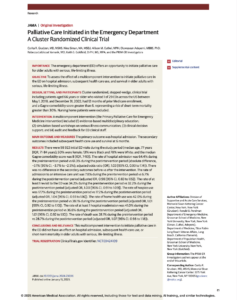 There was no difference in the rate of hospital admission for seriously ill older adults after emergency department staff received the palliative care training intervention. The intervention also did not have an effect on subsequent health care use or short-term mortality.
 Ethics and regulatory onboarding documentation for one of the NIH Pragmatic Trials Collaboratory’s newest trials is now available. The documents include meeting minutes and supplementary materials summarizing recent discussions of ethics and regulatory issues associated with the APA-SM trial.
 In a new report from the NIH Pragmatic Trials Collaboratory, a team of bioethicists explores the ethical obligation to share aggregate results from pragmatic clinical trials with research participants. They conclude with recommendations for how to meet this obligation.
 Drawing on experiences from the NIH Collaboratory Trials, authors of a
 Research-identifiable Medicare data can come from traditional fee-for-service Medicare claims or from Medicare Advantage claims. A new contribution to the Living Textbook of Pragmatic Clinical Trials published this month,