February 22, 2024: Updated Template Provides Guidance for Reporting of Pragmatic Trial Results

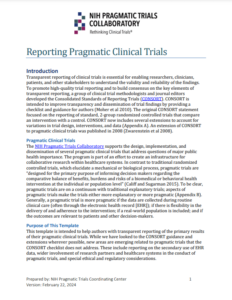
An updated template from the NIH Pragmatic Trials Collaboratory provides guidance for the transparent reporting of the primary results of pragmatic clinical trials.

The template includes elements from the Consolidated Standards of Reporting Trials (CONSORT) statement and its extensions. It also addresses secondary use of electronic health record data, involvement of research partners and healthcare systems in the conduct of pragmatic trials, and special ethical and regulatory considerations.

Download the template.

The updated template is organized by the recommended reporting elements presented in the CONSORT checklist and draws on recent experiences and lessons learned from the NIH Collaboratory Trials. Appendices include links to CONSORT and its relevant extensions, the Pragmatic-Explanatory Continuum Indicator Summary (PRECIS-2) tools and resources, and examples of figures to include in pragmatic trial reports.

Intervention Complexity Calculator

Intervention Complexity Calculator

The Intervention Complexity Calculator was developed as a standard tool to capture intervention complexity with the intent to enhance communication challenges of intervention delivery.

This version of the tool is most likely to be useful to the trial team and its health care system partners during trial planning and conduct. The tool was developed with an awareness of intervention complexity literature, but it was not our intent to create a comprehensive classification approach. We expect that this tool may further evolve with as more pragmatic trials are conducted and feedback is received on the tool performance.

For further details, see the Living Textbook Chapter on Intervention Complexity.

February 2, 2023: New Tool Developed to Assess Intervention Complexity

Cover of Contemporary Clinical TrialsThe NIH Pragmatic Trials Collaboratory has developed an online tool to evaluate the complexity of delivery of a trial intervention. To develop the tool, principal investigators of embedded pragmatic clinical trials (ePCTs) shared critical drivers of complexity that affected their ability to implement an intervention and discern treatment effects. An article describing the tool and its development was published today in Contemporary Clinical Trials.

“The complexity of the intervention delivery can have implications for study planning, ability to maintain fidelity to the intervention during the trial, and/or ability to detect meaningful differences in outcomes,” the authors wrote.

The tool consists of 6 domains comprised of internal and external factors that can impact complexity.

  • Internal factors pertain to the intervention itself:
    • the degree to which the intervention requires re-engineering of existing work flows and tasks;
    • the number of components in the intervention to be delivered; and
    • the level of familiarity or extra training needed for those delivering the intervention.
  • External factors are related to intervention delivery at the system level:
    • the degree to which delivery of the intervention is dependent on setting in which it is implemented;
    • the number of health care systems and clinics involved in delivering the intervention; and
    • the number of steps between the intervention and the outcome’s intended effect.

The authors hope the tool will enable communication about potential challenges of intervention delivery.

“By raising awareness about and increasing preparedness for the potential pitfalls of delivering the intervention within the ePCT design, we hope that this version of the tool will be useful to the trial team and its health system partners during trial planning and conduct,” they wrote.

Future work is planned to further refine the tool based on input from other networks that conduct ePCTs. The tool is free to use and availble online.

March 22, 2022: AHRQ Publishes Hospital Infection Prevention Toolkit Based on ABATE Infection Trial

ABATE Infection logoThe Agency for Healthcare Research and Quality (AHRQ) published a new Toolkit for Decolonization of Non-ICU Patients With Devices to help clinical teams implement a protocol to reduce bloodstream infections by approximately 30% in patients with specific medical devices.
The new toolkit is based on intervention materials successfully used in the ABATE Infection trial, one of the first NIH Collaboratory Trials of the NIH Pragmatic Trials Collaboratory. ABATE Infection was a large-scale pragmatic trial involving approximately 189,000 patients in the baseline period and 340,000 patients in the intervention period across 194 non–critical care units in 53 hospitals.

From the AHRQ announcement:

The free, customizable toolkit includes step-by-step instructions, handouts, and educational videos to show frontline teams how to apply a decolonization protocol for non-ICU patients who may be at greater risk of bloodstream infections because they have certain devices, such as central venous catheters. The decolonization protocol includes instructions on helping patients bathe with an antiseptic soap and applying a nasal antibiotic ointment to carriers of Methicillin-resistant Staphylococcus aureus (MRSA).

ABATE Infection was supported within the NIH Pragmatic Trials Collaboratory by a cooperative agreement from the National Institute of Allergy and Infectious Diseases and by the NIH Common Fund through a cooperative agreement from the Office of Strategic Coordination within the Office of the NIH Director. Learn more about ABATE Infection.

December 16, 2021: NIH Collaboratory Publishes COVID-19 Checklist for Statistical Analysis Plans in Pragmatic Trials

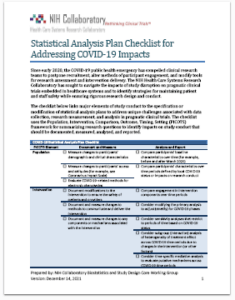
Thumbnail image of the COVID-19 checklistA new tool from the NIH Collaboratory assists investigators in identifying impacts of the COVID-19 public health emergency on ongoing pragmatic clinical trials. The Statistical Analysis Plan Checklist for Addressing COVID-19 Impacts summarizes impacts on trial conduct that study teams should document, measure, analyze, and report.

The new checklist was developed by the NIH Collaboratory’s Biostatistics and Study Design Core Working Group. Since the beginning of the COVID-19 pandemic, many of the NIH Collaboratory Trials have had to postpone recruitment, alter methods of participant engagement, and modify tools for research assessment and intervention delivery.

The leaders of the Biostatistics Core, Dr. Patrick Heagerty and Dr. Liz Turner, spoke in a recent interview about the impacts of the pandemic on the NIH Collaboratory Trials. Early next year, the Coordinating Center will report the results of a survey of the study teams about their experiences with these impacts.

Download the Statistical Analysis Plan Checklist for Addressing COVID-19 Impacts.

How to Use This Site

How to Use This Site

sections

Locating a Chapter

Click the large navigational buttons at the bottom of the website header to reveal a list of chapters within each content category. You can also view a full list of chapters in the Table of Contents.

Moving Within Chapters

Chapters contain one or more sections that cover specific topics. This structure is intended to help you find the information you need quickly and easily. When you select a chapter, you will be taken to Section 1 of that chapter. From the side or footer sections list, you may click a different section to navigate there. The section you are on will be bolded in the sections list. You can also use the “Previous Section” or ”Next Section” links at the bottom of each page to move through the sections in order. Sections may contain lists of additional resources or an alphabetical reference list where appropriate.

Locating Other Content

In addition to the chapters, other pages on the Living Textbook provide information about the NIH Pragmatic Trials Collaboratory program and its initiatives. These pages can be accessed from the Living Textbook homepage or via the navigational menu at the top of the website header.

maglense

How to Search

Search the Living Textbook by clicking on the magnifying glass at the top right of the header. Type a keyword and press the Return key on your keyboard to retrieve a list of search results.

You can also search the NIH Pragmatic Trials Collaboratory's Knowledge Repository archive, which contains additional Grand Rounds presentations, peer-reviewed articles, white papers, guidance documents, and tools related to PCTs.

citations

How to Cite the Living Textbook

To reference a section of the Living Textbook, click on the quotation marks icon at the top of the page. When clicked, the citation for that page is provided in AMA style. Select the citation text with your cursor to copy it to your clipboard.

Copyright Notice

Except where otherwise indicated, material on this website (“Rethinking Clinical Trials®: A Living Textbook of Pragmatic Clinical Trials”) is dedicated to the public domain and may be freely downloaded, shared, adapted, or re-used. In cases where website content is noted as being under copyright, the copyright holder should be contacted for permission to share, reuse, or adapt the material.


Additional Guidance: Adapted Content, Disclaimers, and Trademarks

  • Website content that is shared or reproduced without changes should be attributed to the National Institutes of Health (NIH) Pragmatic Trials Collaboratory and/or the Living Textbook, and, where appropriate, any named authors. Please see the suggested citation on each chapter page for how to cite Living Textbook materials.
  • Website content that is modified, adapted, or edited must not be used in ways that imply the endorsement of personal viewpoints, products, organizations, services, or other commercial concerns.
  • The NIH and NIH Pragmatic Trials Collaboratory logos should be removed from any modified, edited, or adapted content.
  • Reference in this web site to any specific commercial products, process, service, manufacturer, or company does not constitute its endorsement or recommendation by the U.S. Government, the NIH, or the NIH Pragmatic Trials Collaboratory. Neither the NIH nor the NIH Pragmatic Trials Collaboratory is responsible for the contents of any external websites linked to or referenced from this server.
  • None of the material on this site constitutes medical advice, nor is it intended to guide the treatment or diagnosis of medical conditions.
  • The phrase “Rethinking Clinical Trials®” is a registered trademark of Duke University.

If you have any further questions about sharing, reusing, or adapting materials from the Living Textbook, or have any copyright-related questions about content on the site, please contact us at nih-collaboratory@dm.duke.edu.

Quick Start Guides

Quick Start Guides

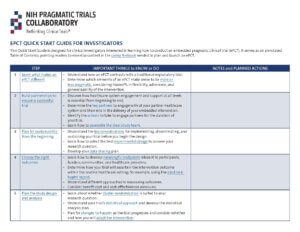
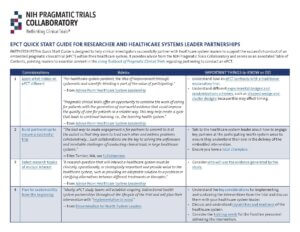
The NIH Collaboratory Quick Start Guides serve as annotated tables of contents, pointing readers to essential content in the Living Textbook to help successfully launch an embedded pragmatic trial (ePCT) and partner with healthcare systems leaders.

These guides will direct you to highlights of the Living Textbook, including chapters that will help you:

Learn How to Conduct an ePCT

  • Learn what makes an ePCT different
  • Build partnerships to ensure a successful trial
  • Plan for sustainability from the beginning
  • Choose the right outcomes
  • Plan the study design and analysis
  • Consider oversight and monitoring
  • Test trial feasibility
  • Prepare to launch
  • Prepare for dissemination and implementation

Learn How to Partner with Healthcare Systems Leaders

  • Learn what makes an ePCT different
  • Build partnerships to ensure a successful trial
  • Select research topics of mutual interest
  • Plan for sustainability from the beginning
  • Discuss data security and data sharing considerations
  • Build data systems for learning healthcare
  • Prepare for implementation