2024 Allan Donner Lecture: The Unit of Inference in Cluster Randomized Trials

2024 Allan Donner Lecture: Dr. Fan Li

Date: Friday, April 5
Time: 1:30 pm – 2:30 pm
Location: PHFM 3015 (Western Centre for Public Health and Family Medicine) or Zoom (link may be requested at EpiBio@uwo.ca)
Link: https://www.schulich.uwo.ca/epibio/about_us/events/2024/2024_Allan_Donner_Lecture.html

The unit of inference in cluster randomized trials

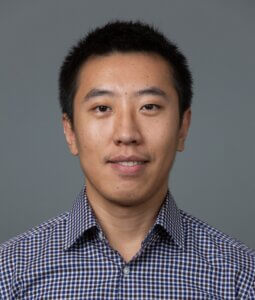
Fan Li

dr_Fan_Li_160x180.jpg

Assistant Professor 
Department of Biostatistics
Yale School of Public Health,
Yale Center for Methods in Implementation and Prevention Science

Short Biography:
Fan Li is a tenure-track Assistant Professor in the Department of Biostatistics at Yale School of Public Health, and Yale Center for Methods in Implementation and Prevention Science. He obtained his PhD in Biostatistics from Duke University in 2019 and joined the Yale faculty since 2019. His research aims to develop methods for designing and analyzing cluster randomized trials, causal inference methods for estimand-aligned analyses of randomized experiments and observational studies. Dr. Li’s methodology research has been funded by multiple awards from the United States National Institutes of Health and Patient-Centered Outcome Research Institute as a principal investigator and a co-investigator. He has published over 120 peer-reviewed articles. He is Co-Editor in Chief of the journal, Epidemiologic Methods, and Associate Editor of several journals including Statistics in Medicine, Clinical Trials, and Implementation Science.

Abstract: 
In cluster randomized trials, intact clusters of individuals rather than individuals themselves are randomly assigned to treatment conditions, creating a two-level structure that complicates the design and analysis compared to individually randomized trials. While the need to address intracluster correlations has motivated a robust literature for designing and analyzing cluster randomized trials in the past two decades, fewer efforts have integrated these developments in the context of treatment effect estimands. On page 13 of Donner and Klar (2000), it has already been suggested that “the target of inference in such studies (CRTs) could be at either the individual level or community level”, but the philosophy around unit of inference seems to be lost in translation until recently. In this presentation, we emphasize the difference between the unit of inference and the unit of analysis, and use the potential outcomes notation to define estimands that represent the unit of inference, regardless of the unit of analysis. In addition, we explain how one can standardize the output from any familiar regression model to ensure estimand-aligned inference. A key take-away is that one does not need to forgo the conventional wisdom developed in the existing literature to obtain the right inferential target, as long as the unit of inference is specified a priori, and a robust standardization procedure is applied to process the regression model output.

Keywords:
Cluster randomized trials; Stepped wedge designs; Causal inference; Estimands; Observational studies; Semiparametric methods.
Website

January 3, 2024: Special Biostatistics Series Concludes With Missing Data in Cluster Randomized Trials

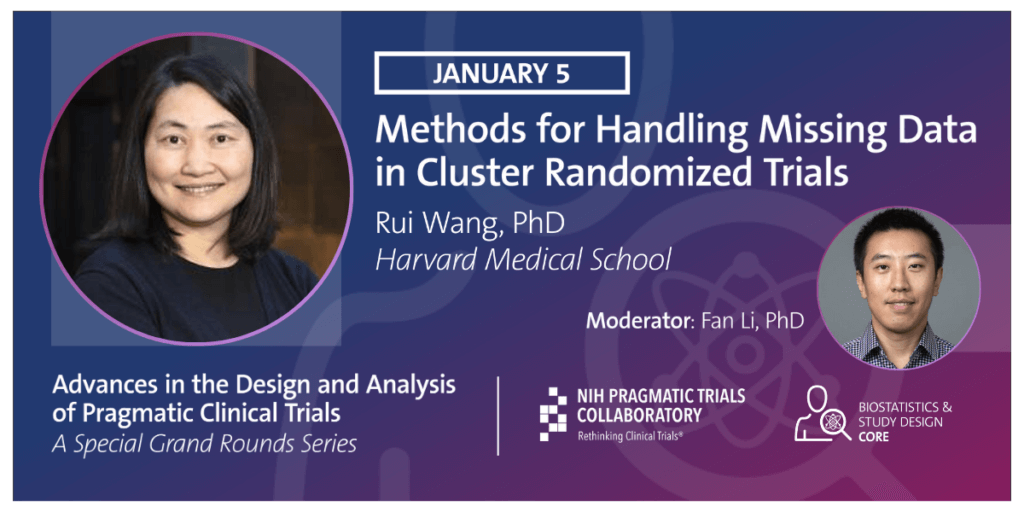
In this Friday's PCT Grand Rounds, Rui Wang of Harvard Medical School will offer the final session in our special series, Advances in the Design and Analysis of Pragmatic Clinical Trials, with "Methods for Handling Missing Data in Cluster Randomized Trials." The session will be held on Friday, January 5, at 1:00 pm eastern.
Wang is an associate professor of population medicine and the director of the Division of Biostatistics in the Department of Population Medicine at Harvard Medical School and the Harvard Pilgrim Health Care Institute. She is also an associate professor in the Department of Biostatistics at the Harvard T.H. Chan School of Public Health. She is a longtime member of the NIH Pragmatic Trials Collaboratory's Biostatistics and Study Design Core Working Group.

This session's moderator, Fan Li, is an assistant professor of biostatistics at the Yale School of Public Health.

Join the online meeting.

This special Grand Rounds series includes moderated webinar discussions that bring together biostatisticians, clinical trials methodologists, and investigators to discuss challenges and share lessons learned in the design, implementation, and analysis of pragmatic trials. Download the series flyer and see the full schedule below, including archived webinar recordings and slides from previous sessions.

All sessions are free and open to the public. No registration is required.

Grand Rounds Biostatistics Series January 5, 2024: Methods for Handling Missing Data in Cluster Randomized Trials (Rui Wang, PhD; Moderator: Fan Li, PhD)

Speaker: Rui Wang, PhD
Associate Professor of Population Medicine and Associate Professor in the Department of Biostatistics, Harvard Pilgrim Health Care Institute and Harvard Medical School

Moderator: Fan Li, PhD
Assistant Professor of Biostatistics, Yale School of Public Health

Topic: Methods for Handling Missing Data in Cluster Randomized Trials

Date: Friday, January 5, 2024, 1:00-2:00 p.m. ET

To join the online meeting:

Click the Zoom Meeting link below:
https://duke.zoom.us/j/95937444078?pwd=M3piOGp3M1RBOTZ2K1NhYzhQRVYwUT09
Meeting ID: 959 3744 4078
Passcode: 858655

One tap mobile

+13017158592,,95937444078#,,,,*858655# US (Washington DC)
+13052241968,,95937444078#,,,,*858655# US
Find your local number: https://duke.zoom.us/u/adyuALazNg

Audio Dial in Options

US:  1-305-224-1968
International: https://duke.zoom.us/u/abvw6X2hYV
Meeting ID: 959 3744 4078
Passcode: 858655

April 10, 2023: Li Receives New PCORI Award to Develop Causal Inference Methods for Stepped-Wedge Cluster Randomized Trials

Headshot of Dr. Fan Li
Dr. Fan Li

Dr. Fan Li, a member of the NIH Pragmatic Trials Collaboratory’s Biostatistics and Study Design Core since 2013, has received approval of a 3-year funding award from the Patient-Centered Outcomes Research Institute (PCORI) to develop causal inference methods for stepped-wedge cluster randomized trials—a design that has been increasingly adopted in pragmatic trials. Li is an assistant professor of biostatistics at the Yale School of Public Health.

The new study, entitled “Toward Improved Design and Analysis of Stepped Wedge Trials: An Estimand-Aligned and Efficiency-Focused Framework,” will contribute new methods and software for planning and analyzing stepped-wedge cluster randomized trials that enable investigators to (a) target transparent causal estimands under the counterfactual outcomes framework and (b) to leverage baseline information for achieving higher statistical efficiency.

This is Li’s second PCORI award. Read a summary of his previous PCORI award.

An estimand is a precise description of the treatment effect reflecting the scientific question, and is ideally a model-free concept. The research team will contribute weighted average effect estimands to quantify treatment effect evidence by recognizing that unequal cluster sizes may contribute to variations of treatment effects in each cluster-period. In addition, pragmatic trials that adopt a stepped-wedge cluster randomized design frequently collect baseline data on the patient-centered outcomes and/or patient-level characteristics. The research team will study and operationalize estimand-aligned methods that effectively leverage such baseline variables through parametric regression and nonparametric machine learning methods.

Li has assembled a multidisciplinary team for this study, including Dr. Patrick Heagerty, professor of biostatistics at the University of Washington and a cochair of the NIH Collaboratory’s Biostatistics and Study Design Core. In addition, Drs. Jeffrey Jarvik, principal investigator of the NIH Collaboratory’s LIRE NIH Collaboratory Trial, and Douglas Zatzick, principal investigator of the TSOS NIH Collaboratory Trial, serve as stakeholders of the study. The stakeholder team also includes colleagues from the NIA IMPACT Collaboratory, Drs. Thomas Travison and Monica Taljaard.

Toward Causal Inference in Cluster Randomized Trials: Estimands and Reflection on Current Practice

Methods: Minds the Gap Webinar Series
“Toward Causal Inference in Cluster Randomized Trials: Estimands and Reflection on Current Practice”
Fan Li, PhD; Yale School of Public Health
National Institutes of Health, Office of Disease Prevention

Cluster randomized trials (CRTs) involve randomizing groups of individuals to different interventions. While model-based methods are extensively studied for analyzing CRTs, there has been little reflection around the treatment effect estimands at the outset. In the first part of this presentation, we describe two relevant estimands that can be addressed through CRTs and point out that they can differ when the treatment effects vary according to cluster sizes. As a cautionary note, we demonstrate how choices between different analytic approaches can impact the interpretation of results by fundamentally changing the question being asked. In the second part, we revisit the linear mixed model as the most commonly used method for analyzing CRTs. The linear mixed model makes stringent assumptions, including normality, linearity, and typically a compound symmetric correlation structure, all of which may be challenging to verify. However, under certain conditions, we show that the linear mixed model consistently estimates the average causal effect under arbitrary misspecification of its working model. Under equal randomization, its model-based variance estimator, surprisingly, remains consistent under model misspecification, justifying the use of confidence intervals output by standard software. These results hold under both simple and stratified randomization, and serve as an important causal inference justification for linear mixed models. Caveats and extensions of our findings will also be mentioned.

For more information, visit https://prevention.nih.gov/education-training/methods-mind-gap/toward-causal-inference-cluster-randomized-trials-estimands-and-reflection-current-practice.

August 26, 2021: Li Receives PCORI Award to Study Methods for Cluster Randomized Trials

Headshot of Dr. Fan Li
Dr. Fan Li

Dr. Fan Li, a longtime member of the NIH Collaboratory’s Biostatistics and Study Design Core, has received approval for a $1 million grant award from the Patient-Centered Outcomes Research Institute (PCORI) to develop methods and software for designing cluster randomized trials. Li is an assistant professor of biostatistics in the Yale School of Public Health.

The study, entitled “New Methods for Planning Cluster Randomized Trials to Detect Treatment Effect Heterogeneity,” will contribute new methods, guidance, and user-friendly software for planning parallel and stepped-wedge cluster randomized trials to enable confirmatory “heterogeneity of treatment effect” (HTE) analyses with sufficient statistical power.

HTE occurs when there is systematic variation in treatment effect across predefined patient or provider subgroups that can arise due to diverse practices, varying responses to treatment, or differing vulnerability to certain diseases, among other reasons. While understanding of HTE has been a recognized goal in individually randomized trials, methods for planning cluster randomized trials with HTE analyses are limited. This PCORI-funded study will expand the current cluster randomized design toolbox to accommodate confirmatory HTE analysis and meet a growing interest in better understanding how patient- and provider-level characteristics moderate the impact of new care innovations in pragmatic trials.

The award has been approved pending completion of a business and programmatic review by PCORI staff and issuance of a formal award contract.

Joining Li on the research team are coinvestigators Dr. Patrick Heagerty of the University of Washington, Dr. Rui Wang of Harvard Medical School and the Harvard Pilgrim Health Care Institute, and Dr. Denise Esserman of the Yale School of Public Health. Heagerty and Wang are members of the NIH Collaboratory’s Biostatistics and Study Design Core. The team will work closely with other NIH Collaboratory colleagues and stakeholders, including Dr. Adrian Hernandez of Duke University, Dr. Jerry Jarvik of the University of Washington, and Dr. Richard Platt of Harvard Medical School and the Harvard Pilgrim Health Care Institute.