Grand Rounds April 1: ICD-Pieces: Improving Care for CKD, Diabetes and Hypertension in Health Systems (Miguel A. Vazquez, MD; George (Holt) Oliver, MD, PhD)

Speakers:

Miguel A. Vazquez, MD
Professor of Medicine
University of Texas Southwestern Medical Center
Dallas, TX

George (Holt) Oliver, MD, PhD
Vice President Clinical Informatics
Parkland Center for Clinical Innovation
Dallas, TX


Topic: ICD-Pieces: Improving Care for CKD, Diabetes and Hypertension in Health Systems

Date: Friday, April 1, 2022, 1:00-2:00 p.m. ET

Meeting Info: To check whether you have the appropriate players installed for UCF (Universal Communications Format) rich media files, go to https://dukemed.webex.com/dukemed/systemdiagnosis.php.

To join the online meeting:
Go to https://dukemed.webex.com/dukemed/j.php?MTID=m4c6e3e4827442a92338a5649cee613e6

Click ‘Connect to Audio”
Choose ‘Computer Audio’ or ‘I will call in’.
If using the ‘call in option’, follow the information from the dialog box that appears.
Be certain to use the Access Code AND the Attendee ID.

Troubleshooting:
If the URL above does not work, go to dukemed.webex.com and enter:
Meeting Number: 2622 682 0537
Meeting Password: 12345

For Audio ONLY:
Call-in toll number (US/Canada): 1-650-479-3207
Access code: 2622 682 0537

NOTE: For Toll-free users, the call-back (call me) services are also available.
March 22, 2022: AHRQ Publishes Hospital Infection Prevention Toolkit Based on ABATE Infection Trial

ABATE Infection logoThe Agency for Healthcare Research and Quality (AHRQ) published a new Toolkit for Decolonization of Non-ICU Patients With Devices to help clinical teams implement a protocol to reduce bloodstream infections by approximately 30% in patients with specific medical devices.

The new toolkit is based on intervention materials successfully used in the ABATE Infection trial, one of the first NIH Collaboratory Trials of the NIH Pragmatic Trials Collaboratory. ABATE Infection was a large-scale pragmatic trial involving approximately 189,000 patients in the baseline period and 340,000 patients in the intervention period across 194 non–critical care units in 53 hospitals.

From the AHRQ announcement:

The free, customizable toolkit includes step-by-step instructions, handouts, and educational videos to show frontline teams how to apply a decolonization protocol for non-ICU patients who may be at greater risk of bloodstream infections because they have certain devices, such as central venous catheters. The decolonization protocol includes instructions on helping patients bathe with an antiseptic soap and applying a nasal antibiotic ointment to carriers of Methicillin-resistant Staphylococcus aureus (MRSA).

ABATE Infection was supported within the NIH Pragmatic Trials Collaboratory by a cooperative agreement from the National Institute of Allergy and Infectious Diseases and by the NIH Common Fund through a cooperative agreement from the Office of Strategic Coordination within the Office of the NIH Director. Learn more about ABATE Infection.

March 1, 2022: BeatPain Utah Has New Study Snapshot, Updated Ethics and Regulatory Documentation

BeatPain Utah logoA downloadable study snapshot and updated ethics and regulatory documentation are now available for BeatPain Utah, an NIH Pragmatic Trials Collaboratory Trial.

BeatPain Utah recently transitioned from the planning phase to the implementation phase. As part of the transition, the study team reviewed and updated the minutes of their initial ethics and regulatory consultation with the Ethics and Regulatory Core. The project is studying real-world implementation of a telehealth physical therapy strategy for patients with chronic back pain in primary care clinics of federally qualified health centers.

  • Also available is a new study snapshot for BeatPain Utah. This downloadable handout summarizes the study’s aims, lessons from the planning phase, and links to other resources from this innovative pragmatic clinical trial.

BeatPain Utah is supported by the NIH through the NIH Heal Initiative under an award from the National Institute of Nursing Research.

January 21, 2022: Primary Palliative Care for Emergency Medicine (Corita R. Grudzen, MD, MSHS, FACEP)

Speaker

Corita R. Grudzen, MD, MSHS, FACEP
Professor, Emergency Medicine and Population Health
Associate Dean, Clinical Sciences
Deputy Director, Clinical and Translational Science Institute
Vice Chair for Research, Emergency Medicine
Ronald O. Perelman Department of Emergency Medicine
NYU Grossman School of Medicine

Keywords

Palliative Care; Stepped-Wedge study design; Emergency Department (ED); Gagne Index; PRIM-ER


Key Points

  • The Emergency Department is increasingly seeing older adults with serious illness rather than patients with acute trauma.
  • Primary Palliative Care for Emergency Medicine (PRIM-ER) is a stepped-wedge study partnership of 18 health systems in 33 EDs designed to change the culture and norms of emergency care to promote palliative care at home or hospice rather than admittance to the hospital.
  • The study used the Gagne Index greater than 6 to identify patients at high risk of short-term mortality. Patients with dementia did not need to meet the Gagne Index criteria to be included in the study.
  • A baseline survey, training of 2,470 emergency providers, and study intervention has been completed at all 33 sites.
  • Only .2% of ED patients in the study were admitted to hospice after their ED visit.  At 12 months post ED visit, 30% of dementia patients had died whereas 15.6% of the non-dementia chronic disease patients had died. Data analysis is ongoing.

Discussion Themes

Stepped-wedge studies present timing issues and COVID-19 increased these problems. A cluster randomized design may have been easier to implement.


The PRIM-ER study was considered quality improvement by the IRB, so no human subjects approval from the IRB was required.


The PRIM-ER next step will be developing tools for patients with dementia regarding palliative care in the ED.


Learn more about the PRIM-ER study.


Tags

#pctGR, @Collaboratory1

January 19, 2022: PCT Grand Rounds Will Feature PRIM-ER Study of Primary Palliative Care in Emergency Medicine

Headshot of Dr. Corita Grudzen
Dr. Corita Grudzen, principal investigator of PRIM-ER

In this Friday’s PCT Grand Rounds, the principal investigator of PRIM-ER, an NIH Collaboratory Trial, will share an update on the implementation of this innovative pragmatic clinical trial.

Principal investigator Dr. Corita Grudzen of the NYU Grossman School of Medicine will present “Primary Palliative Care for Emergency Medicine.” The Grand Rounds session will be held on Friday, January 21, at 1:00 pm eastern.

PRIM-ER, or the Primary Palliative Care for Emergency Medicine study, is a cluster randomized pragmatic trial of a multidisciplinary primary palliative care intervention that consists of education, clinical decision support, and other elements in a diverse mix of emergency departments in the United States. The intervention is intended to improve the delivery of goal-directed emergency care of older adults.

Join the online meeting.

PRIM-ER is supported within the NIH Collaboratory by a cooperative agreement from the National Institute on Aging.

January 18, 2022: Documentation Available From Ethics and Regulatory Consultation With IMPACt-LBP NIH Collaboratory Trial

NIH Pragmatic Trials Collaboratory logo

Meeting minutes and supplementary materials summarizing a recent discussion of ethics and regulatory issues associated with the new IMPACt-LBP NIH Collaboratory Trial are now available. The consultation took place by video conference and included representation from the study’s principal investigators and project manager, members of the NIH Collaboratory’s Ethics and Regulatory Core, NIH staff, and NIH Collaboratory Coordinating Center personnel.

IMPACt-LBP is a 2-arm cluster randomized trial that will evaluate the effect of first-contact patient referral to physical therapists and doctors of chiropractic for patients with low back pain. The study aims to determine if initial contact with these clinicians will improve physical function and decrease pain, among other outcomes, in patients with a primary complaint of low back pain, when compared with usual medical care. Read more about IMPACt-LBP.

Ethics and regulatory documentation for all of the NIH Collaboratory Trials is available on our Data and Resource Sharing page.

December 13, 2021: BeatPain Utah and GRACE Begin Enrollment in Studies of Nonpharmacologic Pain Management

Headshot of Dr. Julie Fritz
Dr. Julie Fritz, BeatPain Utah

The BeatPain Utah study and the GRACE trial have begun enrollment of study participants. Both projects were awarded continuation into the UH3 implementation phase in the summer. The studies make up the second cohort of NIH Collaboratory Trials to be supported through the NIH HEAL Initiative’s PRISM program.

Congratulations to both study teams for reaching this important project milestone!

BeatPain Utah is studying real-world implementation of a telehealth physical therapy strategy for patients with chronic back pain in primary care clinics of federally qualified health centers. Learn more about BeatPain Utah in this interview with principal investigator Dr. Julie Fritz. BeatPain Utah is supported by the NIH through the NIH Heal Initiative under an award from the National Institute of Nursing Research.

The GRACE trial is studying real-world implementation of acupuncture and guided relaxation for patients with pain associated with sickle cell disease. Learn more about GRACE in this interview with co–principal investigator Dr. Robert Molokie. GRACE is supported by the NIH through the NIH HEAL Initiative under an award from the National Center for Complementary and Integrative Health.

Combined headshots of Drs. Ardith Doorenbos, Judith Schlaeger, Robert Molokie, Miriam Ezenwa, and Nirmish Shah
GRACE co–principal investigators Drs. Ardith Doorenbos, Judith Schlaeger, Robert Molokie, Miriam Ezenwa, and Nirmish Shah

The PRISM projects—Pragmatic and Implementation Studies for the Management of Pain to Reduce Opioid Prescribing—are studying the real-world effectiveness of nonpharmacologic interventions for pain and assessing the implementation of these interventions to improve pain management and reduce reliance on opioids. The NIH Collaboratory Coordinating Center serves as the PRISM Resource Coordinating Center.

December 3, 2021: Primary Care-Based Behavioral Treatment for Long Term Opioid Users with Chronic Pain: Primary Results and Lessons Learned from the PPACT Pragmatic Trial (Lynn DeBar, PhD MPH)

Speaker

Lynn DeBar, PhD MPH
Senior Scientist
Kaiser Permanente Washington Health Research Institute
Seattle, WA

Keywords

PPACT, Chronic pain, Opioid use, Patient reported outcome data, Patient-centered research, Cognitive behavioral therapy

Key Points

  • Chronic Pain is responsible for far more years lived with disability than a large number of other diseases and injuries, such as COPD, diabetes, dementia, stroke and others, combined.
  • PPACT was a cluster randomized study aimed at integrating interdisciplinary pain management methods into primary care to improve care for patients with chronic pain.
  • Participants had been prescribed long-term opioids for mixed chronic pain conditions.
  • Study intervention lasted 12 weeks and included cognitive behavioral therapy, yoga-based exercises, physical therapy, a medication review, and support from a primary care provider.
  • Participants in the treatment group of the PPACT study showed a modest reduction of pain that was sustained over a 12 month period.
  • The PPACT intervention was cost effective versus usual treatment methods.

Discussion Themes

An in-person enhanced enrollment session was conducted to give potential subjects a comprehensive overview of the study procedures. This enrollment session led to fewer people enrolling in the study, but of those that did, more completed the study.

The key to successful CBT is an interactive patient-centered approach.


Read more about the PPACT study.


Tags

#pctGR, @Collaboratory1

December 1, 2021: PCT Grand Rounds to Highlight Primary Results of PPACT Study

Head shot of Dr. Lynn DeBar
Dr. Lynn DeBar, principal investigator of PPACT

In this Friday’s PCT Grand Rounds, the principal investigator of the PPACT study, an NIH Collaboratory Trial, will announce the study’s primary results.

Principal investigator Dr. Lynn DeBar of the Kaiser Permanente Washington Health Research Institute, will present “Primary Care-Based Behavioral Treatment for Long Term Opioid Users With Chronic Pain: Primary Results and Lessons Learned From the PPACT Pragmatic Trial.” The Grand Rounds session will be held on Friday, December 3, at 1:00 pm eastern.

PPACT, or the Collaborative Care for Chronic Pain in Primary Care study, was a pragmatic, cluster randomized trial that enrolled 850 patients who were receiving long-term opioid therapy for chronic pain. Patients in the intervention group participated in weekly group sessions that taught a variety of pain self-management techniques. The strategy was compared with usual care.

Join the online meeting.

PPACT was supported within the NIH Collaboratory by the NIH Common Fund and by cooperative agreements from the National Institute of Neurological Disorders and Stroke.

November 9, 2021: PPACT Study Finds Benefits of Cognitive Behavioral Therapy in Reducing Chronic Pain and Pain-Related Disability

Photo of Dr. Lynn DeBar
Dr. Lynn DeBar, principal investigator of PPACT

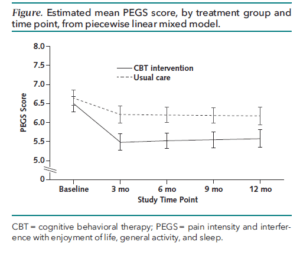
Patients who participated in a cognitive behavioral therapy (CBT) intervention as part of their regular care for chronic pain showed improved function and reduced pain compared to standard treatment, according to the results of the Pain Program for Active Coping and Training (PPACT) study. Although CBT did not reduce opioid use, patients who participated in a 12-week course on pain self-management led by primary care providers showed modest but sustained benefits that persisted for 12 months after the intervention.

Study results were published this month in the Annals of Internal Medicine.

The PPACT study, an NIH Collaboratory Trial, was a pragmatic, cluster randomized trial that enrolled 850 patients receiving long-term opioid therapy for chronic pain. Patients in the intervention group participated in 12 weekly, 90-minute group sessions that taught skills of muscle relaxation, guided imagery, cognitive restructuring, and yoga-based adapted movement. Patients in the usual care group continued to receive pharmacologic and nonpharmacologic treatment.

Figure from PPACT main outcomes paper
Source: Annals of Internal Medicine 2021 Nov 2. doi: 10.7326/M21-1436

Patients were followed for 12 months with primary outcome measures of pain impact on enjoyment of life, activity levels, and sleep. Researchers also assessed secondary outcome measures of pain-related disability and opioid use.

Compared to usual care, the CBT intervention reduced self-reported pain and pain-related disability and increased satisfaction with primary healthcare providers. Opioid use and dose remained the same in both the intervention group and the usual care group.

PPACT was supported within the NIH Collaboratory by the NIH Common Fund, the National Center for Complementary and Integrative Health (NCCIH), and the National Institute of Neurological Disorders and Stroke (NINDS). Learn more about the NIH Collaboratory Trials.