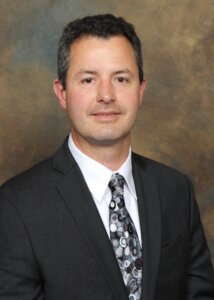
In the latest episode of the NIH Collaboratory Grand Rounds podcast, Dr. Christopher Lindsell and Dr. Adrian Hernandez continue the discussion about research outcomes and the importance of understanding stakeholder perspectives in choosing the correct outcomes for outpatient trials.
Christopher Lindsell, PhD
Professor of Biostatistics and Biomedical Informatics
Director, Vanderbilt Institute for Clinical and Translational Research (VICTR) Methods Program
Codirector, Vanderbilt Health Data Science (HEADS) Center
Topic
Searching for a Unicorn: Understanding Stakeholder Perspectives When Selecting Outcomes for Outpatient Trials
Keywords
Research outcome; Outpatient clinical trials; Patient-reported outcomes; Researcher-observed outcomes; Pragmatic trials; ACTIV-6; Days of benefit; Mean time unwell
Key Points
A research outcome is the main piece of data used to decide if the research intervention has failed or succeeded.
If the incorrect outcome is chosen, the question of whether the intervention has succeeded can’t be answered accurately. Finding the correct outcome requires asking the question ‘What matters?’
In studies that are designed to help you feel better faster, we may need to prioritize symptoms and signs (patient reported outcomes) over objective measures (researcher observed outcomes).
Outcomes should be chosen based on the purpose of the study.
Researchers need to balance sensitivity and specificity when choosing an outcome measure.
The ACTIV-6 study uses an overall symptom outcome scale to determine if patients ‘feel better faster.’
ACTIV-6 uses Days of Benefit and Time to Recovery/hospitalization and death as an outcome to determine if the intervention is successful.
Discussion Themes
It’s important to strive to complete the most powerful and efficient studies that we can do.
Having multiple medicines available that balance risk and benefit differently gives patients options for their treatment. Individual patients have differing levels of risk tolerance and different ideas about what is the most beneficial outcome.
Adrian F. Hernandez, MD, MHS
Executive Director, Duke Clinical Research Institute
Vice Dean, Duke University School of Medicine
Topic
Decentralized Trials: Naughty or Nice?
Keywords
Decentralized trials; Study design; Implementation; Patient engagement; Patient-reported data
Key Points
Decentralized trials have been occurring since the start of the internet and mobile devices to reach people where they are and collect data in places we were not able to in the past.
One key problem decentralized trials can help solve is the gap between those who wish to participate in research and those who actually do participate. Clinical trial deserts and lack of broadband widen the gap between those who wish to participate and those who are able.
Decentralized trials attempt to capture data remotely instead of at a site and virtually(patient-reported) rather than recorded by study personnel.
COVID-19 flipped the model for clinical trial visits from that of site-based visits and care to home based, virtual visits and care.
Enrollment can be a challenge for decentralized trials and requires engagement campaigns at various timepoints in the study to achieve desired enrollment numbers.
Decentralized trials can help ensure inclusion of diverse communities in your study population.
The HeartLine study, CHIEF-HF study, HERO-Together study, and ACTIV-6 study are taking advantage of various technologies to decentralize study design.
Discussion Themes
Decentralized methods may improve recruitment, but may not improve retention. We may need a hybrid model to keep a patient engaged.
Decentralized methods may require decisions about what data we should collect and what we could collect, but don’t need.
Chronic Pain is responsible for far more years lived with disability than a large number of other diseases and injuries, such as COPD, diabetes, dementia, stroke and others, combined.
PPACT was a cluster randomized study aimed at integrating interdisciplinary pain management methods into primary care to improve care for patients with chronic pain.
Participants had been prescribed long-term opioids for mixed chronic pain conditions.
Study intervention lasted 12 weeks and included cognitive behavioral therapy, yoga-based exercises, physical therapy, a medication review, and support from a primary care provider.
Participants in the treatment group of the PPACT study showed a modest reduction of pain that was sustained over a 12 month period.
The PPACT intervention was cost effective versus usual treatment methods.
Discussion Themes
An in-person enhanced enrollment session was conducted to give potential subjects a comprehensive overview of the study procedures. This enrollment session led to fewer people enrolling in the study, but of those that did, more completed the study.
The key to successful CBT is an interactive patient-centered approach.
Anish K. Agarwal MD, MPH MS
Assistant Professor of Emergency Medicine
Clinical Innovation Manager, Penn Medicine Center for Health Care Innovation
University of Pennsylvania, Perelman School of Medicine
Topic
Exploring Approaches in Using Digital and Mobile Health in Patient-oriented Research: Pearls and Pitfalls
Keywords
Mobile health; Digital health; Patient-oriented research; Study design
Key Points
Digital and mobile health is a rapidly evolving field that integrates with the electronic health records in both low and high tech ways.
Dr. Agarwal conducted a randomized control trial of overweight veterans who had daily access to a smartphone or tablet. These participants were sent a wearable device to collect step count data.
An important consideration for studies using mobile health technology is participant access to a smart or mobile device. 85% of Americans have access to a Smartphone where 97% have access to a mobile device that can receive texts. 20% use a smartwatch.
Mobile methods are just tools to support overall study design.
Dr. Agrawal conducted a study on post-operative opioid prescribing and use. Data was gathered from participants via text messaging systems.
Simple text messages that are more conversational in nature are received better by the participant. Links in text messages should be limited. It’s important for participants to understand the privacy and security of their communications and data. Nudge a participant with a text at the right time to avoid being overbearing.
Discussion Themes
Let patients know that SMS is not secure, and frame questions to avoid patients sending HIPAA covered data via text.
A good relationship with your institutions Privacy and Safety office is fundamental to navigating IRB regulations for research with digital and mobile devices.
James C Grotta, MD
Director Stroke Research and Mobile Stroke Unit
Memorial Hermann Hospital-Texas Medical Center
Houston, Texas
Topic
Benefits of Stroke Treatment Delivered Using a Mobile Stroke Unit Compared to Standard Management by Emergency Medical Services: The BEST-MSU Study
Keywords
Stroke; BEST-MSU study; Mobile Stroke Unit; Patient-centered outcome; tPA
Key Points
We can improve stroke outcomes by giving tPA in the first hour after stroke onset, but to do this, we have to bring the treatment to the patient.
The Mobile Stroke Unit (MSU) is an ambulance equipped with a CT scanner and other medical care equipment necessary to treat stroke.
The BEST-MSU Study was a partially randomized trial that examined outcomes of patients who were treated by the MSU versus in the hospital emergency department.
The BEST-MSU study compared the diagnosis of telemedicine and onboard neurologists, and they agreed that the patient was having a stroke 88% of the time, which is the same as the agreement rate of two neurologists in the hospital setting.
For every 100 patients treated with the MSU rather than the standard medical practice in a hospital emergency setting, 27 will have less final disability and 11 more will be disability-free.
Discussion Themes
Consent to deliver treatment wasn’t necessary in this case because the treatment delivered was the standard of care. Consent to use the patient’s data was obtained in the emergency department after the patient had stabilized. Very few patients refused to consent.
Implementation of the MSU with the local fire departments was straight forward, but the politics of the area served was a challenge for implementation.
One barrier to treating stroke quickly with the MSU is the patient’s hesitancy to call 911. Calling emergency services needs to be made less threatening and less expensive to promote better patient outcomes.
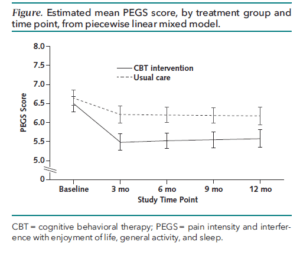
Patients who participated in a cognitive behavioral therapy (CBT) intervention as part of their regular care for chronic pain showed improved function and reduced pain compared to standard treatment, according to the results of the Pain Program for Active Coping and Training (PPACT) study. Although CBT did not reduce opioid use, patients who participated in a 12-week course on pain self-management led by primary care providers showed modest but sustained benefits that persisted for 12 months after the intervention.
The PPACT study, an NIH Collaboratory Trial, was a pragmatic, cluster randomized trial that enrolled 850 patients receiving long-term opioid therapy for chronic pain. Patients in the intervention group participated in 12 weekly, 90-minute group sessions that taught skills of muscle relaxation, guided imagery, cognitive restructuring, and yoga-based adapted movement. Patients in the usual care group continued to receive pharmacologic and nonpharmacologic treatment.
Source: Annals of Internal Medicine 2021 Nov 2. doi: 10.7326/M21-1436
Patients were followed for 12 months with primary outcome measures of pain impact on enjoyment of life, activity levels, and sleep. Researchers also assessed secondary outcome measures of pain-related disability and opioid use.
Compared to usual care, the CBT intervention reduced self-reported pain and pain-related disability and increased satisfaction with primary healthcare providers. Opioid use and dose remained the same in both the intervention group and the usual care group.
PPACT was supported within the NIH Collaboratory by the NIH Common Fund, the National Center for Complementary and Integrative Health (NCCIH), and the National Institute of Neurological Disorders and Stroke (NINDS). Learn more about the NIH Collaboratory Trials.
Patient-reported outcome scores have value and bring different measures of outcome, such as quality of life and burden of treatment into focus in a study.
PROMs, or Patient Reported Outcome Measures, are not routinely collected in clinical care so they are not readily available in the electronic health record.
Challenges of integrating PROMs into clinical trials include the culture of the health care system, budget, time, missing information, and unclear or uncertain interpretation of scores.
Modern Validity Theory refers to the validity of the interpretation of test scores for the proposed use of the test, not the validity of the score itself.
A repository for validity arguments may help avoid redundant research and provide examples of successful validity arguments.
Discussion Themes
How do we educate regulators and researchers about interpreting validity arguments?
Validating PROMs to ensure they are appropriate for use across different cultures and population groups requires historical evidence across many different validity arguments.
PROMs offered in different formats receive better response rates.
Survivor Corps is a 170,000 member grassroots organization founded in 2020 to support and educate people with COVID-19 and those who continue to experience long-lasting symptoms of COVID-19.
People who experience long-term, after-effects of COVID-19 report feeling alone and desperate due to the difficult and dissatisfying medical care they receive and their medical provider’s lack of knowledge about long-term COVID.
Long-term COVID patients want to be heard and believed by medical professionals who are thorough in their examination and testing methods.
Survivor Corps advocates for crucial research to be done on the symptoms that cause the most human pain and suffering, and not just the symptoms that are experienced most frequently.
COVID-19 research can be done at a faster pace if we engage citizen-scientists and quickly release NIH research funding.
The life-or-death struggles of people with long-term COVID illustrate the need to treat this condition as an emergency medical situation—the same as we would treat an acute case of COVID-19.
Discussion Themes
The CDC guidelines are the first-step, interim guidance; however, no treatment options have been offered. Another iteration of these guidelines needs to be released soon.
We know from people who have experienced long-lasting effects of COVID-19 that the condition can be debilitating and devastating—patients are in urgent need of understanding and help.
Medical professionals should focus on real-word evidence to develop patient-centered outcomes.
Speakers:
Theresa Coles, PhD Assistant Professor
Department of Population Health Sciences
Duke University School of Medicine
Kevin Weinfurt, PhD Professor and Vice Chair of Research
Department of Population Health Sciences
Duke University School of Medicine
Topic: Enabling Patient-Reported Outcome Measures in Clinical Trials, Exemplified by Cardiovascular Trials
Date: Friday, September 24, 2021, 1:00-2:00 p.m. ET
Click ‘Connect to Audio”
Choose ‘Computer Audio’ or ‘I will call in’.
If using the ‘call in option’, follow the information from the dialog box that appears.
Be certain to use the Access Code AND the Attendee ID.
Troubleshooting:
If the URL above does not work, go to dukemed.webex.com and enter:
Meeting Number: 2622 682 0537
Meeting Password: 12345
For Audio ONLY:
Call-in toll number (US/Canada): 1-650-479-3207
Access code: 2622 682 0537
NOTE: For Toll-free users, the call-back (call me) services are also available.


 In the latest episode of the NIH Collaboratory Grand Rounds podcast, Dr. Christopher Lindsell and Dr. Adrian Hernandez continue the discussion about research outcomes and the importance of understanding stakeholder perspectives in choosing the correct outcomes for outpatient trials.