August 16, 2023: In This Friday’s PCT Grand Rounds, the Draft Revision of the ICH Good Clinical Practice Guideline

Headshots of Martin Landray, Khair ElZarrad, and Adrian Hernandez
From left: Martin Landray, Khair ElZarrad, and Adrian Hernandez

In this Friday’s PCT Grand Rounds, Martin Landray of the University of Oxford, Khair ElZarrad of the US Food and Drug Administration, and Adrian Hernandez of Duke University will present “Opportunities to Improve Clinical Trials: Draft Revision of the ICH Good Clinical Practice Guideline (E6[R3]).”

The Grand Rounds session will be held on Friday, August 18, 2023, at 1:00 pm eastern.

Landry is a professor of medicine and epidemiology at Oxford Population Health and deputy director of the University of Oxford’s Big Data Institute. ElZarrad is the director of the Office of Medical Policy in the FDA’s Center for Drug Evaluation and Research. Hernandez is a professor of medicine and vice dean of the Duke University School of Medicine and director of the Duke Clinical Research Institute, where he serves as co–principal investigator of the NIH Pragmatic Trials Collaboratory Coordinating Center.

Join the online meeting.

July 13, 2023: Adrian Hernandez Shares Insights Into Driving Change to Promote Data Sharing

Headshot of Dr. Adrian Hernandez
Dr. Adrian Hernandez

At the NIH Pragmatic Trials Collaboratory Steering Committee Meeting in May, we interviewed Dr. Adrian Hernandez about how to better promote data sharing. Hernandez is a co–principal investigator of the program’s Coordinating Center and the executive director of the Duke Clinical Research Institute.

“We have to change the incentive structure because we still have barriers for sharing data. It’s not being done as often as we need it to be, especially with healthcare system trials,” Hernandez said.

Data sharing is important because it increases transparency, reproducibility, and secondary uses of medical research and is good for society. It also has to potential to advance public health, maximize investment, accelerate learning, and foster collaboration.

One of the first steps to improving data sharing is to increase patient understanding and encourage participation.

People are unaware of what’s possible for reusing data—generating new ideas, tackling different health issues that have not been addressed. People don’t realize that their data can have an expansive use.

The incentives for data sharing are different for researchers, clinicians, and healthcare system leaders.

“For researchers, data sharing efforts could be more readily recognized by linking data sets to [digital object identifiers] in publications. Reuse of data can also be part of recognition for promotion and tenure,” Hernandez said. “For healthcare systems to be more engaged in data sharing, they can promote that they are trying to advance knowledge through research activities and by sharing data.”

The barriers to sharing data include lack of trust and the possibility of misuse.

“People get worried about their data being monetized without their permission, and there are concerns about privacy and being re-identified, and that this somehow will cause harm to people individually,” Hernandez said. He noted that the ethical responsibility to share data generated by publicly funded research must be balanced against the need to protect patient privacy and scientific integrity.

For more information, see the article on data sharing and embedded research in the Annals of Internal Medicine, in which authors from the NIH Collaboratory suggest that data sharing policies must not dissuade healthcare system participation. There is also a Living Textbook chapter on Data Sharing and Embedded Research.

In the days ahead, we will share more interviews with program leaders from the 2023 Steering Committee meeting. All of the materials from the 2023 Steering Committee meeting are now available.

June 28, 2023: In This Week’s PCT Grand Rounds, What’s Left for Decentralized Clinical Trials?

Headshots of Adrian Hernandez, Pamela Tenaerts, and Craig LipsetIn this Friday’s PCT Grand Rounds, Adrian Hernandez, Pamela Tenaerts, and Craig Lipset will present “Decentralized Trials – From Guidance to Reality & What’s Left.”

The Grand Rounds session will be held on Friday, June 30, 2023, at 1:00 pm eastern.

Dr. Hernandez is a professor of medicine and director of the Duke Clinical Research Institute at Duke University; he is a co–principal investigator of the NIH Pragmatic Trials Collaboratory Coordinating Center. Dr. Tenaerts is the chief scientific officer of Medable, a cloud computing platform for decentralized clinical trials. Dr. Lipset is cochair of the Decentralized Trials & Research Alliance.

Join the online meeting.

May 12, 2022: Current and Past Leaders of NIH Pragmatic Trials Collaboratory Reflect on the Past, Present, and Future

In an interview at the Steering Committee’s annual meeting in April, Dr. Wendy Weber, Dr. Josephine Briggs, and Dr. Catherine Meyers celebrate the success of the NIH Pragmatic Trials Collaboratory and look at the roadmap to its future.

In the Beginning…

The NIH Pragmatic Trials Collaboratory (then the NIH Health Care Systems Research Collaboratory) began as an NIH Common Fund–initiated program. According to Dr. Josephine Briggs, Director Emeritus of the National Center for Complementary and Integrative Health (NCCIH), the idea began with a recognition that “explanatory trials were often run in ways to demonstrate that an intervention worked with selected populations implemented in a very controlled environment… We really needed to test those interventional trials and see whether they really worked when generalized to a broader population likely to be using them to settings in which the intervention implementation wasn’t as tightly controlled.”

In 2012, the Common Fund awarded both the Coordinating Center and the first 7 NIH Collaboratory Trials (ABATE, BPMedTime, LIRE, PPACT, SPOT, STOP CRC, TiME).

The Present

In its first 10 years, the NIH Pragmatic Trials Collaboratory has supported 22 NIH Collaboratory Trials involving 38 investigators.
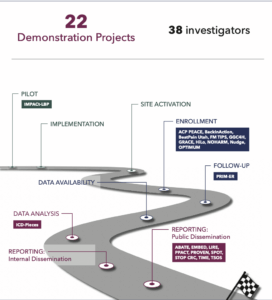
 

Road map

Dr. Cathy Meyers, Director Emeritus of the NCCIH Office of Clinical and Regulatory Affairs stated that “The Coordinating Center has really been a scribe throughout this last decade of recording problems and, more importantly, their solutions, and has even, with the last wave of solicitations for applications, incorporated training.”

Living Textbook VisitorsMuch of this content is housed in Rethinking Clinical Trials®: A Living Textbook of Pragmatic Clinical Trials, a free online textbook developed and maintained by the NIH Collaboratory. Drawing on experiences from the program’s NIH Collaboratory Trials and community of experts, the Living Textbook provides guidance on each step of a pragmatic trial, from study design through applying results in the real world. The Living Textbook is continually updated and expanded as new information emerges. This new knowledge is also disseminated through the NIH Collaboratory’s Knowledge Repository and weekly Grand Rounds series.

Looking to the future

“There are now 8 different partnering institutions and centers that support the NIH Pragmatic Trials Collaboratory, and we are open to more,” said Dr. Wendy Weber, NCCIH Project Officer for the NIH Collaboratory.

When asked what she is looking forward to in the future, Dr. Weber stated that “There is a unique opportunity to look at trials that address health disparities. How do we solve what we know is a problem in the healthcare system? How can we design interventions to improve that. We do so much research documenting how much disparity there is. Let’s do something to actually improve that.”

Towards this end, the NIH released a request for applications (RFA) for new NIH Collaboratory Trial grants that address health disparities.  The RFA for this funding opportunity encourages applications that focus on improving health outcomes in populations that experience health disparities, such as higher rates of disease or mortality compared with the general population. Applications are due June 17, 2022. Letters of intent are due 30 days prior (May 17, 2022).

We will be sharing more insights form the 2022 NIH Pragmatic Trials Steering Committee Meeting over the coming weeks. All meeting materials are available online.

View the full interview.

About the NIH Pragmatic Trials Collaboratory

The NIH Pragmatic Trials Collaboratory Coordinating Center consists of the Duke Clinical Research Institute, the Harvard Pilgrim Health Care Institute, the Kaiser Permanente Washington Health Research Institute, the Johns Hopkins Berman Institute of Bioethics, the University of Washington, and the University of Michigan. The program is supported by the National Institutes of Health (NIH) through cooperative agreement U24AT009676 from the Office of Strategic Coordination within the Office of the NIH Director. It is also supported by the NIH through the NIH HEAL Initiative under award number U24AT010961. The content is solely the responsibility of the authors and does not necessarily represent the official views of the NIH or its HEAL Initiative. To learn more about the program, visit rethinkingclinicaltrials.org.


May 10, 2022: Pragmatic Trials Learn From Disruption in the COVID-19 Pandemic

In an interview at the NIH Pragmatic Trials Collaboratory Steering Committee’s annual meeting in April, Dr. Emily O’Brien and Dr. Adrian Hernandez discussed challenges for pragmatic trials during the COVID-19 pandemic and lessons for the future of the healthcare system.

“We certainly did see some degree of disruption, but I was impressed by the flexibility in the ability to adapt that all of our NIH Collaboratory Trial teams showed,” said O’Brien. “Some of them mentioned the support of having the Cores and consultations with experts in real time to be able to make adjustments,” she said.

O’Brien is a an associate professor in population health sciences at Duke University and a cochair of the NIH Collaboratory’s Patient-Centered Outcomes Core. Hernandez, the executive director of the Duke Clinical Research Institute, is a co–principal investigator of the program’s Coordinating Center. View the full interview.

O’Brien and her colleagues at the NIH Collaboratory Coordinating Center conducted a brief survey about the impacts of the pandemic on the NIH Collaboratory Trials, such as challenges they encountered, solutions they implemented, and any new measures the study teams started using.

“The impacts on the NIH Collaboratory Trials [included] research staff being redeployed to COVID-19 studies or clinician-scientists moving into predominantly clinical care roles as opposed to research roles,” O’Brien explained. “The most obvious impact of those changes was delays across projects. It took longer to get things done, to enroll patients. That was felt pretty universally by our projects, although there were several projects that were further along, had enrollment mechanisms that were in place and already up and running that were less impacted by those delays,” she said.

Some study teams also reported a renewed commitment from their partnering healthcare systems to work together as they encountered challenges in trial implementation.

Hernandez added, “For many studies, we thought they would actually stop. And for traditional trials, that’s what happened. But for [the NIH Collaboratory Trials], since they’re closer, more embedded within healthcare systems, part of the delivery process, they were able to flex because by nature they have to for any environment that changes.”

When asked what the COVID-19 pandemic has taught about what is needed for the future, Hernandez said, “It’s not too different than, say, what we have with the Defense Production Act…. What we need is essentially the equivalent of that, a ‘Pandemic Response Production Act,’ so that healthcare systems can be organized, coordinated to generate evidence around what’s needed for the response.”

February 14, 2022: IMPACT Collaboratory Grand Rounds to Highlight First Decade of NIH Pragmatic Trials Collaboratory

Headshots of Dr. Adrian Hernandez, Dr. Lesley Curtis, and Dr. Kevin Weinfurt
Dr. Adrian Hernandez, Dr. Lesley Curtis, and Dr. Kevin Weinfurt

This week’s NIA IMPACT Collaboratory Grand Rounds session will highlight the first decade of the NIH Pragmatic Trials Collaboratory. The Grand Rounds session—“Lessons From the First Decade of the NIH Pragmatic Trials Collaboratory”—will be held on Thursday, February 17, at 12:00 pm eastern.

The co–principal investigators of the NIH Pragmatic Trials Collaboratory Coordinating Center at Duke University—Drs. Adrian Hernandez, Dr. Lesley Curtis, and Dr. Kevin Weinfurt—will share lessons from the network’s portfolio of NIH Collaboratory Trials and discuss priorities for future research.

The NIA IMPACT Collaboratory is supported by a grant from the National Institute on Aging. Its mission is to advance care for persons with dementia and their caregivers in real-world settings by building national capacity to conduct pragmatic clinical trials that test interventions embedded in healthcare systems.

December 8, 2021: PCT Grand Rounds Asks, ‘Decentralized Trials: Naughty or Nice?’

Head shot of Dr. Adrian Hernandez
Dr. Adrian Hernandez

In this Friday’s PCT Grand Rounds session, Dr. Adrian Hernandez of Duke University will present “Decentralized Trials: Naughty or Nice?”

Dr. Hernandez is a professor of medicine at Duke University and a co–principal investigator of the NIH Collaboratory Coordinating Center.

The Grand Rounds session will be held on Friday, December 10, at 1:00 pm eastern. Join the online meeting.

August 26, 2021: Li Receives PCORI Award to Study Methods for Cluster Randomized Trials

Headshot of Dr. Fan Li
Dr. Fan Li

Dr. Fan Li, a longtime member of the NIH Collaboratory’s Biostatistics and Study Design Core, has received approval for a $1 million grant award from the Patient-Centered Outcomes Research Institute (PCORI) to develop methods and software for designing cluster randomized trials. Li is an assistant professor of biostatistics in the Yale School of Public Health.

The study, entitled “New Methods for Planning Cluster Randomized Trials to Detect Treatment Effect Heterogeneity,” will contribute new methods, guidance, and user-friendly software for planning parallel and stepped-wedge cluster randomized trials to enable confirmatory “heterogeneity of treatment effect” (HTE) analyses with sufficient statistical power.

HTE occurs when there is systematic variation in treatment effect across predefined patient or provider subgroups that can arise due to diverse practices, varying responses to treatment, or differing vulnerability to certain diseases, among other reasons. While understanding of HTE has been a recognized goal in individually randomized trials, methods for planning cluster randomized trials with HTE analyses are limited. This PCORI-funded study will expand the current cluster randomized design toolbox to accommodate confirmatory HTE analysis and meet a growing interest in better understanding how patient- and provider-level characteristics moderate the impact of new care innovations in pragmatic trials.

The award has been approved pending completion of a business and programmatic review by PCORI staff and issuance of a formal award contract.

Joining Li on the research team are coinvestigators Dr. Patrick Heagerty of the University of Washington, Dr. Rui Wang of Harvard Medical School and the Harvard Pilgrim Health Care Institute, and Dr. Denise Esserman of the Yale School of Public Health. Heagerty and Wang are members of the NIH Collaboratory’s Biostatistics and Study Design Core. The team will work closely with other NIH Collaboratory colleagues and stakeholders, including Dr. Adrian Hernandez of Duke University, Dr. Jerry Jarvik of the University of Washington, and Dr. Richard Platt of Harvard Medical School and the Harvard Pilgrim Health Care Institute.