In a new episode of our Rethinking Clinical Trials Podcast, Drs. Angelo Volandes and James Tulsky speak with host Dr. Adrian Hernandez about the results of the ACP PEACE study.
ACP PEACE, an NIH Collaboratory Trial, was a stepped-wedge, cluster randomized trial testing the delivery of a video decision aid to older patients with advanced cancer together with goals-of-care communication skills training to oncology clinicians in 3 healthcare systems. The results of the study were published this month in JAMA Network Open.
The Grand Rounds session will be held on Friday, February 14, 2025, at 1:00 pm eastern.
ACP PEACE, an NIH Collaboratory Trial, is evaluating a comprehensive advance care planning program for older patients with advanced cancer that combines clinician communication skills training and patient video decision aids.
Volandes is a professor of medicine and the vice chair for research in the Department of Medicine at Dartmouth Health and the Geisel School of Medicine at Dartmouth. Tulsky is a professor of medicine at Harvard Medical School and the Poorvu Jaffe Chair of Supportive Oncology at the Dana-Farber Cancer Institute.
The Grand Rounds session will be held on Friday, March 4, at 1:00 pm eastern. Join the online meeting.
The NIH Pragmatic Trials Collaboratory Coordinating Center is using its popular Grand Rounds platform to share late-breaking research and promote resources in support of clinical researchers affected by the COVID-19 public health emergency.
For previous COVID-19 Grand Rounds, and more news and resources related to the COVID-19 public health emergency, see the COVID-19 Resources page.
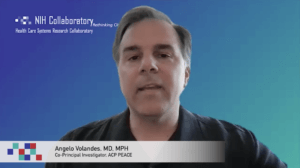
A supplemental grant to the ACP PEACE study team will test the ability of a telehealth program to improve rates of advance care planning among older patients in primary care in a large healthcare system. Dr. Angelo Volandes and Dr. James Tulsky discussed the new study in a Zoom-based interview after the NIH Collaboratory’s annual steering committee meeting.
Volandes said colleagues contacted him early in the COVID-19 pandemic because they felt unprepared to have conversations with patients and their caregivers about advance care planning in primary care. So, he wondered, “What If we could create a telehealth program where we trained clinicians to have these conversations and also empowered patients and caregivers to better understand their options when it came time to making decisions about serious illness like COVID-19?” Volandes is a physician at Brigham and Women’s Hospital and an associate professor of medicine at Harvard Medical School.
The new study will expand on ACP PEACE, an NIH Collaboratory Trial, which is testing implementation of an advance care planning program that combines clinician communication skills training and patient video decision aids. ACP PEACE is focused on patients with advanced cancer and their clinicians in oncology settings.
Both the new study and ACP PEACE will assess how advance care planning practices changed after the start of the COVID-19 pandemic. View the full video.
“The fact that we’re studying time periods before and after COVID…will help us see the extent to which advance care planning shifted during this time period and will help us understand better the results we see in the oncology community [and] what’s happening in the primary care community,” said Tulsky, a co–principal investigator for both studies. Tulsky is chief of psychosocial oncology and palliative care at the Dana-Farber Cancer Institute and a professor of medicine at Harvard Medical School.
Tulsky added that the study team will learn the value of implementing advance care planning over telehealth. Also, he said, “many of the conversations oncologists are planning for are quite late in the course of care, and this is much earlier, and so we’ll see if that makes a difference.”
“Advance care planning isn’t going to be something just for the purview of people with an advanced serious illness…but rather this is something that we all will need to talk about,” said Volandes. “So I really do think this is going to be a culture shift for healthcare more broadly, but also we’re going to see healthcare systems start prioritizing it beyond, say, patients with advanced serious illness to make it the new normal for everybody.”
ACP PEACE is supported within the NIH Collaboratory by a cooperative agreement from the National Institute on Aging and receives logistical and technical support from the NIH Collaboratory Coordinating Center.


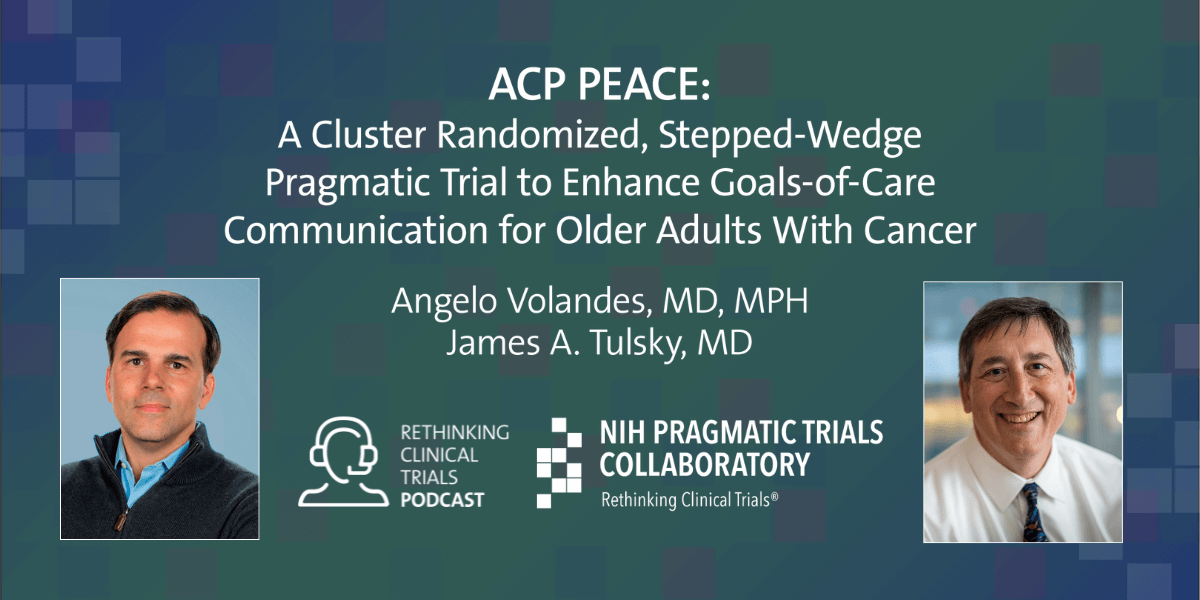 In a new episode of our Rethinking Clinical Trials Podcast, Drs. Angelo Volandes and James Tulsky speak with host Dr. Adrian Hernandez about the results of the ACP PEACE study.
 In this Friday’s PCT Grand Rounds, Angelo Volandes of Dartmouth Health and James Tulsky of Dana-Farber Cancer Institute will present