March 26, 2026: New Podcast Calls Attention to Underrecognized IRGT Trial Design

In a new episode of the NIH Collaboratory Podcast, Drs. Jonathan Moyer and David Murray discussed their recent publication, “Evaluating Analytic Models for Individually Randomized Group Treatment Trials With Complex Clustering in Nested and Crossed Designs.” The episode was moderated by Patrick Heagerty, co-chair of the Biostatistics and Study Design core working group.

Listen to the podcast. For alerts about new episodes, subscribe for free on Spotify, Amazon Music, Apple Podcasts, or SoundCloud.

Individually randomized group treatment trials, or IRGT trials, are those in which participants are randomized to conditions individually but receive the intervention in a group format, delivered by shared agents. Prior to randomization, the individual outcome measures are all independent; after randomization, individual outcomes become correlated over time due to interactions with shared agents or groups.

Moyer noted that the IRGT design is likely more common than investigators realize.

“John and I worked on a project reviewing all of the clinical trials newly supported or approved by NIH in [Fiscal Year] 2023. And of all of the trials that involved individual randomization, about half were IRGTs and about half were RCTs… Only a couple of those IRGT trails were recognized,” said Moyer.

Even if an IRGT trial is recognized as such, identifying the proper analytic model can be tricky. There are multiple dimensions to consider. The trials may be fully nested, with  agents in both arms, or partially nested, with agents in only one arm. In a crossed design, the agents interact with both arms.

The investigation found substantial type I error rate inflation in nested designs when analytic models did not account for multiple membership and when analytic model weights characterizing the association with multiple agents did not match the data generating mechanism. In the podcast, Moyer and Murray translated their findings into guidance for investigators.

“ If investigators have a choice between a nested or crossed design, and it’s not expected that there’s going to be a lot of cross-arm contamination, then a crossed design might be a good choice over the nested design,” said Moyer.

Moyer is a statistician in the NIH Office of Disease Prevention. He is a longtime member of the NIH Pragmatic Trials Collaboratory’s Biostatistics and Study Design Core. Murray is the NIH associate director for prevention and the director of the Office of Disease Prevention. He is a longtime member of the NIH Pragmatic Trials Collaboratory’s Biostatistics and Study Design Core.

February 23, 2026: New Podcast Episode Outlines Guidance for Monitoring in Decentralized Trials

In a new episode of the NIH Collaboratory Podcast, Drs. Christopher Lindsell and Adrian Hernandez discussed the need for virtual vigilance in decentralized trials.

Listen to the podcast. For alerts about new episodes, subscribe for free on Spotify, Amazon Music, Apple Podcasts, or SoundCloud.

Decentralized trials  move research activities from a centralized location, such as a hospital, to a location that is closer to the patient, such as their home or their local pharmacy. In addition to being more convenient for participants, decentralized trials provide research teams with the opportunity to reach a broader population.

Lindsell and Hernandez co-authored a JAMA Viewpoint entitled “Ensuring Virtual Vigilance in Decentralized Clinical Trials.” They also collaborated on the recently published Living Textbook Chapter on Decentralized Pragmatic Clinical Trials. In the podcast, they explored the opportunities that decentralized trials present and the reasons why monitoring is critical to obtaining high-quality results.

“There are 4 areas we have to think of really deeply,” Lindsell said, “Do we have the right person enrolled in the study and giving us the data? Did we get them the right intervention? And are they adherent and are they following the treatment in the right way? Are they giving us the right data and are we reacting to those data in a timely and an appropriate way?”

Research teams conducting decentralized trials should take advantage of different data streams, including metadata, to characterize ongoing engagement and ensure the appropriate engagement of participants throughout a study.

Lindsell is professor and cochief of biostatistics and bioinformatics, director of data science and biostatistics at the Duke Clinical Research Institute, and director of biostatistics and bioinformatics at the Duke Clinical and Translational Science Institute—all at Duke University. Hernandez, who serves as co–principal investigator of the NIH Pragmatic Trials Collaboratory Coordinating Center, is a professor of medicine and vice dean in the Duke University School of Medicine and executive director of the Duke Clinical Research Institute.

January 20, 2025: New Podcast Considers a Path Forward for the American Healthcare Landscape

In a new episode of the Rethinking Clinical Trials Podcast, David Zaas discussed key takeaways from his recent presentation: “Landscape of Healthcare in America: Gaps and Opportunities (That Researchers Need to Hear).”

Listen to the podcast. For alerts about new episodes, subscribe for free on Spotify, Amazon Music, Apple Podcasts, or SoundCloud.

Zaas was the keynote speaker at the recent virtual workshop hosted by the NIH Pragmatic Trials Collaboratory: “Digging Into Dilemmas of Pragmatic Clinical Trials.” His presentation described the state of healthcare delivery in the United States and the constraints on healthcare systems that are important for researchers to understand. In a conversation with Adrian Hernandez, he expanded on some of his most important points.

“Too often I think we look at access as a transactional measure… We have to build systems where we deliver the same outstanding quality and excellence at every site, which means specialization and access to clinical trials as part of a standard of care,” Zaas said.

In addressing the mounting financial pressures faced by healthcare systems, Zaas emphasized the need for continued investment and structural change.

“We know that healthcare has been broken. We now have a burning platform for change… to redesign what we do in order to deliver more efficient, higher value care delivery—and still support the outstanding clinical care and the research that we need to,” Zaas said. “So, while I’m worried about some of the financial challenges, I think we need to use it as an opportunity to change the system for good.”

Zaas is the president of Atrium Health Wake Forest Baptist and professor of internal medicine at Wake Forest University School of Medicine.

October 21, 2025: New Podcast Episode Points Investigators to Strategies for “Avoiding the Fumble” in Pragmatic Trials

In a new episode of the Rethinking Clinical Trials Podcast, Emily O’Brien of Duke University expanded on key takeaways from her recent Grand Rounds presentation, “Avoiding the Fumble: Building on a Decade of Lessons from Pragmatic Clinical Trials.”

Listen to the podcast. For alerts about new episodes, subscribe for free on Spotify, Amazon Music, Apple Podcasts, or SoundCloud.

The Grand Rounds presentation came on the heels of a big decade for pragmatic clinical trials, defined by new opportunities and challenges.

“We’ve seen a huge explosion in interest,” said O’Brien. “And that often comes some reality checks as people begin to understand what it takes to do one of these studies well across multiple sites.”

“The concept of the fumble has been an interesting way to acknowledge that we don’t always get things perfectly right the first time.”

O’Brien and her colleagues on the PCORnet® team developed “The Playbook” as a tool for sharing and refining the best approach to national-scale research. It is a pragmatic application of principles often discussed within the NIH Collaboratory, providing investigators with practical strategies for implementation.

Like the Living Textbook, the Playbook is a living document that will be updated to reflect learnings from the successes and fumbles of future trials.

“If we can establish a culture of transparency and sharing, that can accelerate the implementation of best practices and refinement of those practices,” O’Brien said.

O’Brien is an associate professor in population health sciences at Duke University. She serves as cochair of the NIH Collaboratory’s Patient-Centered Outcomes Core Working Group.

September 23, 2025: New Podcast Episode Considers “Gray Area” Between Intervention and Return of Results

In a new episode of the Rethinking Clinical Trials Podcast, Greg Simon and Lorella Palazzo discuss key takeaways from the new End-of-Trial Decision-Making chapter of the Living Textbook.

Listen to the podcast. For alerts about new episodes, subscribe for free on Spotify, Amazon Music, Apple Podcasts, or SoundCloud.

The chapter provides guidance on how to navigate the hiatus between the end of an intervention and the return of effectiveness results.

“It’s especially relevant to pragmatic trials since there’s often a long period between when the trial activities officially end and when the results are known. What do you do in the meantime?” Simon said.

“And spoiler alert, life is lived in the meantime. Most decisions in healthcare are made in a time of uncertainty.”

The chapter was developed by Greg Simon, Lorella Palazzo, and Rachel Hays. Simon is a senior investigator at the Kaiser Permanente Washington Health Research Institute (KPWHRI) and a professor in the Department of Health Systems Science at the Kaiser Permanente Bernard J. Tyson School of Medicine. He is a longtime member of the Coordinating Center leadership team for the NIH Pragmatic Trials Collaboratory and the chair of the Health Care Systems Interaction Core. Palazzo is a senior collaborative scientist at KPWHRI and a research associate with the Health Care Systems Interactions Core.

August 14, 2025: New Podcast Episode Addresses Keeping Participants Informed in Trials With Waivers of Consent

Dr. Pearl O'Rourke and Dr. Dave WendlerIn a new episode of the Rethinking Clinical Trials Podcast, Pearl O’Rourke and Dave Wendler discuss their recent publication, “Disentangling Informing Participants From Obtaining Their Consent.”
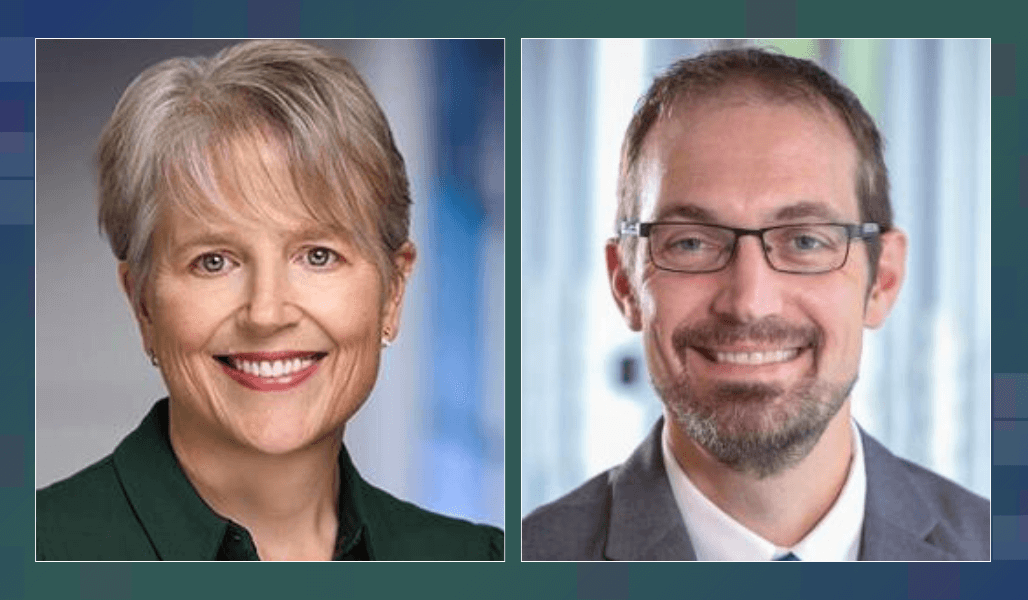
Listen and subscribe to the podcast on Spotify, Amazon Music, Apple Podcasts, or SoundCloud.

O’Rourke and Wendler noted that IRBs will often assume nothing needs to be communicated to participants in trials that have a waiver of informed consent. But research and research oversight is poorly understood by the public, an issue compounded by a lack of transparency.

“For any research going forward, it would be information out. Even if you think about just a general notification: ‘We do research at this institution, your information may be used.’ That’s what we do. Why aren’t we telling people that?” O’Rourke said.

In the article, O’Rourke and Wendler outlined 6 goals that the research community can advance by informing participants. These include respect for persons, participant understanding of the research, and trust and trustworthiness.

O’Rourke, now retired, was the director of human research affairs at Partners HealthCare Systems in Boston and an associate professor of pediatrics at Harvard. She currently serves as cochair of the NIH Collaboratory’s Ethics and Regulatory Core. Wendler is the head of the Section on Research Ethics at the NIH Clinical Center.

July 30, 2025: Podcast Episode Takes Listeners Behind the Scenes of New Learning Module

Headshots of Dr. Lesley Curtis and Dr. Keith MarsoloIn a new episode of the NIH Pragmatic Trials Collaboratory Podcast, Lesley Curtis and Keith Marsolo of the NIH Pragmatic Trials Collaboratory discuss the latest Living Textbook learning module, “Healthcare Data Interoperability and Standardization for Research.”

Listen and subscribe to the podcast on SoundCloud or Apple Podcasts.

Curtis and Marsolo developed the module to help researchers understand how healthcare data are collected and how those data can be used in a variety of research projects.

“For people who haven’t tried to use healthcare data before in research, it seems obvious that it should be so easy. We hear about these things and think, well surely, it all works together to help me answer my question. When in fact, it’s pretty complicated,” Curtis noted on the podcast.

“And unless you have a good understanding of how the pieces fit together and where they don’t, you might be in for a whole lot of frustration and heartache.”

Curtis is professor and chair of population health sciences at Duke University and a co–principal investigator of the NIH Pragmatic Trials Collaboratory Coordinating Center. Marsolo is an associate professor of population health sciences and a cochair of the NIH Collaboratory’s Electronic Health Records Core.

June 26, 2025: New Podcast Episode Considers How to Make Pragmatic Trials More Pragmatic

Drs. Rich Platt, Greg Simon, and Hayden BosworthIn a new episode of the NIH Pragmatic Trials Collaboratory Podcast, Rich Platt, Hayden Bosworth, and Greg Simon of the NIH Pragmatic Trials Collaboratory discuss their JAMA Viewpoint, “Making Pragmatic Clinical Trials More Pragmatic.”
Listen and subscribe to the podcast on SoundCloud or Apple Podcasts.

In the Viewpoint, the authors propose solutions to the discordance between the results of pragmatic trials and the implementation of those results in healthcare settings.

“I think one of the problems with our evidence generating process is that we may think that our
customers are grant review panels or maybe journal editors,” Platt notes in the podcast. “Those may be our short-term customers, but those are not our ultimate customers. Our ultimate customers are people who have to make decisions about healthcare,” he added.

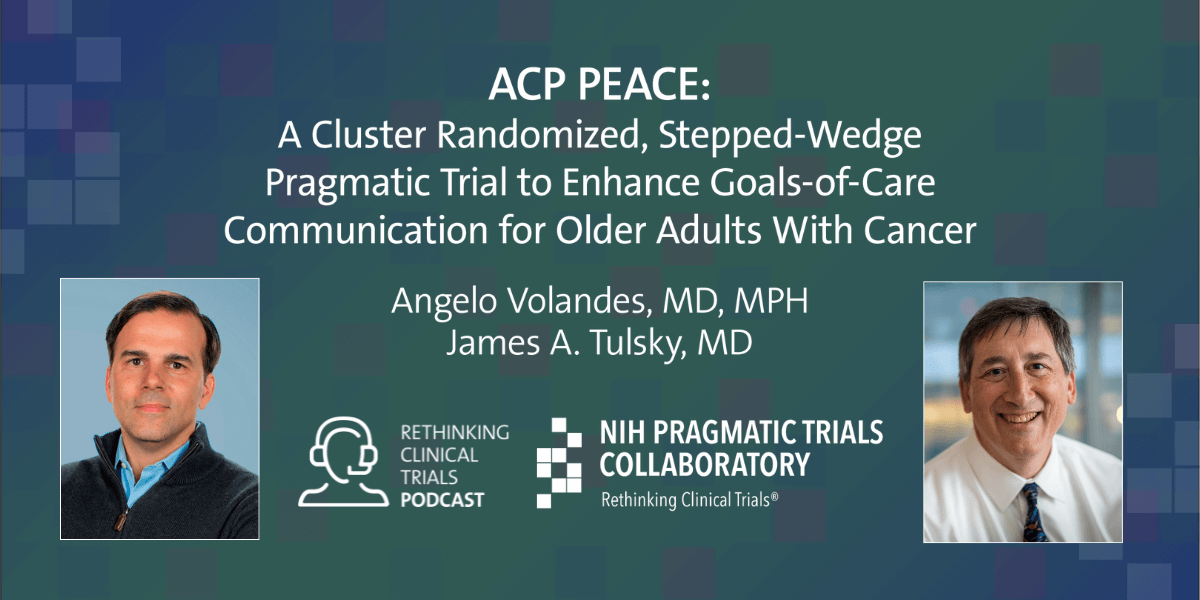
May 19, 2025: Latest Podcast Episode Features the Results of ACP PEACE

In a new episode of our Rethinking Clinical Trials Podcast, Drs. Angelo Volandes and James Tulsky speak with host Dr. Adrian Hernandez about the results of the ACP PEACE study.

Listen and subscribe to the podcast on SoundCloud or Apple Podcasts.

ACP PEACE, an NIH Collaboratory Trial, was a stepped-wedge, cluster randomized trial testing the delivery of a video decision aid to older patients with advanced cancer together with goals-of-care communication skills training to oncology clinicians in 3 healthcare systems. The results of the study were published this month in JAMA Network Open.