March 11, 2021: TSOS Study Intervention Reduces PTSD Symptoms in Injured Patients at Level I Trauma Centers

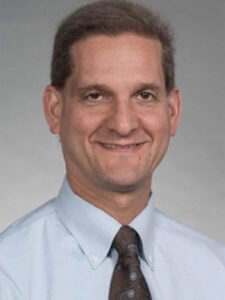
Photo of Dr. Doug Zatzick
Dr. Doug Zatzick

A collaborative care intervention for injured patients at trauma centers can reduce symptoms of posttraumatic stress disorder (PTSD), according to the results of the Trauma Survivors Outcomes and Support (TSOS) study. The results were published online this week in JAMA Surgery.

The TSOS study, an NIH Collaboratory Demonstration Project, was a stepped-wedge, cluster randomized pragmatic clinical trial testing the delivery of a stepped collaborative care intervention vs usual care for 635 injured patients with PTSD symptoms and comorbid conditions at 25 level I trauma centers in the United States.

Patients in the control group received usual care plus nurse notification about the patient’s high level of distress. Patients in the intervention group received collaborative care consisting of evidence-based medication, cognitive behavioral therapy, and case management. Patients in the intervention group whose PTSD symptoms persisted after initial treatment received stepped-up care, such as medication adjustments or additional psychotherapeutic elements.

After 6 months, the intervention group experienced a significant reduction in PTSD symptoms as compared with the control group. The treatment effect was greater for patients with higher baseline PTSD risk.

“Our study shows that a brief, approximately 2-hour collaborative care intervention delivered by frontline trauma center providers can significantly reduce PTSD symptoms in diverse injury survivors, including survivors of firearm injuries,” said Dr. Doug Zatzick of the University of Washington School of Medicine, the TSOS study’s principal investigator. “Collaborative care may therefore be an optimal treatment approach for trauma-exposed patients treated in acute care medical settings,” he said.
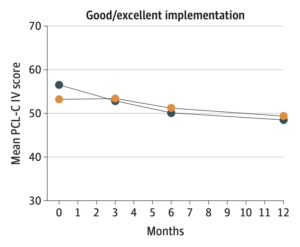
Figure from the TSOS main outcomes paper
Source: JAMA Surg. 2021 Mar 10. doi: 10.1001/jamasurg.2021.0131.

The study also included an implementation process assessment to allow the investigators to examine how the quality of each site’s implementation of the protocol affected study outcomes. The effect of the intervention on PTSD symptoms was greater at trauma centers with good or excellent protocol implementation.

“The upfront integration of an implementation process assessment into the TSOS pragmatic trial design allowed us to identify sites with good/excellent versus fair/poor protocol implementation, a key characteristic in discriminating patient-level PTSD treatment effects,” Zatzick said.

Overall, reduction in PTSD symptoms did not differ significantly between the study arms at 3 and 12 months, and there was no effect on secondary outcomes. However, the subgroup of patients who had firearm injuries and who were treated at sites with good or excellent implementation had among the largest 6-month treatment effects and demonstrated significant treatment effects at 12 months.

TSOS was supported within the NIH Collaboratory by a cooperative agreement from the National Institute of Mental Health and by the NIH Common Fund through a cooperative agreement from the Office of Strategic Coordination within the Office of the NIH Director. Learn more about the NIH Collaboratory Demonstration Projects.

January 5, 2021: New Video Collection Highlights Advances in Electronic Health Records for Pragmatic Research

We are pleased to announce our new collection of short educational videos that highlight advances in the use of electronic health records (EHRs) in pragmatic clinical trials.

The videos are drawn from our 2020 EHR Workshop Grand Rounds Series, “Advances at the Intersection of Digital Health, Electronic Health Records and Pragmatic Clinical Trials.” The series highlighted advances in digital health, new approaches and evolving standards for EHRs, and implications for researchers conducting pragmatic trials. Experts discuss the evolving regulatory context for EHRs, national policy priorities, and innovative uses of EHRs in several NIH Collaboratory Trials.

Video topics include:

Visit the EHR Workshop Video Modules page for access to all of the new videos.

December 15, 2020: A Year of Results and New Insights From the NIH Collaboratory

Collection of Journal CoversNIH Collaboratory researchers in 2020 reported study results, generated new knowledge, and developed innovative research methods in pragmatic clinical trials. Their work included insights from the Coordinating Center and Core Working Groups, analyses from the NIH Collaboratory Distributed Research Network, and results and methodological approaches from the NIH Collaboratory Trials.

So far this year, the NIH Collaboratory has produced more than 3 dozen articles in the peer-reviewed literature, including the primary results of the PROVEN and LIRE trials, the study design of ACP PEACE, insights into the COVID-19 pandemic from TSOS and EMBED, and more:

NIH Collaboratory Coordinating Center

NIH Collaboratory Distributed Research Network

ACP PEACE NIH Collaboratory Trial

EMBED NIH Collaboratory Trial

HiLo NIH Collaboratory Trial

LIRE NIH Collaboratory Trial

PPACT NIH Collaboratory Trial

PRIM-ER NIH Collaboratory Trial

PROVEN NIH Collaboratory Trial

SPOT NIH Collaboratory Trial

STOP CRC NIH Collaboratory Trial

TSOS NIH Collaboratory Trial

October 22, 2020: TSOS Study Team Describes Impacts of a COVID-19 Surge on Delivery of Acute Care and Emergency Services

Photo of Dr. Doug Zatzick
Dr. Doug Zatzick, principal investigator of TSOS

A team of frontline healthcare workers in a level I trauma center recorded observations and summaries of conversations with other healthcare workers and patients about the impacts of a local surge in COVID-19 cases on care delivery.

The ethnographic study at Seattle’s Harborview Medical Center identified impacts in 4 thematic areas, including impacts on procedures, providers, patients, and quality of care. The study also identified strategies healthcare workers used to cope with the physical and mental health demands associated with the pandemic.

The article, published this week in BMJ Open, offers lessons for healthcare systems responding to the COVID-19 pandemic in other settings.

Team members recorded their observations in the context of an ongoing comparative effectiveness trial of multidisciplinary, peer-integrated care coordination for patients with severe injury, and of the ongoing Trauma Survivors Outcomes and Support (TSOS) study. TSOS, an NIH Collaboratory Trial, is a stepped-wedge, cluster randomized pragmatic trial testing the delivery of screening and intervention strategies for patients with posttraumatic stress disorder and comorbid conditions at 24 level I trauma centers in the United States.

This work was supported in part by the Patient-Centered Outcomes Research Institute (PCORI). TSOS is supported within the NIH Collaboratory by a cooperative agreement from the National Institute of Mental Health and by the NIH Common Fund through a cooperative agreement from the Office of Strategic Coordination within the Office of the NIH Director.

For more news and resources related to the COVID-19 public health emergency, see the COVID-19 Resources page.

September 22, 2020: New Article Highlights Ethical and Regulatory Challenges of Conducting PCTs

Cover of Ethics & Human ResearchA recent article in Ethics & Human Research describes the experience and management of regulatory noncompliance during the conduct of a large, multisite embedded pragmatic clinical trial (ePCT). The Trauma Survivors Outcomes and Support (TSOS), an NIH Collaboratory Trial, was a stepped-wedge, cluster-randomized clinical trial of a collaborative care intervention for injured patients with symptoms of posttraumatic stress disorder in 25 level 1 trauma centers in the United States. The article, Ethical and Regulatory Concerns in Pragmatic Clinical Trial Monitoring and Oversight, was coauthored by members of the TSOS study team, the Collaboratory’s Ethics and Regulatory Core, and colleagues.

The authors describe how the study encountered variabilities in participant tracking across sites, which led to a study-wide internal audit and corrective action. The study team implemented a revision of the participant tracking system and retrained site staff in new procedures. Based on the lessons learned, the authors offer recommendations for future PCTs and relevant stakeholders, including institutional review boards, data safety and monitoring boards, institutions, and trial sponsors.

Among the recommendations:

  • Use a single IRB of record to streamline regulatory processes and reduce variability among research sites.
  • Standardize research procedures but allow for real-world flexibility; this could include real-time, workflow-integrated study logging that captures and documents provider turnover and regulatory training compliance.
  • Implement thorough, specific, and practical training in procedures, especially around participant enrollment and tracking.
  • Ensure that research procedures, monitoring and oversight plans, and training are study specific to account for unique issues, contexts, and needs.

Thoughtful planning, communication, and development and dissemination of standardized procedures remain hallmarks of successful research operations both to advance biomedical research and to ensure appropriate safeguards for its participants. –Roberts et al.

September 16, 2020: Results of TSOS Trial to Be Announced in NIH Collaboratory Grand Rounds

Photo of Dr. Doug Zatzick

The principal investigator of the Trauma Survivors Outcomes and Support (TSOS) pragmatic clinical trial, an NIH Collaboratory Trial, will announce the study’s primary results in the next session of PCT Grand Rounds on September 18.

Dr. Doug Zatzick of the University of Washington will present “The Trauma Survivors Outcomes and Support (TSOS) Pragmatic Clinical Trial: Effectiveness and Implementation Process Assessment Results.” The Grand Rounds session will be held on Friday, September 18, at 1:00 pm eastern. Join the online meeting.

TSOS was a stepped-wedge, cluster randomized clinical trial of a collaborative care intervention for injured patients with symptoms of posttraumatic stress disorder in 25 level 1 trauma centers in the United States.

TSOS is supported within the NIH Collaboratory by a cooperative agreement from the National Institute of Mental Health.

Grand Rounds September 18: The Trauma Survivors Outcomes and Support (TSOS) Pragmatic Clinical Trial: Effectiveness and Implementation Process Assessment Results

Speaker:

Douglas Zatzick, MD
Professor of Psychiatry and Behavioral Sciences
Harborview Medical Center, University of Washington School of Medicine

Topic: The Trauma Survivors Outcomes and Support (TSOS) Pragmatic Clinical Trial: Effectiveness and Implementation Process Assessment Results
Date: Friday, September 18, 2020, 1:00-2:00 p.m. ET

Meeting Info: To check whether you have the appropriate players installed for UCF (Universal Communications Format) rich media files, go to https://dukemed.webex.com/dukemed/systemdiagnosis.php.

To join the online meeting:
Go to https://dukemed.webex.com/dukemed/j.php?MTID=m7516d59dab184670d6fc892b1955b4eb

You must log in to the URL first.
Click ‘Audio Conference’
Choose ‘I will call in’, select the Toll number.
Dial in using the information from the dialog box that appears.
Be certain to use the Access Code AND the Attendee ID.

Troubleshooting:
If the URL above does not work, go to dukemed.webex.com and enter:
Meeting Number: 730 486 227
Meeting Password: 1234

For Audio ONLY:
Call-in toll number (US/Canada): 1-650-479-3207
Access code: 730 486 227

NOTE: For Toll-free users, the call-back (call me) services are also available.

May 4, 2020: TSOS Study Team Draws Lessons From Early COVID-19 Experiences in Washington State

Clinicians and researchers at Seattle’s Harborview Medical Center documented their experiences in the early weeks of the COVID-19 outbreak in King County, Washington. Their report offers lessons from clinical and research personnel, patients, and peer interventionists during the evolving pandemic response in an early US COVID-19 epicenter.

The article, published online in Psychiatry, presents a case series of experiences of frontline clinical and research teams in incorporating COVID-19 prevention strategies in the context of an ongoing comparative effectiveness trial of multidisciplinary, peer-integrated care coordination for patients with severe injury. The report also describes key themes from qualitative data collected during daily team meetings for the Trauma Survivors Outcomes and Support (TSOS) study, a pragmatic clinical trial also underway at Harborview. TSOS, an NIH Collaboratory Trial, is a stepped-wedge, cluster randomized pragmatic trial testing the delivery of screening and intervention strategies for patients with posttraumatic stress disorder and comorbid conditions at 24 level I trauma centers in the United States.

The case series offers evidence that primary and secondary prevention strategies can be integrated into ongoing clinical and research interventions during pandemic response. Procedures can also be developed to support team members who are adapting to rapidly changing individual, organizational, and societal demands.

This work was supported in part by the Patient-Centered Outcomes Research Institute (PCORI). TSOS is supported within the NIH Collaboratory by a cooperative agreement from the National Institute of Mental Health and by the NIH Common Fund through a cooperative agreement from the Office of Strategic Coordination within the Office of the NIH Director.

For more news and resources related to the COVID-19 public health emergency, see the COVID-19 Resources page.