


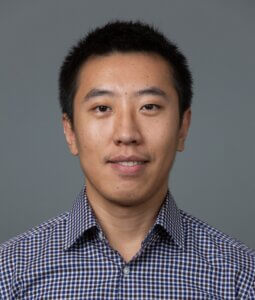
Dr. Fan Li, a member of the NIH Pragmatic Trials Collaboratory’s Biostatistics and Study Design Core since 2013, has received approval of a 3-year funding award from the Patient-Centered Outcomes Research Institute (PCORI) to develop causal inference methods for stepped-wedge cluster randomized trials—a design that has been increasingly adopted in pragmatic trials. Li is an assistant professor of biostatistics at the Yale School of Public Health.
The new study, entitled “Toward Improved Design and Analysis of Stepped Wedge Trials: An Estimand-Aligned and Efficiency-Focused Framework,” will contribute new methods and software for planning and analyzing stepped-wedge cluster randomized trials that enable investigators to (a) target transparent causal estimands under the counterfactual outcomes framework and (b) to leverage baseline information for achieving higher statistical efficiency.
This is Li’s second PCORI award. Read a summary of his previous PCORI award.
An estimand is a precise description of the treatment effect reflecting the scientific question, and is ideally a model-free concept. The research team will contribute weighted average effect estimands to quantify treatment effect evidence by recognizing that unequal cluster sizes may contribute to variations of treatment effects in each cluster-period. In addition, pragmatic trials that adopt a stepped-wedge cluster randomized design frequently collect baseline data on the patient-centered outcomes and/or patient-level characteristics. The research team will study and operationalize estimand-aligned methods that effectively leverage such baseline variables through parametric regression and nonparametric machine learning methods.
Li has assembled a multidisciplinary team for this study, including Dr. Patrick Heagerty, professor of biostatistics at the University of Washington and a cochair of the NIH Collaboratory’s Biostatistics and Study Design Core. In addition, Drs. Jeffrey Jarvik, principal investigator of the NIH Collaboratory’s LIRE NIH Collaboratory Trial, and Douglas Zatzick, principal investigator of the TSOS NIH Collaboratory Trial, serve as stakeholders of the study. The stakeholder team also includes colleagues from the NIA IMPACT Collaboratory, Drs. Thomas Travison and Monica Taljaard.